 English
 Slovenčina


Katalóg
Subcategories
There are 47 products.
Active filters
- Year of publication:: 2013
- Year of publication:: 2013
- Year of publication:: 2013
- Year of publication:: 2013
- Year of publication:: 2013
- Year of publication:: 2018
- Year of publication:: 2018
- Year of publication:: 2018
- Year of publication:: 2018
- Year of publication:: 2022
- Year of publication:: 2022
- Year of publication:: 2022
- Year of publication:: 2022
- Year of publication:: 2022
- Year of publication:: 2022
- Year of publication:: 2022
- Year of publication:: 2022
- Year of publication:: 2022
- Year of publication:: 2022
- Year of publication:: 2024
- Year of publication:: 2024
- Year of publication:: 2024
- Year of publication:: 2024
- Year of publication:: 2024
- Year of publication:: 2024
- Year of publication:: 2024
- Publication language:: English
Pathology Part 2 practical lesson for students...
€15.00
Availability:
100 In Stock
Alžbeta Blichárová - Ľudmila Verbóová - Zuzana Benetinová - Vladimír Tancoš - Patrícia Kollárová - Adam Nedoroščík - Erika Štammová - Pavel Kočan
“Pathology Part 2 (summer semester) - Practical lessons for students of dental medicine” represents the second half of the university textbook designed for the pregradual study of pathology. The textbook complements the lectures of pathology and serves as a source of information for students of dental medicine, that are preparing for the practical credit, as well as the final oral examination.
In this part of the “Pathology” series, forty-four selected histopathological slides are presented. Each selected slide is provided with general information in relation to etiology and pathogenesis of the disease, as well as with corresponding morphological features, including the gross appearance and the most important histopathological characteristics. The textbook summarizes the basic concepts of systemic pathology (pathology of the heart, vessels, lungs, gastrointestinal, urogenital system, breast, musculoskeletal, nervous system, skin and infancy) and pathology of the orofacial region, that is logical continuation and completion of general pathology in the first semester.
Pathology Part 2 Practical lessons for students...
€15.00
Availability:
100 In Stock
Alžbeta Blichárová - Ľudmila Verbóová - Zuzana Benetinová - Vladimír Tancoš - Patrícia Kollárová - Adam Nedoroščík - Erika Štammová - Pavel Kočan
“Pathology Part 2 (summer semester) - Practical lessons for students of general medicine” represents the second half of the university textbook designed for the pregradual study of pathology. The textbook complements the lectures of pathology and serves as a source of information for students of general medicine, that are preparing for the practical credit, as well as the final oral examination.
In this part of the “Pathology” series, seventy selected histopathological slides are presented. Each selected slide is provided with general information in relation to etiology and pathogenesis of the disease, as well as with corresponding morphological features, including the gross appearance and the most important histopathological characteristics. The textbook summarizes the basic concepts of systemic (organ) pathology (pathology of the lungs, hematopoietic, gastrointestinal, urogenital system, breast, endocrine, musculoskeletal, nervous system, skin childhood and infancy), that is logical continuation and completion of general pathology in the first semester.
Keywords: systemic pathology – histopathological slides – general medicine – gross appearance – microscopic image
Medical Biochemistry - Seminars
€28.00
Availability:
50 In Stock
Mária Mareková et al.
Predmet Lekárska biochémia plní v medicínskom štúdiu nezastupiteľnú úlohu, naučiť študentov vnímať prirodzené, fyziologické, ako aj chorobné procesy v organizme ako deje odohrávajúce sa na molekulovej úrovni. Na rozlíšenie patologických pochodov od normálnych je potrebné zvládnuť a pochopiť zmysel obrovského množstva biochemických reakcií prebiehajúcich v bunke (bunkový metabolizmus). Osvojenie si týchto faktov je hlavným cieľom predmetu Lekárska biochémia, ktorého zvládnutie je dobrým základom pre štúdium patobiochémie, fyziológie a klinickej biochémie, ako aj mnohých ďalších odborných predmetov medicínskeho štúdia. Pre lepšie zvládnutie a pochopenie biochemických procesov sme pre študentov pripravili vysokoškolskú učebnicu „Lekárska biochémia – Semináre“, ktorá poskytuje študentom okrem teoretických úvodov aj prehľadné schémy procesov a mnoho otázok, vypracovanie ktorých by malo študentom uľahčiť prípravu na skúšku.
Qauntum theory of magnetism
E-book
E-book
This is a supporting text for the undergraduate students interested in quan- tum theory of magnetism. The text represents an introduction to various theoretical approaches used in this eld. It is an open material, in the sense that it will be supported by appropriate problems to be solved by student at seminars and also as a homework.
The text consists of four chapters that form closed themes of the in- troductory quantum theory of magnetism. In the rst part we explain the quantum origin of the magnetism illustrating the appearance of the ex- change interaction for the case of hydrogen molecule. The second chapter is devoted to the application of the Bogolyubov inequality to the Heisenberg model and it represents the part which is usually missing in the textbooks of magnetism. The third chapter deals with the standard spin wave-theory including the Bloch and Holstein-Primakoff a approach. Finally, we discuss the application of the Jordan-Wigner transformation to one-dimensional spin-1/2 XY model.
The primary ambition of this supportive text is to explain diverse math- ematical methods and their applications in the quantum theory of mag- netism. The text is written in the form which should be sufficient to de- velop the skills of the students up to the very high level. In fact, it is expected that students following this course will able to make their own original applications of the methods presented in this book.
Pathology Part 1 Practical lessons for...
€15.00
Availability:
99 In Stock
Alžbeta Blichárová a kolektív
“Pathology Part 1 (winter semester) - Practical lessons for students of dental medicine” represents the first half of the university textbook designed for the pregradual study of pathology. The textbook complements the lectures of pathology and serves as a source of information for students of dental medicine, that are preparing for the practical as well as the final oral examination.
In this part of the “Pathology” series, fifty-four selected histopathological slides are presented. Each selected slide is provided with general information in relation to etiology and pathogenesis of the disease, as well as with corresponding morphological features, including the gross appearance and the most important histopathological characteristics. The textbook summarizes the basic concepts of general pathology that are necessary to master the broad field of systemic pathology in the second semester.
Pathology Part 1 Practical lesons for students...
€15.00
Availability:
100 In Stock
Alžbeta Blichárová a kolektív
“Pathology Part 1 (winter semester) - Practical lessons for students of general medicine” represents the first half of the university textbook designed for the pregradual study of pathology. The textbook complements the lectures of pathology and serves as a source of information for students of general medicine, that are preparing for the practical as well as the final oral examination.
In this part of the “Pathology” series, seventy selected histopathological slides are presented. Each selected slide is provided with general information in relation to etiology and pathogenesis of the disease, as well as with corresponding morphological features, including the gross appearance and the most important histopathological characteristics. The textbook summarizes the basic concepts of general pathology that are necessary to master the broad field of systemic pathology in the second semester.
Keywords: general pathology – histopathological slides – general medicine – gross appearance – microscopic image
Transformation of Central European Cities in...
E-book
E-book
Henrich Hrehor - Martin Pekár (eds.)
(Košice, Kraków, Miskolc, Opava) : From the Middle Ages to the End of the 18th Century.
Proceedings of the International Scientific Conference, Košice, June 28–29, 2012
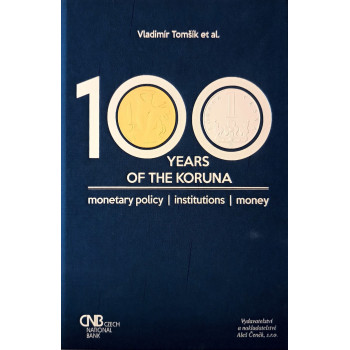
100 years of the koruna
€30.69
Availability:
1 In Stock
Vladimír Tomšík et al.
The book was prepared to mark an important anniversary – one hundred years of our national currency. It was written by a team of Czech National Bank experts headed by CNB Vice-Governor, Professor Vladimír Tomšík. This publication charts the monetary policy history of our central bank (or, to use older terminology, the bank of issue) and describes its institutional development and the banknotes it has issued over time. It covers the period from the establishment of the independent Czechoslovak state in October 1918 and its currency in February 1919 to the present. We have therefore named the publication 100 years of the koruna. Given the twists and turns of history, however, part of the narrative relates to the joint Czechoslovak state, part to the occupied Protectorate and part to the independent Czech Republic. As a result, the original joint Czechoslovak currency was divided temporarily in 1939–1945 and then again – this time for good – in 1993. From that point on, the currencies of the two successor states went their own ways, the Czech koruna continuing to the present day and the Slovak koruna until it was replaced by the single European currency in 2009.
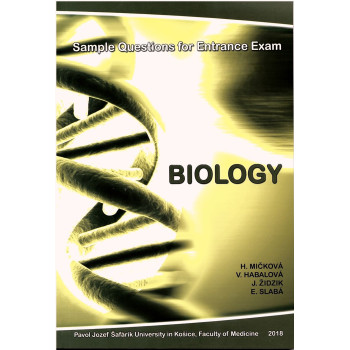
Biology - Sample Questions for Entrance Exam
€15.00
Availability:
3 In Stock
H.Mičková - V.Habalová - J.Židzik - E.Slabá
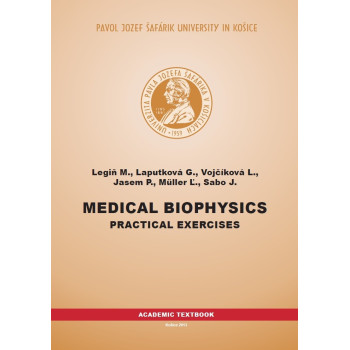
Medical Biophysics: Practical Exercises
€11.23
Availability:
19 In Stock
Michal Legiňa kol.
Progress in biology and medicine has always been significantly related to advances in physics. Not only has physics supplied instruments and methods of measurement that have led to many discoveries in physiology and medicine, but methods of physical research have changed many of the older approaches to the biologic sciences. Such circumstances have even led to development of a new scientific field: biophysics, which uses to a great extent physical instrumentation procedures applied to an experimental system. Because any instrument is an additional factor in any experimental system, it may affect the data. To interpret physical data on biological material correctly then, it is necessary to consider the characteristics of instrument response.
A practical course enables a student to acquire some skills, experience and methodological knowledge for performance of experiments and evaluation of measured data. Due to the fast development of instrumentation technology, it is not possible to teach every operation and procedure upon instruments we may use in a future. Besides the basic physical principles, the aim of a practical course is to point out some general rules and skills for instrument operation and for the interpretation of the measured values derived from such operation.
There are two kinds of lessons in practical courses. The first one focuses on laboratory measurements of some important physical quantities and the evaluation of the measured data. These measured quantities are components of the subject “medical biophysics” or of the phenomena studied. Experience provided in managing various scales and tables, as well as in the construction of tables and graphs is substantial. Lessons also enable students to repeat and to strengthen their knowledge of secondary school physics, which is useful for understanding of many phenomena studied in medical biophysics. The second kind of lesson provides experience with some of the diagnostic and therapeutic medical instruments, which can be seen in practical medicine.
The understanding of basic physical principles of corresponding instruments is both recommended and demanded. Theoretical preparation is not only an appropriate condition for the practical managing of the whole lesson, but also helps to avoid injury. This textbook, therefore, intends to help students in preparing for both the practical lessons and the final exam.
Authors
Textbook of practical physiology: part I -...
€11.50
Availability:
10 In Stock
Mária Pallayová - Štefan Kujaník
The “Textbook of Practical Physiology, Part I - Cardiovascular Physiology” by Mária Pallayová and Štefan Kujaník is a practical textbook of Human Physiology intended for English speaking medical students from general medicine and dentistry curricula.
The textbook covers basic principles in cardiovascular physiology and methods of the cardiovascular examination. Adequate knowledge of the cardiovascular physiology is important for the understanding of cardiovascular system function, as well as for the diagnosis and proper treatment of cardiovascular and other diseases. The practical tasks are constructed to facilitate knowledge acquisition and encourage students to develop practical skills, for instance the ability to follow experimental protocols, to work as part of a team, and to interpret data.
The textbook is written in English and comprises 91 pages in B5 format, grouped into twelve chapters. Each chapter is divided into six sections (Introduction, Principle, Importance, Materials, Procedure, and Protocol) to facilitate students’ understanding of the topics and assist them with preparation of the laboratory reports. The text is accompanied by explanatory figures, graphs, and tables that contribute to the learning experience.
Authors

Clinical Biochemistry
€24.90
Availability:
48 In Stock
Eva Ďurovcová - Mária Mareková
The presented textbook is intended for students of general medicine and should support their knowledge about indication and interpretation of basic biochemical tests. Clinical biochemistry continues to be one of the most rapidly advancing areas of laboratory medicine, which in line with using of modern technology more and more emphasizes the evidence-based medicine in order to improve diagnosis and monitoring of patients. Selected topics have an ambition to outline and explain the most common issues of biochemical diagnosis of in internal medicine. Individual chapters are devoted to disorders of water, electrolyte and acid-base balance, kidney and liver disease, diabetes mellitus, and biomarkers used in the diagnosis of cardiac necrosis and heart failure. Given the limited range, the textbook merely summarizes the basic knowledge that students have obtained during the study of other subjects, such as medical biochemistry, pathophysiology and internal medicine, and emphasis is given to laboratory diagnosis in accordance with the newer guidelines of professional societies. We hope that the textbook will be helpful in the study of clinical subjects and encourage students' interest in laboratory medicine.
Authors