Slovenčina


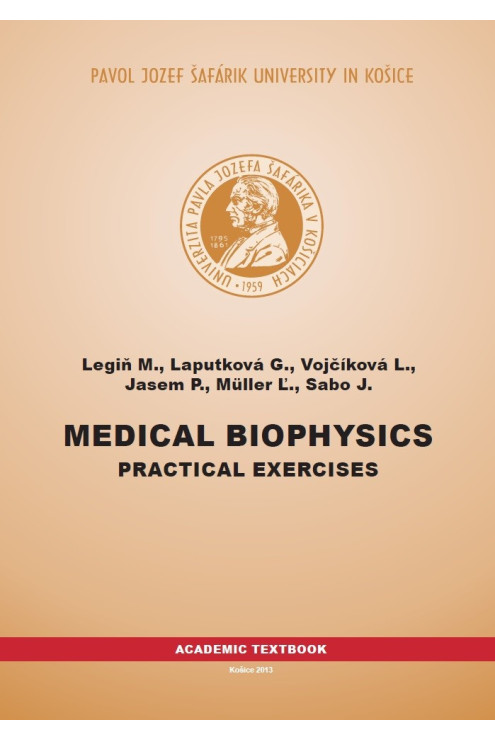
Michal Legiňa kol.
Progress in biology and medicine has always been significantly related to advances in physics. Not only has physics supplied instruments and methods of measurement that have led to many discoveries in physiology and medicine, but methods of physical research have changed many of the older approaches to the biologic sciences. Such circumstances have even led to development of a new scientific field: biophysics, which uses to a great extent physical instrumentation procedures applied to an experimental system. Because any instrument is an additional factor in any experimental system, it may affect the data. To interpret physical data on biological material correctly then, it is necessary to consider the characteristics of instrument response.
A practical course enables a student to acquire some skills, experience and methodological knowledge for performance of experiments and evaluation of measured data. Due to the fast development of instrumentation technology, it is not possible to teach every operation and procedure upon instruments we may use in a future. Besides the basic physical principles, the aim of a practical course is to point out some general rules and skills for instrument operation and for the interpretation of the measured values derived from such operation.
There are two kinds of lessons in practical courses. The first one focuses on laboratory measurements of some important physical quantities and the evaluation of the measured data. These measured quantities are components of the subject “medical biophysics” or of the phenomena studied. Experience provided in managing various scales and tables, as well as in the construction of tables and graphs is substantial. Lessons also enable students to repeat and to strengthen their knowledge of secondary school physics, which is useful for understanding of many phenomena studied in medical biophysics. The second kind of lesson provides experience with some of the diagnostic and therapeutic medical instruments, which can be seen in practical medicine.
The understanding of basic physical principles of corresponding instruments is both recommended and demanded. Theoretical preparation is not only an appropriate condition for the practical managing of the whole lesson, but also helps to avoid injury. This textbook, therefore, intends to help students in preparing for both the practical lessons and the final exam.
Authors

Data sheet
Specific References
E-book
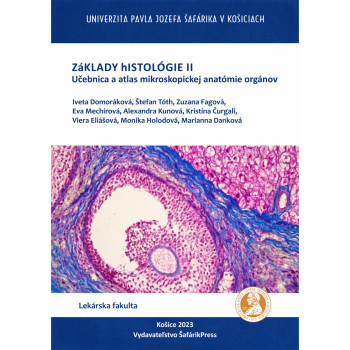
Iveta Domoráková - Štefan Tóth - Zuzana Fagová - Eva Mechírová - Alexandra Kunová - Kristína Čurgali - Viera Eliášová - Monika Holodová - Marianna Danková
In our new electronic textbook, FUNDAMENTALS OF HISTOLOGY II – Textbook and Atlas of Microscopic Anatomy of Organs, we present students and the professional public with essential information about the microscopic structure of organs, accompanied by extensive visual documentation of organ structures and clear legends for the microphotographs.
All histological specimens come from the archive of the Institute of Histology and Embryology, are used in practical exercises, and are also included in teaching presentations. The electronic textbook is intended for undergraduate and postgraduate students of general medicine and dentistry at medical faculties, as well as for students of veterinary medicine and pharmacy, and biology students at faculties of natural sciences.
The textbook is designed so that students can find clear explanations of most medical terms and also reinforce their knowledge of professional terminology in Latin. An advantage of the electronic textbook is the ability to enlarge microscopic photographs, allowing detailed observation of structures without any qualitative loss of the viewed image. The microphotographs used in the atlas were taken with the following equipment: Zeiss Promicra and Olympus BX50 with a Canon EOS 2000D digital camera and QP Industrial 3.2 software.
Download e-book for free (pdf)
E-publication
Jaroslav Majerník - Andrea Kačmariková
The university textbook "Databases in MS Access – accompanying texts for practical exercises" is intended for medical students, students of non-technical universities, and all beginners in working with databases. It introduces the reader to the issues of database processing and explains the basic principles that need to be known when creating relational databases. It is therefore suitable for those who have not yet worked with databases or who are considering managing their data using their own database. However, even more experienced computer users can find useful information here. This university textbook is written in such a way that its content can be mastered with basic knowledge of working with computers and programs running in any version of the MS Windows operating system.
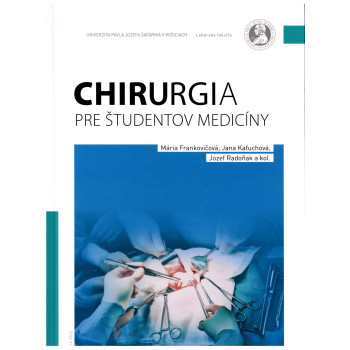
Mária Frankovičová - Jana Kaťuchová - Jozef Radoňak a kol.
Vysokoškolská učebnica určená študentom všeobecného lekárstva, ktorá predstavuje kompaktný zdroj informácií nevyhnutných pre úspešné zvládnutie štúdia predmetu chirurgia. Obsahuje kapitoly z chirurgickej propedeutiky, chirurgie krku, hrudníka a brucha, ako aj nadstavbových chirurgických odborov, vrátane traumatológie, neurochirurgie, ortopédie, urológie, cievnej, plastickej, detskej chirurgie a kardiochirurgie.
Plastická chirurgia je vysoko špecializovaný medicínsky odbor, ktorý sa zaoberá korekciou defektov, rekonštrukciou a zdokonaľovaním ľudského tela.
Náplňou plastickej chirurgie je korekcia rôznych defektov, vrodených i získaných. Medzi vrodené chyby patria deformity tváre, rázštepy pery a podnebia, deformity ušnice, vrodené vývojové chyby končatín. Najčastejšie získané defekty sú po poraneniach, po chirurgických výkonoch, po fyzikálnych poškodeniach kože a štruktúr krytých kožou.
Do plastickej chirurgie patrí i estetická chirurgia, onkochirurgia a mikrochirurgia, ktorá si zaslúži osobitnú pozornosť. Novými trendami v estetickej chirurgii je rekonštrukcia pomocou tukového tkaniva, kmeňových buniek, používanie rôznych umelých materiálov a implantátov.
Predložené učebné texty v jednotlivých kapitolách popisujú základné princípy plastickej chirurgie, používanie lalokových plastík a iné možnosti krytia defektov. V ôsmych kapitolách sú jednotlivo popísané chirurgické možnosti rekonštrukcie tváre, trupu a končatín. Učebné texty venujú pozornosť malígnym a benígnym kožným tumorom a ich liečbe. Posledná kapitola sa zaoberá najčastejšími estetickými operáciami ako sú augmentácia a redukcia prsníkov, facelifting či blefaroplastika.