- New

Zavolajte nám:
+421 55 234 1635E-book
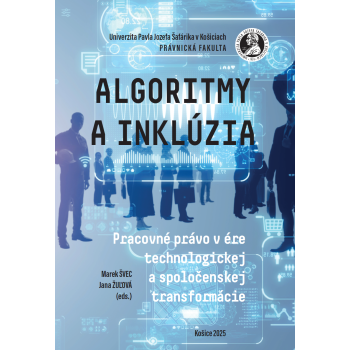
The collection of scientific contributions offers an interdisciplinary analysis of the challenges labour law faces due to digitalization and social change. Its main goal is to highlight potential synergies between the technological management of work processes and the promotion of diversity and inclusion in the workplace, with a focus on legal mechanisms that ensure equal opportunities and protect employees. The collection includes studies on various aspects of labour law protection, such as the prohibition of discrimination, transparency in algorithmic management, protection of individuals with diverse needs, and legislative challenges related to GDPR. It also features contributions to innovative remuneration systems and the protection of socially and health-disadvantaged groups, with special attention to employees of different sexual orientations and pregnant women. A significant portion of the work is dedicated to issues surrounding the use of artificial intelligence and algorithmic management in decision-making within labour relations. This publication serves as an insightful resource for academics, lawyers, students, and practitioners addressing modern employment law challenges, and it encourages further discussion on innovative approaches to contemporary labour law topics.
Download the e-book for free (pdf.)
Data sheet
E-book
Jana Žuľová - Denisa Rudžiková
In the environment of Slovak employers, an active approach to diversity and inclusion in the workplace is coming to the fore. Targeted diversity and inclusion programs help make employers more attractive on the labor market and attract more job seekers. Proactively, better working conditions are created for employees with responsibilities to the family (in most cases still in relation to mothers), groups of people who have been on the fringes of interest until now are also employed (elderly, disabled, LGBT groups, minorities, graduates of secondary and higher education schools).
The presented collection of abstracts responds to the outlined facts, which is a grouping of the starting motives and conclusions of the contributions presented at the scientific conference Diverse and inclusive workplaces - legislative starting points organized by the department of labor law and social security law of the Faculty of Law of the P. J. Šafárik University in Košice, which took place on September 29, 2023 in a hybrid form.
With their abstracts, the authors point to a range of problematic areas that are not only a reflection of academic considerations, but also those legal questions that have to be dealt with in ordinary legal practice. The goal is to use analysis and explanation to define the existing labor law measures/tools applicable to the implementation of diversity and inclusion in the workplace according to the current Slovak legal framework and the EU legal framework and thus emphasize the starting point of any effort to build diversity and the implementation of inclusion in the workplace.
Download e-book for free (pdf)
E-book
Ján Klučka(ed.)
Collection of Papers from the International Scientific Conference Held on May 29–30, 2014 at the Faculty of Law, Pavol Jozef Šafárik University in Košice.
In the first half of this year, a scientific conference entitled “10 Years in the EU: Relations, Questions, Issues” was held in Košice, and the contributions from this event constitute the content of the present collection bearing the same name.
The aim of the organizers—namely, the Slovak Association of European Law, the Representation of the European Commission in the Slovak Republic, and the Institute of European Law together with the Department of International Law of the Faculty of Law at Pavol Jozef Šafárik University—was not only (even if loosely) to follow up on the previous 2009 conference “Community Law in Slovakia – Five Years ‘After’”, but, after another five years, to continue its main objective: to provide participants from both the academic and non-academic community with a space for further analysis and exchange of views on legal issues related to the membership of the Slovak Republic in the European Union and various current issues of the Union’s legal order.
From this perspective, a shift in the overall focus of the conference contributions in 2009 and 2014 can be observed. While the contributions from the first conference focused primarily on various aspects of the application of Union law in the Slovak legal system and related application problems, especially before courts and other authorities, the basic orientation of the contributions from the second conference is already different. The present collection also confirms that the contributions focus primarily on current issues of the European legal order and on certain aspects of the Union’s external policy, while the relationship of Union law to the Slovak legal system is no longer given primary attention.
Several contributions focus on areas characterized by a certain overlap or “cohabitation” of Union law with public international law, private international law, or, more broadly, international relations.
E-book
Ľuboš Dobrovič - Vladimír Vrana
The world of diplomacy, whether ancient or modern, is naturally prone to problems associated with cultural clashes and often serves as an “unarmed battlefield” of cultural concepts. International diplomacy, however, stands on the assumption of war, as misunderstandings and cultural discrepancies lead to confusion. Cultural encounters also provide many opportunities for the choice of misunderstanding: the choice to perceive an act as an insult, even if unintended, or the choice to ignore the most blatant intentional insult, all according to momentary expediency.
The Roman historian Livy recounts an anecdote about the gates of the Temple of Janus, which, when open, signified that Rome was at war. However, the doors of the ancient Temple of Janus were closed only twice from the beginning of the 7th century BC to the end of the 1st century BC. One might ask, how many times and for how long after the signing of the Treaty of Trianon were the metaphorical gates of the European (or global) Temple of Janus closed?
The publication that the reader holds in their hands does not attempt to exhaustively answer all questions of ancient and modern international diplomacy. That is neither possible nor the goal of this scientific monograph. Authors seeking intersections between diplomacy of antiquity, the Middle Ages, and the early 20th century encountered some thought-provoking ideas and controversial debates. Indeed, what other conclusions can the topic of the Treaty of Trianon and the perpetual clash of cultures in the Mediterranean antiquity and medieval Europe bring?
We believe that the topic of ancient and modern diplomacy will inspire the reader and stimulate the professional public to new ideas, reflections, and scholarly activity.
The scientific monograph was prepared as an output of the project of the Agency for the Support of Research and Development No. APVV-19-0419: "100 years of the Treaty of Trianon."
E-book
Dominika Kováčová- Lucia Pištejová- Ivan Vaňa
The present monograph deals with the post-war settlement of relations and peace negotiations related to the settlement of the borders of the newly established Czechoslovak Republic. The work discusses in detail the negotiation processes related to the preparation and signing of the Versailles and Saint-Germain Peace Treaties. Similarly, it then discusses in detail the peripeties related to the drafting of the Treaty of Trianon dealing with the border with Hungary and its subsequent delineation in the field. Last but not least, the thesis captures the settling of Czechoslovakia's international relations with Poland and their common border, with a particular focus on the arbitration settlement on the territory of Orava and Spiš.
Download e-book for free (pdf)
E-book
Alena Krunková - Simona Farkašová
Proceedings of the International Scientific Conference on EU Funds Law in Theory and Practice held on October 3, 2019, in Košice.
The conference was attended by representatives from the academic sphere, educators from the Faculty of Law at UPJŠ in Košice, who created the subject and continue to participate in its teaching. The participants included professionals from practice, such as those from the Office of the Deputy Prime Minister of the Slovak Republic for Investments and Informatization, the Office for Public Procurement of the Slovak Republic, the Supreme Audit Office of the Slovak Republic, and the Ministry of Labor, Social Affairs, and Family of the Slovak Republic. Valuable information was also shared at the conference by representatives from the Ministry of Regional Development of the Czech Republic, OECD representatives, and representatives from the European Commission's Representation in Slovakia. The presented contributions reflected current issues in a highly professional manner, identified problematic areas, and outlined suitable solutions for contentious issues.
From the individual presentations of the conference participants, it was possible to compile a work that, while not extensive in scope, is very remarkable in value. It connects theory and practice in an outstanding manner and thus expands knowledge in the still complex issue of the legal regulation of European Union funds.
E-book
Adrián Popovič a kol.
The possibility of solving the grant project VVGS-2016-284 has provided a unique opportunity for members of the author´s team in the interdisciplinary composition to examine the issue not only from a tax-law point of view, but also from a political point of view. In the presented monograph, the authors focused on the characterization of different aspects of the EU in order to allow the reader correctly understand its position in relation to the outside world and to its inward relations within its Member States in the context of the creation and implementation of the EU tax policy.
Particular attention is paid to the definition of the relationship between national tax legislation and EU law, the impact of the EU's tax policy on the national laws of its Member States, with reference to the identification of the harmonized areas with the approximation of their current stage of development and the final objective. This definition can be seen as a prerequisite for a correct and comprehensive understanding of the application and implementation of EU institutions' initiatives to prevent tax evasion and tax fraud and their implementation into the national legal order of the Slovak Republic. In the last part of the monograph, the authors focused on defining individual EU initiatives to combat tax evasion and tax fraud as a means of implementing its tax policy, in the area of indirect taxation, in particular in the field of value added tax and in the field of direct taxation, especially with regard to corporate taxation, and to evaluate their projection into the national tax legislation of the Slovak Republic. At the same time, in these chapters, they assessed the real impact and effect of the measures admitted on the basis of the initiatives in practice.
The presented work is intended for a university student studying in the field of Tax Law and European Law, as well as the broader legal and economic community. However, in view of the scope and recency of the subject under consideration, the authors believe that the publication will find its application not only in the theoretical field but also in the practical field.
JUDr. Adrián Popovič
E-book
Alena Krunková (ed.)
Proceedings of the Scientific Conference Held on June 28, 2016 at the Faculty of Law of Pavol Jozef Šafárik University in Košice in connection with the implementation of the project “The European Union and Its Impact on the Organization and Functioning of Public Administration in the Slovak Republic” – approved under number MVZP – SK PRES/2016/134
The Slovak Republic, as a member state of the European Union, is undertaking a historic role associated with the Presidency of the Council of the European Union within the presidency trio. At the beginning of 2016, the Ministry of Foreign and European Affairs of the Slovak Republic announced a call for applications for grants for 2016 in the field of international relations and foreign policy, specifically focused on the Slovak Republic’s Presidency of the Council of the European Union. The Faculty of Law of Pavol Jozef Šafárik University in Košice responded to this call and obtained a project aimed at carrying out research activities through a series of events focused on regional self-government in the Slovak Republic in the context of its role within the European Union. The Faculty has long been engaged with issues of European Union law both in its teaching and in the scientific research activities of its individual faculty members. The project aims to enrich this portfolio with special activities targeting not only professionals, but also students and the general public.
The first activity of the project was a conference entitled “The European Union and Its Impact on the Organization and Functioning of Public Administration in the Slovak Republic – Development So Far, Current State, and Perspectives.” The conference was attended by invited public officials, representatives of academia, and representatives of local government, as one of the main goals of the project is to connect the academic community with the practical sphere and thus involve practitioners in the planned activities within the project.
E-book
Jana Žuľová a kol.
The presented publication is intended for employers, managers, and HR professionals who process employees' personal data for various employment-related purposes and need to conduct an audit of their processing in compliance with the GDPR and the new Personal Data Protection Act. The publication will also be useful for new employers who are encountering data protection for the first time and need to establish internal data protection rules, essentially starting from scratch.
The reader has the opportunity to gain a comprehensive understanding of the data protection rules applicable in the employment sector, the obligations of the employer, and the rights of the data subject, i.e., job applicants, employees, and former employees.
E-book
Dominika Cukerová - Andrej Oriňak - Kateřina Hrabánková (eds.)
The proceedings offers contributions from the international scientific conference of doctoral students and young researchers held on 25 April 2024 at the Faculty of Law, UPJŠ in Košice, which was thematically oriented on Innovative Law and Innovations in Law. The authors of the papers confirmed that innovation in law can take many forms. The first part of the papers, which pays attention to how law can respond to innovations, is a manifestation of this. These are the papers by Jana Cihanová, Andrej Oriňák, Denisa Rudžiková and Matej Biroš, who presented the use of deepfake technology, artificial intelligence and software tools in legal practice in the context of their legal regulation. Looking at familiar things differently can also be a source of innovation. In this vein, Dominik Mizerski, Juraj Valentovič, Lucián Török and Kateřina Hrabánková presented interpretive and application innovations in the field of private law. The third part of the papers by Michaela Szittyaiová, Natália Priateľová, Filip Baláži, Elena Lazoríková and Laura Gazdagová offers a preview of the innovations that the public law section is facing today. Finally, the fourth and last group of papers specifically explains innovations against the background of criminal law regulation. These are contributions by Michal Novák, Miroslav Srholec, Vladimír Petrila and Martina Makaturová. The variety of topics covered in this proceedings shows that each area of legal regulation can be characterised by specific innovations and, in this context, by the dynamics with which they permeate legal regulation.
E-book
Anotation Within the university textbook, the author focuses on the introduction to the criminal law of procedural and criminal proceedings, especially in terms of its purpose, individual parts and stages, subjects, procedural acts, decisions, as well as the costs of criminal proceedings. This publication is intended for easier orientation in the basics of criminal procedural law, on which it is possible to build qualified knowledge within the following legal branches or legal institutes. The methodology presented in the publication represents a concentrated form of individual provisions of the relevant generally binding legal regulations, while arguments of criminal law doctrine.
E-book
Nándor Birher-Péter Tamás Bertalan
The document, titled "Vatican Diplomacy Around Trianon from a Hungarian Perspective," is a scholarly work that examines the geopolitical and ecclesiastical changes in East-Central Europe after the Treaty of Trianon in 1920, with a focus on the role of the Vatican. The book explores the interactions between the Vatican and the reshaped geopolitical landscape, emphasizing the influence of religious and ecclesiastical issues on international relations. The monograph posits that Central Europe is not merely a geographic or economic concept but a "spiritual kingdom" with a shared destiny shaped by interdependence and cultural achievements, despite its history of conflicts. Central Europe's rich intellectual and cultural heritage, deeply influenced by religious convictions and Vatican diplomacy, continues to impact the region's identity and unity. The book suggests that the lessons from the early 20th century, including the Trianon Peace Treaty and subsequent geopolitical shifts, are still relevant in understanding the contemporary political and cultural dynamics of Central Europe. The authors encourage readers to reflect on the past and consider how historical events and decisions have shaped present-day Central Europe. The book aims to provide insights into the region's complex history and its ongoing struggle to find its place in the broader European and global context.
Download e-book for free (pdf)
E-book
Erik Štenpien - Lucia Pištejová - Ivan Svatuška
The presented publication is the proceedings of the international conference held on 29.-30. September 2022 in Košice as an output of the grant project APVV-19-0419.
The ambition of the project is to try to reconcile legal and general historians from Slovakia and Hungary in the difficult topic of looking at the Treaty of Trianon from 1920. The conference, held on 29.-30. September 2022 was the third in a series of conferences that for the purpose of assisting in the achievement of said goal. It was attended by legal historians and positive lawyers from several Central European countries. So let the collection serve as another step towards understanding between nations.
Download e-book for free (pdf)
E-book
Adrián Popovič - Jozef Sábo - Anna Vartašová (eds.)
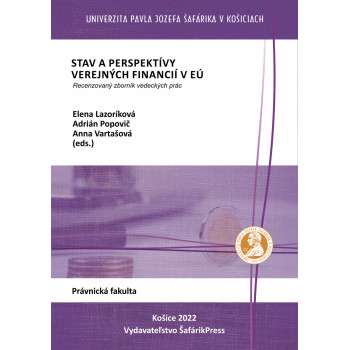
The International Scientific Conference on the topic Condition and perspectives of public finances in the EU was held 2nd – 3rd June 2022in Košice focused on the topics of the EU Budget and Real Estate in taxation. On this occasion, a student symposium on the topic: "Condition and perspectives of financial law and tax law" was organized for students of the Pavol Jozef Šafárik University Faculty of Law in Košice on 1st June 2022. The focus of the symposium was chosen due to the content of the grant project VEGA no. 1/0485/21: „Simultaneity and possibilities of reforming the system of own resources of the EU budget (legal and economic aspects also in the context of the consequences of the COVID-19 pandemic)“, of the grant project VEGA no. 1/0214/21: „Taxation of real property – legal status and potential“ and of the grant project APVV-19-0124 entitled "Tax law and new phenomena in the economy (digital services, shared economy, virtual currencies)", which are currently being addressed at the Department of Financial Law, Tax Law and Economy, Faculty of Law, Pavol Jozef Šafárik University in Košice.
The output of this symposium is a reviewed proceeding of papers, in which students focus on examining the current challenges of financial law and tax law. In this context, students examine not only the issue of current challenges in the field of real estate tax and the introduction of taxation based on their market value of real estate and the institute of remedies in tax procedural law, but also the current issue of EU budget law with a focus on the revenue side of the EU budget.
The authors also assess in detail the current situation in the research area, and they also present de lege ferenda proposals that could contribute to the development and improvement of several aspects of taxation, which is a benefit not only for legal science but also for application practice.
E-book
Miroslav Štrkolec - Anna Vartašová - Monika Stojáková - Soňa Simić
Taxation of Virtual Currency and Digital Services - COVID-19 and other Current Challenges for Tax Law
Reviewed proceedings of scientific papers
This Proceedings presents papers from international scientific conference IV SLOVAK-CZECH DAYS OF TAX LAW on the topic: "Taxation of Virtual Currencies and Digital Services - COVID-19 and other Current Challenges for Tax Law" held on 16th - 18th June 2021 in Košice, Faculty of Law of Pavol Jozef Šafárik University in Košice and was supported by the Slovak Research and Development Agency under the grant No. APVV-19-0124 “Tax Law and New Phenomena in the Economy (Digital Services, Sharing Economy, Virtual Currencies)”.
Download e-book for free (pdf)
E-book
Collection of Papers from the 8th Student Symposium held on April 20–21, 2015 in Danišovce
The capture of the historic Syrian city of Palmyra by fighters of the radical Islamic State caused shock among the global public. The main reason is the barbarism with which this organization proceeds, not only in relation to the treasures of the world’s cultural heritage. The situation in the Middle East, where cultural treasures of inestimable value are under direct threat, demonstrates how fragile the world’s cultural heritage is. The reaction of the international public and world leaders shows how sensitively the destruction of cultural heritage is perceived.
The quoted statement chosen by the editors relates to the threat posed by the Islamic State—however, the spirit of this statement can be applied to any cultural wealth that forms part of the world’s cultural heritage. The destruction or damage of these values primarily represents a loss for humanity as such. Each destroyed artifact of world cultural heritage signifies the disappearance of a unique legacy left by previous generations for the future. At the same time, cultural heritage must be understood as a broad spectrum of assets—both tangible and intangible. Their legal protection was the topic of this year’s symposium. As with any social interest, the protection of cultural heritage can be ensured through various mechanisms and under different forms of social organization.
These diverse approaches are unified by law as a normative system. The question for the 8th year of the symposium on international law was what role international law plays in the protection of cultural heritage. In the context of the European region, the role of the European Union as a regional organization was examined.
E-publication
The proceedings of student papers from the V. Annual Student Symposium represent a collection of analytical and comparative studies in the fields of tax policy, public finance, and financial law, reflecting the current challenges of the Slovak and European economies. The authors (students) focus on a wide range of topics – from considerations regarding the reintroduction of inheritance tax in Slovakia, through issues of tax evasion and abuse of law in taxation, to measures aimed at public finance consolidation. The authors (students) in their contributions also analyse practical aspects of tax administration, such as tax enforcement proceedings, case law concerning the burden of proof, and the financing of civic associations through tax assignation mechanisms. Particular attention is paid to modern challenges of tax policy, including the taxation of digital giants, financial transaction tax, and the regulation of crypto-asset service provision in the V4 countries. The proceedings also highlight the connection between tax instruments, the financing of cultural institutions, and the broader social context of public expenditures. The publication thus offers a comprehensive overview of current trends and perspectives in the field of taxation and public finance within the conditions of the Slovak Republic and the European Union.
Download the e-book for free
This website uses cookies to ensure you get the best experience on our website