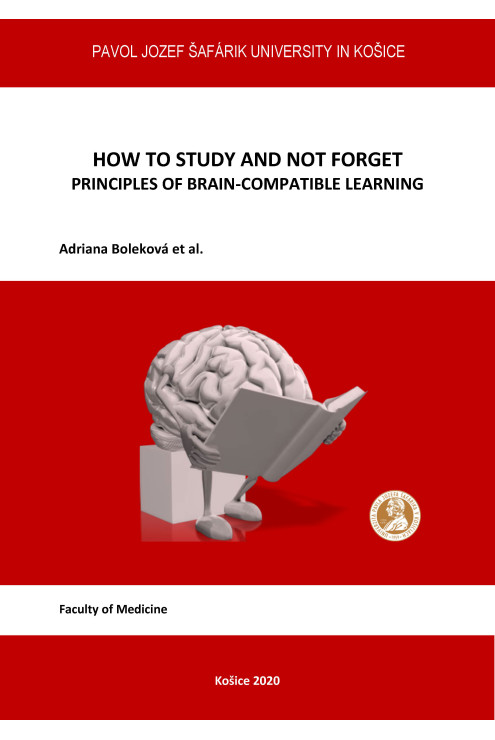
HOW TO STUDY AND NOT FORGET - Principles of brain-compatible learning

E-book

Adriana Boleková et al.

The book is primarily intended for first-year university students, but it is suitable for anyone who needs to learn. Students can find here the basic principles of learning, principles of how to preserve knowledge, how to concentrate without wasting time, how not to stress before a test or exam and many other practical tips. By acquiring simple knowledge, students will be able to learn effectively with the principles of brain-compatible learning in a way that they will acquire as much information as possible in the shortest period of time with maximum retention; that is minimal forgetting.

The book can serve not only as a theoretical background, but also as a practical tool for mastering university education.

The goal was to create a balanced material that would be an interesting source not only for first-year university students, but also for students of higher years and for everyone with a need of lifelong learning.

Download the e-book for free  (pdf)

Quantity

978-80-8152-897-2

Data sheet

Method of publication:
E-book (pdf)
Authors:
Adriana Boleková - Desanka Výbohová - Gabriela Hešková - Dagmar Breznoščáková - Milana Kovaničová - Eva Feketeová - Květuše Lovásová - Ingrid Hodorová - Silvia Rybárová
Document type:
University Textbook
Number of pages:
150
Available from:
28.09.2020
Year of publication:
2020
Edition:
1st edition
Publication language:
English
Faculty:
Faculty of Medicine
Note:
This publication was supported by the KEGA 019UPJŠ-4/2018.
License:
Creative Commons BY NC (Uveďte autora - Nepoužívajte komerčne)
- Free for download

16 other products in the same category:

Nursing care  - clinical procedure I

Nursing care - clinical procedure I

€14.60
Availability: 10 In Stock

Gabriela Štefková - Mária ZamboriováMária Sováriová SoósováRenáta Shafout

We would like to introduce the study material/textbook Nursing Care Clinical Procedures I, which was developed to cover the curriculum of Nursing Care 1 for medical students. Clinical procedures are an essential component of nursing practice. The textbook contains four main chapters. Each chapter begins with a general explanation of the topic, followed by detailed method description of procedures to help students deliver high - quality care to patients. Some chapters also include appendi xes in order to pick up some special examples from clinical practice. The textbook strongly describes bandages because a carelessly or improperly applied bandage can cause discomfort to the patient, in many cases it may expose the wound to the danger of infection. To the best of wound knowledge, these procedures reflect currently accepted clinical practice and up-to-date information. The textbook can be easily integrated into an educational programme and can be used in the laboratory as well as in clinical practice. During the preparation of this textbook the information, facts, notes, publications, books and literature presented in the references section were also used. The publication include DVD, which is concentrated on applying bandages from head to lower extremity. DVD was developed in cooperation during IRES project. The student can also find additional information to study by following references. The reading level of Nursing Care Clinical Procedures I is designed to be comprehensible to as many students as possible, including those for whom Engl ish is a second language. We hope that this textbook will be useful to all readers. The authors take no personal responsibility for applying this information to a particular clinical practice
situation.

Medical Ethics

Medical Ethics

E-book

E-book

Nikita Bobrov et al.

History of ethics represents a search for basic principle, which would enable a distinction between moral and immoral, good and bad, right and wrong. The main problem lies in motives, methods and consequences of human conduct. The integrity of medical profession puts emphasis on life-long study and practice according to the professional competence, and last but not least on ethical principles and rules of medical ethics.
Medical ethics, as a part of bioethics, is currently taking on a huge importance in everyday clinical practice and must face many serious ethical issues regarding the whole system of health care. On general level the decision-making in medical practice is quite easy, based on the requirement to always act in the patient's best interest. However, it is often difficult to know exactly what is best for the patient, in a certain situation, for this particular patient. Also with each progress in medicine and its globalization, the more aspects of human lives are being affected.

Biomedical research, and the new treatment and diagnostic methods it provides are viewed differently in each country, therefore various cultural, religious, social and legal aspects must be considered in their assessment, as well as the basic principles of medical ethics. Worldwide effort on unifying ethical regulations on certain aspects of health care led to the establishment of many legally recognized documents the doctors must be familiar with.

Teaching ethics to students of medical school aims to educate the future doctors towards ethical decision-making, behaviour and professional conduct according to the basic principles of medical ethics.
This textbook provides the basic information on medical ethics for students of medical faculties and serves as a practical introduction to the most common ethical problems of health care provision for their future professional practise.

Authors

Download the e-book for free (pdf)

Ošetrovateľstvo vo vybraných klinických odboroch

Ošetrovateľstvo vo vybraných klinických odboroch

E-book

E-book

Silvia DankováValéria ParováGabriela ŠtefkováLibuša Tirpáková

This university textbook is intended for students of the field of nursing and brings closer the issues in selected clinical fields of nursing, namely dermatovenerology, ophthalmology, otorhinolaryngology and dentistry.

It focuses on the characterization, management of care, reporting and dispensing of specific diseases and nursing care of selected diseases in these fields. It provides important information on the implementation of specific investigative methods and nursing activities that reflect the latest knowledge of the profession, professional guidelines and evidence-based practice.

The authors used relevant sources of domestic and foreign literature as well as electronic sources, which are listed at the end of individual chapters, when processing individual topics. The aim of the authors was to create a university textbook that would help nursing students to orientate themselves in the mentioned clinical fields, or could also be beneficial for nurses in practice.

Download e-book for free (pdf)

Lekárska chémia -  Návody a protokoly na praktické cvičenia

Lekárska chémia - Návody a protokoly na...

E-book

E-book

Marek Stupák et al.

A well-known proverb says: "It is better to see once than to hear a hundred times." With this in mind, the electronic version of the teaching materials has been designed, as we are convinced that practical laboratory experience is irreplaceable and still holds its significance in university studies.

In the provided teaching texts, you will find a set of experiments that complement and help better understand the theoretical knowledge gained through self-study as well as lectures in an appropriate manner. Additionally, this e-version allows students, after printing and subsequently completing individual tables, observations, and conclusions, to submit them as a laboratory report that confirms they have successfully mastered the assigned tasks.

Download the e-book for free (pdf)

Metódy v genetike človeka a molekulovej biológii

Metódy v genetike človeka a molekulovej biológii

E-book

E-book

Jozef Židzik - Terézia Hudáková - Martina Šemeláková - Ján Šalagovič

Methods in human genetics and molecular biology encompass various experimental, diagnostic and analytical techniques used to investigate the structure, function, expression, and regulation of genes, as well as general molecular processes in human cells. The university textbook Methods in Human Genetics and Molecular Biology provides a comprehensive overview of classical and modern experimental and analytical procedures. In fifteen chapters, it addresses methods such as PCR, RFLP, FISH, Western blot, DNA sequencing, DNA microarrays, molecular cloning, cytogenetic analysis, and forensic genetic analysis. The book is primarily intended as study material for the course of the same name taught in the 2nd year of study at the UPJŠ Faculty of Medicine, but it can also be used by all university students in the fields of biology, biotechnology, and related disciplines.

Download the e-book for free (pdf)

Liekové formy a aplikačné cesty podávania liekov so zameraním na ich význam v humánnej medicíne

Liekové formy a aplikačné cesty podávania...

E-book

E-book

Martina ČižmárikováPeter Takáč 

It is known that pharmacology is a rapidly evolving medical field, with information about drug forms and their routes of administration constantly changing. In addition to the emergence of new drug forms, new trends are also observed in the routes of administration suitable for delivering drugs. Despite being significant factors influencing the efficacy and safety of pharmacotherapy – an indispensable component of comprehensive patient care – to our knowledge, there has been a lack of comprehensive and detailed textual material focused on this issue on the market. This fact is related to the broader scope of the professional text we are presenting, as rare drug forms or less commonly used routes of administration are only marginally mentioned or not mentioned at all in available pharmacology textbooks.

Our main goal was therefore to provide sufficient information about existing drug forms, their routes of administration, as well as their methods of delivery, which should serve to enhance the quality of pharmacotherapy in the context of so-called "tailored treatment," whose main effort is to individualize treatment for a specific patient. Although the work focuses on drug application methods, a detailed description of the technical implementation of algorithms and other related procedures is the subject of interest for other fields (nursing, surgical propaedeutics, etc.). Overall, it is a supplementary educational text provided in electronic form, which is extremely popular in today's modern informatized era. Thanks to this, the work can be used at any time at home or in a school environment, comprehensively or progressively, partially. We have also tried to enhance its quality by appropriate content organization, inclusion of practical experiences, as well as the inclusion of colorful images or photographs, overview tables, and appendices.

The textbook is supplemented by test quizzes serving to verify acquired selected knowledge, which are published on the website of the Department of Pharmacology at the Medical Faculty of UPJŠ in Košice (under "Teaching" → "Taught subjects"), and which will be continuously supplemented and updated (http://www.lf.upjs.sk/farmakologia/TEST%201.htm; http://www.lf.upjs.sk/farmakologia/TEST%202.htm).

Although the work is primarily intended for medical students, or students of pharmacy and other healthcare fields, we firmly believe that enriching information will be found in it by beginning graduates of these fields, as well as their teachers.

Download the e-book for free (pdf)

Ochorenia obličiek v detskom veku vybrané kapitoly

Ochorenia obličiek v detskom veku vybrané kapitoly

€18.00
Availability: 16 In Stock

Gabriel Koľvek

Tento učebný text je zameraný na najčastejšie ochorenia obličiek detského veku. Venuje sa vybraným vrodeným (ako napr. vrodené anomálie obličiek a močových ciest) ako aj získaným ochoreniam obličiek (infekcie močových ciest, nefrotický syndróm, hemolyticko-uremický syndróm a ďalšie), ktoré sú opísané komplexne od epidemiológie, patofyziológie, cez klinický obraz, diagnostiku až po liečbu a prognózu. Texty zahŕňajú najnovšie diagnostické a terapeutické postupy opierajúce sa o recetné vedecké poznatky. Informácie uvedené v texte môžu významne pomôcť k úspešnému absolvovaniu štátnej skúšky z predmetu Pediatria. Text je starostlivo vybraný a rozsah kondenzovaný tak, aby vyhovoval predovšetkým potrebám pregraduálneho štúdia a zároveň dopĺňal vedomosti a skúsenosti získané na prednáškach a praktických cvičeniach. Učebnica tiež poskytuje základné informácie pre lekárov v špecializačnej príprave.


Vybrané kapitoly z detskej kardiológie

Vybrané kapitoly z detskej kardiológie

€9.00
Availability: 244 In Stock

 Ingrid Schusterová 

To offer our medical students of 5th and 6th classes as well as to professional public (pediatrics, pediatric cardiologists) integrated information from pediatric cardiology, which is based on scientific knowledge of experts and practical requirements including our experiences. The publication will extend given the discipline of cardiovascular risk factors of cardiovascular heart disease and acquired heart diseases, which are more actual at the present time in the children as we as bring the new didactic methods in pediatric cardiology teaching.

Autor

Ošetrovateľské techniky

Ošetrovateľské techniky

E-book

E-book

Libuša Tirpáková - Mária Sováriová Soósová a kol.

It is expected that nurses and professionals working in healthcare will be able to perform various specialized procedures, or assist with selected procedures, skillfully, confidently, and safely.

The university textbook of Nursing Techniques guides students through the most commonly performed nursing activities, reflecting the latest knowledge from the profession, evidence-based practice, and professional guidelines. A significant aspect of this publication is its emphasis on patient individuality and involvement in the planning and implementation of procedures, as well as the prevention of complications and the consistent performance of nursing interventions in accordance with the latest professional and scientific knowledge.

The textbook is divided into twelve chapters. In the introductory chapters, the authors address the organization of the nursing unit and infection control in healthcare facilities. Further chapters are devoted to patient assessment, especially vital functions, nutritional care, preparation and administration of various forms of medication, collection of biological material, care of urinary and bowel elimination, nurse assistance during punctures, wound care, and electrocardiographic examination.

The main aim is to address primarily nursing students, but also students of general and dental medicine and selected healthcare disciplines. We believe that both students and professionals will find in this textbook a guide and a practical assistant.

Download the e-book for free (pdf)

Pathology  Part 1 Practical lessons for students of dental medicine

Pathology Part 1 Practical lessons for...

€15.00
Availability: 99 In Stock

Alžbeta Blichárová a kolektív

“Pathology Part 1 (winter semester) - Practical lessons for students of dental medicine” represents the first half of the university textbook designed for the pregradual study of pathology. The textbook complements the lectures of pathology and serves as a source of information for students of dental medicine, that are preparing for the practical as well as the final oral examination.

In this part of the “Pathology” series, fifty-four selected histopathological slides are presented. Each selected slide is provided with general information in relation to etiology and pathogenesis of the disease, as well as with corresponding morphological features, including the gross appearance and the most important histopathological characteristics. The textbook summarizes the basic concepts of general pathology that are necessary to master the broad field of systemic pathology in the second semester.


Autonómny nervový systém v klinickej praxi

Autonómny nervový systém v klinickej praxi

E-book

E-book

Ladislav Kočan-Dušan Rybár-Róbert Rapčan

The autonomic nervous system is a vital component of the peripheral nervous system, responsible for maintaining homeostasis and regulating internal processes within the body. Unlike the voluntary control exerted by the central nervous system, the autonomic nervous system operates involuntarily, innervating smooth organs, vessels, skin glands, and even exerting some influence over skeletal muscles in connection with vegetative functions such as breathing, digestion, and the urinary and gonadal systems. Its impact extends crucially to the cardiac muscles of the heart and plays a significant role in endocrine and metabolic functions, thermoregulation, as well as emotional and behavioral responses, including adaptive reactions to stressors. The aim of this publication is to provide a comprehensive and objective exploration of the anatomical and physiological intricacies of the autonomic nervous system, offering insights into its clinical applications. Within these pages, we meticulously delineate various interventional therapeutic procedures tailored to specific diagnoses related to the autonomic nervous system, aligning each intervention with the anatomical framework of the autonomic system. The efficacy of these procedures is evaluated based on the level of evidence, as per the current recommendations of Evidence-Based Medicine. This publication is primarily crafted for fifth and sixth-year medical students and medical professionals specializing in anesthesiology, intensive care, and pain medicine. It serves as a valuable resource for gaining a deeper understanding of autonomic nervous system function and its clinical implications, facilitating informed decision-making in clinical practice.

Download e-book for free (pdf)

ATLAS OF FORENSIC MEDICINE: Autopsy findings in violent and non-violent deaths

ATLAS OF FORENSIC MEDICINE: Autopsy findings in...

E-book

E-publikácia

Dorota Sopková

Forensic Medicine is a medical discipline that is concerned with determination of the cause of death in cases violent and non-violent deaths by performing an autopsy. It is based on morphological findings, which characterize the effects of various forms of violence, as well as pathological changes in various diseases. The presented textbook provides comprehensive and complete overview of the fundamental tasks and theoretical knowledge of the field of forensic medicine. Its aim is to provide a theoretical basis in the form of images of morphological autopsy findings for the study of the compulsory subject Forensic Medicine and Medical Law in the study programs General Medicine and Dentistry. The author emphasizes the necessity to understand the fundamentals of forensic medicine in every medical field and a multidisciplinary approach in clarifying medico-legal issues.

Download the e-book for free (pdf)

Memoriál MVDr. Jána Rosochu, CSc.

Memoriál MVDr. Jána Rosochu, CSc.

E-book

E-booka

Denisa Harvanová (ed.)

The proceedings contain abstracts submitted by participants of the international scientific event entitled "MVDr. Ján Rosocha, CSc. Memorial" (3rd year). The event is part of a bilateral project named: "Extracellular vesicles: a promising cell-free therapy for cartilage repair (SK-AT-23-0005)", which is implemented within the framework of cooperation between Pavol Jozef Šafárik University in Košice, Slovakia, and the University for Continuing Education Krems in Austria. It is funded by the Slovak Research and Development Agency (APVV) under the bilateral call Slovakia-Austria 2023 and by OEAD – Agency for Education and Internationalisation under the project number SK11/2024. The MVDr. Ján Rosocha, CSc. Memorial (3rd year) was held on October 14, 2025, on the premises of the Faculty of Medicine, P. J. Šafárik University in Košice, Slovak Republic.

Download the e-book for free (pdf)

Dve úrovne vedomia: bazálne a rozvinuté vedomie

Dve úrovne vedomia: bazálne a rozvinuté vedomie

€19.10
Availability: 2 In Stock

Jozef Kafka

Význam vedomia pre každého človeka ale aj pre pozná­vanie je taký rozhodujúci, že by bolo nesprávne hovoriť o ňom iba pri psychických procesoch, lebo je jadrom ľudskej individuality a práve vedomím sa človek odlišuje od ostat­ných živých tvorov.

Je potešujúce, že nová oblasť poznávania označovaná ako veda o mysli začína sa vedomím zaoberať podrobnejšie a vylučuje tvrdenia, že vedomie nejestvuje hoci zatiaľ hovorí podľa mojej mienky iba o bazálnom vedomí a jej inter­pretácie prekračujú zistené fakty.

V svojej odbornej činnosti a aj v učebniciach som rozlišoval dve cesty poznávania vedomia a  iba postupne som si uvedomil, že mám pred sebou dva úrovne vedomia. V tejto práci  rozlišujem tieto dve úrovne:

  • bazálne vedomie,
  • rozvinuté vedomie.

Ak bazálne vedomie vyjadruje bdenie a spánok, tiež po­zornosť a gnostické rozpoznávanie, teda  idiognózia a somatognózia, rozvinuté vedomie predpokladá reč a vytvára také prejavy, ktoré označujeme ako duševné, teda identita, sebareali­záciu, čo vyjadruje schopnosť uvedomovania si seba, okolia, spoločnosti ale aj všetkého čo sme schopní poznať.

Také chápanie je blízke výkladu fyziológa Pavlova o dvoch signálnych sústavách a chápaniu Poppera o treťom sve­te ale aj ďalšie náhľady, nikto však neurobil určitejšie závery a nedošiel k náhľadu, že naše vedomie má dvojvrstevnú podobu, dve úrovne.

Napriek rozsiahlej a takmer neprehľadnej literatúre vieme o vedomí málo, okrem toho, že je to schopnosť uvedomo­vania, teda schopnosť uvedomiť si, že jestvujem, že som, že jest­vujú aj iní ľudia, že jestvuje niečo čo označujeme ako svet ako nepredstaviteľný vesmír. Uvedomujem si, že som individua­litou jedinečnou, ale limitovanou narodením a smrťou a že mám aj zmysel svojho bytia. Toto uvedomovanie, akokoľvek spo­chybňované je pre človeka prítomné v jeho poznávaní, hoci nemáme zmysly, ktorými by sme vedeli lokalizovať jeho prí­tomnosť v mozgu, ale svojou charakteristikou s dynamikou a integráciou má však duševný charakter, odlišný od    ostatných preja­vov mozgovej činnosti.

Práca sa pokúša v deviatich kapitolách osvetliť, čo sa chápe pojmom bazálne a rozvinuté vedomie    a možno ju rozdeliť do troch okruhov:

V prvých šiestich kapitolách diela hovorí o vedomí ako o doméne bytia človeka, podáva sa preto výklad vedomia a jeho rozlíšenie, potom sa hovorí o kolobehu života a rozvoji ve­domia, kladie sa otázka vedomia u stavovcov, potom náhľady filozofické a metodológia skúmania vedomia. Nasledujú ďalšie kapitoly, ktoré analyzujú podrobnejšie dve formy, úrovne vedomia, sú to kapitoly 7-9, začínajú ana­lýzou individuality človeka, lebo to je báza vedomia aj je­ho foriem, ďalej kapitoly o bazálnom vedomí a rozvinu­tom vedomí, čo považujem za jadro predkladanej práce. Napokon sa opisujú niektoré poruchy vedomia, ktoré dokladajú realitu vedomia v podobe  jej porúch ale aj možnosti rozlí­šenia dvoch úrovní, ktoré sa dajú zistiť pri starostlivom štúdiu a pri práci s chorými.

ABSTRACT BOOK - 72nd Czech-Slovak Pharmacological Days

ABSTRACT BOOK - 72nd Czech-Slovak...

E-book

E-book

Ján Mojžiš - Ladislav Mirossay -Andrej Miroššay (eds.)

This long-standing scientific conference continues its tradition of fostering collaboration, sharing knowledge, and supporting progress in the fields of pharmacology, pharmacy, toxicology, and biomedical sciences. The 2025 meeting brings together distinguished researchers, clinicians, educators, and students from the Czech Republic, Slovakia, and beyond, united by a common goal—to advance our understanding of pharmacological science and improve human health.

Download the e-book for free (pdf)

Vedecká komunikácia a manažment výskumných projektov

Vedecká komunikácia a manažment výskumných...

E-book

E-book

Lucia Bosáková - Zuzana DankulincováDaniela Fiľakovská

Publication called Scientific communication and management of research projects serves as background and teaching material. Its aim is to help university students and researchers develop competencies important for scientific work, such as scientific integrity, critical work with literary sources, management of research projects and scientific communication. Publication is divided into four parts.

The first part is focused on the preparation of a research project, where it is important to know the basic ethical principles applied in the research project, but also to be able to critically assess literary sources and process them. In the second part, it provides information on the preparation of research projects and their management, including their financing, from preparation and planning, through initialization to implementation, management, logistics, monitoring, evaluation and termination. The third part pays attention to the preparation, processing and presentation of scientific results in the form of a scientific article, presentation, poster or press release, thus covering not only a professional but also a lay audience.

The final fourth part provides information about communication with a scientific journal, whether it is the process of sending, revising an article up to its publication, or the process of assessing scientific work by scientific journal editors in the process of screening and peer review.

Download the e-book for free (pdf)

This website uses cookies to ensure you get the best experience on our website