Slovenčina


E-book
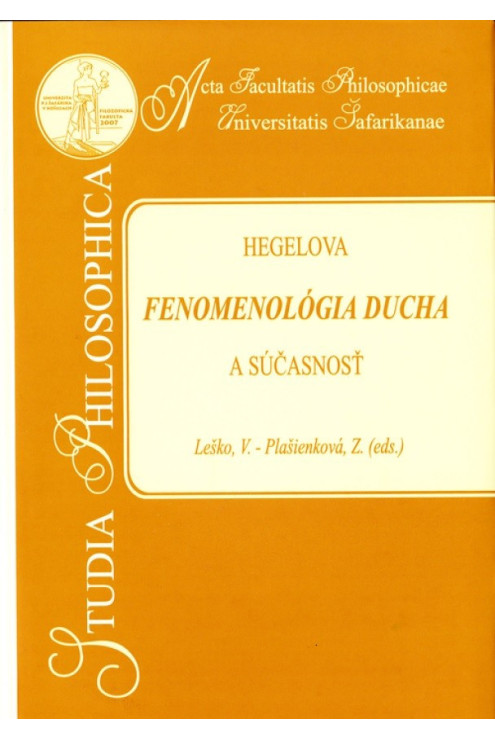
Vladimír Leško - Zlatica Plašienková (eds.)
In 2007, the philosophical world commemorated an extraordinary anniversary - two hundred years since the first publication of Georg Wilhelm Friedrich Hegel's brilliant work The Phenomenology of Spirit (1807). Of course, we can have different value scales of the most important philosophical works written in the history of philosophy, but the above-mentioned work of Hegel should certainly not be absent from the top places in them. Hegel's Phenomenology of Spirit decisively changed the philosophical discourse of the 19th century and greatly influenced philosophy in the 20th century. Few of the great philosophers after Hegel could afford to pass over the philosophical work of the 1807 supreme representative of German classical philosophy and not draw, either positively or critically, on his philosophical legacy.
The philosophical conference entitled Hegel's "Phenomenology of Spirit" and the Present, dedicated to Hegel's work Phenomenology of Spirit, was prepared by the Department of Philosophy and History of Philosophy of the Faculty of Arts of the Pavol Jozef Šafárik University in Košice in cooperation with the Slovak Philosophical Association at the Slovak Academy of Sciences in Bratislava on October 4, 2007 and was organized by the Slovak Philosophical Association in Košice.

Data sheet
E-publication
The monograph offers a comprehensive perspective on the theoretical, methodological, and empirical dimensions of participatory visual research within the field of social work. It is grounded in the understanding that social work plays a crucial role in amplifying the voices of vulnerable groups and promoting social justice, with particular attention paid to persons with disabilities who frequently encounter limited opportunities for participation as well as persistent social, communicative, and environmental barriers. The author analyses the concept of participation in alignment with the principle of “Nothing about us without us” and presents the PhotoVoice method as an interdisciplinary tool that integrates participatory action research, critical pedagogy, feminist epistemologies, and documentary photography. The method is understood not only as a research technique but also as a form of visual advocacy, enabling participants to articulate their experiences, needs, and perspectives in ways accessible to both professional audiences and the wider public. The monograph reflects on the development of PhotoVoice in international scholarship and highlights its potential to transcend traditional academic boundaries toward participatory and transformative practice in social work. The empirical section comprises three projects conducted by the author in the Slovak context, focusing on diverse groups of persons with disabilities and their families, who face specific social needs and everyday barriers. The findings demonstrate the potential of PhotoVoice to strengthen participation through accessible and meaningful visual tools. The monograph also addresses methodological, ethical, and terminological considerations and adopts an inclusive understanding of disability consistent with contemporary approaches in social work.
E-book
Renáta Orosová - Lucia Diheneščíková - Katarína Petríková - Lívia Nemcová
Proceedings of Abstracts from the International Scientific Conference: Education and Training 2018: The 21st Century Educator and Their Perspectives in Educational Practice
The international scientific conference focuses on issues related to education and training in primary, secondary, and higher education institutions from the perspective of educators.
It emphasizes the current state and future perspectives of 21st-century educators in educational practice, addressing pedagogical and sociological aspects of education within foundational educational institutions. Additionally, it explores contemporary aspects of pre-service teacher preparation.
The conference is aimed at researchers, young university lecturers, doctoral students, as well as professional and educational practitioners. Its goal is to present the educator—whether a teacher, social pedagogue, or special educator—in a modern perspective, highlighting their essential collaboration in the context of education. Furthermore, it seeks to stimulate discussions on pressing issues within the fields of education and training in light of the current situation in the education sector.
E-book
Marián Gladiš - Lucia Jasinská (eds.)
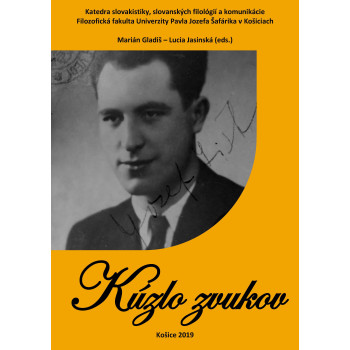
This peer-reviewed collection of papers is a publication output of the scientific colloquium named The Magic of Sounds, which was organized by the Department of Slovak Studies, Slavonic Philologies and Communication at the Faculty of Arts of the Pavol Jozef Šafárik University in Košice, and by the Košice Branch of the Slovak Linguistic Society at the Ľudovít Štúr Linguistic Institute of the Slovak Academy of Sciences in Bratislava, on the occasion of the 100th anniversary of birth of Associate Professor PhDr. Jozef Liška, PhD., the founder of the Slovak logopaedics.
Participants focused their papers on the analysis of the linguistic and speech therapy work of J. Liška, his contribution to Slovak dialectology and orthoepy, presented him as an Anglicist, and they also dealt with the audio aspect of children's speech, exact methods of disturbances and low voice quality measuring, or machine speech processing.
An interpretative paper of the documentary They Will Speak Well, a socially important piece of film work, which was made in 1958 under the supervision of J. Liška, is also included in the proceedings.
E-book
The monograph Social Institutions and Social Organizations analyzes the issues of society, spheres of society, models of social coexistence, social system, social institutions and social organizations that arise within individual social institutions. From social institutions, the monograph focuses on culture, religion, education, politics, health and economics.Individual social institutions are analyzed from several sociological perspectives, which allows the creation of a broader view of the analyzed issues.
Download e-book for free (pdf)