Filter By

Year of publication:

Year of publication:

Publication language:

Publication language:

Faculty:

Faculty:

Active filters

  • Year of publication:: 2009
  • Year of publication:: 2013
  • Year of publication:: 2017
  • Year of publication:: 2023
  • Year of publication:: 2023
  • Year of publication:: 2025
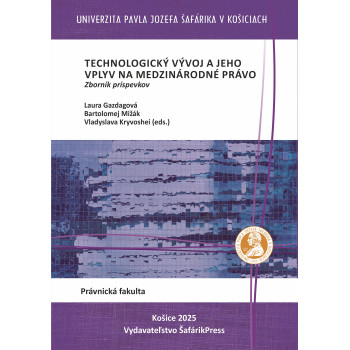
Technologický vývoj a jeho vplyv na medzinárodné právo

Technologický vývoj a jeho vplyv na...

E-book

E-publication
Laura Gazdagová-Bartolomej Mižák-Vladyslava Kryvoshei
Technological development is increasingly reshaping the environment in which international law operates. Rapid digitalization, global interconnectedness, and the emergence of new technologies raise questions that traditional legal norms are not always prepared to address. New forms of cross-border interactions, security challenges, and ethical dilemmas influence the functioning of states, international organizations, and other actors. Against this backdrop, discussions are evolving on how international law can maintain its relevance in an era of rapid innovation and how it may adapt to a dynamic technological landscape.
Download the e-book for free

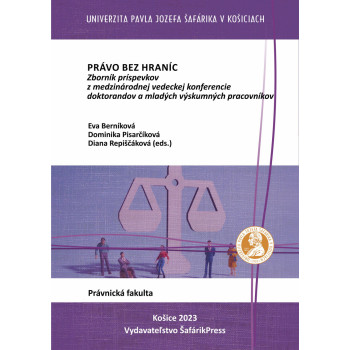
Law without borders

Law without borders

E-book

E-book

Eva Berníková - Dominika Pisarčíková - Diana Repiščáková (eds.)

Proceedings of the International Scientific Conference of Doctoral Students and Young Researchers

At the Department of Constitutional and Administrative Law of the Faculty of Law at Pavol Jozef Šafárik University in Košice, a research team led by the principal investigator Associate Professor JUDr. Radomír Jakab, PhD., is conducting a research project entitled "Extraterritorial Effects of Foreign Administrative Decisions in the Conditions of the European Union," supported by a grant from the Scientific Grant Agency under number 1/0187/22.

The aim of this project is the scientific examination of the extraterritorial impact of administrative decisions of the EU member states on the territory of other member states, in order to assess the need, possibilities, and desirable scope of harmonizing legal regulation among EU member states to enhance the free movement of administrative decisions within the European Union. On April 27, 2023, in connection with the project, an international scientific conference of doctoral students and young researchers titled "Law Without Borders" was held, attended by doctoral students and young researchers from Slovak as well as foreign universities.

At this conference, contributions based on various legal systems were presented to highlight the interweaving and mutual influence of different legal orders. The conference featured presentations not only from positive law disciplines but also from theoretical and historical legal perspectives. Scientific papers based on these contributions were compiled in the proceedings.

Download the e-book for free (pdf)

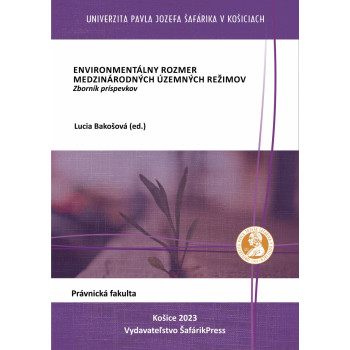
Environmentálny rozmer medzinárodných územných režimov

Environmentálny rozmer medzinárodných územných...

E-book

E-book

Lucia Bakošová (ed.)

Proceedings from the XVII Annual Student Symposium on International and European Law held on October 27, 2023.

The presented proceedings from the student symposium are part of a long-standing tradition of student symposia organized by the Institute of International Law and European Law of the Faculty of Law at Pavol Jozef Šafárik University in Košice. This seventeenth edition of the symposium, entitled "The Environmental Dimension of International Territorial Regimes," took place on October 27, 2023.

The symposium was thematically dedicated to the current and dynamically developing issue of the environmental dimension of international territorial regimes.

Download e-book for free (pdf)

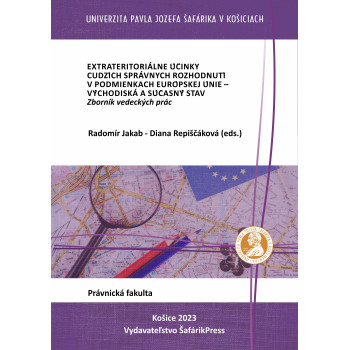
Extrateritoriálne účinky cudzích správnych rozhodnutí v podmienkach Európskej únie – východiská a súčasný stav

Extrateritoriálne účinky cudzích správnych...

E-book

E-book

Radomír Jakab - Diana Repiščáková (eds.)

The collection of scientific papers was created as part of a scientific seminar entitled “Extraterritorial Effects of Foreign Administrative Decisions in the Conditions of the European Union – Starting Points and Current State,” held from November 23 to 25, 2022, at the training and educational facility in Danišovce, in connection with the implementation of a scientific project entitled “Extraterritorial Effects of Foreign Administrative Decisions in the Conditions of the European Union,” supported by a grant from the Scientific Grant Agency under No. 01/187/2022.

The aim of the mentioned project is the scientific examination of extraterritoriality, i.e., the extraterritorial effects of administrative decisions of the Member States of the European Union on the territory of other Member States, in order to assess the need for, possibilities of, and desirable scope of harmonization of the legal regulation of the Member States of the European Union, with the goal of increasing the level of free movement of administrative decisions within the European Union. As part of the research project, an initial scientific seminar was held under the title “Extraterritorial Effects of Foreign Administrative Decisions in the Conditions of the European Union – Starting Points and Current State.”

Members of the research team, who are also members of the Department of Constitutional Law and Administrative Law at the Faculty of Law of Pavol Jozef Šafárik University in Košice, participated in this scientific seminar. At the seminar, contributions were presented that primarily summarized the current state of knowledge in the area of extraterritorial effects of foreign administrative decisions in the context of the European Union. This summary will serve as a basis for the further scientific examination of this issue by the members of the research team. These contributions subsequently formed the scientific papers included in this collection.

Download the e-book for free (pdf)

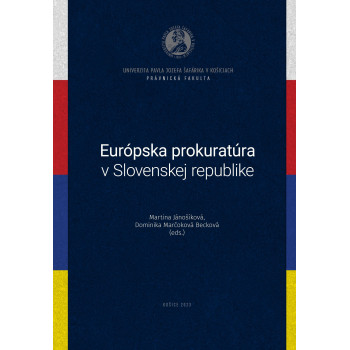
Európska prokuratúra v Slovenskej republike

Európska prokuratúra v Slovenskej republike

E-book

E-book

Martina Jánošíková -  Dominika Marčoková Becková (eds.)

The peer-reviewed Proceeding of Scientific Papers is dedicated to the issue of the European Public Prosecutor's Office and is the result of a scientific project APVV-18-0421 European Public Prosecutor's Office in Connections of the Constitutional Order of the Slovak Republic as Strengthening of the European Integration through Law.

In their works, the authors of scientific papers, dealt with the issue of the European Public Prosecutor's Office in the context of European Union law and criminal law, as well as the relation of the European Public Prosecutor's Office with the national prosecutor's office and law enforcement authorities. The scientific works published in the proceeding dealt with the topics of the reasons for the establishment of the European Public Prosecutor's Office, the position of the European Public Prosecutor's Office in the institutional system of the EU and the Slovak Republic, relations of cooperation and coordination between the European Public Prosecutor's Office and the Public Prosecutor's Office of the Slovak Republic, the protection of the constitutionality and legality of the procedures and decisions of the European Public Prosecutor's Office, with special attention to the protection of fundamental rights, as well as the first result and evaluation of the operation of the European Public Prosecutor's Office in the Slovak Republic.

Thanks to the content of scientific papers, the reader can get a more comprehensive idea of this new body of the European Union, which operates in an area traditionally associated with state sovereignty and represents another step forward in the integration processes represented by the European Union.

Download the e-book for free (pdf)

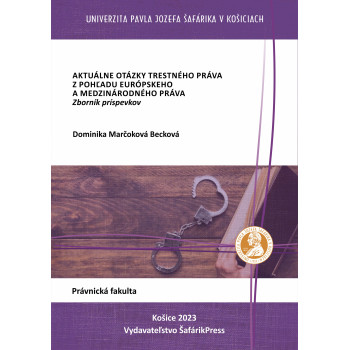
Aktuálne otázky trestného práva z pohľadu európskeho a medzinárodného práva

Aktuálne otázky trestného práva z pohľadu...

E-book

E-book

Dominika Marčoková Becková (ed.)

Proceedings of Papers of XVIth year of the student symposium of the Institute of International Law and European Law

Proceedings of Papers of XVIth year of the student symposium of the Institute of International Law and European Law is devoted to selected aspects of the place and role of criminal law from the point of view of contemporary EU law and international law. In their contributions, students deal with current topics of criminal law in the law of the European Union and international law. In the EU law, the most actual issue is the European Public Prosecutor's Office, a body of the EU responsible for investigateing and prosecuting criminal offenses affecting the Union's financial interests.

The first part of papers dealt with the reasons for the establishment of the European Public Prosecutor's Office, its structure and tasks, the issue of conducting the investigation of the European Public Prosecutor's Office in the conditions of the Slovak Republic, as well as with the relations of the European Public Prosecutor's Office with its closest partner, the European Anti-Fraud Office.

The second part of the contributions reflects current issues and challenges of criminal law in international law. Authors in their papers focused on the issue of the International Criminal Tribunal for Ukraine, the legal problems and challenges associated with its creation, on the issue of the crime of aggression before the International Criminal Court, as well as on issues of immunity of state representatives before national courts.

Download the e-book for free  (pdf)

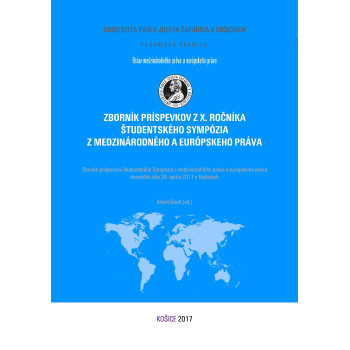
Zborník príspevkov z X. ročníka študentského sympózia z medzinárodného a európskeho práva

Zborník príspevkov z X. ročníka študentského...

E-book

E-book

Adam Giertl (ed.)

Proceedings of the Student Symposium on International Law and European Law held on April 28, 2017, at the Faculty of Law of Pavol Jozef Šafárik University in Košice

The Student Symposium is regularly organized by the Institute of International Law and European Law, and in 2017, it marked the jubilee tenth edition of the symposium, which over time expanded its focus to include European law.

The tradition of holding student symposia is also associated with the good practice of preparing proceedings from each event. Understandably, the tenth edition is no exception, and thus, the tenth edition of the symposium proceedings is now available to readers. In previous years, the symposium has always focused on specific areas of international and European law. Thus, the subjects of study for symposium participants have included migration issues (2016), the protection of cultural values (2015), and the challenges of cyberspace (2013).

This year, given that it is the jubilee tenth edition, the symposium organizers have chosen to approach the symposium's focus thematically and recall some significant milestones in the development of international law that occurred in years ending with the number seven.

Download the e-book for free (pdf)

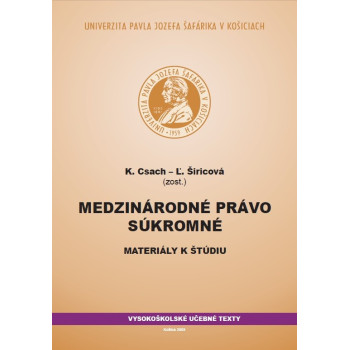
Medzinárodné právo súkromné

Medzinárodné právo súkromné

E-book

E-book

Kristián Csach - Ľubica Širicová

Private international law has undergone dramatic changes in recent periods. The fully operational process of communitarization of this legal field has not yet – and perhaps could not have been – effectively reflected by domestic legislators. Under the current legal status, it is not uncommon for legal issues to intertwine regulations of community origin and domestic legislation (embodied primarily by Act No. 97/1963 Coll. on Private International Law and Procedure).

Questions about the obsolescence of some provisions of this, until recently, universal codified regulation of private international law arise mainly (but not exclusively) from the conflict rules contained in the so-called "Rome I" Regulation on the law applicable to contractual obligations, the "Rome II" Regulation on the law applicable to non-contractual obligations, and most recently in Council Regulation (EC) No. 4/2009 of 18 December 2008 on jurisdiction, applicable law, recognition, and enforcement of decisions and cooperation in matters relating to maintenance obligations.

Respecting the principle of the primacy of generally binding acts of the Community over domestic law, the correct application of normative texts cannot be achieved without the ability to quickly navigate through the norms and subsequently compare them.

Students and anyone else are therefore confronted with a multitude of legal regulations of substantial scope and detailed regulation. Currently, apart from systematically arranged references on the websites of the Ministry of Justice, we do not find a comprehensive material that would offer an overview of legal regulations in the field of private international law and procedure.

Download the e-book for free (pdf)

Medzinárodné právo verejné (Materiály k štúdiu)

Medzinárodné právo verejné (Materiály k štúdiu)

E-book

E-book

Ľudmila Pošiváková - Adam Giertl

The presented selection of public international law documents aims to map international law from both historical and sectoral perspectives. The reader will find several historical documents in this collection, but the focus is primarily on currently valid legal sources.

The selection is guided by the publication Public International Law – General and Special Part by Prof. Ján Klučko, which is reflected in the division into general and special parts. The general part addresses the historical development of international law but primarily focuses on the protection of individuals and responsibility relationships in international law. The special part then examines the international regulation of various institutions of international law.

We acknowledge that this selection offers room for expansion, but we believe it meets basic requirements and fills a certain gap in the study of international law.

We trust that this collection of public international law materials will be beneficial for students, and not only for them, in the study of public international law and will contribute to raising awareness in this field.

Download the e-book for free (pdf)

Oslava právneho štátu (Právny štát z pohľadu teórie štátu a práva a medzinárodného práva)

Oslava právneho štátu (Právny štát z pohľadu...

E-book

E-book

Ľudmila Pošiváková -  Zuzana Antošová - Milan Kočan (eds.)

Proceedings from the Student Debate held on April 24, 2013, at the Faculty of Law of Pavol Jozef Šafárik University in Košice.

In the current period, the rule of law is widely debated both at the academic and political levels. This debate is not only related to the effort to establish the Rule of Law in states that have transitioned from socialist to democratic systems but also in states experiencing various unrests, whether political or religious.

However, it is not just a debate about certain characteristics of the Rule of Law that are missing in domestic law or at the level of international law, but also a debate about the very definition and meaning of the Rule of Law. The rule of law can be likened to an ideal that almost every state strives to achieve. Even in the case of the establishment of the independent Slovak Republic, the framers decided to include among the introductory provisions, which should form the core of the constitution, that the Slovak Republic is a state governed by the rule of law.

However, to achieve the ideal of the rule of law, it is necessary not only to declare it but also to adopt measures essential for an independent judiciary, democracy, the effective enforcement of human rights, the separation of powers, and many other elements that characterize a state governed by the rule of law.

Download the e-book for free (pdf)

Informačná spoločnosť a medzinárodné právo

Informačná spoločnosť a medzinárodné právo

E-book

E-book

Adam Giertl - Ľubica Gregová Širicová (eds.)

Proceedings from the 5th Student Symposium held on April 21-22, 2013

The French delegate to the Commission on Human Rights, while discussing the inclusion of the term "media" in the article on freedom of expression in the draft of the International Covenant on Civil and Political Rights, wisely urged other members of the commission to be forward-looking regarding the information media of the future.

The discussion took place in 1950, when delegates could not yet foresee the impact of the internet on social relations. Given that it is now clear that information technologies significantly influence law, including international law, the organizers of the student symposium decided to dedicate its sixth edition to the theme "Information Society and International Law."

Students of the Faculty of Law, after registering for the symposium, first focused on preparing their contributions, with each participant having access to a consultant if needed. This year, the list of consultants, in addition to members of the Institute of European Law and the Department of International Law, was expanded to include an expert in intellectual property law, Mgr. Martin Husovec, a graduate of our Faculty of Law and currently an IMPRS-CI doctoral student at the Max Planck Institute for Intellectual Property and Competition Law. We also take this opportunity to thank him for dedicating his time to the students and providing them with valuable advice in preparing their contributions. After the preparatory phase, the symposium itself took place, with the aim of presenting the prepared contributions and discussing them.

The presented contributions reflected a wide range of intersections between international law and the information society.

Download the e-book for free (pdf)

Regionalizmus: Stav, východiská, perspektívy

Regionalizmus: Stav, východiská, perspektívy

E-book

E-book

Adam Giertl (ed.)

Proceedings of Scientific Works

International law does not represent a monolithic entity of uniform legal norms. It is a legal system that is fundamentally created by the consensus of states. It reflects the collective will of multiple entities regarding what should be binding and enforceable as law among them.

From this understanding arises the fact that the needs for legal regulation will differ in various parts of the world. The consequence of this situation is the formation of regional groupings where, to some extent, specific legal rules apply. As Professor Klučka points out in his study published in this proceedings, regionalization can occur both on a contractual basis and on an institutional basis. Regionalism in law thus raises many interesting questions that legal science addresses.

This proceedings of scientific papers also aims to contribute to the knowledge in this field.

Download the e-book for free (pdf)

This website uses cookies to ensure you get the best experience on our website