Filter By

Selections

Selections

Year of publication:

Year of publication:

Publication language:

Publication language:

Faculty:

Faculty:

Active filters

  • Year of publication:: 2014
  • Year of publication:: 2024
  • Year of publication:: 2026
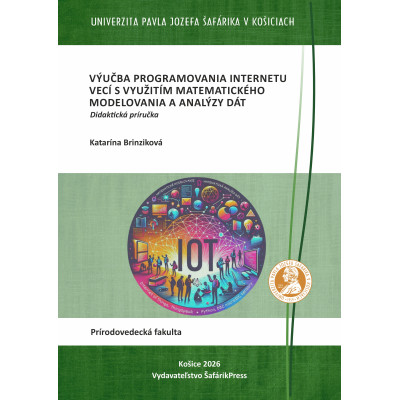
Výučba programovania internetu vecí s využitím matematického modelovania a analýzy dát
  • New

Výučba programovania internetu vecí s využitím...

E-book

E-book

Katarína Brinziková

This teaching guide for instructing students in Internet of Things programming using mathematical modeling and data analysis is intended for mathematics and computer science teachers in elementary and secondary schools, as well as for students training to teach these subjects. It responds to the requirements of the new curriculum reform in Slovakia, which emphasizes a cyclical learning process, the development of data, digital, and mathematical literacy, and the integration of teaching with real-world problems and technologies. The guide is designed in accordance with the methodological framework of design-based research. It contains technological and methodological foundations, as well as a set of proven teaching activities divided into three levels of difficulty. The teaching guide provides teachers with specific instructions, recommendations, and examples of best practices for the meaningful integration of IoT and mathematical modeling into teaching across different educational cycles, creating space for modern, interdisciplinary, and data-driven education.
Download the e-book for free (pdf)

Linear programming via problem solving

Linear programming via problem solving

E-book

E-book

Katarína Cechlárová

Linear programming belongs to parts of mathematics with the greatest number of real applications. This Slovak-English problem collection provides an overview of basic knowledge in the area, application problems as well as problems to acquire routine in calculations. It is complemented by questions motivating the student to look for further theoretical principles, construct conterexamples  and formulate arguments to explain the studied phenomena.

Download the e-book for free (pdf)

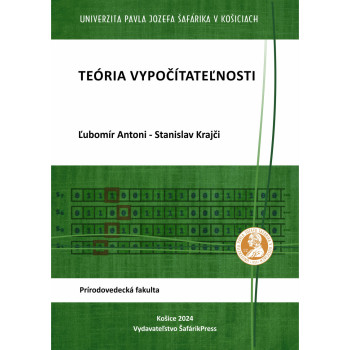
Teória vypočítateľnosti

Teória vypočítateľnosti

E-book

E-book

Ľubomír Antoni-Stanislav Krajči

An important part of theoretical computer science is the problem of Turing machines. This computational model has two basic properties: like any other computational program, the software of a Turing machine is composed of instructions, but in its case they are all of a single type. Every other (so far known) computer program can be transformed into a Turing machine program without loss of information. While the second feature reduces the question of what a calculator cannot do to the question of what a Turing machine cannot do, the first feature allows a much simpler investigation of such a question. Using this computational model, we can thus find concrete problems that no automaton can ever deal with (perhaps the most famous is the problem of the Turing machine stopping). Their existence demonstrates the fundamental limitations of (not only ideal) computational means, and thus encourages both criticality and humility in our thinking.

Download e-book for free (pdf)

Tvorba úloh pre programátorské súťaže

Tvorba úloh pre programátorské súťaže

E-book

E-book

Ľubomír ŠnajderJán Guniš

The publication lists interim results of qualitative educational research focused on the development and evaluation of programming tasks being carried out by authors since 2005 in the frame of programming competition PALMA junior.

The publication consists of three chapters: Computer science competitions in Slovakia, Tasks in computer science education, Selected problems of PALMA junior competition. The first chapter provides an overview of computer science competitions for a primary and secondary schools in Slovakia. The second chapter described the issue of learning tasks - their components, focus, formulation types, and development system of tasks. The third chapter contains the assignments and commented author solutions of selected problems represented focus of PALMA junior competition – programming, algorithms and mathematics.

For each problem is mentioned analysis of pupils’ solutions aimed to ways of thinking, typical misconceptions, sets of preparatory and extended problems. The publication is addressed to computer science teacher trainers, authors of programming competitions problems, and computer science teachers.  

Download the e-book for free (pdf)

This website uses cookies to ensure you get the best experience on our website