Slovenčina


E-book
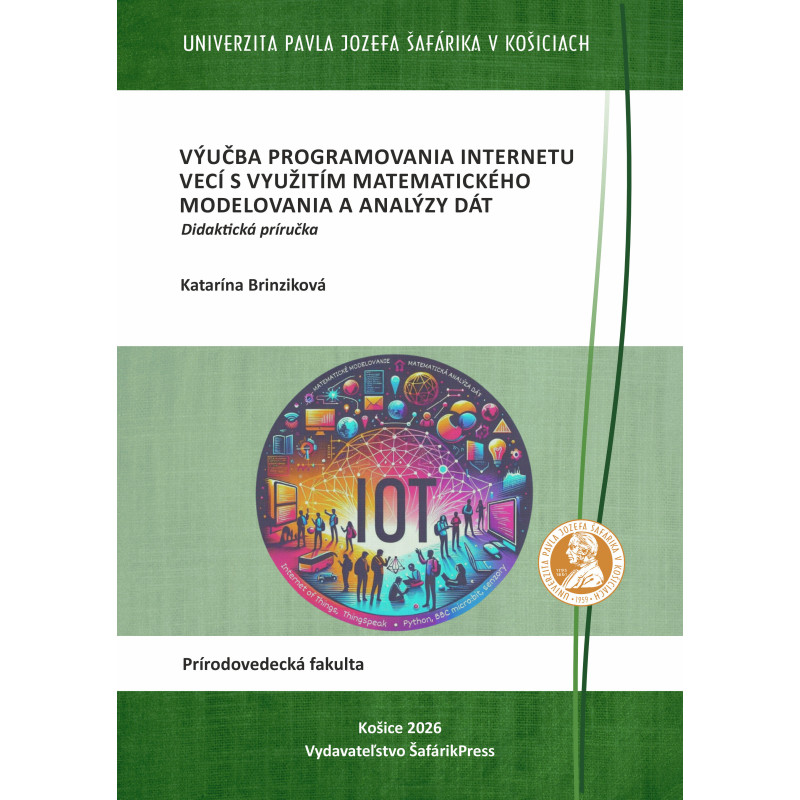
This teaching guide for instructing students in Internet of Things programming using mathematical modeling and data analysis is intended for mathematics and computer science teachers in elementary and secondary schools, as well as for students training to teach these subjects. It responds to the requirements of the new curriculum reform in Slovakia, which emphasizes a cyclical learning process, the development of data, digital, and mathematical literacy, and the integration of teaching with real-world problems and technologies. The guide is designed in accordance with the methodological framework of design-based research. It contains technological and methodological foundations, as well as a set of proven teaching activities divided into three levels of difficulty. The teaching guide provides teachers with specific instructions, recommendations, and examples of best practices for the meaningful integration of IoT and mathematical modeling into teaching across different educational cycles, creating space for modern, interdisciplinary, and data-driven education.

Data sheet
E-book
Janka Vrláková - Stanislav Vokál
Atomic and nuclear physics are relatively young scientific disciplines forming the final part of the general physics course at the Faculty of Physics of the Jagiellonian University. Their aim is to explain the nature of the basic physical properties of atoms, atomic nucleus and elementary particles.
This is also the content of the lectures and exercises ‘General Physics IV’ in the 2nd year of the Bachelor's degree in Physics at the Faculty of Natural Sciences (PF) of the P.J. Šafárik University (UPJŠ) in Košice. They are followed by optional lectures ‘Nuclear Radiation in the Environment’, ‘Introduction to the Physics of the Microworld’ in the 3rd year of the Bachelor's degree of single-discipline study of physics, or teacher study of physics in combination with another subject, and ‘Subnuclear Physics’ in the 1st year of the Master's degree of teacher study of physics in combination with another subject.
In the aforementioned lectures, the latest experimental findings on the structure and behaviour of the microworld are presented by means of physical theories and their subsequent experimental verification in experiments.
E-book
These "Exercise Manuals" present a concise overview of commonly used methodologies as well as progressive techniques, such as the use of liquid chromatography and fluorescence microscopy. Individual tasks were selected based on the research focus of the Department of Botany at the Faculty of Science, Pavol Jozef Šafárik University in Košice, particularly in the context of "stress physiology."
Some tasks can also be utilized within the subject "Plant Ecology." Chamomile (Matricaria chamomilla) is typically used as a model plant for individual tasks due to its long-standing history of research at the Department of Botany and its ease of cultivation under laboratory conditions. The chapters also briefly discuss the significance of monitored parameters, principles of their determination, and metabolism (formation or degradation), aiming to indicate their mutual context.
This approach highlights that determining an individual parameter cannot provide a general explanation for the overall causes and impacts of observed changes; however, it can serve as a basis for testing hypotheses at the level of other parameters.
For deeper study of specific issues, there is an abundance of high-quality international monographs and review articles available.
E-book
We have prepared a publication that focuses on the personalities of professors. These personalities represent entire scientific teams, participated in the creation of new study programs, and had a significant impact on the formation of the faculty. Factually, we tried to capture the basic data in a uniform structure. We are building on a similar publication from ten years ago, which greatly helped us, especially with professors who worked at the faculty many years ago and whose memories are gradually fading. The ambition of the publication is to contribute to the preservation of basic information that is closely related to the history of the faculty.
doc. RNDr. Roman Soták, PhD. Dean of the Faculty of Science, UPJŠ in Košice
Download e-book for free (pdf)
E-book
Stanislav Lukáč - Ľubomír Šnajder - Ján Guniš - Zuzana Ješková
The publication is intended for researchers in didactics and teachers of mathematics and computer science. Our aim is to provide readers with a basic orientation in the issue of inquiry-based teaching, to explain and demonstrate several levels of student inquiry through examples, and to offer a classification of inquiry skills.
The core part of the publication consists of methodologies for inquiry-based teaching of specific topics from school mathematics and computer science. We present ideas for implementing inquiry activities, active work with information in solving various types of problems, and the application of modern digital technologies in exploring and discovering patterns.
The publication includes seven methodologies for teaching mathematics and eight methodologies for teaching computer science in the 1st and 2nd years of secondary school.