Filter By

Selections

Selections

Year of publication:

Year of publication:

Publication language:

Publication language:

Faculty:

Faculty:

UPJŠ Unit

UPJŠ Unit

Active filters

  • Year of publication:: 2012
  • Year of publication:: 2013
  • Year of publication:: 2016
  • Year of publication:: 2018
  • Year of publication:: 2018
  • Year of publication:: 2018
  • Year of publication:: 2018
  • Year of publication:: 2019
  • Year of publication:: 2026
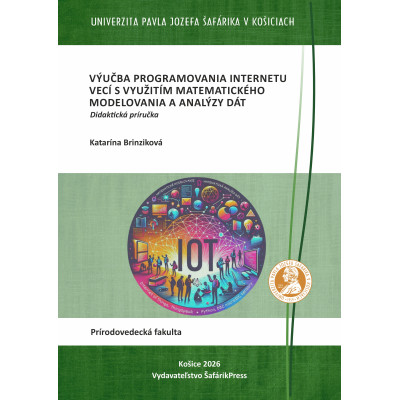
Výučba programovania internetu vecí s využitím matematického modelovania a analýzy dát
  • New

Výučba programovania internetu vecí s využitím...

E-book

E-book

Katarína Brinziková

This teaching guide for instructing students in Internet of Things programming using mathematical modeling and data analysis is intended for mathematics and computer science teachers in elementary and secondary schools, as well as for students training to teach these subjects. It responds to the requirements of the new curriculum reform in Slovakia, which emphasizes a cyclical learning process, the development of data, digital, and mathematical literacy, and the integration of teaching with real-world problems and technologies. The guide is designed in accordance with the methodological framework of design-based research. It contains technological and methodological foundations, as well as a set of proven teaching activities divided into three levels of difficulty. The teaching guide provides teachers with specific instructions, recommendations, and examples of best practices for the meaningful integration of IoT and mathematical modeling into teaching across different educational cycles, creating space for modern, interdisciplinary, and data-driven education.
Download the e-book for free (pdf)

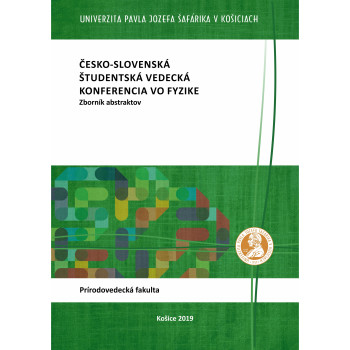
Študentská vedecká konferencia PF UPJŠ 2019

Študentská vedecká konferencia PF UPJŠ 2019

E-book

E-book

Katarína Cechlárová (ed.)

This year, the Student Scientific Conference was held on April 24, 2019, across 17 sections in disciplines such as biology and ecology, chemistry, physics, geography, mathematics, informatics, and their didactics. Bachelor’s and master’s students presented a total of 124 contributions. The most successful participants advanced to national or traditional Czech-Slovak student scientific showcases in fields like physics, chemistry, mathematics, informatics, and mathematics didactics.

In addition to faculty students, 10 high school students participated outside the competition. They were invited based on their achievements in subject-specific Olympiads or because they were already engaged with the faculty under the guidance of dedicated teachers in laboratory work as part of their preparation for future studies. The day also featured a programming competition with 23 participants, an IHRA contest involving 16 teams of high school students and 15 teams from elementary schools, and a new Puzzle section where 72 high school students from the region competed.

The abstracts from the Student Scientific Conference demonstrate that our faculty's students not only absorb theoretical knowledge delivered in lectures but also actively engage in solving partial scientific problems that align with research objectives at the institutes of PF UPJŠ. This collection serves as both a record of scientific activity at the faculty and a dignified presentation for the broader public.

Prof. RNDr. Katarína Cechlárová, DrSc.

Vice-Dean for Education

Doc. RNDr. Gabriel Semanišin, PhD.

Dean of the Faculty

Download the e-book for free  (pdf)

Aproximačné a pravdepodobnostné algoritmy

Aproximačné a pravdepodobnostné algoritmy

E-book

E-book

Ondrej KrídloGabriel Semanišin

For computer scientists, the constant challenge is to seek efficient algorithms and various technical and implementation possibilities to improve the computational complexity of currently known algorithms. Partial solutions are offered by approaches such as grid-based methods and parallelization of computation. Quantum computers represent a significant but still unfulfilled promise. From a theoretical perspective, probabilistic and approximation approaches provide very effective solutions, and these are the methods we aim to explore in detail.

These electronic university textbooks serve as supplementary materials for the course Approximation and Probabilistic Algorithms. They were developed from the authors' materials and contributions by Prof. RNDr. Viliam Geffert, DrSc., whom the authors thank for providing the manuscript. Acknowledgments also extend to RNDr. Ján Katrenič, PhD., who prepared the first set of exercises for the course, and Žaneta Semanišinová, who reviewed large portions of the text and contributed suggestions for its improvement.

Download the e-book for free (pdf)

Študentská vedecká konferencia PF UPJŠ 2018

Študentská vedecká konferencia PF UPJŠ 2018

E-book

E-book

Katarína Cechlárová (ed.)

In 2018, the Student Scientific Conference was held on April 18, 2018, in 16 sections covering biology and ecology, chemistry, physics, geography, mathematics, computer science, and their subject didactics. There were 110 registered contributions from bachelor's and master's students. Additionally, eight high school students participated outside of the competition; these students already visit our alma mater at a young age, work in our laboratories, and prepare for further studies under the guidance of our enthusiastic teachers. The day also included a programming competition and the IHRA competition in three categories, where students from PF UPJŠ competed alongside pupils from elementary and secondary schools.

The abstracts of the Student Scientific Conference contributions convincingly demonstrate that PF UPJŠ students study their field not only theoretically but also actively engage in solving partial scientific problems that are part of the research goals at PF UPJŠ institutes. This collection provides an overview of scientific activity at the faculty, which we believe will be interesting for the broader public as well.

Download the e-book for free  (pdf)

Študentská vedecká konferencia PF UPJŠ 2017

Študentská vedecká konferencia PF UPJŠ 2017

E-book

E-book

Katarína CechlárováEva Pitoňáková (eds.)

Proceedings of Abstracts from Contributions by Participants of the Student Scientific Conference at the Faculty of Science, UPJŠ in Košice, Held on April 26, 2017

This is the fifth edition of the proceedings from the Student Scientific Conference (ŠVK) at the Faculty of Science, Pavol Jozef Šafárik University in Košice. We are pleased that ŠVK has become an integral part of faculty life and a showcase for the quality of education provided. In 2017, ŠVK took place as part of the traditional Science Days on April 26, 2017. 105 students from the Faculty of Science presented their work. Contributions were organized into 15 sections, supplemented by an open programming competition involving 17 students and the final round of the IHRA competition, which included 27 teams from across Slovakia.

The abstracts in this proceedings demonstrate that students at the Faculty of Science, UPJŠ, acquire knowledge and skills in their field not only through theoretical study of disciplines but also through active engagement in solving partial scientific problems aligned with research goals at the faculty’s institutes. These abstracts also provide an overview of the faculty’s scientific activity, which we believe will be of interest to the broader public.

doc. RNDr. Gabriel Semanišin, PhD.

Dean of the Faculty

Download the e-book for free (pdf)

Náhodné procesy a ich aplikácie

Náhodné procesy a ich aplikácie

E-book

E-book

Valéria SkřivánkováMartina Hančová

The publication is focused on discrete random processes, primarily on Markov chains, which have wide application in the field of economics and finance.

The textbook is divided into five chapters, the first of which serves as an introduction to random processes and provides definition, properties and classification of random processes in general. The second chapter discusses Markov chains with discrete time, including valuation of transitions between states and their optimal management. The third chapter focuses on special Markov chains with continuous time and emphasizes construction and solution to the system of Kolmogorov differential equations, which describe the dynamics of the process development. The last two chapters illustrate applications of Markov chains using examples of queuing system modeling and renewal theory.

Besides the explanation of basic terms, definitions and theorems with proofs, this textbook also provides number of solved examples to illustrate the discussed theory. Problem assignments are placed at the end of each chapter, so that readers can test their understanding of the content as they progress through the book. Solutions to all the problems and the list of references are provided at the end of the publication.

This textbook is primarily intented for students majoring in Economics and Financial Mathematics at the Faculty of Science of Pavol Jozef Šafárik University in Košice, and it covers content of the course “Random Proceses 1“ thought there. It might however serve also students from other schools in similar progams or professionals interested in this topic.

Download the e-book for free (pdf)

Určitý integrál

Určitý integrál

E-book

E-book

Ondrej Hutník

The concept of the integral is one of the most significant concepts in mathematics as a whole. In its most primitive form, it was already used by the ancient Greeks in the creation of Euclidean geometry. However, it was only after Descartes' work on analytical geometry in 1637 that mathematicians could begin to consider the integral as a subject of analysis. Descartes' work laid the groundwork for the discovery of infinitesimal calculus by Leibniz and Newton around 1665. At that time, a great dispute arose over the priority of this discovery, dividing scholars of Germany and England into two opposing camps, each favoring their own champion. Today, we know that Newton's work on fluxions and fluents was somewhat earlier, but Leibniz's notation and approach have gained more acceptance in the mathematical world, and the symbols ∫ ∫ and d d are still used today. A brief overview of the history of the integral will be presented in Chapter 1.

Today, there is a plethora of scripts, textbooks, and books dedicated to explaining the concept of the integral. Therefore, every potential author faces the initial question of whether to write another text on this topic. Our affirmative answer to this question was driven by the students' request to find the subject matter of a part of the winter semester of the second year presented in a coherent form. The second motivation is a slightly different approach to the topic. If we consider the methods typically used in solving problems and gaining routine with a certain integral, it mainly involves the Newton-Leibniz formula, and often there is little time left to compute the definite (Riemann) integral using its definition. Therefore, we included a discussion of the Newton integral in Chapter 2, which reflects this fact and is directly related to the indefinite integral, whose various calculation methods receive relatively much attention in the previous semester. Only after that, in Chapter 3, do we build the theory of the Riemann integral, present criteria for its existence, classes of integrable functions, basic properties, and finally its relationship with the Newton integral. Questions primarily concerning geometric applications are addressed in Chapter 4, and in the final chapter, we focus on extending the Riemann integral to unbounded functions and unbounded intervals.

Download the e-book for free (pdf)

Študentská vedecká konferencia PF UPJŠ 2013

Študentská vedecká konferencia PF UPJŠ 2013

E-book

E-book

Vladimír Zeleňák (ed.)

The publication contains abstracts of contributions presented at the Student Scientific Conference of the Faculty of Natural Sciences at UPJŠ in Košice, held on April 25, 2013. The event was marked by the celebration of the 50th anniversary of the Faculty of Natural Sciences at UPJŠ and was part of a series of events called ScienceFest.

Download the e-book for free (pdf)

Študentská vedecká konferencia PF UPJŠ 2016

Študentská vedecká konferencia PF UPJŠ 2016

E-book

E-book

Vladimír Zeleňák (ed.)

Proceedings of Abstracts of the Student Scientific Conference of the Faculty of Science, Pavol Jozef Šafárik University in Košice

A characteristic feature of education at high-quality universities — among which the Faculty of Science at Pavol Jozef Šafárik University (UPJŠ) in Košice proudly belongs — is the close connection between education and scientific research. Students gain knowledge in their field of study not only through theoretical coursework in individual disciplines, but also through active involvement in solving specific scientific tasks as part of research teams. This can occur during the development of final theses or through participation in the Student Research Assistant Program (ŠPVS), which was revitalized at the faculty in 2015.

The Student Scientific Conference (ŠVK) is one of the faculty’s traditional events, organized during the Faculty’s Science Days as part of Sciencefest. By its very nature, it fits seamlessly into the aforementioned framework of combining education with research, and it has long enjoyed great popularity and student interest. In 2016, the conference featured presentations by 125 students of the Faculty of Science at UPJŠ in Košice, across 16 thematic sections. This collection of abstracts provides an overview of the focus and goals of the student projects. We believe it will serve as inspiration for other potential participants of future conferences and will also be of interest to the broader public, offering additional insight into the faculty's activities.

Download the e-book for free (pdf)

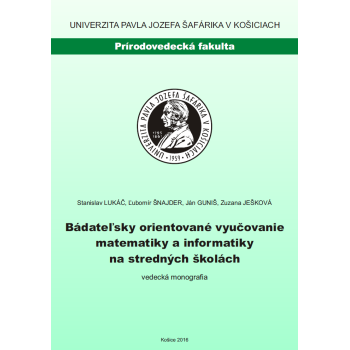
Bádateľsky orientované vyučovanie matematiky a informatiky na stredných školách

Bádateľsky orientované vyučovanie matematiky a...

E-book

E-book

Stanislav Lukáč - Ľubomír Šnajder - Ján Guniš - Zuzana Ješková

The publication is intended for researchers in didactics and teachers of mathematics and computer science. Our aim is to provide readers with a basic orientation in the issue of inquiry-based teaching, to explain and demonstrate several levels of student inquiry through examples, and to offer a classification of inquiry skills.

The core part of the publication consists of methodologies for inquiry-based teaching of specific topics from school mathematics and computer science. We present ideas for implementing inquiry activities, active work with information in solving various types of problems, and the application of modern digital technologies in exploring and discovering patterns.

The publication includes seven methodologies for teaching mathematics and eight methodologies for teaching computer science in the 1st and 2nd years of secondary school.

Download the e-book for free (pdf)

Prílohy

This website uses cookies to ensure you get the best experience on our website