Filter By

Categories

Categories

Selections

Selections

Year of publication:

Year of publication:

Faculty:

Faculty:

Method of publication:

Method of publication:

Active filters

  • Categories: Social sciences
  • Faculty:: Faculty of Law
  • Faculty:: Prírodovedecká fakulta
  • Faculty:: Rektorát
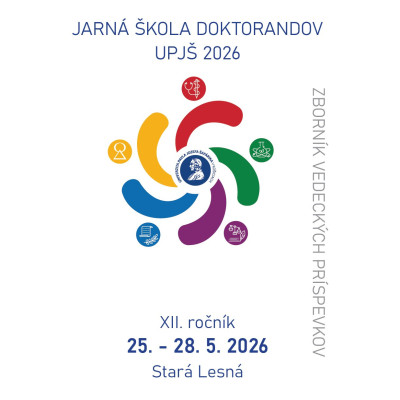
Jarná škola doktorandov 2026
  • New

Jarná škola doktorandov 2026

E-book

E-book

Monika Halánová (ed.)

On May 25 -28. 2026, Stará Lesná will host the 12th year of the university-wide event ‘Spring School of Doctoral Students of Pavol Jozef Šafárik University in Košice’. As part of the professional program, there will be six plenary lectures by prominent experts from Pavol Jozef Šafárik University in Košice and two workshops will be held. A total of 49 full-time doctoral students will present the results of their scientific research work, of which 21 doctoral students in the section of medical and natural sciences (Faculty of Medicine/Faculty of Science) and 28 doctoral students in the section of social sciences and humanities (Faculty of Law/Faculty of Public Administration/Faculty of Arts).

Download the e-book for free (pdf)

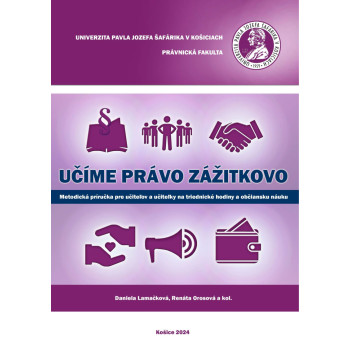
Učíme právo zážitkovo

Učíme právo zážitkovo

E-book

E-book

Daniela Lamačková-Renáta Orosová- Beáta Sakalová- Diana Repiščáková

Methodological guide for teachers for classroom lessons and civics Teaching law experientially? Is it even possible? The answers to these questions are provided by a methodological guide that uniquely links experiential learning methods with legal content. This methodological guide is a set of techniques based on the use of interactive and participatory learning methods, focusing on selected human rights and value-oriented topics, which also have the potential to develop other key competences of students, such as their communication skills, their ability to learn and educate independently, their ability to think critically, their ability to work with and analyse texts, their ability to discuss and express their opinions, and their ability to listen to each other. The methodological guide consists of a set of training activities - techniques, while each technique contains a precise description of the procedure for conducting a specific activity, the expected duration of the activity, aids, discussion topics and also a short pedagogical and legal commentary, precisely "tailored" to the specific legal topic. The legal topics are chosen to be generally applicable to both classroom and civics lessons, to raise questions about the functioning of rules and the need to respect them, mutual respect and tolerance, and to encourage reflection on the limits of individual rights and on responsibility in exercising one's rights. The techniques use training methods such as group work, brainstorming, role-playing, dealing with model situations, as well as a simulated court process. The methodological guide is intended for classroom teachers in the implementation of classroom lessons, and also for the purposes of the subject of civics, as well as for students of pedagogy at the Pavol Jozef Šafárik University in Košice.

Download e-book for free (pdf)

Didaktika školských pokusov zo všeobecnej a anorganickej chémie

Didaktika školských pokusov zo všeobecnej a...

E-book

E-book

Ivana Sotáková-Martin Vavra-Mária Ganajová

This textbook has been designed for the master students of chemistry teaching (combined) at the Faculty of Science, Pavol Jozef Šafárik University in Košice as a source of model school experiments in general and inorganic chemistry. It will be used for teaching the Special Practice of School Experiments I compulsory course. It consists of instructions for experiments related to the selected topics in general and inorganic chemistry as well as the didactic and technical aspects of their performance. Each experiment includes an explanation of the principle, specification of the tools and chemicals needed, working procedure, and the respective apparatus assembly scheme. At the end of each experiment, the observation and explanation necessary for the correct interpretation of the results of the chemical experiment performed are provided. To follow the requirements for the digital transformation of education, selected computer-aided experiments and visualiser projections have been included as well. The next part is focused on the work with the monitoring suitcase, which can be used for making simple field experiments related to environmental topics. The final part is dedicated to attractive experiments that complement the topics in inorganic chemistry and can be used to motivate students. All experiment instructions are in line with the requirements specified by the state educational programmes for primary and grammar schools. This book allows teachers to select appropriate demonstrative experiments or experiments for laboratory classes performed by students themselves. The videos of selected experiments are also available as part of the interactive periodical table of elements operated by the Institute of Chemistry, Faculty of Science, Pavol Jozef Šafárik University in Košice.

Download e-book for free (pdf)

A guide to the didactics of biology

A guide to the didactics of biology

E-book

E-book

Katarína Kimáková

The textbook is intended for university students who are preparing for the profession of biology teacher. The structure of the book is similar to an encyclopedia, with one page devoted to each content item, but the topics of the chapters and subchapters follow each other.

The explanatory text on the page illustrates the diagram and there are notes and links to other sources of information. For better orientation, the content of the textbook is divided into 8 sections, which cover several chapters. It follows the general didactics, which it connects with the teaching of biological content. The book provides a basic orientation in the approaches to learning this subject, and also explains the relationship between biology as a science and the didactics of biology. It deals with teaching standards and curricula, advises on how to master biological concepts and understanding, how to communicate with students in biology classes, when and why are effective visual and practical methods. It acquaints the reader with the issue of setting goals for biological education in the cognitive, psychomotor and affective areas in relation to formative and summative assessment.

Hopeful as well as experienced teachers will find in this publication not only a look into the history of teaching biology, but also a look into the future. Current trends in biology teaching, the connection of teaching with digital technologies, the virtual learning environment and interactive simulations and models belong to science lessons today.

Download the e-book for free (pdf)

Spravodlivosť, spoločenstvo, sloboda

Spravodlivosť, spoločenstvo, sloboda

E-book

E-book

Alexander BröstlMarta Breichová Lapčáková (eds.)

The presented Collection Volume is dedicated to three framework areas, namely justice, community and freedom. These are the thematic areas of the 30th IVR World Congress, on the occasion of which a meeting of its Slovak section was held. The published contributions focus on the main topic of the congress, which is also the central topic of legal and social sciences. Thus, in the Collection we will find reflections on the freedom of the individual in society, its various shades of meaning and forms. The question of the organization of social relations in the form of the degree of participation of citizens in state power in the context of the democratic form of government and its current challenges should not be neglected either. Thus, the institutions of direct and indirect democracy, the dangers of the lures of the so-called totalitarian democracy, or the question of identities in a postmodern pluralistic society. The question of justice in procedural law is not avoided either.

The collection thus provides the reader with a wide area of research from legal-philosophical questions, through questions of the theory of the constitutional state, to their application in legal practice. Geographically, it maps the events in the Central European and wider European area with an impact on their global dimension. The publication can thus become a useful source of knowledge and current developments in jurisprudence and its main topics with the aim of a better understanding of social reality.

Download the e-book for free  (pdf)

Ochrana (duševného) zdravia zamestnanca

Ochrana (duševného) zdravia zamestnanca

E-book

E-book

Milena Barinková (ed.)

The complex of legal norms protecting work, ensuring safety and health protection at work, is very broad in scope, extending beyond the Labour Code to include other specific legal regulations, collective agreements, executive legal regulations, and internal corporate normative acts.

Health protection of employees from hazardous workplace influences is a central requirement stemming from fundamental human rights guaranteed by the Constitution of the Slovak Republic. To ensure its universal enforcement across all employers in both private and public sectors, strict regulation through cogent norms is fully justified. The European Commission’s Communication to the European Parliament, Council, European Economic and Social Committee, and Committee of the Regions on the EU Strategic Framework on Health and Safety at Work 2014–2020 (COM(2014) 332 final) addresses the need to account for labor market changes arising from demographic shifts, aging populations, and technological advancements.

Work pace demands are intensifying, and all age categories of employees must adapt to new technologies, organizational changes, and evolving job structures. This increases requirements for maintaining health fitness throughout entire professional careers. Mental health fitness, which receives insufficient specific attention, is an inherent part of health fitness requirements. Prevention plays a critical role in mental health protection.

Download the e-book for free (pdf)

Prehľad dejín biológie, lekárstva a farmácie

Prehľad dejín biológie, lekárstva a farmácie

E-book

E-book

Martin BačkorMiriam Bačkorová

The proposed text focuses on the history of studying biology, medicine, and pharmacy as scientific disciplines from prehistoric times through antiquity, the Middle Ages, and the modern era. The text chronologically organizes the most significant figures in the history of biological scientific disciplines, outlines key characteristics of major historical discoveries, and reevaluates their significance from the perspective of 21st-century science.

The educational text is chronologically divided into the most significant periods of civilization development. The last two completed centuries—the 19th and 20th—are subdivided into major life science fields due to the unprecedented growth of biological disciplines and the resulting volume of acquired information.

Since it can sometimes be challenging in science to define what constitutes the past versus the present of a particular discipline, we have excluded significant biological discoveries from the early 21st century, which are typically regarded as the “present” of biology.

Download the e-book for free (pdf)

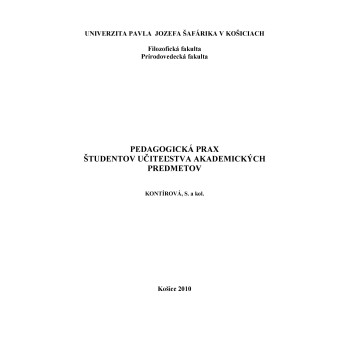
Pedagogická prax študentov učiteľstva akademických predmetov

Pedagogická prax študentov učiteľstva...

E-book

E-book

Silvia Kontírová a kol.

Pedagogical practice is an organizational form of higher education training for prospective teachers, implemented through mandatory pedagogical practice subjects.

These subjects have an integrative and practical-training character, building upon the theoretical and practical instruction provided to students at the faculty. They are conducted within the scope defined by curricula in the conditions of specialized workplaces (training schools) and under the supervision of qualified professionals (training teachers). Unlike other higher education subjects, pedagogical practice primarily provides students with opportunities for independent creative teaching in real school environments.

The practical activities of students in training schools are characterized as supervised, monitored, and evaluated by designated entities.

Download the e-book for free (pdf)

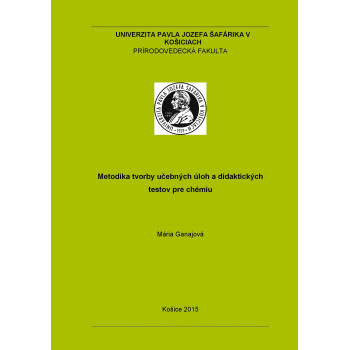
Metodika tvorby učebných úloh a didaktických testov pre chémiu

Metodika tvorby učebných úloh a didaktických...

E-book

E-book

Mária Ganajová

The current teaching of chemistry has its specific problems. On one hand, due to the shift of the focus of chemistry curriculum towards theoretical content, the difficulty of chemistry material has increased, and in connection with this, students' interest in chemistry has decreased.

The lack of student interest in chemistry is mostly supported by the opinion that it is precisely chemistry that significantly contributes to the deterioration of environmental quality. On the other hand, we live in an era where we encounter chemical products practically everywhere. It is necessary to learn the basics of chemistry as well as possible, which makes the question of increasing interest in chemistry education and improving its effectiveness very relevant. State educational programs have been introduced into Slovak schools as a foundation for the creation of school educational programs. These emphasize not only acquiring a certain amount of knowledge but also the development and enhancement of key and specific competencies of students, preparing them for lifelong learning and their application in life.

Therefore, increasing attention is being paid to one of the fundamental didactic tools for raising student activity in teaching, and thus improving the effectiveness of chemistry education – learning tasks. From both theory and practice of chemistry teaching, we know that learning tasks, questions, examples, exercises, etc., are among the important components of every teaching lesson. Learning tasks are applied in all phases of teaching – in the motivational phase, the phase of acquiring knowledge, the phase of consolidating knowledge, and the phase of checking the acquired knowledge. It is therefore clear that every teacher will sooner or later find themselves in a situation where they will have to select learning tasks from textbooks, workbooks, collections of problems and examples, or create them themselves.

This scientific monograph is intended for educational specialists and chemistry teachers, aiming to familiarize them with examples of various types and forms of learning tasks and the basics of their creation in chemistry. It can also be helpful for them in preparing certification works focused on test creation and their statistical evaluation.

Download the e-book for free (pdf)

This website uses cookies to ensure you get the best experience on our website