 English
 Slovenčina


Katalóg
Subcategories
There are 14 products.
Active filters
- Categories: Medicine
- Year of publication:: 2003
- Year of publication:: 2013
- Year of publication:: 2013
- Year of publication:: 2013
- Year of publication:: 2013
- Year of publication:: 2023
- Year of publication:: 2023
- Year of publication:: 2024
- Year of publication:: 2024
- Year of publication:: 2024
- Year of publication:: 2024
- Publication language:: English
Ultrasound Anatomy 2
€25.00
Availability:
99 In Stock
Ingrid Hodorová - Květuše Lovásová
The publication is a continuation of the already published university textbook"Ultrasound Anatomy 1" and fills the gap in the medical literary market concerning the ultrasound view of peripheral nerves and vessels of the limbs, and neck as well.
Physical Examination in Internal Medicine
€25.40
Availability:
2 In Stock
Ladislav Chrobák - Thomas Gral - Jiří Kvasnička and coworkers
Publikace je anglickou verzí nejúspěšnější učebnice propedeutiky pro zahraniční ale i naše studenty. Česká i anglická verze knihy je studenty hodnocena jako didakticky nejlepší ze současně dostupných učebnic pro základní klinické obory. Studenti se systematicky seznamují naprosto srozumitelným a názorným způsobem s fyzikálním vyšetřením a interpretací získaných nálezů. Publikace provází medika jak po dobu studia, ale plně ji využije i ve své budoucí lékařské praxi. Knihu ocení i mnozí pedagogové.
FORENSIC MEDICINE - Textbook for Medical Students
E-book
E-book
Dorota Sopková - Silvia Farkašová Iannaccone
Forensic medicine is a medical discipline that is concerned with the determination of the cause of death in cases of violent and non-violent deaths, as well as the assessment of the effects of violence on the human body, including in cases of living persons. The presented textbook provides a consolidated and comprehensive review of the basic tasks and theoretical knowledge of the field of forensic medicine. Its goal is to provide a theoretical basis for the study of the compulsory subject Forensic Medicine and Medical Law in the study programs General Medicine and Dental Medicine, which has been absent until now. The authors emphasize the need to know the basics of forensic medicine in every medical field and a multidisciplinary approach to solving medico-legal questions.
Student scientific international conference...
E-book
E-book
Martina Šemeláková (ed.)
Proceedings contain abstracts from participants of the scientific conference with international participation under the name: Student scientific international conference GenICa”, supported by the project "Bilateral relations and common knowledge between Slovakia and Iceland research at Universities on the topic "Genomic instability and cancer "GenICa", funded under the EEA and Norwegian 2014-2021 Financial Mechanism Programme (FBR02, bilateral initiatives under the Fund for Bilateral Relations at national level co-financed by EEA and Norwegian Financial Mechanism 2014-2021) which took place on 19 - 21 June 2024 in the premises of Hotel Sorea Trigan, Štrbské Pleso, Slovakia.
Download e-book for free (pdf)
Applications of the Autonomic Nervous System in...
E-book
E-book
Ladislav Kočan - Dušan Rybár - Róbert Rapčan
The autonomic nervous system is a vital component of the peripheral nervous system, responsible for maintaining homeostasis and regulating internal processes within the body. Unlike the voluntary control exerted by the central nervous system, the autonomic nervous system operates involuntarily, innervating smooth organs, vessels, skin glands, and even exerting some influence over skeletal muscles in connection with vegetative functions such as breathing, digestion, and the urinary and gonadal systems. Its impact extends crucially to the cardiac muscles of the heart and plays a significant role in endocrine and metabolic functions, thermoregulation, as well as emotional and behavioral responses, including adaptive reactions to stressors.
The aim of this publication is to provide a comprehensive and objective exploration of the anatomical and physiological intricacies of the autonomic nervous system, offering insights into its clinical applications. Within these pages, we meticulously delineate various interventional therapeutic procedures tailored to specific diagnoses related to the autonomic nervous system, aligning each intervention with the anatomical framework of the autonomic system. The efficacy of these procedures is evaluated based on the level of evidence, as per the current recommendations of Evidence-Based Medicine.
This publication is primarily crafted for fifth and sixth-year medical students and medical professionals specializing in anesthesiology, intensive care, and pain medicine. It serves as a valuable resource for gaining a deeper understanding of autonomic nervous system function and its clinical implications, facilitating informed decision-making in clinical practice.
Surgery for medical students
€45.00
Availability:
97 In Stock
Mária Frankovičová - Jana Kaťuchová
Dear readers and students,
The book “Surgery for Medical Students“ is a textbook intended to be used by those studying at medical faculties and in other healthcare fields. In this textbook, the authors, encompassing all surgical specialties, have tried to provide the reader with a holistic context of the study material intended to be used in preparation for the state exam from surgery. I thank all the co-authors for their willingness and cooperation. To the students I hope you have a pleasant time reading and studying the book.
Prof. MUDr. Mária Frankovičová, PhD
Medical Chemistry
E-book
Marek Stupák et al.
Medical Chemistry presents an overview of the most important topics of general, organic and bioinorganic chemistry for students of General and Dental Medicine study programs. Its aim is to provide a theoretical basis for the study of the subject Medical Chemistry and for understanding processes and chemical reactions which are taking place in the human body.
Each topic directly links chemical principles to the processes in living organisms and thus can help the students to clearly see the application of the presented information. Therefore, it also provides a good starting point for further study of Medical Biochemistry, for which the knowledge of these principles is necessary.
Download e-book for free (pdf)
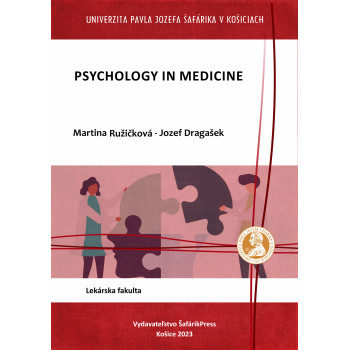
Psychology in Medicine
E-book
E-book
Martina Ružičková - Jozef Dragašek
MEFANET
Psychology is becoming increasingly important in people's lives. It is significant to research human behaviour and how people interact with their environment, as well as how they develop physically, mentally, emotionally, and socially. A rising number of people have been both physically and mentally harmed in recent years as a result of cognitive, emotional, or behavioural disorders.
It was determined that a study book on psychology for medical students was required. Presented study book Psychology in Medicine gives students a fundamental insight into patients´ behaviour in general, and demonstrates the role of psychology in relieving health concerns in particular. It includes topics of medical psychology and clinical psychology that are applied in health care. The chapters address the basic principles of human behaviour, communication between patients and physicians, personality psychology, psychodiagnostic techniques, psychotherapy treatment, abnormal psychology, dealing with stressful events and physical illnesses. The study textbook also emphasises the importance of good mental health and self-care in a doctor's practise.
There is a hope that this book will provide both a source of information and inspiration for doctors and all health care professionals.
Elementary organic molecules in biochemistry
€22.00
Availability:
45 In Stock
Nature, as well as the human body, contains an abundant quantity of organic molecules. This textbook describes selected oxygen, sulfur, nitrogen derivatives of hydrocarbons, heterocyclic compounds of their reactions, which are important in the human body or are found in pharmaceutical active substances, poisons, foodstuffs and heat-treated food. The last part of the textbook describes the isomerism of organic compounds, which enables dynamic changes in the structure of molecules that have different properties. Nature is filled with different plants and animals and is the first laboratory to produce bioactive organic natural compounds. These compounds are compatible with human cells and are applicable as therapeutic medicine. There is an effort to reproduce natural molecules in chemical laboratories, but they cannot be as perfect as the natural ones. Synthetic molecules can serve as a model for multiple studies, but there still does not exist a magic panacea pill or a perfect copy of nature, for the treatment of various diseases. Knowledge about the regenerative and toxic effect of medicinal substances in dependence on their structure (type and number of substituents) is very important for the understanding of their role in modulation of health and disease in dependence on their concentration. Compounds can be used daily only in recommended doses (higher doses can be toxic), but still will not replace a healthy diet. People need a varied diet to be healthy, in which are all necessary nutrients, what Hippocrates demonstrated long ago “Let food be the medicine, and let medicine be the food.” This book is written for students who select bioorganic chemistry subject during the study of general medicine or dentistry as well as for motivated students who would like to practice their knowledge and wish to improve in this subject and for students who would like to learn simplified basic organic reactions with their future application in biochemistry. Learn the simple models mainly through creative simple instruction by using different colours, by repetition, practice by drawing of formulas by hand (at least three times) and memorization of common names of compounds and their reactions which have application in biochemistry. Thus, establishing simple educational methods how to distinguish organic molecules according to the colours of a functional group can promote universal learning for all students who thought that chemistry is a difficult subject, but hopefully they change their opinion after study of this book.
Keywords: organic molecules, oxygen, sulfur, nitrogen derivatives of hydrocarbons, heterocyclic compounds, chemical reactions, isomerism of organic compounds
Medical Biophysics: Practical Exercises
€11.23
Availability:
19 In Stock
Michal Legiňa kol.
Progress in biology and medicine has always been significantly related to advances in physics. Not only has physics supplied instruments and methods of measurement that have led to many discoveries in physiology and medicine, but methods of physical research have changed many of the older approaches to the biologic sciences. Such circumstances have even led to development of a new scientific field: biophysics, which uses to a great extent physical instrumentation procedures applied to an experimental system. Because any instrument is an additional factor in any experimental system, it may affect the data. To interpret physical data on biological material correctly then, it is necessary to consider the characteristics of instrument response.
A practical course enables a student to acquire some skills, experience and methodological knowledge for performance of experiments and evaluation of measured data. Due to the fast development of instrumentation technology, it is not possible to teach every operation and procedure upon instruments we may use in a future. Besides the basic physical principles, the aim of a practical course is to point out some general rules and skills for instrument operation and for the interpretation of the measured values derived from such operation.
There are two kinds of lessons in practical courses. The first one focuses on laboratory measurements of some important physical quantities and the evaluation of the measured data. These measured quantities are components of the subject “medical biophysics” or of the phenomena studied. Experience provided in managing various scales and tables, as well as in the construction of tables and graphs is substantial. Lessons also enable students to repeat and to strengthen their knowledge of secondary school physics, which is useful for understanding of many phenomena studied in medical biophysics. The second kind of lesson provides experience with some of the diagnostic and therapeutic medical instruments, which can be seen in practical medicine.
The understanding of basic physical principles of corresponding instruments is both recommended and demanded. Theoretical preparation is not only an appropriate condition for the practical managing of the whole lesson, but also helps to avoid injury. This textbook, therefore, intends to help students in preparing for both the practical lessons and the final exam.
Authors
Textbook of practical physiology: part I -...
€11.50
Availability:
10 In Stock
Mária Pallayová - Štefan Kujaník
The “Textbook of Practical Physiology, Part I - Cardiovascular Physiology” by Mária Pallayová and Štefan Kujaník is a practical textbook of Human Physiology intended for English speaking medical students from general medicine and dentistry curricula.
The textbook covers basic principles in cardiovascular physiology and methods of the cardiovascular examination. Adequate knowledge of the cardiovascular physiology is important for the understanding of cardiovascular system function, as well as for the diagnosis and proper treatment of cardiovascular and other diseases. The practical tasks are constructed to facilitate knowledge acquisition and encourage students to develop practical skills, for instance the ability to follow experimental protocols, to work as part of a team, and to interpret data.
The textbook is written in English and comprises 91 pages in B5 format, grouped into twelve chapters. Each chapter is divided into six sections (Introduction, Principle, Importance, Materials, Procedure, and Protocol) to facilitate students’ understanding of the topics and assist them with preparation of the laboratory reports. The text is accompanied by explanatory figures, graphs, and tables that contribute to the learning experience.
Authors

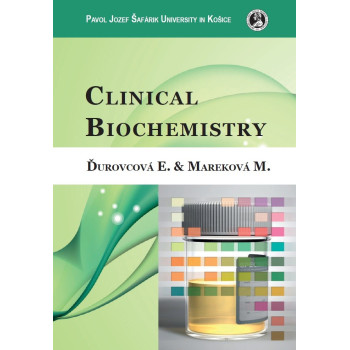
Clinical Biochemistry
€24.90
Availability:
48 In Stock
Eva Ďurovcová - Mária Mareková
The presented textbook is intended for students of general medicine and should support their knowledge about indication and interpretation of basic biochemical tests. Clinical biochemistry continues to be one of the most rapidly advancing areas of laboratory medicine, which in line with using of modern technology more and more emphasizes the evidence-based medicine in order to improve diagnosis and monitoring of patients. Selected topics have an ambition to outline and explain the most common issues of biochemical diagnosis of in internal medicine. Individual chapters are devoted to disorders of water, electrolyte and acid-base balance, kidney and liver disease, diabetes mellitus, and biomarkers used in the diagnosis of cardiac necrosis and heart failure. Given the limited range, the textbook merely summarizes the basic knowledge that students have obtained during the study of other subjects, such as medical biochemistry, pathophysiology and internal medicine, and emphasis is given to laboratory diagnosis in accordance with the newer guidelines of professional societies. We hope that the textbook will be helpful in the study of clinical subjects and encourage students' interest in laboratory medicine.
Authors