Filter By

Categories

Categories

Year of publication:

Year of publication:

Publication language:

Publication language:

Faculty:

Faculty:

UPJŠ Unit

UPJŠ Unit

Method of publication:

Method of publication:

Active filters

  • Year of publication:: 2013
  • Year of publication:: 2013
  • Year of publication:: 2013
  • Year of publication:: 2013
  • Year of publication:: 2013
  • Year of publication:: 2017
  • Year of publication:: 2017
  • Year of publication:: 2017
  • Year of publication:: 2023
  • Year of publication:: 2023
  • Year of publication:: 2023
  • Year of publication:: 2025
  • Year of publication:: 2025
  • Publication language:: English
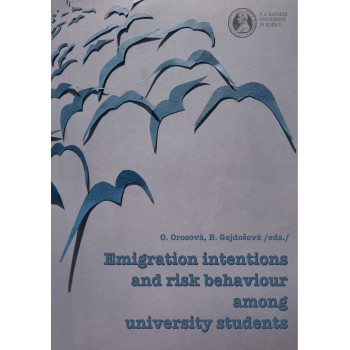
Emigration intentions and risk behaviour among university students

Emigration intentions and risk behaviour among...

E-book

E-book

Oľga OrosováBeáta Gajdošová (eds.)

This publication considers social, economic, political, and psychological indicators of emigration behavior and emigration intentions as appropriate predictors of future behavior.

Theories of motivation and theories of behavioral intentions and their effectiveness are popular in migration research. On the other hand, the Health Belief Model and its adaptation in the research of emigration intentions bring a relatively new and perspective view on this topic.

According to the results presented in this publication, the factors that attract students to emigration (pull factors) are language skills and career opportunities abroad, the desire for change and new experiences, perceived feasibility of emigration, and self-efficacy.

Download the e-book for free (pdf)

Elementary organic molecules in biochemistry

Elementary organic molecules in biochemistry

€22.00
Availability: 45 In Stock

Vladimíra Tomečková

Nature, as well as the human body, contains an abundant quantity of organic molecules. This textbook describes selected oxygen, sulfur, nitrogen derivatives of hydrocarbons, heterocyclic compounds of their reactions, which are important in the human body or are found in pharmaceutical active substances, poisons, foodstuffs and heat-treated food. The last part of the textbook describes the isomerism of organic compounds, which enables dynamic changes in the structure of molecules that have different properties. Nature is filled with different plants and animals and is the first laboratory to produce bioactive organic natural compounds. These compounds are compatible with human cells and are applicable as therapeutic medicine. There is an effort to reproduce natural molecules in chemical laboratories, but they cannot be as perfect as the natural ones. Synthetic molecules can serve as a model for multiple studies, but there still does not exist a magic panacea pill or a perfect copy of nature, for the treatment of various diseases. Knowledge about the regenerative and toxic effect of medicinal substances in dependence on their structure (type and number of substituents) is very important for the understanding of their role in modulation of health and disease in dependence on their concentration. Compounds can be used daily only in recommended doses (higher doses can be toxic), but still will not replace a healthy diet. People need a varied diet to be healthy, in which are all necessary nutrients, what Hippocrates demonstrated long ago “Let food be the medicine, and let medicine be the food.” This book is written for students who select bioorganic chemistry subject during the study of general medicine or dentistry as well as for motivated students who would like to practice their knowledge and wish to improve in this subject and for students who would like to learn simplified basic organic reactions with their future application in biochemistry. Learn the simple models mainly through creative simple instruction by using different colours, by repetition, practice by drawing of formulas by hand (at least three times) and memorization of common names of compounds and their reactions which have application in biochemistry. Thus, establishing simple educational methods how to distinguish organic molecules according to the colours of a functional group can promote universal learning for all students who thought that chemistry is a difficult subject, but hopefully they change their opinion after study of this book.

Keywords: organic molecules, oxygen, sulfur, nitrogen derivatives of hydrocarbons, heterocyclic compounds, chemical reactions, isomerism of organic compounds

Qauntum theory of magnetism

Qauntum theory of magnetism

E-book

E-book

Michal Jaščur

This is a supporting text for the undergraduate students interested in quan- tum theory of magnetism. The text represents an introduction to various theoretical approaches used in this eld. It is an open material, in the sense that it will be supported by appropriate problems to be solved by student at seminars and also as a homework.

The text consists of four chapters that form closed themes of the in- troductory quantum theory of magnetism. In the rst part we explain the quantum origin of the magnetism illustrating the appearance of the ex- change interaction for the case of hydrogen molecule. The second chapter is devoted to the application of the Bogolyubov inequality to the Heisenberg model and it represents the part which is usually missing in the textbooks of magnetism. The third chapter deals with the standard spin wave-theory including the Bloch and Holstein-Primakoff a approach. Finally, we discuss the application of the Jordan-Wigner transformation to one-dimensional spin-1/2 XY model.

The primary ambition of this supportive text is to explain diverse math- ematical methods and their applications in the quantum theory of mag- netism. The text is written in the form which should be sufficient to de- velop the skills of the students up to the very high level. In fact, it is expected that students following this course will able to make their own original applications of the methods presented in this book.

Download the e-book for free (pdf)

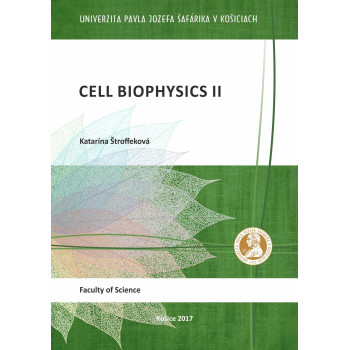
Cell Biophysics II

Cell Biophysics II

E-book

E-book

Katarína Štrofeková

Cell Biophysics II is the one semester comprehensive course textbook for PhD students. It encompasses basic principles and mechanisms underlying cell physiology and biophysics with aims:

• General knowledge of the principles of cellular function, including membrane, cytoplasmic and nuclear roles in normal and abnormal conditions.
• In-depth understanding of the mechanisms underlying the cell functions at the molecular and subcellular level.
• Awareness of cell pathologies that lead to specific disease symptoms and phenotypes.
• The ability to apply learned principles to solve new problems (analysis & synthesis).

Download the e-book for free (pdf)

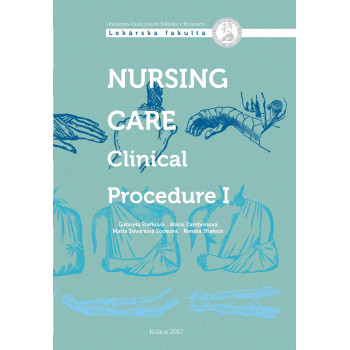
Nursing care  - clinical procedure I

Nursing care - clinical procedure I

€14.60
Availability: 10 In Stock

Gabriela Štefková - Mária ZamboriováMária Sováriová SoósováRenáta Shafout

We would like to introduce the study material/textbook Nursing Care Clinical Procedures I, which was developed to cover the curriculum of Nursing Care 1 for medical students. Clinical procedures are an essential component of nursing practice. The textbook contains four main chapters. Each chapter begins with a general explanation of the topic, followed by detailed method description of procedures to help students deliver high - quality care to patients. Some chapters also include appendi xes in order to pick up some special examples from clinical practice. The textbook strongly describes bandages because a carelessly or improperly applied bandage can cause discomfort to the patient, in many cases it may expose the wound to the danger of infection. To the best of wound knowledge, these procedures reflect currently accepted clinical practice and up-to-date information. The textbook can be easily integrated into an educational programme and can be used in the laboratory as well as in clinical practice. During the preparation of this textbook the information, facts, notes, publications, books and literature presented in the references section were also used. The publication include DVD, which is concentrated on applying bandages from head to lower extremity. DVD was developed in cooperation during IRES project. The student can also find additional information to study by following references. The reading level of Nursing Care Clinical Procedures I is designed to be comprehensible to as many students as possible, including those for whom Engl ish is a second language. We hope that this textbook will be useful to all readers. The authors take no personal responsibility for applying this information to a particular clinical practice
situation.

Essentials of Language Typology

Essentials of Language Typology

E-book

E-book

Lívia Körtvélyessy

This university textbook explains to students enrolled in the course Linguistic Typology and Universals the basic terminology, theoretical approaches, and research methods. The textbook is divided into eleven chapters. Each chapter presents theoretical knowledge in an accessible manner, along with practical exercises aimed at developing students’ skills in the respective area.

The textbook covers the following topics: the subject and nature of linguistic typology, a brief history of this linguistic discipline, genealogical classification of languages, various approaches and main objectives of typology across different linguistic levels (phonology, morphology, syntax, and lexicon), as well as areal typology, complex issues of language universals, and the nature and essence of typologists’ work. Given the extensive research activities of linguists from the Department of British and American Studies at Pavol Jozef Šafárik University in Košice, the textbook also introduces students to the results achieved by these scholars in this rapidly developing field of linguistics.

Download the e-book for free (pdf)

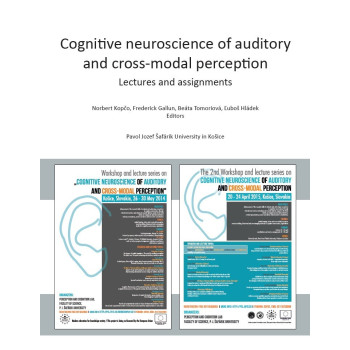
Cognitive neuroscience of auditory and cross-modal perception - Lectures and assignments

Cognitive neuroscience of auditory and...

E-book

Norbert Kopčo - Frederick Gallun - Beáta Tomoriová - Ľuboš Hládek(eds.)

Cognitive neuroscience is a fast developing scientific field which aims at uncovering the neural basis of human perception and cognition. To achieve this goal, cognitive neuroscience uses a variety of tools and approaches ranging from non-invasive brain imaging to psychophysics and neural modeling. Mastering such tools requires skills and knowledge from multiple scientific domains, including neurophysiology, cognitive psychology, and several computational fields.

Access on request via email: kogneuro (@) gmail.com

http://pcl.upjs.sk/workshopcd 

https://sites.google.com/site/kogneuro/

Medical Biophysics: Practical Exercises

Medical Biophysics: Practical Exercises

€11.23
Availability: 19 In Stock

Michal Legiňa kol.

Progress in biology and medicine has always been significantly related to advances in physics. Not only has physics supplied instruments and methods of measurement that have led to many discoveries in physiology and medicine, but methods of physical research have changed many of the older approaches to the biologic sciences. Such circumstances have even led to development of a new scientific field: biophysics, which uses to a great extent physical instrumentation procedures applied to an experimental system. Because any instrument is an additional factor in any experimental system, it may affect the data. To interpret physical data on biological material correctly then, it is necessary to consider the characteristics of instrument response.

A practical course enables a student to acquire some skills, experience and methodological knowledge for performance of experiments and evaluation of measured data. Due to the fast development of instrumentation technology, it is not possible to teach every operation and procedure upon instruments we may use in a future. Besides the basic physical principles, the aim of a practical course is to point out some general rules and skills for instrument operation and for the interpretation of the measured values derived from such operation.

There are two kinds of lessons in practical courses. The first one focuses on laboratory measurements of some important physical quantities and the evaluation of the measured data. These measured quantities are components of the subject “medical biophysics” or of the phenomena studied. Experience provided in managing various scales and tables, as well as in the construction of tables and graphs is substantial. Lessons also enable students to repeat and to strengthen their knowledge of secondary school physics, which is useful for understanding of many phenomena studied in medical biophysics. The second kind of lesson provides experience with some of the diagnostic and therapeutic medical instruments, which can be seen in practical medicine.

The understanding of basic physical principles of corresponding instruments is both recommended and demanded. Theoretical preparation is not only an appropriate condition for the practical managing of the whole lesson, but also helps to avoid injury. This textbook, therefore, intends to help students in preparing for both the practical lessons and the final exam.

Authors

Textbook of practical physiology: part I - cardiovascular physiology

Textbook of practical physiology: part I -...

€11.50
Availability: 10 In Stock

Mária Pallayová - Štefan Kujaník

The “Textbook of Practical Physiology, Part I - Cardiovascular Physiology” by Mária Pallayová and Štefan Kujaník is a practical textbook of Human Physiology intended for English speaking medical students from general medicine and dentistry curricula.

The textbook covers basic principles in cardiovascular physiology and methods of the cardiovascular examination. Adequate knowledge of the cardiovascular physiology is important for the understanding of cardiovascular system function, as well as for the diagnosis and proper treatment of cardiovascular and other diseases. The practical tasks are constructed to facilitate knowledge acquisition and encourage students to develop practical skills, for instance the ability to follow experimental protocols, to work as part of a team, and to interpret data.

The textbook is written in English and comprises 91 pages in B5 format, grouped into twelve chapters. Each chapter is divided into six sections (Introduction, Principle, Importance, Materials, Procedure, and Protocol) to facilitate students’ understanding of the topics and assist them with preparation of the laboratory reports. The text is accompanied by explanatory figures, graphs, and tables that contribute to the learning experience.

Authors

Clinical Biochemistry

Clinical Biochemistry

€24.90
Availability: 48 In Stock

 Eva Ďurovcová - Mária Mareková 

The presented textbook is intended for students of general medicine and should support their knowledge about indication and interpretation of basic biochemical tests. Clinical biochemistry continues to be one of the most rapidly advancing areas of laboratory medicine, which in line with using of modern technology more and more emphasizes the evidence-based medicine in order to improve diagnosis and monitoring of patients. Selected topics have an ambition to outline and explain the most common issues of biochemical diagnosis of in internal medicine. Individual chapters are devoted to disorders of water, electrolyte and acid-base balance, kidney and liver disease, diabetes mellitus, and biomarkers used in the diagnosis of cardiac necrosis and heart failure. Given the limited range, the textbook merely summarizes the basic knowledge that students have obtained during the study of other subjects, such as medical biochemistry, pathophysiology and internal medicine, and emphasis is given to laboratory diagnosis in accordance with the newer guidelines of professional societies. We hope that the textbook will be helpful in the study of clinical subjects and encourage students' interest in laboratory medicine.

Authors

This website uses cookies to ensure you get the best experience on our website