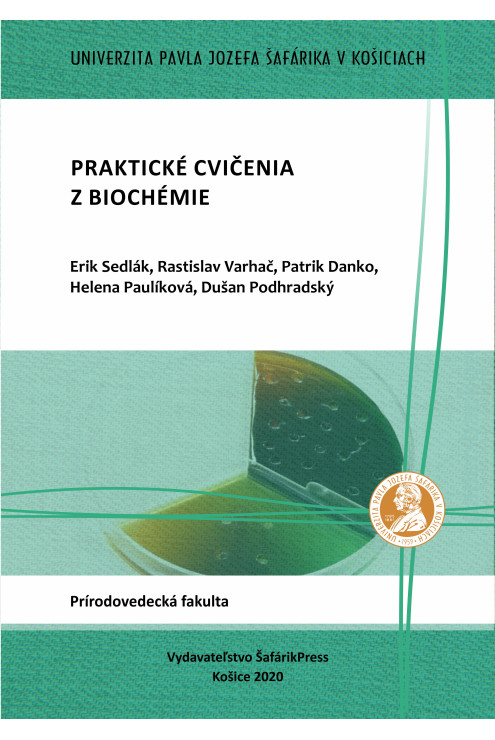
Praktické cvičenia z biochémie

E-book

Erik Sedlák - Rastislav Varhač -  Patrik Danko - Helena Paulíková - Dušan Podhradský

The presented scripts were created in an effort to update and especially clarify the tasks that are solved in the basic practical exercises in biochemistry students of the 2nd and 3rd year of the bachelor's degree in chemistry, biology and their combinations with other disciplines. Most of the tasks come from the original scripts "Podhradský, Mihalovová: Praktické cvičenia z biochémie, Košice 1989".

Some of them have been modified to a greater or lesser extent and adapted to current conditions in the laboratory. New tasks were also added, such as those dedicated to nucleic acids. The scripts are thematically divided into six separate units, each of which consists of several tasks. The names of the units correspond to the nature of the biomacromolecules, which form their central theme. Theoretical introductions at the beginning of the unit are newly constructed and their main goal is to provide a brief overview of the basic biochemical methods used in the study of biomacromolecules.

These scripts are intentionally only available in electronic form. The reason is the effort to continuously update and modernize individual tasks according to the changing possibilities of our laboratory. We hope that the scripts will fulfill their role and that students will have sufficient theoretical knowledge and practical skills in the field of basic biochemical methods after completing these laboratory exercises.

Download e-book for free (pdf)

Quantity

978-80-8152-902-3

Data sheet

Method of publication:
E-book (pdf)
Authors:
Erik Sedlák - Rastislav Varhač - Patrik Danko - Helena Paulíková - Dušan Podhradský
Document type:
Course Notes
Number of pages:
154
Available from:
14.0.2020
Year of publication:
2020
Edition:
1st edition
Publication language:
Slovak
Faculty:
Prírodovedecká fakulta
License:
CC BY NC SA (Uveďte autora - Nepoužívajte komerčne - Zachovajte licenciu )
- Free for download

16 other products in the same category:

NANOVIR – Nanočastice pre riešenie...

E-book

E-book

Adriana Zeleňáková - Jozef Bednarčík

Peer-reviewed Proceedings of the Scientific Conference NANOVIR

The main objective of the scientific conference NANOVIR was the presentation of scientific results obtained during the implementation of the NANOVIR project – Nanoparticles for solving diagnostic and therapeutic problems with COVID-19, co-financed by the European Regional Development Fund within the Operational Programme Integrated Infrastructure 2014 – 2020, ITMS: 313011AUW7.

The project was carried out from January 1, 2021, to June 30, 2023, and was supported with a sum of EUR 1,916,004.79. Three co-investigating organizations participated in the project: Pavol Jozef Šafárik University in Košice as the main investigator, the University of Veterinary Medicine and Pharmacy in Košice as partner no. 1, and the Institute of Experimental Physics of the Slovak Academy of Sciences as partner no. 2.

Download the e-book for free (pdf)

Novel Trends in Chemistry, Research and...

E-book

E-publication
Soňa Király

The Book of Abstracts of the institutional conference Novel Trends in Chemistry, Research and Education 2025 consists of 88 contributions that reflect the current scientific direction and disciplinary diversity of chemical research at our faculty. The publication is divided into several chapters, including abstracts of 6 invited lectures, 4 plenary lectures, and thematically oriented sessions covering a broad spectrum of chemical disciplines. A total of 78 abstracts are included within the sections.

Download the e-book for free

18th Czech and Slovak Conference on Magnetism –...

E-book

E-book

Jozef Bednarčík - Hana Vargová (eds.)

The Czech and Slovak Conference on Magnetism (CSMAG) is a scientific meeting that honors a longstanding tradition initiated in Košice in 1960. Evolving from a regional gathering of the Czechoslovak magnetic community into a prominent international forum, CSMAG brings together researchers from diverse fields of magnetism. The conference covers a wide range of topics including theoretical and experimental magnetism, magnetic materials for energy and spintronics applications, low-dimensional and molecular magnets, rare-earth and actinide systems, and multifunctional materials. With contributions from over 20 countries, CSMAG’25 fosters cross-disciplinary collaboration and showcases the latest advances in both fundamental studies and practical applications of magnetic phenomena.

Download the e-book for free (pdf)

DidSci+ Conference 2022 - PROCEEDINGS −...

E-book

E-book

Mária Ganajová - Jozef Hanč - Ivana Sotáková - Petra Letošníková (eds.)

The International Conference on Research in Didactics of the Science – DidSci+ 2022, continues in the educational legacy of the successful series of the previous DidSci conferences held from 2004 in Krakow, Prague, Brno, or Trnava. The DidSci+ conferences present a platform for enduring international cooperation, focusing on the frontiers and current challenges in science education research. This special edition of DidSci conferences, celebrating its 10th anniversary, was held in Košice, at the Faculty of Science of Pavol Jozef Šafárik University, from June 26 to 29, 2022. The careful double-blind review process has led to two major publications offering a comprehensive look at the latest advances in STEM and science subjects education. The first volume of selected papers is published as the IOP Conference Series proceedings, Vol. 3037 with open access at https://iopscience.iop.org/issue/1742-6596/3037/1, and is primarily devoted to STEM education, assessment, evaluation, feedback strategies, and teacher development. The second volume of selected papers, published by ŠafárikPress, focuses more on curriculum development, educational innovation, and digital technologies, primarily in chemistry and biology. Both publications are intended for a wide audience, including in-service and pre-service teachers of science subjects, university students in scientific disciplines, researchers in science education, professionals in pedagogical and methodological centers, curriculum developers, and textbook authors.

Download the e-book for free (pdf)

The XIV. European Magnetic Sensors and...

E-book

E-book

Jozef Bednarčík (ed.)

The European Magnetic Sensors and Actuators Conference (EMSA) is a consolidated European forum that serves to assess the status, recent progress, and development in the field of magnetic sensor technology and magnetic actuators. It was first held in 1996 in Iasi (Romania) and since then has continued every two-three years in different European cities. The aim of the conference is to generate an overview of research in magnetic sensors and actuators, to recognize their relevance in modern industry and to identify potential future collaborations. EMSA 2024 will provide an excellent opportunity to bring together scientists and engineers from universities, research institutes and industry to present and discuss their most recent results covering both fundamental and applied aspects of magnetic sensors and actuators.

Download e-book for free (pdf)

Biochemická terminológia

€11.60
Availability: 44 In Stock

 Mária KožurkováMartin Putala 

Cieľom tejto knihy je spracovať názvoslovné zásady a pravidlá, podľa ktorých sa tvoria slovenské názvy biochemických zlúčenín. Táto monografia je po dlhšom čase prvým pokusom o spracovanie tohto problému, a preto dúfame, že bude pomôckou a prínosom nielen pre študentov a učiteľov ale aj vedeckých pracovníkov. Poslúži aj študentom stredných škôl, ktorí majú záujem o biochémiu a molekulovú biológiu. Kniha obsahuje najnovšie názvoslovie, zásady a pravidlá pri tvorbe názvov biochemických zlúčenín. Kniha plne aplikuje odporúčania spoločnej komisie Medzinárodnej únie pre teoretickú a aplikovanú chémiu (IUPAC) a Medzinárodnej únie pre biochémiu a molekulárnu biológiu (IUBMB) so zahrnutím aktuálnych úprav názvoslovia, stereochémie a grafického znázornenia štruktúr podľa IUPAC. 

Autori

Praktikum z molekulového modelingu

E-book

E-book

Ladislav Janovec

An enormous progress in computer technology, closely linked with advances in computational chemistry, has enabled the user to exploit the principles of quantum chemistry to elucidate the chemical phenomena.

Computational chemistry is the branch of science that requires, except an academic knowledge, software skills to fully exploit a potential of theoretical methods. The aim of this textbook is to help the user take the legendary first step in the field of computational chemistry to opening a new horizon of knowledge.

Download the e-book for free (pdf)

Všeobecná fyzika IV, 1. časť: Atómová fyzika

E-book

E-book

Adela KravčákováStanislav VokálJanka Vrláková 

The presented “General Physics IV, Part 1: Atomic Physics” is intended as a basic study material for lectures from General Physics IV in the second year of bachelor-level study of physics and interdisciplinary study in combination with physics at the Faculty of Science, P. J. Šafárik University in Košice. The content covers the first part of the given course of physics, devoted to atomic physics.

The aim of the course is to obtain basic information about the structure of the atom and the electron shell of the atom.

Download the e-book for free  (pdf)

Určitý integrál

E-book

E-book

Ondrej Hutník

The concept of the integral is one of the most significant concepts in mathematics as a whole. In its most primitive form, it was already used by the ancient Greeks in the creation of Euclidean geometry. However, it was only after Descartes' work on analytical geometry in 1637 that mathematicians could begin to consider the integral as a subject of analysis. Descartes' work laid the groundwork for the discovery of infinitesimal calculus by Leibniz and Newton around 1665. At that time, a great dispute arose over the priority of this discovery, dividing scholars of Germany and England into two opposing camps, each favoring their own champion. Today, we know that Newton's work on fluxions and fluents was somewhat earlier, but Leibniz's notation and approach have gained more acceptance in the mathematical world, and the symbols ∫ ∫ and d d are still used today. A brief overview of the history of the integral will be presented in Chapter 1.

Today, there is a plethora of scripts, textbooks, and books dedicated to explaining the concept of the integral. Therefore, every potential author faces the initial question of whether to write another text on this topic. Our affirmative answer to this question was driven by the students' request to find the subject matter of a part of the winter semester of the second year presented in a coherent form. The second motivation is a slightly different approach to the topic. If we consider the methods typically used in solving problems and gaining routine with a certain integral, it mainly involves the Newton-Leibniz formula, and often there is little time left to compute the definite (Riemann) integral using its definition. Therefore, we included a discussion of the Newton integral in Chapter 2, which reflects this fact and is directly related to the indefinite integral, whose various calculation methods receive relatively much attention in the previous semester. Only after that, in Chapter 3, do we build the theory of the Riemann integral, present criteria for its existence, classes of integrable functions, basic properties, and finally its relationship with the Newton integral. Questions primarily concerning geometric applications are addressed in Chapter 4, and in the final chapter, we focus on extending the Riemann integral to unbounded functions and unbounded intervals.

Download the e-book for free (pdf)

Predictive Modeling of Soil Types and Their...

E-book

E-book

Vasyl Cherlinka - Michal Gallay - Yuryi Dmytruk

The textbook is a practical guide to predictive mapping of soil types and properties in R. It bridges digital soil mapping theory with hands-on practice, covering the full workflow from data acquisition and preprocessing to validation and uncertainty quantification. Early chapters introduce the tidyverse ecosystem and the sf and terra packages for spatial data handling. Subsequent parts address modelling of categorical variables (soil types/WRB) and continuous variables (soil organic carbon) using Random Forest, Cubist, and Quantile Regression Forests. Step-by-step code examples show training/testing, feature selection, accuracy metrics, and model interpretation. Reproducibility and cartographic best practice are emphasised. A Slovakia case study demonstrates real-world application while outlining limits and generalisability. The book targets bachelor’s, master’s, and PhD students in geography, geoinformatics, environmental and agricultural sciences, as well as practitioners. Written in English, it fits international courses and mobility programmes.

Download the e-book for free (pdf)

1st Workshop on Perspective Electron Spin...

E-book

E-book

Jozef Strečka- Katarína Karl’ová (eds.)

Zborník obsahuje program a abstrakty workshopu s názvom: 1st Workshop on Perspective Electron Spin Systems for Future Quantum Technologies, ktorý sa bude konať 28.-29. júna 2022 v Košiciach. Workshop je organizovaný Prírodovedeckou fakultou Pavla Jozefa Šafárika v Košiciach a Ústavom experimentálnej fyziky Slovenskej akadémie vied v Košiciach s finančnou podporou Agentúry na podporu výskumu a vývoja. Ústrednými témami konferencie budú súčasné problémy kvantovej fyziky - kvantovej teórie magnetizmu spinových a elektrónových štruktúr, exotických kvantových spinových stavov, kvantového previazania, kvantových fázových prechodov, topologického kvantového počítania a kvantového spracovania informácie. Účastníci workshopu budú prezentovať originálne pôvodné výsledky svojho výskumu, ktoré môžu zásadným spôsobom ovplyvniť vývoj budúcich kvantových technológií.   

Download the e-book for free (pdf)

Špeciálne praktikum školských pokusov z...

E-book

E-book

Jana Špaková Raschmanová - Zuzana Kudličková - Kvetoslava Stanková

Organic chemistry plays a key role in our lives, from the pharmaceutical industry to the production of plastics and food additives. Additionally, it is essential in biochemistry, as it deals with the basic building blocks of living organisms, such as carbohydrates, lipids, proteins, and nucleic acids. One of the best ways to teach organic chemistry and increase students' interest in the subject is through conducting school experiments. This study material presents a collection of visually striking practical experiments in organic chemistry that will help students better understand the chemical processes and techniques used in the field. This electronic study material is supplemented with visual material, allowing students to verify the results of experiments and better understand the individual procedures. At the end of each section, there are questions to help assess the acquired knowledge and encourage deeper understanding of the experiments conducted.

Download the e-book for free (pdf)

Cytológia pracovný zošit na praktické cvičenia

€10.50
Availability: 35 In Stock

Ján Kleban a kolektív

Predkladaný pracovný zošit na praktické cvičenia z cytológie je určený poslucháčom 1. ročníka bakalárskeho štúdia biológie a 1. ročníka bakalárskeho medziodborového štúdia v kombinácii s biológiou na Prírodovedeckej fakulte Univerzity Pavla Jozefa Šafárika v Košiciach. Slúži ako návod, ktorý má študentom uľahčiť prácu a umožniť rýchlejšiu orientáciu v zadanej úlohe. Úprava pracovného zošita do formy protokolov umožňuje študentom zakresliť vlastné pozorovanie a tým stimuluje študentov k presnejšiemu a trvalejšiemu zapamätaniu si precvičovanej úlohy a zároveň umožňuje spätnú kontrolu pedagógom. Počas cvičení sa študenti postupne oboznámia so základnými pojmami optiky, s aplikáciami využívajúcimi mikroskopickú techniku, ale aj so základnými rozdielmi medzi štruktúrou rastlinnej a živočíšnej bunky a ich organelami.

Bibliography of the amphibian and reptile...

E-book

E-book

Marcel UhrinDavid JandzikAndrej ČerňanskýMichal RindošBlanka LehotskáStanislav DankoJán KautmanPeter MikulíčekPeter UrbanDaniel Jablonski

Bibliographies provide basic scientific information, illustrate quality and intensity of research in a particular topic, area, or time, and thus help build a cultural-historical perspective of society’s appreciation of knowledge and education. Here we provide a bibliography of herpetological research in the region of Slovakia between the years 1791 and 2017. We collected 2,183 references authored by 1,453 different authors and covering all species of amphibians (18) and reptiles (13) occurring in Slovakia and, in addition, amphibian and reptile taxa occurring in 94 other countries.

Most of the contributions were published in popular magazines and non-indexed journals, while only about 12% of all references represent scientific articles from journals indexed in relevant scientific databases. The extensiveness of study on amphibians and reptiles has varied among different periods within the selected time frame. However, an obvious intensification in the field of herpetology can be observed, especially during the second half of the 20th century. While there have only been few professionals specialized in herpetology, an important role in promoting the research and conservation of amphibians and reptiles in Slovakia has been played by non-governmental organizations and hobbyists. The most frequent type of herpetological data in the referenced literature comes from faunistic research, followed by conservation and general information on herpetofauna, with the majority of published articles in indexed journals coming from the fields of palaeontology, phylogeography, and population genetics.

The presented bibliography is the first step towards building a solid base for future systematic herpetological research in the country and Central Europe.

Download the e-book for free (pdf)

Návody na cvičenia z fyziológie rastlín

E-book

E-book

Miroslav Repčák - Martin Bačkor - Peter Paľove-Balang - Silvia Gajdošová

The establishment of the Plant Physiology Laboratory at the Department of Botany, Faculty of Arts, Pavol Jozef Šafárik University in Košice in 1969 was associated with the name of Ing. Štefan Kocúrik, CSc. (1923–2006), who also prepared the first "Instructions for Exercises in Plant Physiology" (Košice 1972, 1976).

Since 1980, the manual by Associate Professor RNDr. Karol Erdelský, CSc., and Ing. Fridrich Frič, DrSc., titled "Practicum and Analytical Methods in Plant Physiology" (Bratislava 1980) has been used. With the increase in the number of students, it became relevant in 1991 to publish the "Instructions for Exercises in Plant Physiology" again to improve preparation and the efficient organization of practical work. Associate Professor RNDr. A. Košturiak, CSc., contributed significantly to the expansion of the introductory part of the instructions with his valuable advice, for which the authors are grateful. For the fourth edition, some tasks were updated and modernized, taking into account the possibilities of the renovated laboratory. The selection of tasks was adapted to the current scope of exercises for individual plant physiology subjects within the bachelor's and master's study programs in biology and ecology. These subjects include: Plant Physiology, Plant Metabolism, Mineral Nutrition of Plants, Plant Growth and Development, and Plant Ecology. Some tasks are also suitable for high school experiments.

The choice of topics was influenced by the research focus of our workplace on secondary metabolism, ecophysiology, and medicinal plants. The instructions generally adhere to the SI unit system, occasionally including other commonly used units.

Download the e-book for free (pdf)

Programovanie v Pythone 1

E-book

E-book

Ján GunišĽubomír Šnajder

Prílohy

College scripts Programming in Python 1 are intended for future teachers of computer science. The content of the course is related to the teaching of programming in Scratch and is an introduction to text-based programming in Python.

Programming is introduced as a means of developing problem-solving skills. The first chapter is devoted to problem solving. The next 12 chapters sequentially introduce basic language constructions, data structures, and selected types of algorithms. Each of these chapters begins with an introduction to the problem. This section is primarily intended for self-study, to prepare students for the exercises. The following subchapter summarizes and completes the knowledge, and additional insights and approaches related to the chapter topic are presented. The chapters include a collection of exercises designed to practice and deepen knowledge and skills on the topic.

The final part of the chapter presents the solved problems. This section serves as a guide to solving the problems in the collection.

i

Download the e-book for free (pdf)

This website uses cookies to ensure you get the best experience on our website