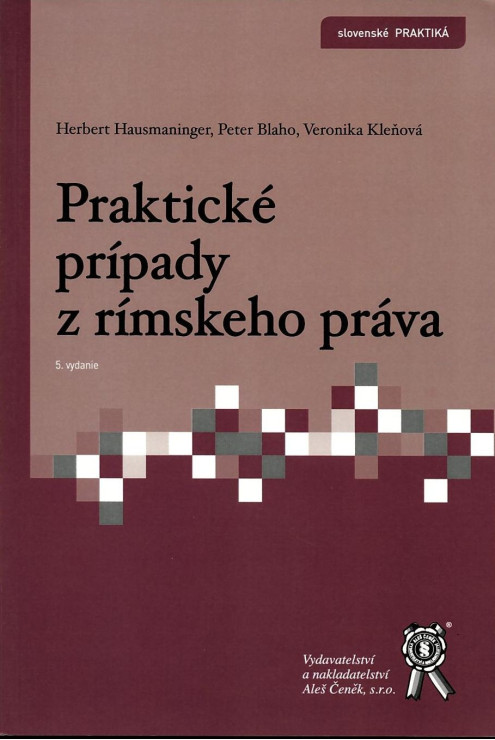
Praktické prípady z rímskeho práva

€19.38

Herbert Hausmaninger - Peter Blaho -  Veronika Kleňová

Kniha obsahuje konkrétne prípady z oblasti rímskeho civilného procesu, rodinného, vecného, záväzkového a dedičského práva, ktoré sa odohrali v antickom Ríme a jeho provinciách. Vybrané boli prípady s osobitným významom pre vývoj civilného práva kontinentálnej Európy. Prostredníctvom týchto prípadov zbierka umožňuje rekonštruovať skutkový stav a právnické odôvodnenia rozhodnutí rímskych právnikov. Vnútorná štruktúra každého prípadu je viac-menej konštantná. V záhlaví je uvedená inskripcia právneho prameňa; nasleduje úplný latinský text a jeho preklad. Každý prípad sa končí položenými otázkami, odkazmi na najdôležitejšie občianske zákonníky a na literatúru. Otázky sú zväčša formulované stručne, s cieľom povzbudiť čitateľa pri hľadaní vlastnej cesty k prameňom. Osobitný dôraz sa kladie na odôvodnenie príslušného rozhodnutia, pričom sa prihliada na spôsob argumentácie rímskych právnikov. Poznámka na občianske zákonníky má nielen ukázať na pretrvávanie rímskeho práva v moderných súkromnoprávnych poriadkoch, ale aj podporiť diskusiu k rímskemu riešeniu právnych problémov.

Quantity
Last items in stock

978-80-7380-827-3

Data sheet

Method of publication:
Printed publication
Authors:
Herbert Hausmaninger - Peter Blaho - Veronika Kleňová
Document type:
učebnica pre vysoké školy
Number of pages:
337
Year of publication:
2021
Edition:
5. vydanie
Publication language:
Slovak
License:
Copyright

Specific References

MPN
302828

16 other products in the same category:

Míľniky právneho vývoja v Európe po prvej svetovej vojne

Míľniky právneho vývoja v Európe po prvej...

E-book

E-book

Ivan SvatuškaLucia Pištejová (eds.)

Collection of Scientific Contributions from the International Scientific Conference of PhD Students and Young Researchers held on April 22, 2022, organized by the Department of State and Law History of the Faculty of Law, Pavol Jozef Šafárik University in Košice.

We recommend this collection to the attention not only of PhD students and young researchers but also to all experts working in the fields of general history and legal science. At the same time, we bring it to the attention of all lay enthusiasts interested in the issues of legal development after the First World War. After all, as one of the world-renowned foreign legal historians likes to say: "Law is the most beautiful science in the world, because everyone can find an area that interests them in it."

Download the e-book for free (pdf)

PRÁVO – OBCHOD – EKONOMIKA XIII.

PRÁVO – OBCHOD – EKONOMIKA XIII.

E-book

E-book

Ján Husár - Regina Hučková (eds.)

Publication Law Business Economy XIII. is collection of international scientific works which contains scientific contributions of wide variety of branches of law, as well as related fields of scientific expertise. Among areas of issues which were discussed in this publication are questions of civil, commercial, tax, custom, competition, intellectual proporty, arbitration and corporate law, as well as other partial areas, including scientific works dealing with economic regulation and business and IT law. Entire publication is significant with richness of scientific contributions from various jurisdictions, because of renowed authors from various countries. Apart from theoretical contribution and expansion of current state of the art in submitted interdisciplinary area, solutions to legal problems were formulated at de lege ferenda level.

Download the e-book for free (pdf)

Novelizovaný trestný poriadok 2023

Novelizovaný trestný poriadok 2023

€8.00
Availability: 1 In Stock

Novelizovaný Trestný poriadok s aktualizovanými dôvodovými správami v úplnom znení

ZÁKON Č. 301/2005 Z. Z. TRESTNÝ PORIADOK V ZNENÍ ZÁKONA Č. 650/2005 Z. Z., ZÁKONA Č. 692/2006 Z. Z., ZÁKONA Č. 342/2007 Z. Z., ZÁKONA Č. 643/2007 Z. Z., ZÁKONA Č. 61/2008 Z. Z., ZÁKONA Č. 491/2008 Z. Z., ZÁKONA Č. 498/2008 Z. Z., ZÁKONA Č. 5/2009 Z. Z., ZÁKONA Č. 59/2009 Z. Z., ZÁKONA Č. 70/2009 Z. Z., ZÁKONA Č. 97/2009 Z. Z., NÁLEZU ÚSTAVNÉHO SÚDU SLOVENSKEJ REPUBLIKY Č. 290/2009 Z. Z., ZÁKONA Č. 291/2009 Z. Z., ZÁKONA Č. 305/2009 Z. Z., ZÁKONA Č. 576/2009 Z. Z., ZÁKONA Č. 93/2010 Z. Z., ZÁKONA Č. 224/2010 Z. Z., ZÁKONA Č. 346/2010 Z. Z., ZÁKONA Č. 547/2010 Z. Z., ZÁKONA Č. 220/2011 Z. Z., ZÁKONA Č. 262/2011 Z. Z., ZÁKONA Č. 331/2011 Z. Z., ZÁKONA Č. 236/2012 Z. Z., ZÁKONA Č. 334/2012 Z. Z., ZÁKONA Č. 345/2012 Z. Z., ZÁKONA Č. 204/2013 Z. Z., ZÁKONA Č. 305/2013 Z. Z., ZÁKONA Č. 1/2014 Z. Z., ZÁKONA Č. 195/2014 Z. Z., ZÁKON Č. 307/2014 Z. Z., ZÁKONA Č. 353/2014 Z. Z., ZÁKONA Č. 78/2015 Z. Z., NÁLEZU ÚSTAVNÉHO SÚDU SLOVENSKEJ REPUBLIKY Č. 139/2015 Z. Z., ZÁKONA Č. 174/2015 Z. Z., ZÁKONA Č. 397/2015 Z. Z., ZÁKONA Č. 398/2015 Z. Z., ZÁKONA Č. 401/2015 Z. Z., ZÁKONA Č. 440/2015 Z. Z., ZÁKONA Č. 444/2015 Z. Z., ZÁKONA Č. 91/2016 Z. Z., ZÁKONA Č. 125/2016 Z. Z., ZÁKONA Č. 316/2016 Z. Z., ZÁKONA Č. 152/2017 Z. Z., ZÁKONA Č. 236/2017 Z. Z., ZÁKONA Č. 274/2017 Z. Z., ZÁKONA Č. 161/2018 Z. Z., ZÁKONA Č. 314/2018 Z. Z., ZÁKONA Č. 321/2018 Z. Z., ZÁKONA Č. 3/2019 Z. Z., ZÁKONA Č. 6/2019 Z. Z., ZÁKONA Č. 35/2019 Z. Z., ZÁKONA Č. 54/2019 Z. Z., ZÁKONA Č. 214/2019 Z. Z., ZÁKONA Č. 231/2019 Z. Z., ZÁKONA Č. 312/2020 Z. Z., ZÁKONA Č. 423/2020 Z. Z., ZÁKONA Č. 308/2021 Z. Z., ZÁKONA Č. 432/2021 Z. Z., ZÁKONA Č. 150/2022 Z. Z., ZÁKONA Č. 340/2022 Z. Z., ZÁKONA Č. 398/2022 Z. Z. A ZÁKONA Č. 49/2023 Z. Z..

Prípady z medzinárodného práva verejného

Prípady z medzinárodného práva verejného

E-book

E-book

Ľudmila ElbertĽubica Gregová Širicová (eds.)

In addition to acquiring theoretical knowledge, it is necessary to study and analyze the decisions of international judicial and arbitration bodies in order to fully understand the subject of the Public International Law or disciplines closely related to it.

Since the Slovak literature in the field of Public International Law does not contain any electronic textbook of selected decisions of international judicial and arbitration bodies, the authors of the submitted publication aim to eliminate this gap by elaborating the “Public International Law Casebook”, which will primarily be intended for undergraduate students of the law faculties in the Slovak republic and the Czech republic.

The proposed publication seeks to make the study of international law more attractive through a publication that will make students familiar with the decisions translated into the Slovak language in a popular electronic form.

Download the e-book for free (pdf)

Správne právo hmotné - Všeobecná časť

Správne právo hmotné - Všeobecná časť

€19.05
Availability: 20 In Stock

Tibor Seman - Radomír Jakab - Jozef Tekeli

The presented textbook on the general part of substantive administrative law offers a comprehensive collection of knowledge, principles, doctrines, institutions, and legal norms that form the foundation for the existence and functioning of public administration. It serves as a prerequisite for mastering the special part of substantive administrative law and administrative procedural law. This updated version of the first edition of the textbook reflects the current development of public administration, the state of administrative law, and educational needs. The textbook introduces key institutions of the general part of administrative law, which are essential for understanding how public administration operates in Slovakia. It includes the characteristics and internal structure of administrative law, its sources, and its relationships with other branches of law. Covered topics include subjects of administrative law, the organization of public administration, methods and forms of its activities, guarantees of legality in public administration, administrative liability, civil service, and work performed in the public interest. It will be useful not only to students but also to anyone interested in the theory and practice of such a dynamic branch of law as administrative law undoubtedly is.

The loan or usury? Compulsory enforcement of judgment - roman and law foundations and problems of application practice

The loan or usury? Compulsory enforcement of...

E-book

E-book

Terézia HišemováDarina Kmecová (eds.)

Reviewed proceedings of scientific papers of Conference of Slovak and Czech law romanists, which take place at May, 10.-11.5.2018, at Faculty of Law, UPJŠ in Košice.

The submitted reviewed proceeding of scientific papers on „The loan or usury? Compulsory enforcement of roman - law basics and problems of application practice.”  is prepared within the solution of the grant project VEGA on: „The loan or usury? Compulsory enforcement of historical - law basics and problems of application practice.”, no. p. 1/0198/17.

The authors of papers are important personalities of Roman law working in the Slovak and Czech Republic, as well as PhD students and young scientists from Slovak and foreign universities who are active in the academic environment as well as in legal practice. The main goal of the editors is to help improve the current legal situation, which is assessed as unsatisfactory, and through a historical excursion of the development of the loan institute and then the forced execution of the decision, to create de lege ferenda proposals considering all areas of research.

The Proceedings trace the interrelationships between the substantive law institute in terms of the Roman law of contractus unilaterales - mutuum in its various types, often realized by the attachment of high interest rates, which bordered on the insurrection and the procedural law of individual lawsuits enforced in the legislative, formular and cognitive process. If there was no possibility to impose certain behaviour on the obligated person (the debtor, the sentenced person), then the declared general obligation to enforce the legal norms was only a legal term. It has always been the case that every internally well-organized state, whether antique or present, has to use power tools - often with the use of gross violence - but within the limits of the law, to promote what it has declared valid law. It must protect creditors on the one hand, but it must also prevent self-help and the use of illegal, unjustified and disproportionate violence.

The loan contract as a real contract has often become an integral part and relatively the most frequent reason leading to the compulsory enforcement, especially when contracting parties often agree on the connection of interest - sometimes within the legal limit, sometimes exceeding the legal framework - and in this way the potential future creditor (the plaintiff) significantly increased the insolvency risk of the debtor (the defendant, the sentenced) and of the subsequent execution. The pronounced and deepening social stratification of the Roman population and the secondary depreciation effort, the cancellation of the debts of the poor part of the population logically culminated in social unrest and revolt against the enforcement of the enforcement law.

The proceedings capture not only the rich scientific discussion of Slovak and Czech legal Romanists, but also the opinions, experience and knowledge of experts on contemporary law dealing with this type of issues. As a result, it provides a unique interdisciplinary view of the subject and raises many stimulus points for future research. This work proves that the problems encountered by the various representatives of the Roman jurisprudence and their legal and theoretical bases and solutions are undoubtedly useful and serve as a guideline also for solving legal issues in the field of modern enforcement proceedings.

Download the e-book for free (pdf)

Možnosti využitia prostriedkov alternatívneho riešenia sporov (ADR) vo verejnej správe

Možnosti využitia prostriedkov alternatívneho...

E-book

E-book

Martin Vernarský, Viktória Adamov Kráľová, Rastislav Král

This collection of papers from a scientific conference brings together different perspectives on issues related to the use of alternative dispute resolution methods in public administration. The dominant thematic focus of the contributions was to examine the potential of alternative dispute resolution methods in protecting the public interest on the one hand, and the subjective rights of natural persons and legal entities in the exercise of public administration on the other. The collection provides a space for researchers working on this topic to present the results of their research to date and compare them with the reality of administrative dispute resolution. The combination of a theoretical approach with practical experience significantly contributes to the improvement of the scientific work of the project researchers, while also enriching practitioners with the diversity and innovativeness of theoretical perspectives on their established practice.

Download the e-book for free (pdf.)

Ako správne pracovať s prameňmi práva Európskej únie. Metodická príručka.

Ako správne pracovať s prameňmi práva Európskej...

E-book

E-book

Dominika BeckováRadoslav BenkoValéria Ružičková

Studies of the European Union law may hardly be possible without making use of its sources. Lots of types of legal rules, several forms of judicial decisions as well as a wide spectrum of criteria used while searching among legal acts of the European Union and case-law of its courts in search engines on the official websites of the European Union may, however, appear confusing, thereby making the work with sources of the European Union law more complicated and prolonging it.

Methodology Guide „How to Work Correctly with the Sources of the European Union Law“ aims to help students to understand the system of sources of the European Union law as well as the sources themselves, offer them tips and advice useful during their search and thus contribute to the adoption of fundamental procedures for working with them.

Download the e-book for free (pdf)

Zákon o národnostiach a Rada vlády Slovenskej socialistickej republiky pre národnosti (predstavy a realita)

Zákon o národnostiach a Rada vlády Slovenskej...

E-book

E-book

Jana Šutajová

From January 1, 1969, the Constitutional Act on the Status of Nationalities in the Czechoslovak Socialist Republic (ČSSR) and the Constitutional Act on the Federation came into effect. The Constitutional Act on the Status of Nationalities represented at least a formal significant step forward in the legal regulation of minority rights. However, this law was intended to serve as a foundation for further legal adjustments. It was declared that additional steps and negotiations for the adoption of implementing regulations would follow and that further laws would be enacted at both the federal and national levels. Nevertheless, no additional law or government regulation related to the constitutional act on the status of nationalities in the ČSSR was ever issued.

During the normalization period, issues concerning further legislation related to national minorities were not addressed. However, in the brief period following the adoption of the constitutional act in 1968 until the end of 1969, some institutions attempted to prepare and promote such legal norms. One of these institutions was the Government Council of the Slovak Socialist Republic (SSR) for Nationalities (hereafter referred to as the Council or the Government Council for Nationalities). The monograph provides an insight into the development of additional legal norms arising from the constitutional act on the status of nationalities in the Slovak Socialist Republic, prepared by the Government Council of SSR for Nationalities. This council was one of the institutions established in Slovakia after the formation of the Czechoslovak federation and dealt with nationality issues.

In addressing further legal norms stemming from the constitutional act on nationalities in ČSSR, it was necessary to consider prior developments. Therefore, the first part of the monograph examines the status of minorities in Czechoslovakia before adopting the constitutional act, activities of nationalities preceding its adoption, and its enactment itself. Subsequent sections focus on institutional changes in SSR following federalization, the establishment of the Government Council of SSR for Nationalities, and specific actions taken by this Council and its expert bodies in drafting proposals for laws concerning nationalities in the Slovak Socialist Republic.

The motivation for writing this monograph stemmed from the fact that this topic has so far received attention only in a few studies in Slovakia, which primarily focused on the Hungarian minority during either the Prague Spring or normalization periods.

Download the e-book for free (pdf)

Probácia v systéme trestnej politiky a sociálnej práce

Probácia v systéme trestnej politiky a...

E-book

E-book

Vladimír LichnerDušan Šlosár

Issues of punishment are directly linked to a state’s criminal policy, which is an inseparable part of its social policy. Historically, the state has held a unique dominant position in the realm of punishment. Once the conditions for imposing a penalty are met, the state fulfills its obligation by sentencing through independent courts. However, it does not address questions of satisfaction, which belong to the victim. The victim may be a specific physical person or legal entity that suffered harm due to the criminal act. This harm simultaneously affects civil society as a whole. The state prioritizes its duty to punish and decide on the matter over compensating the harmed individual or civil society.

By mediation in criminal cases, we mean extrajudicial facilitation of resolving disputes between the offender and the harmed party, with the assistance and personal participation of a mediator. The mediator, as an independent and impartial person, helps parties identify their interests and supports them in finding shared, practical, and realistic solutions to the points causing their conflict. Probation refers to monitoring, supervising the accused, defendant, or convicted individual, as well as providing individual assistance to the offender and encouraging them to lead a lawful life. This reduces the risk of recidivism, or repeated criminal behavior.

Download the e-book for free (pdf)

IV. SLOVENSKO-ČESKÉ DNI DAŇOVÉHO PRÁVA

IV. SLOVENSKO-ČESKÉ DNI DAŇOVÉHO PRÁVA

E-book

E-book

Miroslav ŠtrkolecAnna VartašováMonika Stojáková  - Soňa Simić

Taxation of Virtual Currency and Digital Services - COVID-19 and other Current Challenges for Tax Law

Reviewed proceedings of scientific papers

This Proceedings presents papers from international scientific conference IV SLOVAK-CZECH DAYS OF TAX LAW on the topic: "Taxation of Virtual Currencies and Digital Services - COVID-19 and other Current Challenges for Tax Law" held on 16th - 18th June 2021 in Košice, Faculty of Law of Pavol Jozef Šafárik University in Košice and was supported by the Slovak Research and Development Agency under the grant No. APVV-19-0124 “Tax Law and New Phenomena in the Economy (Digital Services, Sharing Economy, Virtual Currencies)”.

Download e-book for free (pdf)

Liber Amicorum Ján Klučka

Liber Amicorum Ján Klučka

E-book

E-book

Dominika Becková (ed.)

This Liber Amicorum presents a collection of contributions in Honour of Professor Ján Klučka. This Liber Amicorum was written by his colleagues from universities, collaborators from the judiciary, former colleagues from the Constitutional Court of the Slovak republic and the Court of Justice of the European Union, current colleagues from the Faculty of Law and his former PhD. students. Their contributions elaborate the knowledge their gained from the work they conducted together with Professor Ján Klučka and are interspersed with references to memories associated with Professor Ján Klučka.

Download e-book for free (pdf)

Ochrana, prevencia a zodpovednosť v právnych vzťahoch

Ochrana, prevencia a zodpovednosť v právnych...

E-book

E-book

Ivan KundrátKatarína SkolodováMonika Minčičová (eds.)

Peer-reviewed conference proceedings

The continuation of the tradition of an international scientific conference of doctoral students and young researchers have not been exception this year. The Department of Labour Law and Social Security Law, Faculty of Law, Pavol Jozef Šafarik University in Košice, as the organizer of this year's international scientific conference, has chosen a topic entitled "Protection, Prevention and Legal Liability."

Because of the unfavorable epidemiological situation and the cancellation of scientific, professional and other mass events, the conference was transferred to a virtual form. The electronic platform of the conference via online discussion was realized from 3rd to 17th April 2020. The protective function of law, preventive obligations, but also the emerging responsibilities are a vast source of ideas for scientific research, asking questions and finding answers to a range of theoretical and application-law problems in every area of public and private law. Evidence of a generously understood topic is the presented proceedings of scientific papers.

The proceedings, created within the solution of the grant task APVV-16-0002 -Mental Health in the Workplace and Employee Health Assessment, includes various aspects of legal regulation, from academic authors and authors from legal practice. Despite the diversity of the scientific focus, the papers are characterized by a unifying line corresponding to the central theme of the conference and show the interconnectedness of the different areas of law.

Download the e-book for free  (pdf)

KOŠICE CRIMINAL LAW DAYS 2022, VI. „The value direction of criminal law“

KOŠICE CRIMINAL LAW DAYS 2022, VI. „The value...

E-book

E-book

Sergej RomžaVeronika TóthováBronislava Vinnerová (eds.)


The Collection of scientific contributions nationwide interdisciplinary scientific conference with international participation

The text book of scientific contributions The value direction of criminal law is the output of a nationwide interdisciplinary scientific conference with international participation organized by the Department of Criminal Law of the Faculty of Law of the UPJŠ in Košice. The proceedings contain contributions focused on issues of the value direction of criminal law, both in the field of substantive and procedural law.

This is a highly topical issue, as the values of law as such are reflected in each of its areas. In view of social events, the constant amendment of the criminal codes and, in particular, the forthcoming amendment of both the Criminal Code and the Code of Criminal Procedure, we consider the topic of the conference and the title of the text book to be highly topical, without significant limits in scientific research.

In their contributions, the participants of the national interdisciplinary scientific conference with international participation also devoted themselves to reflections de lege ferenda and offer insights into the above-mentioned amendments to the criminal codes into practice as well as their upcoming amendments.

The aim of the published proceedings is to continue to improve and develop new knowledge in the field of criminal law in the light of the new rules, while adhering to all established values, on the basis of the previous professional knowledge.

Download the e-book for free  (pdf)

Iniciatívy EÚ pri predchádzaní daňovým únikom a daňovým podvodom a ich implementácia do vnútroštátneho právneho poriadku

Iniciatívy EÚ pri predchádzaní daňovým únikom a...

E-book

E-book

Adrián Popovič a kol.

The possibility of solving the grant project VVGS-2016-284 has provided a unique opportunity for members of the author´s team in the interdisciplinary composition to examine the issue not only from a tax-law point of view, but also from a political point of viewIn the presented monograph, the authors focused on the characterization of different aspects of the EU in order to allow the reader correctly understand its position in relation to the outside world and to its inward relations within its Member States in the context of the creation and implementation of the EU tax policy.

Particular attention is paid to the definition of the relationship between national tax legislation and EU law, the impact of the EU's tax policy on the national laws of its Member States, with reference to the identification of the harmonized areas with the approximation of their current stage of development and the final objective. This definition can be seen as a prerequisite for a correct and comprehensive understanding of the application and implementation of EU institutions' initiatives to prevent tax evasion and tax fraud and their implementation into the national legal order of the Slovak Republic. In the last part of the monograph, the authors focused on defining individual EU initiatives to combat tax evasion and tax fraud as a means of implementing its tax policy, in the area of ​​indirect taxation, in particular in the field of value added tax and in the field of direct taxation, especially with regard to corporate taxation, and to evaluate their projection into the national tax legislation of the Slovak Republic. At the same time, in these chapters, they assessed the real impact and effect of the measures admitted on the basis of the initiatives in practice.

The presented work is intended for a university student studying in the field of Tax Law and European Law, as well as the broader legal and economic community. However, in view of the scope and recency of the subject under consideration, the authors believe that the publication will find its application not only in the theoretical field but also in the practical field.

 JUDr. Adrián Popovič

Download the e-book for free (pdf)

Novelizovaný obchodný zákonník

Novelizovaný obchodný zákonník

€8.48
Availability: 1 In Stock

NOVELIZOVANÝ OBCHODNÝ ZÁKONNÍK s aktualizovanými dôvodovými správami

ZÁKON Č. 513/1991 ZB. OBCHODNÝ ZÁKONNÍK V ZNENÍ ZÁKONA Č. 264/1992 ZB., ZÁKONA Č. 600/1992 ZB., ZÁKONA NÁRODNEJ RADY SLOVENSKEJ REPUBLIKY Č. 278/1993 Z. Z., ZÁKONA NÁRODNEJ RADY SLOVENSKEJ REPUBLIKY Č. 249/1994 Z. Z., ZÁKONA NÁRODNEJ RADY SLOVENSKEJ REPUBLIKY Č. 106/1995 Z. Z., ZÁKONA NÁRODNEJ RADY SLOVENSKEJ REPUBLIKY Č. 171/1995 Z. Z., ZÁKONA NÁRODNEJ RADY SLOVENSKEJ REPUBLIKY Č. 58/1996 Z. Z., ZÁKONA NÁRODNEJ RADY SLOVENSKEJ REPUBLIKY Č. 317/1996 Z. Z., ZÁKONA NÁRODNEJ RADY SLOVENSKEJ REPUBLIKY Č. 373/1996 Z. Z., ZÁKONA Č. 11/1998 Z. Z., ZÁKONA Č. 127/1999 Z. Z., ZÁKONA Č. 263/1999 Z. Z., ZÁKONA Č. 238/2000 Z. Z., ZÁKONA Č. 147/2001 Z. Z., ZÁKONA Č. 500/2001 Z. Z., ZÁKONA Č. 426/2002 Z. Z., ZÁKONA Č. 510/2002 Z. Z., ZÁKONA Č. 526/2002 Z. Z., ZÁKONA Č. 530/2003 Z. Z., ZÁKONA Č. 432/2004 Z. Z., ZÁKONA Č. 315/2005 Z. Z., ZÁKONA Č. 19/2007 Z. Z., ZÁKONA Č. 84/2007 Z. Z., ZÁKONA Č. 657/2007 Z. Z., ZÁKONA Č. 659/2007 Z. Z., ZÁKONA Č. 429/2008 Z. Z., ZÁKONA Č. 454/2008 Z. Z., ZÁKONA Č. 477/2008 Z. Z., ZÁKONA Č. 276/2009 Z. Z., ZÁKONA Č. 487/2009 Z. Z., ZÁKONA Č. 492/2009 Z. Z., ZÁKONA Č. 546/2010 Z. Z., ZÁKONA Č. 193/2011 Z. Z., ZÁKONA Č. 547/2011 Z. Z., ZÁKONA Č. 197/2012 Z. Z., ZÁKONA Č. 246/2012 Z. Z., ZÁKONA Č. 440/2012 Z. Z., ZÁKONA Č. 9/2013 Z. Z., ZÁKONA Č. 352/2013 Z. Z., ZÁKONA Č. 357/2013 Z. Z., ZÁKONA Č. 87/2015 Z. Z., ZÁKONA Č. 117/2015 Z. Z., ZÁKONA Č. 172/2015 Z. Z., ZÁKONA Č. 361/2015 Z. Z., ZÁKONA Č. 389/2015 Z. Z., ZÁKONA Č. 125/2016 Z. Z., ZÁKONA Č. 264/2017 Z. Z., ZÁKONA Č. 112/2018 Z. Z., ZÁKONA Č. 156/2019 Z. Z., ZÁKONA Č. 390/2019 Z. Z., ZÁKONA Č. 198/2020 Z. Z., ZÁKONA Č. 519/2021 Z. Z., ZÁKONA Č. 111/2022 Z. Z., ZÁKONA Č. 407/2022 Z. Z. A ZÁKONA Č. 8/2023 Z. Z.

This website uses cookies to ensure you get the best experience on our website