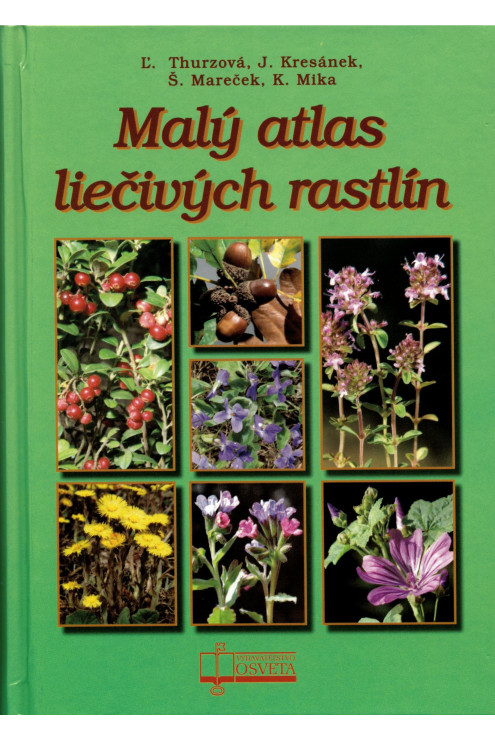
Malý atlas liečivých rastlín

€15.00
Tax included

Ľ. Thurzová - J. Kresánek - Š. Mareček - K. Mika

Predchádzajúce vydanie Malého atlasu liečivých rastlín, okrem desiatok zahraničných vydaní, bolo roku 1983. Základ tohto záslužného diela ostal nezmenený. V biochemickom a vo farmakodynamickom výskume sa však za posledné roky udiali závažné zmeny, ktoré skorigovali niektoré zaužívané dogmy. Tieto zmeny bolo treba rešpektovať vo fytoterapeutickej aplikácii.
V minulosti veľmi populárna a obľúbená publikácia chce opäť poskytnúť užitočné vedomosti všetkým, ktorí sa zaujímajú o fytoterapiu, aspoň z najfrekventovanejších druhov liečivých rastlín.

Quantity
Last items in stock

Osveta
978-80-8063-318-9

Data sheet

Method of publication:
Printed publication
Authors:
Ľ. Thurzová - J. Kresánek - Š. Mareček - K. Mika
Document type:
Monograph
Number of pages:
419
Year of publication:
2010
Edition:
10. vydanie
Publication language:
Slovak
License:
Copyright

Specific References

MPN
301482

16 other products in the same category:

Praktické cvičenia z lekárskej biológie

E-book

E-publication

Eva Slabá-Helena Mičková- Terézia Hudáková-Janka Vašková

Teaching texts „Praktické cvičenia z lekárskej biológie“ provide the theoretical foundations of microscopy, various microscopic techniques and preparation of microscopic slides in an understandable form. The chapters of the teaching texts contain model questions and tasks from cytology, molecular biology and genetics enabling students to acquire new knowledge from individual thematic areas and provide instructions for the implementation of tasks during laboratory lessons in medical biology. Teaching texts are primarily intended for the practical lessons in the subjects Biológia 1 and Biológia 2 for Slovak students of the first year of General Medicine and the subjects Lekárska biológia and Genetika a regeneratívna medicína for Slovak students of the first and second year of Dental Medicine at P. J. Šafárik University in Košice – Faculty of Medicine.

Download the e-book for free (pdf)

EFFUSE – River Landscape, Volume 1: Scientific...

E-book

E-publication
Beáta Valkay ed.
Ivana Slepáková-Andrej Mock a kol.

The textbook EFFUSE – River Landscape, Volume 1: Scientific Education for Everybody, developed within the EFFUSE project, explores the importance of water for living organisms and the specific features of water in the Transcarpathian region. It addresses the issue of water pollution and presents bioindication as an effective method of environmental research. The publication explains how the ecological status of rivers and water quality can be assessed using aquatic plants, insects, fish, and amphibians. It also raises awareness about the microbial composition of water and offers guidance on protecting oneself from waterborne infections. Finally, it highlights the significance of environmental education and awareness in strengthening the relationship between humans and the natural environment.

Download the e-book for free (pdf)

Cell Biophysics II

E-book

E-book

Katarína Štrofeková

Cell Biophysics II is the one semester comprehensive course textbook for PhD students. It encompasses basic principles and mechanisms underlying cell physiology and biophysics with aims:

• General knowledge of the principles of cellular function, including membrane, cytoplasmic and nuclear roles in normal and abnormal conditions.
• In-depth understanding of the mechanisms underlying the cell functions at the molecular and subcellular level.
• Awareness of cell pathologies that lead to specific disease symptoms and phenotypes.
• The ability to apply learned principles to solve new problems (analysis & synthesis).

Download the e-book for free (pdf)

BIOLÓGIA LIŠAJNÍKOV. Časť C: Identifikácia...

E-book

E-book

Mária VilkováMonika GarberováMichal Goga

Nuclear Magnetic Resonance (NMR) is currently a widely used analytical tool that finds application in many fields of science and technology. The broadening of its practical use brings with it the necessity to create educational texts appropriate to the given scientific discipline.

This university textbook is intended for students of biology and serves as a supplement to the study materials for the advanced master's course "Biology of Lichens." At the same time, it represents a useful resource for master's and doctoral students involved in research, helping them interpret NMR spectra and present basic theoretical concepts.

The textbook briefly describes the important aspects of each NMR spectroscopic technique without delving excessively into the physical principles of individual methods or complex mathematical analyses. In this edition, the structures of lichen metabolites have been included, which students will isolate, purify, and identify using various analytical methods during practical exercises. An entire chapter is dedicated to a detailed description of solving the NMR spectra of isolated metabolites, with each step in elucidating the structures of both known and unknown metabolites explained in detail. The solved tasks are followed by numerous unsolved examples, including high-resolution 1D and 2D NMR spectra of metabolites, intended to further develop the acquired knowledge and skills of students and doctoral candidates in structure elucidation using NMR spectroscopy.

Download e-book for free (pdf)

Študentská vedecká konferencia PF UPJŠ 2017

E-book

E-book

Katarína CechlárováEva Pitoňáková (eds.)

Proceedings of Abstracts from Contributions by Participants of the Student Scientific Conference at the Faculty of Science, UPJŠ in Košice, Held on April 26, 2017

This is the fifth edition of the proceedings from the Student Scientific Conference (ŠVK) at the Faculty of Science, Pavol Jozef Šafárik University in Košice. We are pleased that ŠVK has become an integral part of faculty life and a showcase for the quality of education provided. In 2017, ŠVK took place as part of the traditional Science Days on April 26, 2017. 105 students from the Faculty of Science presented their work. Contributions were organized into 15 sections, supplemented by an open programming competition involving 17 students and the final round of the IHRA competition, which included 27 teams from across Slovakia.

The abstracts in this proceedings demonstrate that students at the Faculty of Science, UPJŠ, acquire knowledge and skills in their field not only through theoretical study of disciplines but also through active engagement in solving partial scientific problems aligned with research goals at the faculty’s institutes. These abstracts also provide an overview of the faculty’s scientific activity, which we believe will be of interest to the broader public.

doc. RNDr. Gabriel Semanišin, PhD.

Dean of the Faculty

Download the e-book for free (pdf)

O jaskyniach a krase pre každého – vybrané...

E-book

E-book

Alena Gessert

Caves have always been very specific places throughout history. In some cultures, they served as sites for sacrifices or remembrance, while in others, they were seen as places where one could cross to the "other side of life." People used caves for shelter, as places to leave messages, to wait out bad weather, and in some cases, even lived in them. During wars in our region, entire families or villages would hide from enemies in caves, or they would use them to conceal weapons.

Today, in most countries, caves are destinations for tourists who want to experience something new and unknown: darkness, high humidity, and the fascinating beauty of underground formations. They are also sought after by cavers who long to explore caves, enter worlds where no human has set foot before, find evidence of previous habitation, or conduct research that continually advances our knowledge.

In the publication you are holding, we present both traditional and less conventional topics about the formation of karst and caves, selected ecological aspects, maps and their creation, significant caves of the world, and the life of people in such areas. We also offer an overview of important karst locations that are definitely worth learning more about or visiting in person. This publication is intended for readers among pupils, students, teachers, and the general public, and we believe it will draw you into this mysterious world.

Download e-book for free (pdf)

Jarná škola doktorandov 2020

E-book

E-book

Peter Fedoročko (ed.)

Proceedings of the 7th Annual Doctoral Spring School 2020

From November 10 to November 11, 2020, the 7th annual Spring School for Doctoral Students at Pavol Jozef Šafárik University in Košice will take place in Košice in a modified mode in the on-line space. The scientific program of the spring school will comprise 2 plenary lectures by leading scientific experts of Pavol Jozef Šafárik University in Košice. Doctoral students will present their research papers in two sections: 24 doctoral students of Faculty of Public Administration, Faculty of Law and Faculty of Arts, and 22 doctoral students of Faculty of Medicine and Faculty of Science.

The scientific programme of the spring school will also include a panel discussion with the management of Pavol Jozef Šafárik University in Košice.

Download the e-book for free  (pdf)

Ecology of Soil Animals

E-book

E-book

Natália Raschmanová - Ľubomír Kováč

The text summarizes the basic knowledge about the functioning of the soil ecosystem with a focus on soil protists and dominant groups of soil animals. Characteristics of each soil animal group include basic morphology, ecology, distribution, population dynamics and their importance in the soil ecosystem. The aim of the text is to gain a basic understanding of the diversity and interactions of soil fauna with the soil environment. It deals with the ecological classification of soil fauna on the basis of body size, presence in the soil during the life cycle, food preference and by locomotion. It highlights important morphological and ecophysiological adaptations of soil fauna to physical and chemical environmental factors. The text also gives an overview of the basic methods in the field collection of soil fauna and their extraction from soil samples under laboratory conditions. It further informs on the method of taxonomic identification and ecological evaluation of soil fauna communities. Discusses the soil fauna of different types of ecosystems. It highlights the differences in soil fauna communities that inhabit grassland and forest habitats, and agricultural soils. This teaching material is intended for students in biology degree programmes.

Download the e-book for free (pdf)

A guide to the didactics of biology

E-book

E-book

Katarína Kimáková

The textbook is intended for university students who are preparing for the profession of biology teacher. The structure of the book is similar to an encyclopedia, with one page devoted to each content item, but the topics of the chapters and subchapters follow each other.

The explanatory text on the page illustrates the diagram and there are notes and links to other sources of information. For better orientation, the content of the textbook is divided into 8 sections, which cover several chapters. It follows the general didactics, which it connects with the teaching of biological content. The book provides a basic orientation in the approaches to learning this subject, and also explains the relationship between biology as a science and the didactics of biology. It deals with teaching standards and curricula, advises on how to master biological concepts and understanding, how to communicate with students in biology classes, when and why are effective visual and practical methods. It acquaints the reader with the issue of setting goals for biological education in the cognitive, psychomotor and affective areas in relation to formative and summative assessment.

Hopeful as well as experienced teachers will find in this publication not only a look into the history of teaching biology, but also a look into the future. Current trends in biology teaching, the connection of teaching with digital technologies, the virtual learning environment and interactive simulations and models belong to science lessons today.

Download the e-book for free (pdf)

ANATOMICKÉ TERMÍNY PRE JEDNOODBOROVÉ A...

E-book

E-book

Juraj ŠevcFilip Mochnacký

Students studying biology as the single-subject or as a part of two-subject programs on various faculties of sciences are often encountered with the problem, how to limit the topics in the subject Human anatomy. This List of anatomical terms is aiming to help the non-medical students to get acquainted with the extensive anatomical nomenclature and to optimize the number of anatomical terms, which should be memorized, to preserve the sufficient capacity of the students for another knowledge of the field of systemic, comparative, developmental and functional anatomy. The emphasis on the arrangement of individual anatomical terms into the logical units supports the hierarchical view on the architecture of the human body.

Despite the common opinion, anatomical nomenclature represents a framework, which is during the further study gradually enveloped with the knowledge of more or less related disciplines concerning with the human body and its biological processes. Moreover, besides this ambition, which exceeds the area of the human anatomy, this List of anatomical terms continues the long tradition with respect to the valid Latin and Slovak anatomical terminology.

Download the e-book for free  (pdf)

EFFUSE Scientific education for advanced

E-book

E-publication

Beáta Valkay ed.
Ivana Slepáková-Monika Balogová a kol.

EFFUSE - Scientific Education for Advanced is an educational material designed for university students interested in ecological sciences, biology and environmental protection. The publication was developed as part of the EFFUSE project and focuses on the scientific investigation of living organisms in the river ecosystem, with an emphasis on their ecological role and importance as bioindicators. The river ecosystem is a dynamic environment where a wide range of organisms can be studied, from algae and phytoplankton to aquatic invertebrates, fish, amphibians and reptiles. This publication presents a detailed study of their adaptations, life cycles, reproductive strategies and their importance for ecological balance. Particular attention is paid to fish and amphibians, whose environmental demands and sensitivity to pollution make them important indicators of water quality and environmental status. The publication also provides guidance on how to integrate their study into university education in the form of practical research. It also includes a chapter on science education in the context of sustainable development, which is often absent from university curricula in Slovakia and Ukraine. This material promotes the link between theory and practice and develops students' scientific thinking in order to prepare them to meet the environmental challenges of the future.

Download the e-book for free (pdf)

Ortuť v životnom prostredí ako rizikový faktor...

E-book

E-book

Tatiana Kimáková

This scientific monograph is a comprehensive scientific work focused on the presence and effects of mercury in the environment, as well as the health risk factors associated with it.

The monograph presents a characterization of mercury in a multidisciplinary scope, discusses its use in industry and healthcare, and describes the negative impacts of mercury on the environment and public health. It also provides proposals and recommendations for at-risk groups. The monograph includes a comprehensive study of mercury concentration in samples of domestic and foreign production commodities and plant samples using the atomic absorption spectrometer AMA 254.

This scientific monograph is suitable for the scientific community, students of medical, veterinary, natural sciences, and agricultural fields, as well as public health students at all three levels of university study. It is also intended for all interested members of the informed public.

PDF preview

The publication is available for purchase through our online store.>>

JARNÁ ŠKOLA DOKTORANDOV 2023

E-book

E-book

Peter Fedoročko (ed.)

From June 13 to June 16, 2023, the 9th annual Spring School for Doctoral Students at Pavol Jozef Šafárik University in Košice will take place in Stará Lesná. The scientific program of the spring school will comprise 3 plenary lectures by leading scientific experts and 1 workshop.

Doctoral students will present their research papers in two sections: 24 doctoral students of Faculty of Public Administration, Faculty of Law and Faculty of Arts, and 24 doctoral students of Faculty of Medicine and Faculty of Science. The scientific programme of the spring school will also include a panel discussion with the management of Pavol Jozef Šafárik University in Košice.

Download the e-book for free  (pdf)

Študentská vedecká konferencia PF UPJŠ 2018

E-book

E-book

Katarína Cechlárová (ed.)

In 2018, the Student Scientific Conference was held on April 18, 2018, in 16 sections covering biology and ecology, chemistry, physics, geography, mathematics, computer science, and their subject didactics. There were 110 registered contributions from bachelor's and master's students. Additionally, eight high school students participated outside of the competition; these students already visit our alma mater at a young age, work in our laboratories, and prepare for further studies under the guidance of our enthusiastic teachers. The day also included a programming competition and the IHRA competition in three categories, where students from PF UPJŠ competed alongside pupils from elementary and secondary schools.

The abstracts of the Student Scientific Conference contributions convincingly demonstrate that PF UPJŠ students study their field not only theoretically but also actively engage in solving partial scientific problems that are part of the research goals at PF UPJŠ institutes. This collection provides an overview of scientific activity at the faculty, which we believe will be interesting for the broader public as well.

Download the e-book for free  (pdf)

Študentská vedecká konferencia PF UPJŠ 2015

E-book

E-book

Vladimír Zeleňák(ed.)

The proceedings contain abstracts of contributions from participants of the Student Scientific Conference of the Faculty of Science, Pavol Jozef Šafárik University in Košice, which took place on April 22, 2015.

The Student Scientific Conference (SSC) enjoys long-term popularity among the faculty's students and teachers, and we are pleased that this was no different this year, with 128 contributions submitted to the SSC.

The contributions were organized into 19 sections, additionally complemented by an open programming competition and the final of the IHRA contest. For many students, presenting at the SSC is one of the first opportunities to gain experience in presenting their results before a professional audience. Considering the number of submitted contributions, along with the members of the expert juries from the faculty's teaching staff and the audience who came to support their classmates' presentations, the SSC is an event where a large part of the student and academic community of the faculty meets at one place and time. Many abstracts presented in this proceedings were developed as part of students' work on partial tasks that are components of research projects at the departments of the Faculty of Science, Pavol Jozef Šafárik University.

The abstracts represent, in a way, an overview of research topics at the individual workplaces of the faculty. The SSC proceedings thus serve as a useful tool that students and faculty teachers can use to present the faculty externally to partners, employers, and potential collaborators. Partners from practice have shown interest in cooperating in organizing the SSC for a long time. Since 2005, the association of IT companies has awarded a Prize for the Most Original Work and a Prize for the Work with the Best Prospects for Practical Application.

Download the e-book for free (pdf)

This website uses cookies to ensure you get the best experience on our website