Filter By

Year of publication:

Year of publication:

Publication language:

Publication language:

Active filters

  • Year of publication:: 2017
  • Year of publication:: 2021
  • Year of publication:: 2021
  • Year of publication:: 2021
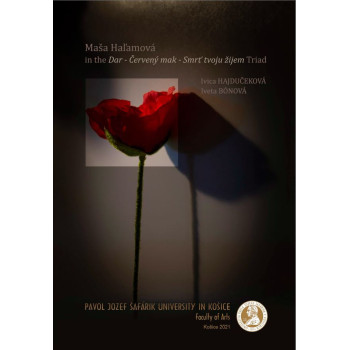
Maša Haľamová in the Dar – Červený mak – Smrť tvoju žijem Triad

Maša Haľamová in the Dar – Červený mak – Smrť...

E-book

E-book

Ivica HajdučekováIveta Bónová

The monograph Maša Haľamová in the triad Dar – červený mak – Smrť tvoju žijem was created as part of the project APVV-19-0244 (Methodological Approaches in Literary Research with an Impact on the Media Environment) in collaboration between Ivica Hajdučeková and Iveta Bónová.

In two parts – Personal History and (Re)interpretation of Maša Haľamová's Poetry, and Phonetic-Rhythmic Embodiment of Maša Haľamová's Poetry – it presents the results of archival research (reconstruction of life events, notes on poetic inspiration, consensus in the opinions of literary critics of the 20th and 21st centuries), (re)interpretations of three poetic collections focusing on the spiritual dimension and the process of spiritualization, and an in-depth analysis of the phonetic-rhythmic qualities of verse structure.

In conclusion, the authors suggest that the Slovak poet Maša Haľamová can be considered a representative of spiritual poetry, which in the Slovak interwar literature follows a specific type of confessional (Protestant) tradition, and at the level of phonetic embodiment, her sound-rhythmic potential acts in the name of subtlety of expression.
Download the e-book for free  (pdf)

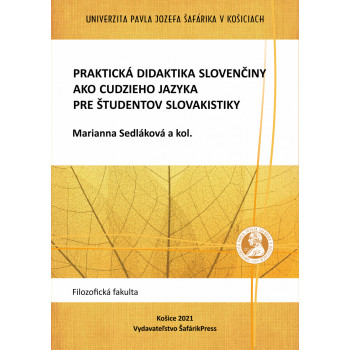
Praktická didaktika slovenčiny ako cudzieho jazyka pre študentov slovakistiky

Praktická didaktika slovenčiny ako cudzieho...

E-book

E-book

Marianna Sedláková a kol.

The textbook is intended for students of Slovak studies to study the subject of didactics of Slovak as a foreign language.

Its core consists of relevant knowledge gained from the didactics of Slovak as a foreign language, with references to other professional literature. The textbook also includes practical guides for teaching specific language phenomena in schools with Hungarian as the language of instruction or in schools where students predominantly have a mother tongue other than Slovak, such as Romani. Essentially, it involves transforming knowledge acquired and verified in teaching adult foreigners, mainly at universities, into a didactic context for the second level of elementary school and high school, with appropriate emphasis on teaching Slovak as a foreign language at the first level of elementary school as the starting point for the educational process.

The textbook builds on the findings of real research on the state of teaching Slovak as a foreign language in elementary and secondary schools in eastern Slovakia, conducted in projects (EXPERT and DiSaC) implemented at UPJŠ in Košice from 2012 to 2015.

Download the e-book for free(pdf)

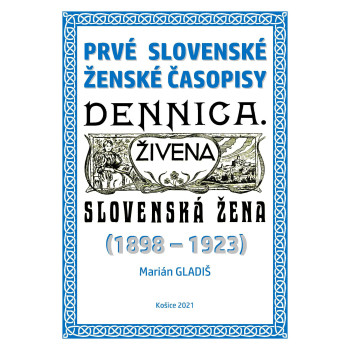
Prvé slovenské ženské časopisy: Dennica, Živena, Slovenská žena (1898 – 1923)

Prvé slovenské ženské časopisy: Dennica,...

E-book

E-book

Marián Gladiš

The monograph entitled The first Slovak women’s magazines: Dennica, Živena, Slovenská žena (1898–1923) provides a general view of the initial stage of the formation of women’s magazine production in Slovakia, defined by a period of 25 years at the turn of the 19th and 20th centuries between 1898 and 1923, in the context of the historical and social development, to which the Slovak journalistic milieu inevitably responded.

The publication is a result of detailed material research of Slovak historical periodicals, implemented mainly from the perspective of the mediological methods and standards of research work.

Download the e-book for free  (pdf)

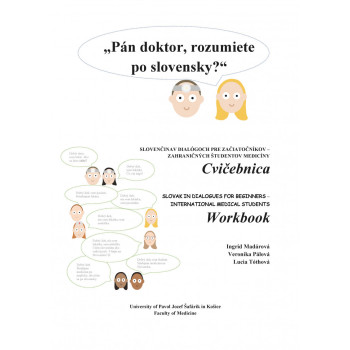
„Pán doktor, rozumiete po slovensky?“

„Pán doktor, rozumiete po slovensky?“

E-book

SLOVAK IN DIALOGUES FOR BEGINNERS – INTERNATIONAL MEDICAL STUDENTS - Workbook

E-book

Ingrid MadárováVeronika PálováLucia Tóthová

Audio attachments - format RAR

The audio-exercise workbook “Pán doktor, rozumiete po slovensky?”is a follow-up to the textbook “Pán doktor, hovoríte po slovensky?” (Madárová et al.)and is intended for international students of Slovak as a foreign language in the medical environment.

This workbook provides the students with an opportunity to practise and enhance mostly their listening skills and pronunciation through various short dialogues between doctors and patients in the Slovak language. Dialogues contain the vocabulary used in the textbook Pán doktorhovoríte po slovensky?.  Students are encouraged to build their confidence in speaking Slovak by practising these dialogues in the new workbook.

The audio-exercise workbook is comprised of 16 units. Each unit offers short dialogues and recordings

A number of dialogues enable its wide use for self-studying while the most frequent phrases related primarily to body parts, signs and symptoms of illnesses, diseases or various medical conditions are practised in different contexts in a variety of exercises.

Original illustrations enable students to understand dialogues more easily and the correct answers of the exercises and the scripts of the recordings can be found in the Answer key at the end of the workbook.

Download the e-book for free (pdf)

Doktorandské miscelaneá 7

Doktorandské miscelaneá 7

E-book

E-book

Lukáš Šutor

The seventh volume of Doctoral Miscellanea was created in this year's specific research and educational situation, which predetermined its character as a non-conference collection.

The previous two editions continued the tradition of domestic scientific events (initially seminars, later conferences) at the Autumn School of Doctoral Students of the Faculty of Arts at UPJŠ in Košice, thereby creating an opportunity to verify more comprehensive scientific conclusions before a diverse audience, not only of experienced educators but also of researchers from their own generation. This phase was narrowed down to communication between the supervisor/reviewer and the doctoral student during the publication's creation. However, this did not automatically mean a less intense dialogue. Many contributions underwent interesting changes and variations.

The resulting studies reflect not only the degree of development of dissertation projects but often also the interest of young scientists in specific issues that have the potential for independent research. After all, they chose our domestic collection for testing their ideas.

Download e-book for free (pdf)

Slovenčina pre prekladateľov a tlmočníkov

Slovenčina pre prekladateľov a tlmočníkov

E-book

E-book

Renáta Gregová

This textbook is designated for the students of translation and interpreting study programmes. The increase of linguistic competence in foreign language, but also in mother tongue is an inevitable part of the preparation of translators and interpreters. The low linguistic competence is often one of the reasons of the unsatisfactory quality of translation. The main aim of this book is to provide the material for the consolidation of linguistic terminology and for the improvement of oral and written utterances in the Slovak language.

Consequently, the textbook encompasses the theoretical and the practical part. The theoretical part summarizes the basic knowledge of language levels. In the practical part, there is the brief description of the selected orthoepic, morphological, syntactic, lexical and stylistic norms of the standard Slovak with the reference to the relevant literature offering deeper analysis of the given problem. Then practical exercises verifying the mastering of linguistic norms follow. At the end of the book, there is the little Slovak-English dictionary of the selected linguistic terms that may help students in their study of the English linguistics.

Download e-book for free (pdf)

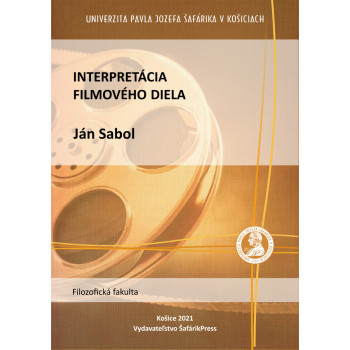
Interpretácia filmového diela

Interpretácia filmového diela

E-book

E-book

Ján Sabol

Literary, but especially film production has entered new, so to speak culturally anthropological contexts over the past period. As the technological base of this new art evolved, its position and character changed in the socio-cultural context of human existence and society.

Film and the media world in a broader context are no longer just the domain of art or media disciplines but are entering a wider framework of socio-cultural-anthropological scientific disciplines. Increasingly, people are confronted with a new phenomenon of virtual worlds, virtual dimensions that influence real reality through their actions and thoughts.

Download e-book for free (pdf)

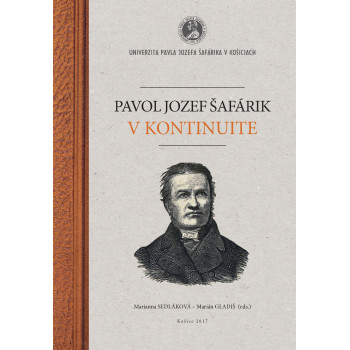
Pavol Jozef Šafárik v kontinuite

Pavol Jozef Šafárik v kontinuite

E-book

E-book

Marianna SedlákováMarián Gladiš (eds.)

The content of the book publication Pavol Jozef Šafárik in Continuity consists of contributions from two events organized by the Department of Slovak Studies, Slavic Philologies, and Communication at the Faculty of Arts of Pavol Jozef Šafárik University in Košice during its short existence.

The first event was a scientific seminar held on the occasion of the 150th anniversary of the death of P. J. Šafárik, titled Pavol Jozef Šafárik – Scientist and Artist, which took place on January 27–28, 2012, in Košice and Kobeliarovo. The second event was an internal scientific seminar on the occasion of the 220th anniversary of Šafárik’s birth, held on December 15, 2015, under the title In the Quiet Home Circle. Symbolically—beginning with death and ending with birth (thus indicating the living continuity of Šafárik’s research legacy)—we aim to continue the study of Pavol Jozef Šafárik’s scientific work and increasingly involve the youngest generation of researchers (represented by doctoral students of the department in the field of literary studies). This is despite the fact that the literature on the life and work of this scholar and poet, who stood at the birth of Slavic studies, is very rich, and most of his works have already been scientifically analyzed. However, it appears that even seemingly outdated views of Šafárik still deserve scientific attention in the new context of humanities and natural sciences, as can be read in the contributions published in this volume.

Through the continuous publication of the Collected Works of Pavol Jozef Šafárik, both mentioned seminars, and the publication of this volume, the Faculty of Arts of Pavol Jozef Šafárik University in Košice has continued the activities of the Prešov Faculty of Arts from the time before its separation from the union of faculties of Pavol Jozef Šafárik University in Košice in 1997. The selection and arrangement of contributions in the volume symbolize the "passing of the baton" in research and publishing activities related to Pavol Jozef Šafárik—a scientific personality of global stature, who in 1959 gave his name to our university.

Compiled by the editors.

Download the e-book for free  (pdf)

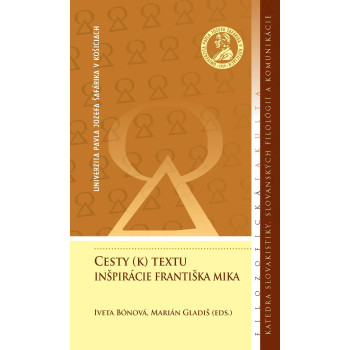
Cesty (k) textu. Inšpirácie Františka Mika

Cesty (k) textu. Inšpirácie Františka Mika

E-book

E-book

Iveta Bónová - Marián Gladiš (eds.)

About the personality of university professor František Miko, DrSc., much has rightly been written, especially after 1989. Indeed, anyone involved in language and literature, at least within the geographical scope of the West Slavic region, is familiar with his work, particularly his brilliant expressive conception of style.

Our ambition in the introduction of this presented collection is not to substitute a dictionary of linguists, nor to provide a comprehensive view of his life and professional career. Rather, it is to remind ourselves of an exceptional individual—a scientist whose attitude, contributions, and results have influenced and continue to influence not only entire generations of researchers but also scientific thinking as a whole.

In the presented collection, we supplement the characterization contained in the inventively and convincingly formulated title of the obituary The Quiet Revolutionary of Our Science, František Miko, with a set of thematically diverse contributions (from the fields of style, sound, translation studies, phraseology, didactics...) dedicated to this significant figure of Slovak science on the occasion of what would have been his ninety-fifth birthday.

Download the e-book for free

This website uses cookies to ensure you get the best experience on our website