 English
 Slovenčina


Philosophy & History of Philosophy (e-books)
There are 14 products.
Active filters


Leibniz a Heidegger – veta o (dostatočnom) dôvode
E-book
E-book
Philosophy is interwoven throughout its history with several principles that bring light and order to this kind of thinking, whether it is a systematic or a non-systematic form of philosophizing.
Each of the principles represents in its own way the origin (ἀρχή) of all deductive reasoning, but not all philosophical statements and conceptions are obliged to proceed in the same way, for not all philosophical statements and conceptions are calculus. Actually, such a form of rationalist philosophizing is really a minority in the history of philosophy. But in spite of its minority presence, it will always attract attention to some extent, whether by becoming a pillar of thought itself and finding a permanent place in its foundations, or by becoming an indispensable mainstay of philosophical reasoning. In fact, there are not many principles in the history of philosophical thought.
The state of affairs is primarily due to the heterogeneous and in many cases irrationalist nature of philosophical thinking.

Patočka o vzniku matematickej prírodovedy
E-book
E-book
The work presented in the following text is an attempt to analyze Patočka's perspective on the emergence and essence of mathematical natural science in the 17th century. During this period, Patočka's attention was particularly drawn to Descartes' philosophy and Cartesianism, as well as the philosophies of Galileo, Bacon, and Leibniz.
Patočka himself devoted continuous and exceptional attention to these questions, as evidenced by several monographic works and numerous articles and studies he wrote on the subject.
Patočkova filozofia dejín
E-book
E-book
The aim of the presented monograph is primarily to introduce Patočka's concept of the philosophy of history as comprehensively as possible, although I am aware that this is by no means an easy task. This difficulty arises not only because, as already mentioned, there is currently no extensive and exhaustive work on this topic.
While there is a relatively large number of studies devoted to Patočka's concept of the philosophy of history, none of them, however, examine this concept from a comprehensive perspective as a unified whole – most focus on specific partial issues (and there are many) stemming from this concept. This fact, incidentally, serves as clear evidence to me that this is undoubtedly a highly demanding topic.

Patočka, fenomenológia a dejiny filozofie
E-book
E-book
Vladimír Leško - Milovan Ješič - Pavol Tholt
The philosophical work of the most significant Czech philosopher of the 20th century, Jan Patočka (1907–1977), stands out for its unique intellectual originality.
Even at the time of its creation, it significantly transcended the narrow boundaries of the contemporary Czechoslovak spiritual space and uniquely connected our country with the most advanced philosophical teachings of Western thought, in which Husserl's phenomenology and Heidegger's fundamental ontology played a dominant role. Certainly, it would be a great mistake to reduce the decisive position of Patočka's philosophical work merely to the reception and critical-creative elaboration of Husserl's and Heidegger's philosophy.
In this context, we cannot overlook the decisive contribution of Eugen Fink, who introduced Patočka to the intricacies of Husserl's and Heidegger's philosophy. Both thinkers then continued in a lifelong creative philosophical dialogue. However, it is also necessary to mention Patočka's intense interest in the works of Scheler, Ingarden, Landgrebe, as well as Sartre and others.

Kant, fenomenológia a analytická filozofia
E-book
E-book
Vladimír Leško - Milovan Ješič - Eugen Andreanský
The philosophical work of Immanuel Kant, the founder of German classical idealism, is one of those which, by the strength of its theoretical legacy, is permanently inspiring even in contemporary philosophical activities. This is an indisputable fact that cannot be seriously objected to. The philosophical teachings of Edmund Husserl, the founder of phenomenology, his successor Martin Heidegger, as well as several representatives of analytic philosophy, are proof of this fact. The above fact led the authors of this work to the idea of devoting a separate collective monograph to the indicated problem.
Heidegger a grécka filozofia
E-book
E-kniha
Vladimír Leško - Katarína Mayerová (eds.)
The main aim of the present work is to try to capture the decisive mode of Heidegger's philosophical understanding of the central problem of Greek philosophy, the problem of being, in the teachings of Anaximander, Heracleitus, Parmenides, Plato, and Aristotle. The authors of each section present their own understanding of Heidegger and his distinctive philosophical reception of Greek philosophy. In this context, it should be noted that the authors themselves sought their own point of view. With Heidegger's work in general, it is almost impossible to find the same interpretive consonance. This is also true for his reception of the Greek heritage. However, it is all the more professionally provoking for further philosophical investigations.
Hegel v kontextoch Heideggerovej a Patočkovej...
E-book
E-book
Vladimír Leško - Pavol Tholt (eds.)
Proceedings of the Third International Philosophical Conference Hegel in the Contexts of Heidegger's and Patoček's Philosophy, held on 1-2 October 2009.
The Philosophical Proceedings is a presentation of the results of the work of the research teams of the research projects VEGA 1/0650/08 - Heidegger and the History of Philosophy and VEGA 1/4679/07 - Jan Patočka's Asubjective Phenomenology and the History of Philosophy solved at the Department of Philosophy and the History of Philosophy of the Faculty of Philosophy of the University of Applied Sciences in Košice.

Dejiny filozofie ako filozofický problém
E-book
E-book
Vladimír Leško - Pavol Tholt (eds.)
Proceedings of the Fourth International Philosophical Symposium History of Philosophy as a Philosophical Problem, held on 14-15 October 2010
The Philosophical Proceedings is the final presentation of the results of the work of the research teams of the research projects VEGA 1/0650/08 - Heidegger and the History of Philosophy and VEGA 1/4679/07 - Jan Patočka's Asubjective Phenomenology and the History of Philosophy solved at the Department of Philosophy and the History of Philosophy of the Faculty of Philosophy of the University of Applied Sciences in Košice.
Gadamer a grécka filozofia
E-book
E-book
Attempting to confront Gadamer's teachings not only with the giants of Greek philosophy but also with Hegel and Heidegger is no easy task. However, Gadamer's entire historical-philosophical work is most prominently associated with these ancient thinkers and the two geniuses of German philosophical thought. Therefore, there is no avoiding it. Without this confrontation, all my efforts would be, in a certain sense, futile. Whether and how I succeed is another question. Every reader will surely form their own judgment.

Možné svety z pohľadu logickej sémantiky a...
E-book
E-book
The presented monograph aims to critically map the understanding of the concept of possible worlds.
The first chapter describes the formation of the semantics of possible worlds, along with indicating some problems it brings, which were incisively revealed primarily by W. V. O. Quine. In the next two chapters, the work focuses on more modern views on the nature of possible worlds, with the main attention given to the dichotomy between the possibilist and actualist approach to the question of modalities, alongside which it is necessary to assess other distinctions (essentialism - anti-essentialism, realism - reductionism (or ersatzism or fictionalism), naturalism - non-naturalism, etc.). Increased attention in the work is specifically devoted to the possibilism of D. Lewis and the actualist concepts of S. Kripke, A. Plantinga, R. M. Adams, N. Rescher, D. Armstrong, and J. Hintikka.
An unconventional approach to the issue of possible worlds is captured in the fourth chapter. It is primarily dedicated to the significant concept of Jaakko Hintikka, which works with the notion of epistemic possible worlds and documents the inclination towards the modification and relativization of modal discourse. The conclusion provides an evaluation of the discussion that touches on the main problems associated with considerations of possible worlds.
In the presented monograph, some representative concepts of possible worlds, or possible individuals, are clarified, and the overall process is indicated from assessing possible worlds as ideal logical constructs through their relativization by separate domains of individuals for individual worlds and further through the relationship of attainability to financial, impossible, and non-standard possible worlds.

THE FUNCTION OF METAPHOR IN MEDIEVAL NEOPLATONISM
E-book
E-book
Mária Mičaninová - Ivica Hajdučeková (eds.)
In the framework of the project VEGA of the Ministry of Education, Science, Research and Sport of the Slovak Republic 1/0330/12 The Function of Metaphor in the Philosophy of Shlomo ben Yehuda ibn Gabirol and Shihab al-Din Yahya al-Suhrawardi, project leader Assoc. Prof. Mária Mičaninová, CSc., under the patronage of the rector of Pavol Jozef Šafárik University in Košice, The Slovak Republic, Prof. MUDr. Ladislav Mirossay, DrSc., and of The Department of Philosophy and History of Philosophy of the Faculty of Arts of the same University, took place on 4th – 5th October 2013 an International conference on The Function of Metaphor in Medieval Neoplatonism. Two days´conference was opened by Dean of the Faculty of Arts of P. J. Šafárik University, Prof. PhDr. Ján Gbúr, CSc.,in the presence of Prof. PhDr. Vladimír Leško, CSc., Head of The Department of Philosophy and History of Philosophy, and of foreign guests and students of the University.

Úvod do dejín stredovekej židovskej filozofie
E-book
E-book
Scholars whose works constitute medieval philosophy were active as theologians, jurists, physicians, and sometimes even poets. Among them, there is hardly anyone who could be described exclusively as a philosopher.
For theologians and (religious) jurists, the primary source of their philosophical reflection was the Bible or the Qur’an. The second source was the philosophical heritage of the preceding antiquity, in which the figure of Aristotle and his commentators dominated. The Peripatetic legacy was complemented by followers of Plato in the long line of so-called Neoplatonic philosophy (e.g., Plotinus, Iamblichus, and Proclus), which in its beginnings developed within the environment of Hellenistic schools.
It is therefore not surprising that the main philosophical problem for medieval scholars was the relationship between theology and philosophy, or faith and reason, and, consequently, the relationship between theology and metaphysics. In the context of Christian thought, this was already discussed in the 2nd century, when some Church Fathers questioned the value of secular learning for those to whom the truth had been revealed by God.
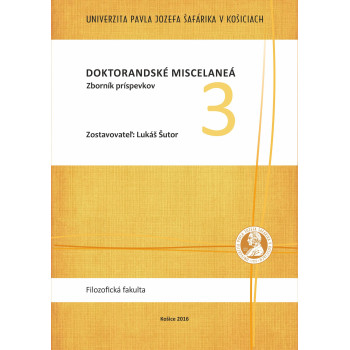
Doktorandské Miscelaneá 3
E-book
E-book
Lukáš Šutor (ed.)
Contributions in the field of psychology address current issues such as normative beliefs and attitudes regarding alcohol consumption, the characteristics of loneliness, questions of pupil personality and the perception of teachers’ interaction styles. They also consider hyperexcitability (excessive psychological excitability), research theorems on injustice, and fundamental concepts and their theoretical connections in the field of self-regulation research within the context of executive functions.
In philosophy, the authors focus on selected aspects of works belonging to major currents of world philosophy (Heidegger, Wittgenstein, Plotinus, Descartes, Patočka).
In literary studies (Slovak studies), the topics include modeling the theme of death in prose texts, the depiction of technological progress in space science fiction films, and the translation work of K. Strmeň, Návštevy (Anthology of World Lyric Poetry).
In the field of social work, the authors present contributions on current trends in preventing burnout syndrome in helping professions, the use of logotherapy in foster care, certain factors enabling the emergence, development, and spread of socially pathological phenomena (“cyberbullying”), religiosity and the value of human life, and an empirical analysis of the competencies of social workers in institutional care for people with intellectual disabilities.
The political science contribution analyzes selected institutions and documents within the European system of human rights protection, while the British and American studies paper examines the relationship between metaphor and metonymy in the interpretation of the meaning of new English compounds.