Filter By

Year of publication:

Year of publication:

Publication language:

Publication language:

Active filters

  • Year of publication:: 2014
  • Year of publication:: 2016
  • Year of publication:: 2020
  • Year of publication:: 2025
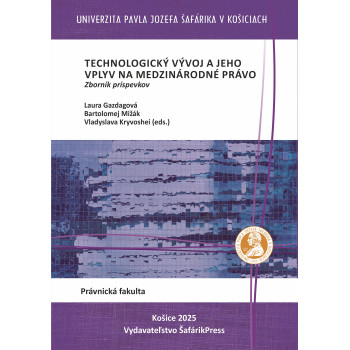
Technologický vývoj a jeho vplyv na medzinárodné právo

Technologický vývoj a jeho vplyv na...

E-book

E-publication
Laura Gazdagová-Bartolomej Mižák-Vladyslava Kryvoshei
Technological development is increasingly reshaping the environment in which international law operates. Rapid digitalization, global interconnectedness, and the emergence of new technologies raise questions that traditional legal norms are not always prepared to address. New forms of cross-border interactions, security challenges, and ethical dilemmas influence the functioning of states, international organizations, and other actors. Against this backdrop, discussions are evolving on how international law can maintain its relevance in an era of rapid innovation and how it may adapt to a dynamic technological landscape.
Download the e-book for free

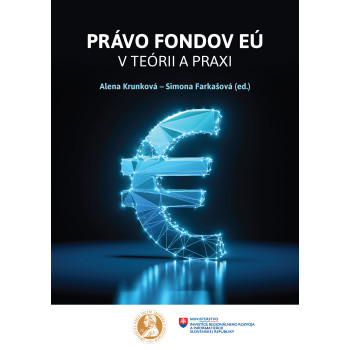
Právo fondov EÚ v teórii a praxi

Právo fondov EÚ v teórii a praxi

E-book

E-book

Alena Krunková - Simona Farkašová

Proceedings of the International Scientific Conference on EU Funds Law in Theory and Practice held on October 3, 2019, in Košice.

The conference was attended by representatives from the academic sphere, educators from the Faculty of Law at UPJŠ in Košice, who created the subject and continue to participate in its teaching. The participants included professionals from practice, such as those from the Office of the Deputy Prime Minister of the Slovak Republic for Investments and Informatization, the Office for Public Procurement of the Slovak Republic, the Supreme Audit Office of the Slovak Republic, and the Ministry of Labor, Social Affairs, and Family of the Slovak Republic. Valuable information was also shared at the conference by representatives from the Ministry of Regional Development of the Czech Republic, OECD representatives, and representatives from the European Commission's Representation in Slovakia. The presented contributions reflected current issues in a highly professional manner, identified problematic areas, and outlined suitable solutions for contentious issues.

From the individual presentations of the conference participants, it was possible to compile a work that, while not extensive in scope, is very remarkable in value. It connects theory and practice in an outstanding manner and thus expands knowledge in the still complex issue of the legal regulation of European Union funds.

Download the e-book for free (pdf)

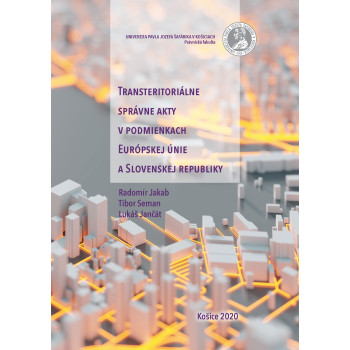
Transteritoriálne správne akty v podmienkach Európskej únie a Slovenskej republiky

Transteritoriálne správne akty v podmienkach...

E-book

E-book

Radomír Jakab - Tibor Seman - Lukáš Jančát

The concept of a transterritorial administrative act is relatively new in administrative law, especially in the conditions of the Slovak Republic. It has practical applicability to the application of European Union law (including international law). Its essence lies in the fact that the effects of such an administrative act issued within one Member State exceed the territory of that Member State, have effects in other Member States, in all Member States of the European Union without being subject to the recognition process.

The purpose of the monograph is to present outputs of the scientific examination of this type of administrative acts, the definition of its characteristics and its effects, the examination of the possibilities of procedural defense against its effects by the State concerned, and possibly the possibility of unifying the action of the Member States of the European Union in case of procedural defense against the effects of transterritorial administrative acts. The monograph also contains analysis of certain types of transterrritorial administrative acts that are commonly used in the conditions of the European union and Slovak republic; they are also categorized under specific criteria.,

Download the e-book for free  (pdf)

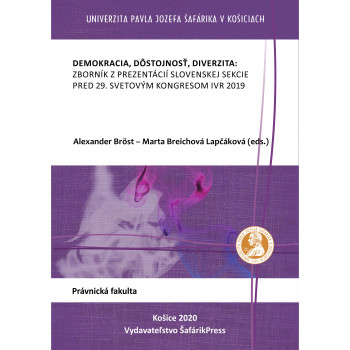
Demokracia, dôstojnosť, diverzita: Zborník z prezentácií slovenskej sekcie pred 29. svetovým kongresom IVR 2019

Demokracia, dôstojnosť, diverzita: Zborník z...

E-book

E-book

Alexander Bröstl - Marta Breichová Lapčáková (eds.)

Under the auspices of the Institute of Legal Theory of Gustav Radbruch and the Slovak Section of the International Association for Philosophy of Law and Social Philosophy (IVR), a 3D flash conference was held on May 16, 2019, at the Faculty of Law of UPJŠ in Košice. This event was primarily dedicated to the upcoming 29th World Congress of IVR in Lucerne, Switzerland. In line with the main theme of the congress, the conference focused on "Dignity, Democracy, Diversity." At the time of the conference, it was clear that the number of participants at the world congress would significantly exceed 1,000, with discussions taking place in 151 special workshops and 28 working groups.

During the congress, a round table was also announced featuring Professor Brian Tamanaha, recipient of the IVR award for best book for "Realistic Theory of Law" (Cambridge 2017), a meeting regarding the IVR Encyclopedia, a panel on academic freedom issues, and a gathering of chairs from national sections of IVR.

Download the e-book for free (pdf)

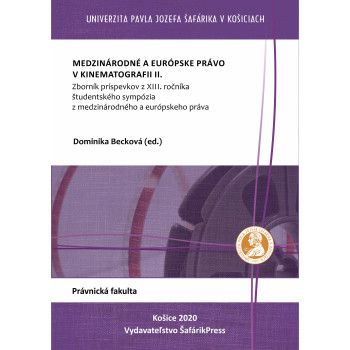
Medzinárodné a európske právo v kinematografii II.

Medzinárodné a európske právo v kinematografii II.

E-book

E-book

Dominika Becková (ed.)

Proceedings of Contributions from the XIII. Year of the Student Symposium on International and European Law held on March 6, 2020, at the Faculty of Law of UPJŠ in Košice

The Student Symposium on International and European Law has its traditional place in the calendar of events at the Faculty of Law of Pavol Jozef Šafárik University in Košice. In the academic year 2019/2020, the Institute of International Law and European Law decided to continue this tradition and offer students an opportunity to present their professional opinions on selected topics and problematic issues of international and European law.

The XIII. edition of the student symposium continued from its previous year and once again focused students' attention on the institutions of international and European law depicted in films. The films processed by the participants of the symposium offer a wide range of institutions of international and European law.

In their contributions, participants addressed issues related to diplomatic law, terrorism, armed conflicts, the use of robots, environmental protection, and questions regarding the legal regime of outer space.

Download the e-book for free  (pdf)

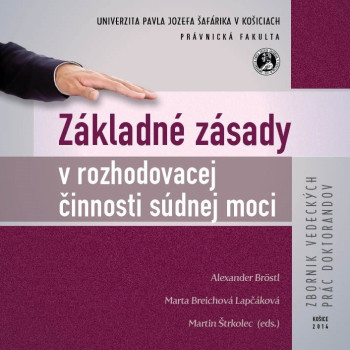
Základné zásady v rozhodovacej činnosti súdnej moci

Základné zásady v rozhodovacej činnosti súdnej...

E-book

E-book

Alexander Bröstl - Marta Breichová Lapčáková - Martin Štrkolec (eds.)

Collection of scientific papers by doctoral students.

Thematically, the contributions are diverse: they feature fundamental principles in public law (basic principles of criminal proceedings, the principle of contradiction, basic principles of constitutional court proceedings, basic principles in private law and procedural law (superficies solo cedit), the principle of civil court proceedings in deciding labor disputes, equality of participants and the duty to instruct, objection of bias in light of the right to an impartial court, the principle of speed and the principle of economy in the decision-making activities of general courts, basic principles in legal theory and international law (general legal principles recognized by civilized nations), coexistence of the principle of equality and the principle of non-discrimination in the legal order of the European Union, argumentation through the principle of rule of law in the decision-making activities of courts, the impact of fundamental principles on the interpretation of legal norms.

It is important that the authors, i.e., doctoral students from law faculties in the Czech Republic and the Slovak Republic, almost unanimously examine these principles in the process of application (interpretation) of law, from the perspective of how legal (primarily judicial) practice deals with them. This should be fundamentally welcomed and appreciated.

Download the e-book for free (pdf)

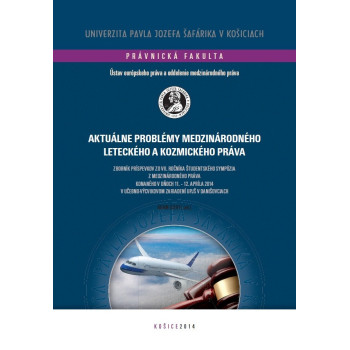
Aktuálne problémy medzinárodného leteckého a kozmického práva

Aktuálne problémy medzinárodného leteckého a...

E-book

E-book

Adam Giertl (ed.)

Proceedings from the VII. annual student symposium on international law held on April 11-12, 2014 at the UPJŠ training facility in Danišovce

Despite this, flying and space travel are now a common part of human civilization. What is the role of law in this process? This is the question posed by the organizers of the VII. annual student symposium on international law, aiming to evaluate the contribution of international law in the field of aviation and space flights, especially in light of current developments.

The individual topics were tackled by second, third, and higher-year students of the Faculty of Law at UPJŠ in Košice. The result of their work on the assigned topics, which the authors could consult with members of the Institute of European Law and the Department of International Law, is the presented work.

The proceedings are thematically divided into two parts. The first part acquaints the reader with selected topics related to aviation law, and the second part is dedicated to international space law.

With its focus, the proceedings also have a broader impact, as in some aspects it fits into the broader context of research conducted at the Institute of European Law and the Department of International Law, which focuses on examining the influence of regionalism on general international law and vice versa. This issue is also reflected in the topics of the individual contributions.

Download the e-book for free (pdf)

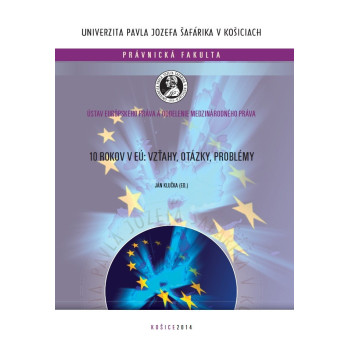
10 rokov v EÚ: Vzťahy, otázky, problémy

10 rokov v EÚ: Vzťahy, otázky, problémy

E-book

E-book

Ján Klučka(ed.)

Collection of Papers from the International Scientific Conference Held on May 29–30, 2014 at the Faculty of Law, Pavol Jozef Šafárik University in Košice.

In the first half of this year, a scientific conference entitled “10 Years in the EU: Relations, Questions, Issues” was held in Košice, and the contributions from this event constitute the content of the present collection bearing the same name.

The aim of the organizers—namely, the Slovak Association of European Law, the Representation of the European Commission in the Slovak Republic, and the Institute of European Law together with the Department of International Law of the Faculty of Law at Pavol Jozef Šafárik University—was not only (even if loosely) to follow up on the previous 2009 conference “Community Law in Slovakia – Five Years ‘After’”, but, after another five years, to continue its main objective: to provide participants from both the academic and non-academic community with a space for further analysis and exchange of views on legal issues related to the membership of the Slovak Republic in the European Union and various current issues of the Union’s legal order.

From this perspective, a shift in the overall focus of the conference contributions in 2009 and 2014 can be observed. While the contributions from the first conference focused primarily on various aspects of the application of Union law in the Slovak legal system and related application problems, especially before courts and other authorities, the basic orientation of the contributions from the second conference is already different. The present collection also confirms that the contributions focus primarily on current issues of the European legal order and on certain aspects of the Union’s external policy, while the relationship of Union law to the Slovak legal system is no longer given primary attention.

Several contributions focus on areas characterized by a certain overlap or “cohabitation” of Union law with public international law, private international law, or, more broadly, international relations.

Download the e-book for free (pdf)

Aktuálne otázky migrácie z pohľadu medzinárodného práva s osobitným zreteľom na Chartu práv Európskej únie

Aktuálne otázky migrácie z pohľadu...

E-book

E-book

Adam Giertl (ed.)

Collection of Papers from the 9th Annual Student Symposium on International and European Law held on April 22, 2016 at the Faculty of Law, Pavol Jozef Šafárik University in Košice

As indicated by the very title of the 9th Annual Student Symposium on International and European Law, “Current Issues of Migration from the Perspective of International Law with Special Regard to the Charter of Fundamental Rights of the European Union,” the participants focused on the highly topical subject of European migration, which they examined from various aspects of both international and Union law (a total of 9 contributions).

In assessing the role of individual actors primarily involved in addressing the problems arising from migration to Europe, particular emphasis was placed on the role of international specialized organizations, which often provide direct assistance to migrants “in the field” through humanitarian or medical aid. However, this is not the only response of the international community, as it is complemented by the activities of the concerned states as well as various non-governmental organizations and volunteers. Regarding the evaluation of the European Union’s activities, the symposium participants agreed that the mass migration wave caught the EU relatively unprepared—institutionally, legislatively, and technically—accompanied by a lack of clarity in adopting a fundamental approach to this reality.

It was also emphasized that these shortcomings occurred despite the fact that developments in the preceding period clearly signaled the possibility of gradual migration to the European Union escalating into a mass phenomenon. According to the participants, additional ex post and sometimes delayed measures adopted in response to the ongoing migration process contributed to an overall increase in political tension within the EU and divided its member states into opposing camps.

Download the e-book for free (pdf)

Európska únia a jej vplyv na organizáciu a fungovanie verejnej správy v Slovenskej republike

Európska únia a jej vplyv na organizáciu a...

E-book

E-book

Alena Krunková (ed.)

Proceedings of the Scientific Conference Held on June 28, 2016 at the Faculty of Law of Pavol Jozef Šafárik University in Košice in connection with the implementation of the project “The European Union and Its Impact on the Organization and Functioning of Public Administration in the Slovak Republic” – approved under number MVZP – SK PRES/2016/134

The Slovak Republic, as a member state of the European Union, is undertaking a historic role associated with the Presidency of the Council of the European Union within the presidency trio. At the beginning of 2016, the Ministry of Foreign and European Affairs of the Slovak Republic announced a call for applications for grants for 2016 in the field of international relations and foreign policy, specifically focused on the Slovak Republic’s Presidency of the Council of the European Union. The Faculty of Law of Pavol Jozef Šafárik University in Košice responded to this call and obtained a project aimed at carrying out research activities through a series of events focused on regional self-government in the Slovak Republic in the context of its role within the European Union. The Faculty has long been engaged with issues of European Union law both in its teaching and in the scientific research activities of its individual faculty members. The project aims to enrich this portfolio with special activities targeting not only professionals, but also students and the general public.

The first activity of the project was a conference entitled “The European Union and Its Impact on the Organization and Functioning of Public Administration in the Slovak Republic – Development So Far, Current State, and Perspectives.” The conference was attended by invited public officials, representatives of academia, and representatives of local government, as one of the main goals of the project is to connect the academic community with the practical sphere and thus involve practitioners in the planned activities within the project.

Download the e-book for free (pdf)

This website uses cookies to ensure you get the best experience on our website