Filter By

Categories

Categories

Year of publication:

Year of publication:

Publication language:

Publication language:

Faculty:

Faculty:

Active filters

  • Year of publication:: 2013
  • Year of publication:: 2014
  • Year of publication:: 2024
  • Year of publication:: 2024
  • Publication language:: Slovak
  • Faculty:: Faculty of Law
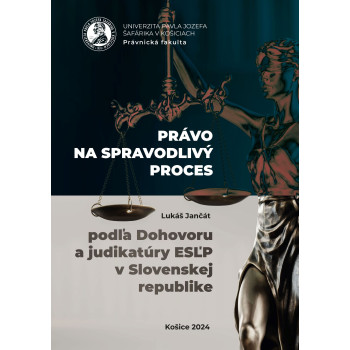
Právo na spravodlivý proces podľa Dohovoru a judikatúry ESĽP v Slovenskej republike

Právo na spravodlivý proces podľa Dohovoru a...

E-book

E-book

Lukáš Jančát

The Convention on the Protection of Human Rights and Fundamental Freedoms and the case-law of the ECtHR represent a decisive legal instrument for the evolution of the right to a fair trial in the member states of the Council of Europe and the European Union, including the Slovak Republic, which affects the minimum level of procedural guarantees for individuals in judicial and administrative proceedings.

The primary purpose of the textbook is to fill the gap consisting in the absence of a comprehensive study text for undergraduate students at Pavol Jozef Šafarik University in Košice, Faculty of Law for the planned subject Right to a fair trial in administrative issues, and doctoral students at this faculty for the subject Protection of fundamental rights and freedoms in criminal matters according to the case-law of the ECtHR.

However, this textbook is also intended as a supplementary study aid for bachelor students in order to deepen their knowledge of the subject Administrative Law II, the result of which is to acquire knowledge about procedural administrative law in the Slovak Republic, as well as the subject of European Administrative Law, the result of which is the acquisition of knowledge about the influence of Council of Europe law on the national administrative law of the Slovak Republic.
Download the e-book for free(pdf)

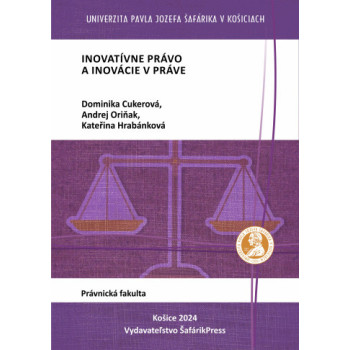
INNOVATIVE LAW & INNOVATIONS IN LAW

INNOVATIVE LAW & INNOVATIONS IN LAW

E-book

E-book

Dominika Cukerová - Andrej Oriňak - Kateřina Hrabánková (eds.)

The proceedings offers contributions from the international scientific conference of doctoral students and young researchers held on 25 April 2024 at the Faculty of Law, UPJŠ in Košice, which was thematically oriented on Innovative Law and Innovations in Law. The authors of the papers confirmed that innovation in law can take many forms. The first part of the papers, which pays attention to how law can respond to innovations, is a manifestation of this. These are the papers by Jana Cihanová, Andrej Oriňák, Denisa Rudžiková and Matej Biroš, who presented the use of deepfake technology, artificial intelligence and software tools in legal practice in the context of their legal regulation. Looking at familiar things differently can also be a source of innovation. In this vein, Dominik Mizerski, Juraj Valentovič, Lucián Török and Kateřina Hrabánková presented interpretive and application innovations in the field of private law. The third part of the papers by Michaela Szittyaiová, Natália Priateľová, Filip Baláži, Elena Lazoríková and Laura Gazdagová offers a preview of the innovations that the public law section is facing today. Finally, the fourth and last group of papers specifically explains innovations against the background of criminal law regulation. These are contributions by Michal Novák, Miroslav Srholec, Vladimír Petrila and Martina Makaturová. The variety of topics covered in this proceedings shows that each area of legal regulation can be characterised by specific innovations and, in this context, by the dynamics with which they permeate legal regulation.

Download the e-book for free (pdf)

Učíme právo zážitkovo

Učíme právo zážitkovo

E-book

E-book

Daniela Lamačková-Renáta Orosová- Beáta Sakalová- Diana Repiščáková

Methodological guide for teachers for classroom lessons and civics Teaching law experientially? Is it even possible? The answers to these questions are provided by a methodological guide that uniquely links experiential learning methods with legal content. This methodological guide is a set of techniques based on the use of interactive and participatory learning methods, focusing on selected human rights and value-oriented topics, which also have the potential to develop other key competences of students, such as their communication skills, their ability to learn and educate independently, their ability to think critically, their ability to work with and analyse texts, their ability to discuss and express their opinions, and their ability to listen to each other. The methodological guide consists of a set of training activities - techniques, while each technique contains a precise description of the procedure for conducting a specific activity, the expected duration of the activity, aids, discussion topics and also a short pedagogical and legal commentary, precisely "tailored" to the specific legal topic. The legal topics are chosen to be generally applicable to both classroom and civics lessons, to raise questions about the functioning of rules and the need to respect them, mutual respect and tolerance, and to encourage reflection on the limits of individual rights and on responsibility in exercising one's rights. The techniques use training methods such as group work, brainstorming, role-playing, dealing with model situations, as well as a simulated court process. The methodological guide is intended for classroom teachers in the implementation of classroom lessons, and also for the purposes of the subject of civics, as well as for students of pedagogy at the Pavol Jozef Šafárik University in Košice.

Download e-book for free (pdf)

Hranice Československej republiky optikou Versaillského mierového systému

Hranice Československej republiky optikou...

E-book

E-book

Dominika Kováčová- Lucia Pištejová- Ivan Vaňa

The present monograph deals with the post-war settlement of relations and peace negotiations related to the settlement of the borders of the newly established Czechoslovak Republic. The work discusses in detail the negotiation processes related to the preparation and signing of the Versailles and Saint-Germain Peace Treaties. Similarly, it then discusses in detail the peripeties related to the drafting of the Treaty of Trianon dealing with the border with Hungary and its subsequent delineation in the field. Last but not least, the thesis captures the settling of Czechoslovakia's international relations with Poland and their common border, with a particular focus on the arbitration settlement on the territory of Orava and Spiš.

Download e-book for free (pdf)

Antické paradigmy a Trianonská zmluva

Antické paradigmy a Trianonská zmluva

E-book

E-book

Ľuboš Dobrovič - Vladimír Vrana

The world of diplomacy, whether ancient or modern, is naturally prone to problems associated with cultural clashes and often serves as an “unarmed battlefield” of cultural concepts. International diplomacy, however, stands on the assumption of war, as misunderstandings and cultural discrepancies lead to confusion. Cultural encounters also provide many opportunities for the choice of misunderstanding: the choice to perceive an act as an insult, even if unintended, or the choice to ignore the most blatant intentional insult, all according to momentary expediency.

The Roman historian Livy recounts an anecdote about the gates of the Temple of Janus, which, when open, signified that Rome was at war. However, the doors of the ancient Temple of Janus were closed only twice from the beginning of the 7th century BC to the end of the 1st century BC. One might ask, how many times and for how long after the signing of the Treaty of Trianon were the metaphorical gates of the European (or global) Temple of Janus closed?

The publication that the reader holds in their hands does not attempt to exhaustively answer all questions of ancient and modern international diplomacy. That is neither possible nor the goal of this scientific monograph. Authors seeking intersections between diplomacy of antiquity, the Middle Ages, and the early 20th century encountered some thought-provoking ideas and controversial debates. Indeed, what other conclusions can the topic of the Treaty of Trianon and the perpetual clash of cultures in the Mediterranean antiquity and medieval Europe bring?

We believe that the topic of ancient and modern diplomacy will inspire the reader and stimulate the professional public to new ideas, reflections, and scholarly activity.

The scientific monograph was prepared as an output of the project of the Agency for the Support of Research and Development No. APVV-19-0419: "100 years of the Treaty of Trianon."

Download the e-book for free (pdf)

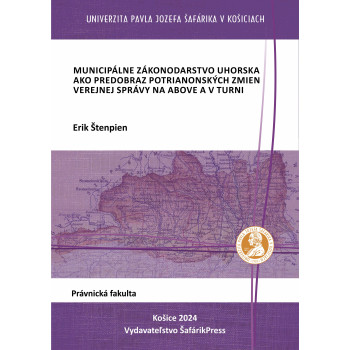
Municipálne zákonodarstvo Uhorska ako predobraz potrianonských zmien verejnej správy na Above a v Turni

Municipálne zákonodarstvo Uhorska ako predobraz...

E-book

E-book

Erik Štenpien

The presented monograph is dedicated to the reforms of local administration in the middle of the 19th century, which led to the introduction of municipalism - the nationalization of local administration. The work is primarily devoted to the analysis of the differences between legal articles 42/1870 and 21/1884, the second of which has so far been considered by Slovak legal historians as an amendment. I will explain the differences in the text of both standards, as well as by pointing out the practice of applying both standards in local practice in Abov and Turňa, the legal article 21/1884 is applicable, it is recoded and after the thresholds of the Czechoslovakia it was received as an obligation of the local sparva in Slovakia and is valid even in the time of Conclusion The Trianon peace treaty.

Download the e-book for free (pdf)

Obchodné a pracovné právo: Na spoločnej vlne

Obchodné a pracovné právo: Na spoločnej vlne

E-book

E-book

Natália Kalinák-Andrej Oriňak

The Department of Commercial Law and Economic Law together with the Department of Labour Law and Social Security Law of the Faculty of Law of UPJŠ in Košice organized the 8th annual student symposium, this time on commercial, labour and private international law, which took place at the Faculty of Law of UPJŠ in Košice on 1 December 2023. The student symposium under the title Commercial and Labour Law on a Common Wave was carried out as part of the research projects VEGA 1/0259/22 and VEGA č. 1/0291/23. The aim of the annual symposia is to create a discussion platform for students under the supervision of mentors from among the members of the department, namely teachers, researchers and PhD students. The theme of this year's symposium brought about discussion of interesting theoretical and practical legal issues thematically focused on the synergy of business law and labour law. The students addressed topical issues related to the status of entrepreneurs, the conduct of companies in labour law relations as well as the duties and responsibilities of employees. The topics of the sharing economy, gender quotas in corporate bodies and unfair bribery were not forgotten. While working on individual topics, students had the opportunity to improve their analytical thinking and argumentation skills, while they could practice writing a legal professional text, which in practice often increases the success of every lawyer. Students had the opportunity to develop their critical thinking and learn how to clearly formulate their own opinions on current legal issues. After the presentation of the papers, not only the team of lecturers and researchers, but also the students themselves engaged in a fruitful discussion, asking a number of original questions. Each student participant was awarded a certificate for their active participation in the symposium. The present proceedings are the outcome of the students' work from this event.

Download e-book for free (pdf)

Medzinárodné právo verejné (Materiály k štúdiu)

Medzinárodné právo verejné (Materiály k štúdiu)

E-book

E-book

Ľudmila Pošiváková - Adam Giertl

The presented selection of public international law documents aims to map international law from both historical and sectoral perspectives. The reader will find several historical documents in this collection, but the focus is primarily on currently valid legal sources.

The selection is guided by the publication Public International Law – General and Special Part by Prof. Ján Klučko, which is reflected in the division into general and special parts. The general part addresses the historical development of international law but primarily focuses on the protection of individuals and responsibility relationships in international law. The special part then examines the international regulation of various institutions of international law.

We acknowledge that this selection offers room for expansion, but we believe it meets basic requirements and fills a certain gap in the study of international law.

We trust that this collection of public international law materials will be beneficial for students, and not only for them, in the study of public international law and will contribute to raising awareness in this field.

Download the e-book for free (pdf)

Oslava právneho štátu (Právny štát z pohľadu teórie štátu a práva a medzinárodného práva)

Oslava právneho štátu (Právny štát z pohľadu...

E-book

E-book

Ľudmila Pošiváková Zuzana Antošová - Milan Kočan (eds.)

Proceedings from the Student Debate held on April 24, 2013, at the Faculty of Law of Pavol Jozef Šafárik University in Košice.

In the current period, the rule of law is widely debated both at the academic and political levels. This debate is not only related to the effort to establish the Rule of Law in states that have transitioned from socialist to democratic systems but also in states experiencing various unrests, whether political or religious.

However, it is not just a debate about certain characteristics of the Rule of Law that are missing in domestic law or at the level of international law, but also a debate about the very definition and meaning of the Rule of Law. The rule of law can be likened to an ideal that almost every state strives to achieve. Even in the case of the establishment of the independent Slovak Republic, the framers decided to include among the introductory provisions, which should form the core of the constitution, that the Slovak Republic is a state governed by the rule of law.

However, to achieve the ideal of the rule of law, it is necessary not only to declare it but also to adopt measures essential for an independent judiciary, democracy, the effective enforcement of human rights, the separation of powers, and many other elements that characterize a state governed by the rule of law.

Download the e-book for free (pdf)

Informačná spoločnosť a medzinárodné právo

Informačná spoločnosť a medzinárodné právo

E-book

E-book

Adam Giertl - Ľubica Gregová Širicová (eds.)

Proceedings from the 5th Student Symposium held on April 21-22, 2013

The French delegate to the Commission on Human Rights, while discussing the inclusion of the term "media" in the article on freedom of expression in the draft of the International Covenant on Civil and Political Rights, wisely urged other members of the commission to be forward-looking regarding the information media of the future.

The discussion took place in 1950, when delegates could not yet foresee the impact of the internet on social relations. Given that it is now clear that information technologies significantly influence law, including international law, the organizers of the student symposium decided to dedicate its sixth edition to the theme "Information Society and International Law."

Students of the Faculty of Law, after registering for the symposium, first focused on preparing their contributions, with each participant having access to a consultant if needed. This year, the list of consultants, in addition to members of the Institute of European Law and the Department of International Law, was expanded to include an expert in intellectual property law, Mgr. Martin Husovec, a graduate of our Faculty of Law and currently an IMPRS-CI doctoral student at the Max Planck Institute for Intellectual Property and Competition Law. We also take this opportunity to thank him for dedicating his time to the students and providing them with valuable advice in preparing their contributions. After the preparatory phase, the symposium itself took place, with the aim of presenting the prepared contributions and discussing them.

The presented contributions reflected a wide range of intersections between international law and the information society.

Download the e-book for free (pdf)

Regionalizmus: Stav, východiská, perspektívy

Regionalizmus: Stav, východiská, perspektívy

E-book

E-book

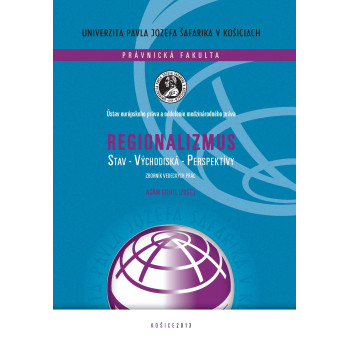
Adam Giertl (ed.)

Proceedings of Scientific Works

International law does not represent a monolithic entity of uniform legal norms. It is a legal system that is fundamentally created by the consensus of states. It reflects the collective will of multiple entities regarding what should be binding and enforceable as law among them.

From this understanding arises the fact that the needs for legal regulation will differ in various parts of the world. The consequence of this situation is the formation of regional groupings where, to some extent, specific legal rules apply. As Professor Klučka points out in his study published in this proceedings, regionalization can occur both on a contractual basis and on an institutional basis. Regionalism in law thus raises many interesting questions that legal science addresses.

This proceedings of scientific papers also aims to contribute to the knowledge in this field.

Download the e-book for free (pdf)

Tvorba a realizácia pracovného práva so zreteľom na regionálne aspekty trhu práce

Tvorba a realizácia pracovného práva so...

E-book

E-book

Milena Barinková (ed.)

The researchers of the grant task ‘Creation and implementation of labour law with regard to regional aspects of the labour market’ deal in their work with the analysis of employers' attempts for legislative changes in the level of social rights of employees justified by regional differences, the analysis of possible impacts in their implementation, as well as the assessment of their compliance with the protective function of Slovak labour law and the value character of fundamental human rights inherent in the European and legal culture.

Download the e-book for free (pdf)

Kúpna zmluva – história a súčasnosť II.

Kúpna zmluva – história a súčasnosť II.

E-book

E-book

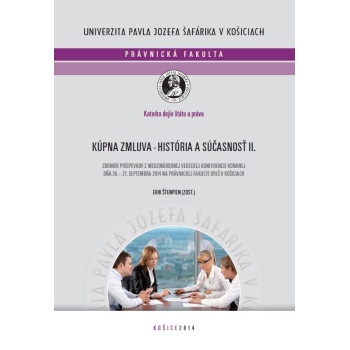
Erik Štenpien (ed.)

Proceedings from the international scientific conference held on September 26-27, 2014 at the Faculty of Law, UPJŠ in Košice

Nowadays, in the modern 21st century, we have a much more complex society than the ancient one. It requires legal regulation of various types of purchase contracts, where although the basic feature remains, it needs to be specified further, and the simple sentence 'I sell, you buy' needs to be supplemented with conditions 'how, where, when, under what conditions?' This is the task of modern civil law. The current recodification of civil law has already taken place in some European countries, and it is currently underway in our country. Therefore, it is important to meet at conferences with colleagues from these countries and exchange knowledge, to discuss their experiences, avoid the bad, and accept or adjust the good according to our conditions.

This proceedings is the output publication from the conference held on September 26-27, 2014 in Košice. It was the second conference with the participation of the most prominent legal Romanists, legal historians, and civilists from home and abroad. The proceedings is the result of unique cooperation among experts from various fields of legal science. I believe that the published outputs will help to understand the institute of purchase contracts from all its aspects and will become an inspiration for both experts and laypeople.

Download the e-book for free (pdf)

Základné zásady v rozhodovacej činnosti súdnej moci

Základné zásady v rozhodovacej činnosti súdnej...

E-book

E-book

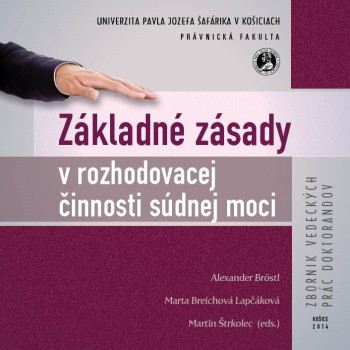
Alexander Bröstl - Marta Breichová Lapčáková - Martin Štrkolec (eds.)

Collection of scientific papers by doctoral students.

Thematically, the contributions are diverse: they feature fundamental principles in public law (basic principles of criminal proceedings, the principle of contradiction, basic principles of constitutional court proceedings, basic principles in private law and procedural law (superficies solo cedit), the principle of civil court proceedings in deciding labor disputes, equality of participants and the duty to instruct, objection of bias in light of the right to an impartial court, the principle of speed and the principle of economy in the decision-making activities of general courts, basic principles in legal theory and international law (general legal principles recognized by civilized nations), coexistence of the principle of equality and the principle of non-discrimination in the legal order of the European Union, argumentation through the principle of rule of law in the decision-making activities of courts, the impact of fundamental principles on the interpretation of legal norms.

It is important that the authors, i.e., doctoral students from law faculties in the Czech Republic and the Slovak Republic, almost unanimously examine these principles in the process of application (interpretation) of law, from the perspective of how legal (primarily judicial) practice deals with them. This should be fundamentally welcomed and appreciated.

Download the e-book for free (pdf)

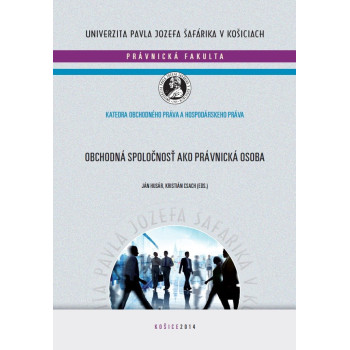
Obchodná spoločnosť ako právnická osoba

Obchodná spoločnosť ako právnická osoba

E-book

E-book

Ján Husár - Kristián Csach (eds.)

The collection contains contributions presented at the international conference held on April 1st - 3rd 2014 in Smolenice, organized by Pavol Jozef Šafárik University in Košice in cooperation with the Institute of State and Law of the Slovak Academy of Sciences and the Institute of State and Law of the Czech Academy of Sciences. Authors are high-profile Slovak and Czech scholars in the field of private law and company law, as well as representatives of new generation of young researchers. Contributions focus on contemporary issues in the field of company law, in particular theoretical basis of corporations, groups of companies, doctrine of abuse of rights, reflective loss and new tendencies in corporate law in foreign legal orders. The first part of the contributions presented at the conference have been already published in the special issue of the theoretical magazine Právny Obzor n. 4/2014. 

Download the e-book for free (pdf)

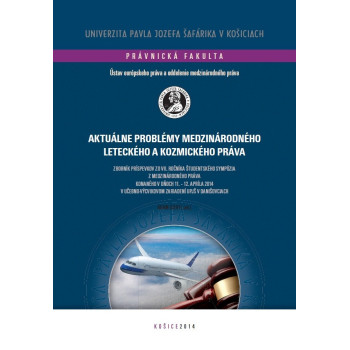
Aktuálne problémy medzinárodného leteckého a kozmického práva

Aktuálne problémy medzinárodného leteckého a...

E-book

E-book

Adam Giertl (ed.)

Proceedings from the VII. annual student symposium on international law held on April 11-12, 2014 at the UPJŠ training facility in Danišovce

Despite this, flying and space travel are now a common part of human civilization. What is the role of law in this process? This is the question posed by the organizers of the VII. annual student symposium on international law, aiming to evaluate the contribution of international law in the field of aviation and space flights, especially in light of current developments.

The individual topics were tackled by second, third, and higher-year students of the Faculty of Law at UPJŠ in Košice. The result of their work on the assigned topics, which the authors could consult with members of the Institute of European Law and the Department of International Law, is the presented work.

The proceedings are thematically divided into two parts. The first part acquaints the reader with selected topics related to aviation law, and the second part is dedicated to international space law.

With its focus, the proceedings also have a broader impact, as in some aspects it fits into the broader context of research conducted at the Institute of European Law and the Department of International Law, which focuses on examining the influence of regionalism on general international law and vice versa. This issue is also reflected in the topics of the individual contributions.

Download the e-book for free (pdf)

This website uses cookies to ensure you get the best experience on our website