Filter By

Categories

Categories

Year of publication:

Year of publication:

Publication language:

Publication language:

Faculty:

Faculty:

Method of publication:

Method of publication:

Active filters

  • Year of publication:: 2015
  • Year of publication:: 2019
  • Year of publication:: 2019
  • Year of publication:: 2019
  • Year of publication:: 2019
  • Year of publication:: 2019
  • Year of publication:: 2019
  • Year of publication:: 2019
  • Year of publication:: 2019
  • Year of publication:: 2019
  • Year of publication:: 2019
  • Year of publication:: 2019
  • Year of publication:: 2019
  • Year of publication:: 2019
  • Faculty:: Faculty of Arts
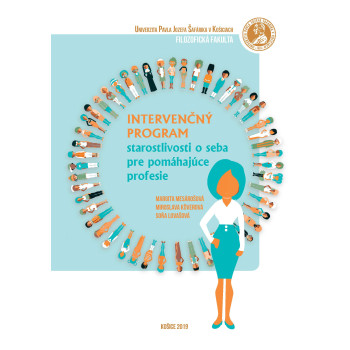
Intervenčný program starostlivosti o seba pre pomáhajúce profesie

Intervenčný program starostlivosti o seba pre...

E-book

E-book

Margita MesárošováMiroslava KöverováSoňa Lovašová

Intervention Program for Supporting Self-Care in Helping Professions: "How Do I Take Care of Myself?" The intervention program "How Do I Take Care of Myself?" was developed as part of the research project APVV14-0921, "Self-Care as a Factor in Coping with the Negative Consequences of Engaging in Helping Professions." Its uniqueness lies in being created based on specific research outputs from the program's authors and project.

In the first chapter, the authors offer insights into the preparation of the intervention program, justifying its theoretical foundations, methods, and specifics of the program participants. They also provide an overview of research on the effectiveness of various intervention programs aimed at reducing the negative consequences of helping and enhancing self-care and other positive effects of engaging in helping professions. Subsequent chapters focus on a detailed analysis and evaluation of the effectiveness of the intervention program "How Do I Take Care of Myself?" and its comparison with the effectiveness of other programs, which were differently focused, targeted at different populations of helping professionals, and had different theoretical and practical orientations and foundations. Most of these studies demonstrated positive changes only in isolated cases, due to various methodological shortcomings often related to practical application.

What differentiates the intervention program presented in this monograph is the participation of helping professionals actively practicing in the social field, unlike most intervention programs compiled and validated for students of these professions. The student population, being more accessible to researchers, allows for better methodology, including a larger number of participants, as well as experimental manipulation and group balancing. In the case of participants in the validation of the program "How Do I Take Care of Myself?", it involved practitioners who are engaged in the daily work process and completed training during their work breaks, which placed high demands on balancing their work and personal tasks. We believe that the effects we discovered during the validation of the effectiveness of the presented intervention program were not always clearly mathematically graspable but were evident from individual feedback.

We present the text of this monograph to the professional public with the aim of highlighting the benefits, limitations of the intervention program, as well as inspiring researchers and practitioners to further work in this area.

Authors
Download the e-book for free (pdf)

Školská psychológia 2018 - História a perspektívy

Školská psychológia 2018 - História a perspektívy

E-book

E-book

Pavol KačmárMargita MesárošováLadislav Lovaš (eds.)

This publication introduces a selected body of papers presented at scientific conference School psychology: History and perspectives that took place on October 17 and 18 in Košice.

The conference commemorated two important jubilees. The first was the birth anniversary of prof. Ján Hvozdík (100 years), the second jubilee was related to the opening of the study of psychology at the University of Pavol Jozef Šafárik (50 years).

The contributions have undergone peer review.

Download the e-book for free  (pdf)

Edukácia, roč. 3, č. 1/2019

Edukácia, roč. 3, č. 1/2019

E-book

E-book

Renáta Orosová (executive editor)

Website >>>

The scientific-professional journal Edukácia focuses on issues of education and upbringing in primary, secondary, and higher education. It emphasizes the current state and perspectives of educational practice, current aspects of pre-graduate teacher training, social pedagogy, special education, as well as pedagogical and psychological aspects of education in basic educational institutions from the perspective of the broader pedagogical community. It is intended for researchers, young university teachers, doctoral students, as well as professional and pedagogical staff, with the aim of presenting trends in education and stimulating discussion on current issues in the presented areas of upbringing and education.

Download the e-book for free (pdf)

Zlomové osmičky

Zlomové osmičky

E-book

E-book

Tomáš DvorskýLucia LaczkóMária Petriková  (eds.)

The collection of articles from the VII. International Scientific Conference for Students and Young Scientists, organized by the Department of Political Science of the Faculty of Arts of the Pavol Jozef Šafárik University in Košice, in cooperation with the Res Publica Civic Association the Faculty of Social Sciences of the University of Saints Cyril and Methodius in Trnava, held on 17 May 2019 in Košice.

The aim of this publication, entitled The Turning Eights, is to point out the importance of the years ending with number eight, which have significantly affected historical development and appear to be justified in the current political context.

The almanac consists of 11 articles, which are primarily in the Slovak language. The individual contributions deal with aspects of national and foreign policies that are united in theme called The Turning Eightswith the individual interest of each author.

The topics of the almanac are the municipal elections, the position of municipalities at the public administration system, development in self-governing regions and the non-governmental organizations. The presented publication also contains articles that deal with topics in specific countries, such as China, Israel and Russia.

Download the e-book for free  (pdf)

Sociálne a politické analýzy 1-2015

Sociálne a politické analýzy 1-2015

E-book

E-journal

Juraj Schenk et al.

The scientific journal Sociálne a politické analýzy (Social and Political Analyses) serves as an interactive electronic platform for communication and the presentation (publication) of experts and their work in the fields of basic and applied research and analyses within sociological, psychological, political, and methodological contexts. It is a medium focused on intensively supporting research activities and analyses within an interdisciplinary framework, facilitating the exchange of experiences, fostering collaboration, and revitalizing the production of scientific work in this area.

The publication section of the journal offers space for works such as:

- Original sociological, psychological, and political studies and analyses in any areas of social life

- Methodological studies

- Research reports

- Studies from qualification theses Research and analysis projects

- Reviews

Download the e-journal for free (pdf)

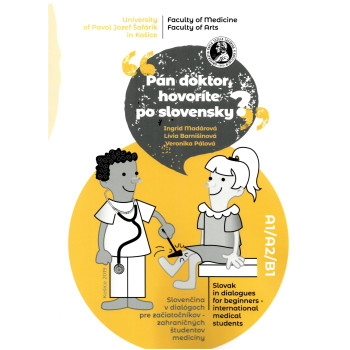
Pán doktor, hovoríte po slovensky?

Pán doktor, hovoríte po slovensky?

€14.00
Availability: 19 In Stock

Ingrid Madárová - Lívia Barnišinová - Veronika Pálová

Táto učebnica je určená pre zahraničných študentov medicíny – začiatočníkov – ako slovenčina na špecifický účel výučby. Jej cieľom je pomôcť zahraničným študentom, ktorí (1) študujú medicínu (2) v cudzom jazyku (anglický jazyk) a (3) v zahraničí (Slovensko) zvládnuť výzvu pri príprave na praktickú časť ich štúdia – konverzácia s pacientom v Slovenskom jazyku.Zámerom je poskytnúť študentom krok za krokom najfrekventovanejšie slovné spojenia a výrazy potrebné pri komunikácii s pacientom. Lekcie sa zameriavajú hlavne na slovnú zásobu týkajúcu sa častí ľudského tela a na základné symptómy a príznaky chorôb.Dôraz je kladený na krátke dialógy medzi lekárom a pacientom. Pri precvičovaní dialógov sú študenti vedení k nácviku komunikácie so zreteľom na porozumenie, bez prípadných obáv o gramatickú správnosť. Gramatické javy sú predstavované postupne, cez jednoduché  pomôcky – „tipy“.V prípade potreby si môžu študenti nájsť a doplniť si „chýbajúce časti gramatiky“ prostredníctvom odkazov na odporúčanú literatúru. Cieľom tejto knihy je uľahčiť a zefektívniť celý proces štúdia/osvojenia si (lekárskej) slovenčiny.

Realism, Modernism, Postmodernism: Five Modern Literary Texts in Context

Realism, Modernism, Postmodernism: Five Modern...

E-book

E-book

Soňa Šnircová

This textbook has been designed as supporting material for the postgraduate course on modern trends in European literature. It focuses on the presentation of five modern literary modes of writing: the realistic mode which was brought to its prominence by the nineteenth-century Realist movement; the stream-of-consciousness and ‘absurdist’ modes which were developed in the context of modernism; and the magical realist and metafictional modes which are associated mainly with postmodernist literary trends. Each mode is represented by a well-known text which demonstrates the formal aspects of each mode and deals with the thematic concerns typical of the literary movement that influenced its production.

The textbook adopts an interdisciplinary approach, placing the chosen literary texts into the historical, philosophical and cultural contexts that shaped their characters, and thereby providing the background knowledge necessary for a deeper understanding of their formal and thematic aspects.

Download the e-book for free(pdf)

Reflexia pedagogických možností vých. systémov vybraných detských a mládež. organizácií  v edukačnom priestore SR

Reflexia pedagogických možností vých. systémov...

E-book

E-book

Ján Juščák - Milan Darák

The aim of the monograph was to analyze the pedagogical possibilities of educational systems within children's and youth organizations, with an emphasis on those targeting the age group of children up to 15 years.

The starting point was an analysis of the current state of theory and practice in children's and youth organizations, with the intention of describing prevailing trends in their development and activities. This publication closely follows the previous monograph (Juščák, J. – Darák, M.: 2015), in which we processed, according to a unified methodology and using generally accepted pedagogical terminology, the collected available materials on the educational systems of selected (most representative) children's and youth organizations in Slovakia. Through a subsequent comparison of the obtained empirical data on educational systems, we aimed to identify their similar (identical) as well as specific (distinct) elements as a basis for establishing categorization criteria for their classification.

The culmination of our efforts was an attempt to characterize a children's organization as an educational institution, describing its characteristic features, functions, aims, content, principles, and educational methodology.

Download the e-book for free (pdf)

Reflexia pedagogických možností vých. systémov vybraných detských a mládež. organizácií  v edukačnom priestore SR

Reflexia pedagogických možností vých. systémov...

E-book

E-book

Ján Juščák - Milan Darák

 The aim of the monograph was to analyze and address the issue of educational systems within children's and youth organizations, with an emphasis on those focused on the age category of children up to 15 years.

The starting point was an analysis of the current state of the educational environment in terms of the systemic nature of education and the basic categories of the educational system. The collected available materials on the educational systems of selected (most representative) children's and youth organizations in the Slovak Republic were subsequently processed according to a unified methodology and using generally accepted pedagogical terminology.

Download the e-book for free (pdf)

Gender perspectives in slovak literature of the late 19th and early 20th centuries (Interpretation Studies)

Gender perspectives in slovak literature of the...

E-book

E-book

Ivica Hajdučeková

The development of this bilingual coursebook evolved as part of project KEGA Nr. 020UPJŠ-4/2013 headed by prof. PhDr. Ján Gbúr, CSc., and emerged from earlier research which had successfully analysed realist and modernist Slovak literature from a gender perspective. Based on initial interpretations which drew from philosophical, sociological and historiographical approaches, we were able to anticipate the issues which could be raised in other texts and thus establish a hypothesis for the subsequent literaryscientific research. Our research has also been influenced by the continually evolving nature of gender studies, and we have therefore decided to adopt a somewhat unusual approach in this coursebook and briefly examine some contemporary texts thereby creating an intentional shift in our timeline. The modern works of Z.Kepplová and U. Kovalyk have raised a number of interesting issues, and a study of the interwar work of M. Urban reveals further interpretations on the basis of gender. After this brief overview, we return to the main focus of the study: gender approaches to Slovak literature of the late 19th and early 20th centuries.

The study focuses on the complexity of male-female relationships in the work of both male and female authors of realist and modernist literature at the end of the 19th and the beginning of the 20th century. Works by the founding generation of realism and late realism were analysed, with particular attention being paid to the fiction of M. Kukučín, J. Čajak, J. G. Tajovský, J. Jesenský, E. M. Šoltésová, T. Vansová, Ľ. Podjavorinská and B. S. Timrava. The works of H. Gregorová and Ľ. Groeblová were also studied as prime examples of Slovak literary modernism. 

We hope that this bilingual coursebook will allow realist and modernist Slovak fiction, and the Slovak national literary tradition in general, to receive wider critical renown beyond the borders of Slovakia and also to demonstrate its place in contemporary literary theory.

Download the e-book for free (pdf)

Školský systém na Slovensku v medzivojnovej Československej republike (1918 - 1938)

Školský systém na Slovensku v medzivojnovej...

E-book

E-book

Soňa Gabzdilová

The educational system (schooling) is one of the most effective tools for shaping the young generation in any advanced society. Schools not only create the knowledge base necessary for fulfilling the demands of the economy and the social sphere, but they also shape the national and ideological identity of each member of society. The school plays a decisive role in forming positive values, but it can also become a breeding ground for xenophobia and racist attitudes. The school has an irreplaceable role in creating national consciousness, identification with one's own nation, its history, the heroic deeds of ancestors, and the meaning of its existence.

After the dissolution of Austria-Hungary, there were fundamental geopolitical changes in Central Europe. One of these was the creation of Czechoslovakia, a state founded on radically different principles than pre-war Hungary. The founders of the Czechoslovak Republic (CSR), the personalities who decisively determined the character of the political system in the newly established republic, did not belong to the privileged classes of the previous regime. Unlike Hungary, where political power was controlled almost without exception by the nobility, the elite in Czechoslovakia consisted of men who were radical critics of Austria-Hungary.

A fitting example was the most influential figure of interwar Czechoslovakia, President Tomáš Garrigue Masaryk. Despite his origins, Masaryk was perceived by both Czechs and Slovaks as the founder of the state, a legendary figure whose political and social influence far exceeded the powers of the presidential office.

Download the e-book for free (pdf)

Výzvy a perspektívy vnútornej a zahraničnej politiky

Výzvy a perspektívy vnútornej a zahraničnej...

E-book

E-book

Gabriel Eštok- Mária Hrehová- Jakub Bardovič (eds.)

Proceedings of the 3rd Annual Scientific Conference of Students and Young Researchers held on May 23, 2014, by the Department of Political Science, Faculty of Arts, Pavol Jozef Šafárik University in Košice

On May 23, 2014, the Department of Political Science at the Faculty of Arts, Pavol Jozef Šafárik University in Košice hosted a conference entitled “Challenges and Perspectives of Domestic and Foreign Policy.” This was the third conference for students and young researchers organized by the Department of Political Science in cooperation with the civic association Res Publica. The event featured numerous young people interested in contemporary political issues, each presenting on a topic related to domestic or foreign policy. It can be stated that these presentations were of a high professional standard and stimulated discussion on the topics and problems raised.

The publication you are holding is a collection of scholarly works by students and young experts who focused on a variety of subjects. Some authors addressed issues of foreign policy, particularly the analysis of selected countries’ policies (Slovak Republic, USA), examined the Iranian nuclear program, or explored the possibilities of federalizing Ukraine as a solution to the emerging situation. Another contribution offered a perspective on foreign policy from the viewpoint of Slovak emigrants in Australia. Despite the wide range of topics addressed in the individual contributions, a common denominator can be found: the effort to highlight a particular problem or propose its solution, thereby contributing to the fulfillment of the ideal of democracy, the improvement of policy-making and functioning, and, above all, making the world a better place for all of us.

Editors

Download the e-book for free(pdf)

This website uses cookies to ensure you get the best experience on our website