Filter By

Categories

Categories

Year of publication:

Year of publication:

Publication language:

Publication language:

Faculty:

Faculty:

Method of publication:

Method of publication:

Active filters

  • Year of publication:: 2014
  • Year of publication:: 2016
  • Year of publication:: 2016
  • Year of publication:: 2018
  • Year of publication:: 2018
  • Year of publication:: 2018
  • Year of publication:: 2018
  • Year of publication:: 2018
  • Year of publication:: 2018
  • Year of publication:: 2018
  • Year of publication:: 2018
  • Year of publication:: 2018
  • Year of publication:: 2018
  • Year of publication:: 2020
  • Year of publication:: 2020
  • Year of publication:: 2020
  • Faculty:: Faculty of Law
  • Faculty:: Faculty of Public Administration
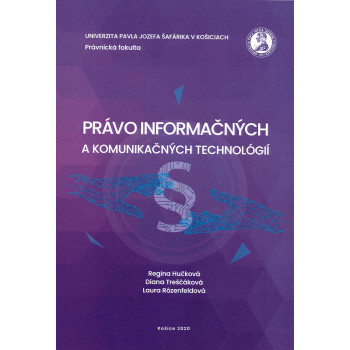
Právo informačných a komunikačných technológií

Právo informačných a komunikačných technológií

€19.50
Availability: 5 In Stock

Regina Hučková - Diana Treščáková - Laura Rózenfeldová

Vysokoškolská učebnica Právo informačných a komunikačných technológií je určená študentom vysokých škôl vo všeobecnosti, najmä však študentom Právnickej fakulty, ktorí majú záujem o štúdium práva v spojení s informačnými a komunikačnými technológiami. Učebnica predstavuje zdroj informácií potrebných nielen pre štúdium tejto problematiky, ale aj pre rozšírenie celkového obzoru v danej problematike.

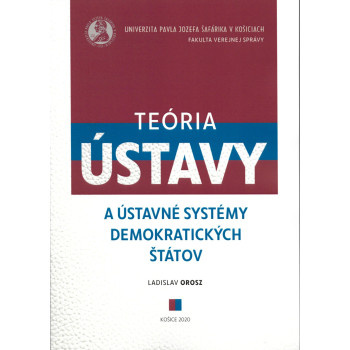
Teória ústavy a ústavné systémy demokratických štátov

Teória ústavy a ústavné systémy demokratických...

€21.00
Availability: 1 In Stock

Ladislav Orosz

Vysokoškolská učebnica pripravená pre štúdium verejnoprávnych disciplín na Fakulte verejnej správy UPJŠ v Košiciach, ktorá je využiteľná ako študijná literatúra aj pre študentov právnických fakúlt a politológie. V prvej časti učebnice je predmetom výkladu a analýzy teória ústavy. Autor kladie v tejto časti osobitný zreteľ  na dynamicky sa rozvíjajúce časti ústavnej teórie, ku ktorým patrí najmä problematika materiálneho jadra ústavy a súdna kontrola ústavnosti. Druhá časť učebnice má komparatívny charakter. Autor v nej analyzuje genézu a rozbor súčasného stavu ústavných modelov tradičných demokracií (USA,  Spojené kráľovstvo Veľkej Británie a Severného Írska, Francúzska a SRN), ako štátov zoskupenia V4 (Poľská republika, Maďarsko, Česká republika, Slovenská republika).

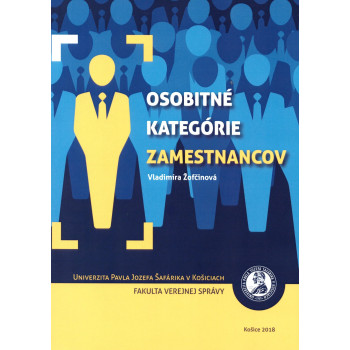
Osobitné kategórie zamestnancov

Osobitné kategórie zamestnancov

€14.00
Availability: 19 In Stock

Vladimíra Žofčinová

Meniace sa podmienky na trhu práce prinášajú aj nové výzvy pre pracovné právo. Pôvodne relatívne homogénny charakter pracovných síl je minulosťou a dochádza ku stále väčšej fragmentácii. Štandardná práca v pracovnom pomere na neurčitý čas a na plný úväzok je na ústupe, rozširujú sa najrôznejšie formy atypických zamestnaní. Osobitná regulácia právneho postavenia zamestnaných osôb môže byť  determinantom ovplyvňujúcim zachovávanie dôstojnosti a ich ochrany v pracovnom procese. Osobitné kategórie zamestnancov, ktorým v tejto monografii venujeme pozornosť sú určitým spôsobom „povýšené“ z hľadiska ochrany a  u niektorých  kategórií zamestnancov zaznamenávame práve medzerovitosť v ochrannej zložke pracovného práva. Trendom vývoja pracovného práva je okrem iného prirodzená miera upúšťania od prílišnej kogentnosti a rigidnosti právnej úpravy. Paradoxne nastupujúca ,,rigidná“ požiadavka flexibility pracovnoprávnych vzťahov a jej postupné „zapracovanie„ do jednotlivých právnych inštitútov Zákonníka práce či iných pracovnoprávnych predpisov,  spôsobuje ďalšie významné prehlbovanie zaostávania posilňovania ochrany zamestnanca (pri telepráci, pri platformových zamestnancoch).

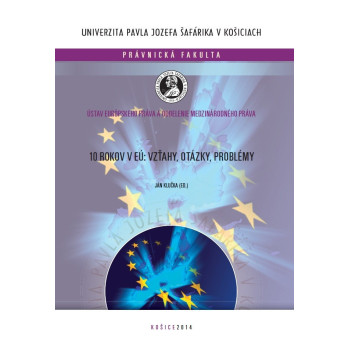
10 rokov v EÚ: Vzťahy, otázky, problémy

10 rokov v EÚ: Vzťahy, otázky, problémy

E-book

E-book

Ján Klučka(ed.)

Collection of Papers from the International Scientific Conference Held on May 29–30, 2014 at the Faculty of Law, Pavol Jozef Šafárik University in Košice.

In the first half of this year, a scientific conference entitled “10 Years in the EU: Relations, Questions, Issues” was held in Košice, and the contributions from this event constitute the content of the present collection bearing the same name.

The aim of the organizers—namely, the Slovak Association of European Law, the Representation of the European Commission in the Slovak Republic, and the Institute of European Law together with the Department of International Law of the Faculty of Law at Pavol Jozef Šafárik University—was not only (even if loosely) to follow up on the previous 2009 conference “Community Law in Slovakia – Five Years ‘After’”, but, after another five years, to continue its main objective: to provide participants from both the academic and non-academic community with a space for further analysis and exchange of views on legal issues related to the membership of the Slovak Republic in the European Union and various current issues of the Union’s legal order.

From this perspective, a shift in the overall focus of the conference contributions in 2009 and 2014 can be observed. While the contributions from the first conference focused primarily on various aspects of the application of Union law in the Slovak legal system and related application problems, especially before courts and other authorities, the basic orientation of the contributions from the second conference is already different. The present collection also confirms that the contributions focus primarily on current issues of the European legal order and on certain aspects of the Union’s external policy, while the relationship of Union law to the Slovak legal system is no longer given primary attention.

Several contributions focus on areas characterized by a certain overlap or “cohabitation” of Union law with public international law, private international law, or, more broadly, international relations.

Download the e-book for free (pdf)

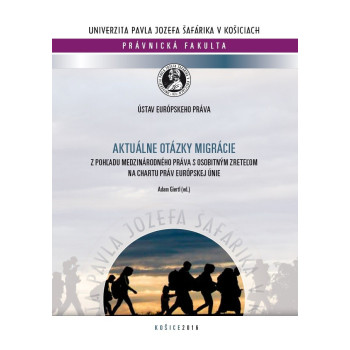
Aktuálne otázky migrácie z pohľadu medzinárodného práva s osobitným zreteľom na Chartu práv Európskej únie

Aktuálne otázky migrácie z pohľadu...

E-book

E-book

Adam Giertl (ed.)

Collection of Papers from the 9th Annual Student Symposium on International and European Law held on April 22, 2016 at the Faculty of Law, Pavol Jozef Šafárik University in Košice

As indicated by the very title of the 9th Annual Student Symposium on International and European Law, “Current Issues of Migration from the Perspective of International Law with Special Regard to the Charter of Fundamental Rights of the European Union,” the participants focused on the highly topical subject of European migration, which they examined from various aspects of both international and Union law (a total of 9 contributions).

In assessing the role of individual actors primarily involved in addressing the problems arising from migration to Europe, particular emphasis was placed on the role of international specialized organizations, which often provide direct assistance to migrants “in the field” through humanitarian or medical aid. However, this is not the only response of the international community, as it is complemented by the activities of the concerned states as well as various non-governmental organizations and volunteers. Regarding the evaluation of the European Union’s activities, the symposium participants agreed that the mass migration wave caught the EU relatively unprepared—institutionally, legislatively, and technically—accompanied by a lack of clarity in adopting a fundamental approach to this reality.

It was also emphasized that these shortcomings occurred despite the fact that developments in the preceding period clearly signaled the possibility of gradual migration to the European Union escalating into a mass phenomenon. According to the participants, additional ex post and sometimes delayed measures adopted in response to the ongoing migration process contributed to an overall increase in political tension within the EU and divided its member states into opposing camps.

Download the e-book for free (pdf)

Európska únia a jej vplyv na organizáciu a fungovanie verejnej správy v Slovenskej republike

Európska únia a jej vplyv na organizáciu a...

E-book

E-book

Alena Krunková (ed.)

Proceedings of the Scientific Conference Held on June 28, 2016 at the Faculty of Law of Pavol Jozef Šafárik University in Košice in connection with the implementation of the project “The European Union and Its Impact on the Organization and Functioning of Public Administration in the Slovak Republic” – approved under number MVZP – SK PRES/2016/134

The Slovak Republic, as a member state of the European Union, is undertaking a historic role associated with the Presidency of the Council of the European Union within the presidency trio. At the beginning of 2016, the Ministry of Foreign and European Affairs of the Slovak Republic announced a call for applications for grants for 2016 in the field of international relations and foreign policy, specifically focused on the Slovak Republic’s Presidency of the Council of the European Union. The Faculty of Law of Pavol Jozef Šafárik University in Košice responded to this call and obtained a project aimed at carrying out research activities through a series of events focused on regional self-government in the Slovak Republic in the context of its role within the European Union. The Faculty has long been engaged with issues of European Union law both in its teaching and in the scientific research activities of its individual faculty members. The project aims to enrich this portfolio with special activities targeting not only professionals, but also students and the general public.

The first activity of the project was a conference entitled “The European Union and Its Impact on the Organization and Functioning of Public Administration in the Slovak Republic – Development So Far, Current State, and Perspectives.” The conference was attended by invited public officials, representatives of academia, and representatives of local government, as one of the main goals of the project is to connect the academic community with the practical sphere and thus involve practitioners in the planned activities within the project.

Download the e-book for free (pdf)

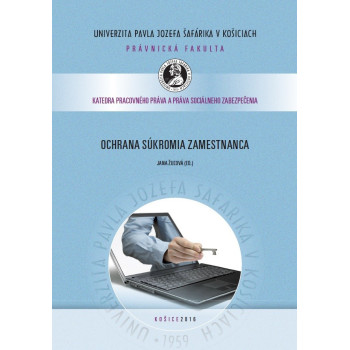
Ochrana súkromia zamestnanca

Ochrana súkromia zamestnanca

E-book

E-book

Jana Žuľová(ed.)

Proceedings from the 1st Annual Student Symposium on Labor Law held on April 8–9, 2016 in Danišovce

Discussions on the topic of privacy are currently very topical and interesting. The advancement and progress of technology have added a new dimension to individual privacy. With the use of modern electronic devices, terms such as precious commodity, chimera, or illusion are increasingly associated with privacy. Workplaces have not remained immune to modernization either. Machines are replacing human labor, programming and planning the production process, but also controlling, monitoring, and recording the fulfillment of assigned work tasks.

The availability of technology and its implementation in employers’ operations intrude upon the personal and private sphere of employees, which is an inherent part of every person’s life and does not remain left behind the doors of the workplace. Proper and correct use of monitoring mechanisms by employers means not only mastering their technical installation at the workplace and covering the associated financial costs, but also respecting the privacy of employees.

It cannot be overlooked that the right to privacy is among the fundamental human rights and freedoms, enjoying the corresponding characteristics (inalienability, non-transferability, irrevocability, etc.) and appropriate legal protection. And even though it is not absolute and may be suspended in favor of another right (especially the employer’s right to protect their property), every intervention—such as comprehensive camera surveillance, monitoring of phone calls, email correspondence, blocking certain websites, etc.—always has adverse consequences for the privacy of the employee.

Download the e-book for free (pdf)

Obchodné záväzky: Všeobecná časť

Obchodné záväzky: Všeobecná časť

E-book

E-book

Dominika Zavadová(ed.)

Proceedings from the 3rd Student Symposium on Commercial Law

In November 2015, the third annual Student Symposium on Commercial Law took place at the university facility in Danišovce.

After two years of symposia focused on company law, the main topic of the third edition was the general part of commercial obligations law. This year as well, the goal of the student symposium remained to provide more space for students to formulate their own perspectives on current legal issues and to present the results of their own work.

The overarching topic made it possible to assign several current issues, allowing students to tackle problems they are likely to encounter in their future practice. The selected topics are not among those unanimously accepted by legal doctrine or established case law. On the contrary, the topics were deliberately chosen for the lack of sufficient domestic literary sources. As a result, processing the individual topics required more than just standard textbook or commentary knowledge.

The participating members of the department, both teachers and doctoral candidates, acted this year primarily as contact persons, rather than as consultants or supervisors of the students’ work. The primary purpose of the symposium at the faculty is to enable students interested in commercial law to develop their analytical and argumentative skills, as well as to express their personalities. We aim for students to develop not only professional knowledge but also personal skills-so-called soft skills-the art of presenting their own opinions and arguing persuasively.

Download the e-book for free (pdf)

Medzinárodné daňové úniky a metódy ich predchádzania

Medzinárodné daňové úniky a metódy ich...

E-book

E-book

Peter Huba - Jozef Sábo - Martin Štrkolec

The presented monograph aims to provide an in-depth overview of the issue of international tax evasion, both in terms of its conceptual foundations and with regard to specific methods and schemes used to carry out tax evasion.

The members of the authorial team have also addressed questions of tax evasion in their previous works: "International Tax Evasion and Tax Havens" (JUDr. Jozef Sábo) and "Legal Aspects of the Elimination of Double Taxation and Prevention of Tax Evasion" (JUDr. Peter Huba).

This monograph represents a synthesis of the relevant research activities of the authorial team, enriched by the interdisciplinary dimension of the tax evasion problem. At the same time, it highlights those shortcomings that appear to be the most serious from the perspective of the risk of international tax evasion and base erosion in Slovakia. In this respect, a comparative perspective on the issue is presented, drawing extensively from American sources, mainly due to the high quality and long-standing research on international tax evasion in the United States.

The authorial team believes that this monograph will help to bring the issue of corporate income tax evasion closer to the professional public, and that it will receive attention equal to that given to VAT fraud and other pressing issues of current tax legislation.

Download the e-book for free (pdf)

Teória a prax verejnej správy (2016)

Teória a prax verejnej správy (2016)

E-book

E-book

Ondrej Mitaľ - Veronika Nováková(eds.)

Reviewed Proceedings of the Doctoral Students' Scientific Conference

The proceedings contain contributions from the participants of the conference Theory and Practice of Public Administration: Doctoral Students' Scientific Conference, held on February 17, 2016, at the Faculty of Public Administration of Pavol Jozef Šafárik University in Košice.

The publication includes 29 contributions, thematically divided into political science, legal, and socio-economic sections. Participants presented diverse and current professional topics, enriching the contemporary theory and practice of public administration. Authors incorporated significant insights, opinions, experiences, and knowledge into their conference papers. All published contributions provide space for deeper, qualified discussion.

Download the e-book for free (pdf)

This website uses cookies to ensure you get the best experience on our website