Filter By

Selections

Selections

Year of publication:

Year of publication:

Publication language:

Publication language:

Active filters

  • Year of publication:: 2013
  • Year of publication:: 2023
  • Year of publication:: 2026
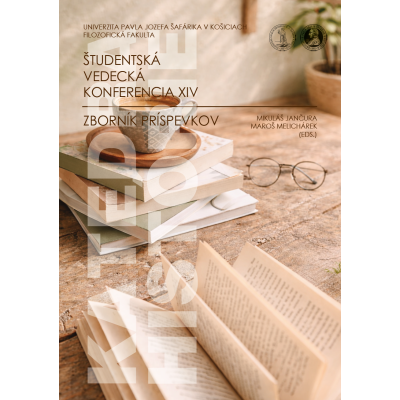
Študentská vedecká konferencia XIV.
  • New

Študentská vedecká konferencia XIV.

E-book

E-book
Mikuláš Jančura Maroš Melichárek (eds.)
This conference textbook is published as the output of the 13th annual Student Scientific Conference held in December 2025. The Student Scientific Conference is a selective course included in the curricula of the Department of History at the Faculty of Arts, Pavol Jozef Šafárik University in Košice (FF UPJŠ), which has been organized since 2011. Its primary objective is to provide a platform for Bachelor’s and Master’s students to present fragments of their primary research conducted during the preparation of their final theses. The aim of these proceedings is not only to publish these thematically diverse texts but also to demonstrate a commitment to above-standard pedagogical activities and to provide benefit to university studies. This is reflected, on the one hand, in the form of a published output and, on the other, in the motivation it provides for students to actively participate in the event. This year's volume contains twelve texts with a chronological scope ranging from Antiquity to 20th-century history. Thematically, it covers a broad spectrum, from political and economic to cultural history. A specific feature of this volume is the inclusion of four international papers by students from the Cardinal Stefan Wyszyński University in Warsaw and Charles University in Prague. Their participation in the conference is the result of established cooperation based on the Erasmus+ Blended Intensive Programme (BIP), which took place in Košice from October 13 to October 17, 2025.
Download the e-book for free (pdf)
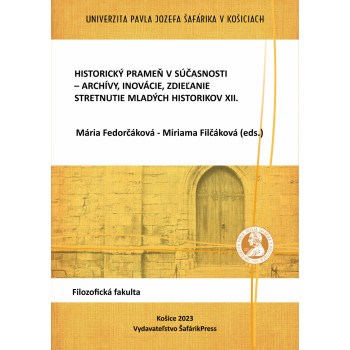
Historický prameň v súčasnosti – archívy, inovácie, zdieľanie. Stretnutie mladých historikov XII.

Historický prameň v súčasnosti – archívy,...

E-book

E-book

Mária FedorčákováMiriama Filčáková (eds.)

Proceedings of the 12th Scientific Conference of Young Historians, organized by the Department of History of the Faculty of Arts at Pavol Jozef Šafárik University in Košice in cooperation with the State Archive in Košice and the Slovak Historical Society at the Slovak Academy of Sciences on October 12, 2022

The theme of the conference proceedings is the issue of sources, their interpretation and use of current digital technologies in their research and access. The proceedings constit of 7 papers by authors working in Slovak and Czech universities.

The digitisation of seals is the subject of the paper by Barbora Borůvková. Michael Dudzik deals with the problem of building the road network in modern France and written and cartographic sources. Trends of digitization in Slovak archives and their perception by researchers are elaborated by in Miriama Fialkovičová´s study. Miriama Filčáková dealt with sources on the history of tertiary education in Košice in connection with the establishment of the UPJŠ. The possibilities of researching sources on the electrification of Slovakia are dealt with in the study by Dominik Hrtus. Ondrej Šály in his paper treated the letters of serfs in the 18th century as a source for economic history. Vavrinec Žeňuch discusses the possibilities of researching the eclesiastical history of the Uh county in the modern period.

Download e-book for free (pdf)

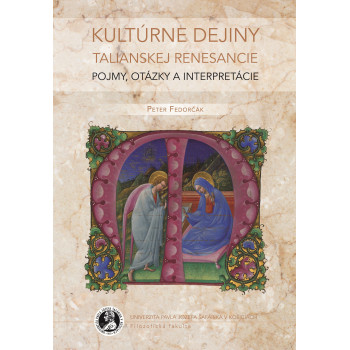
Kultúrne dejiny talianskej renesancie: Pojmy, otázky a interpretácie

Kultúrne dejiny talianskej renesancie: Pojmy,...

E-book

E-bool

Peter Fedorčák

When studying the Renaissance, researchers utilize various critical and core terms and concepts which it is necessary to characterize.

However, many such points, notably the following, are problematic: The relationship between the Renaissance and the antiquity; The connection with the Middle Ages; The transformation to Mannerism and Baroque; Realism and Secularism in Renaissance art; The individualism of the Renaissance artist; The reasons for the creation of Renaissance art in Italy, its determinants and stimulators; Distinguishing between the analysis of the genesis of the Renaissance and the analysis of the creation of the period’s art generally; Regional differences in Italy and their impact on the art; Chronological limits of the Renaissance and its milestones; The terms “Medieval Ages” and “Early Modern Period”; The impact, and its extent, of the artistic influences of the Byzantine, Gothic and Romanesque arts on the Renaissance. The term “Renaissance” itself, its content and existence, are also the subject of the discussion with students, alongside learning how such terms and definitions came about and continue to evolve, how they attain their content, how this content morphs in the historical discourse, what academical pluralism and freedom of thinking look like in the discourse led by historians, what the differences are between scientists and schools of thought on the same subject and how it is possible that they are so numerous.

The students will come to recognize the leading scholars in the field, and follow their arguments and methodological approaches. They shall be invited to closely trace and scrutinize the logic which those historians use in building their argumentation. It shall be seen that the freedom to create terms, concepts and new definitions cannot stand on an ignorance of the (historical) facts, as becomes clear with expanding knowledge of those historical facts, the variability of their interpretation growing in tandem. This approach, actually used across the whole range of seminars and lectures, shall drive discussion on the topics covered, students being invited to formulate their own theses and antitheses.

Download the e-book for free  (pdf)
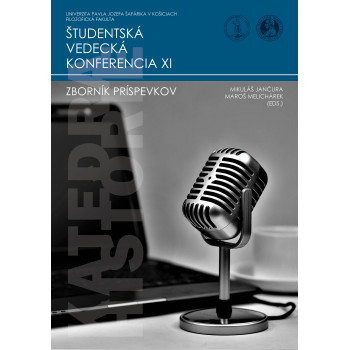
Študentská vedecká konferencia XI.

Študentská vedecká konferencia XI.

E-book

E-book

Mikuláš Jančura - Maroš Melichárek (eds.)

The textbook is derived from the outcomes of the eleventh annual student scientific conference, which took place in December 2022.

The student scientific conference is an integral component of the curriculum within the Department of History at the Faculty of Arts, UPJŠ, and has been implemented since 2011. Its primary objective is to provide a platform for Bachelor's and Master's degree students to present segments of their original research as part of their thesis development.

The purpose of this textbook extends beyond the mere publication of these diverse thematic texts. It also strives to emphasize the significance of exceptional pedagogical initiatives and the added value of university education for students, manifested through the dissemination of their scholarly output.

Download the e-book for free  (pdf)
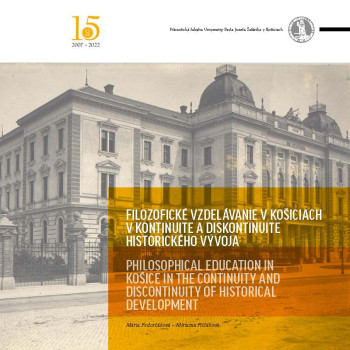
Philosophical Education in Košice in the Continuity and Discontinuity of Historical Development

Philosophical Education in Košice in the...

E-book

E-book

Mária Fedorčáková - Miriama Filčáková

Current publication is dealing with the history of philosophical education in Košice since the beginning to the foundation of the Faculty of Arts at Pavol Jozef Šafárik University in Košice in 2007. Beginnings of philosophical education in Košice are connected to the fundation of the University of Košice in 1657, which was originally founded as Jesuit university with two faculties – Faculty of Theology and Faculy of Arts.

The publication is dealing with the philosophy teaching in the Faculty of Arts and examines the philosophy teachers and students. Another interest is given to decline of philosophy teaching caused by transformation of the University into the Royal Academy and the Academy of Law at the end of the 18 and during 19 century. The second part of the publication is dealing with the history of higher education after the second world war and the foundation of the University of Pavol Jozef Šafárik in Košice.

The authoress focuses on circumstances of the foundation of the Faculty of Arts in Prešov and its history and later development after 1989, which included also division of the university in 1997. The last part of publication presents the history of the university buildings, in which the Faculty of Arts is situated.

Download the e-book for free  (pdf)
Vybrané kapitoly z dejín Grécka a Ríma

Vybrané kapitoly z dejín Grécka a Ríma

E-book

E-book

Milan Olejník

The history of ancient Greece and Rome represents the culmination of achievements made by ancient civilizations in political, economic, and social spheres, as well as in understanding humanity and the world, and in art. The Greeks were the first in human history to establish a system where a certain part of society—full-fledged citizens—had the opportunity to freely participate in political decisions. They could vote, be elected to offices within the political system, and discuss issues affecting community life.

A high level of education and the pursuit of rational explanations for natural phenomena enabled the Greeks to reach a level of knowledge that European nations only achieved in the modern era. Greek accomplishments in sculpture, architecture, and literature remain an inspiration to this day.

Despite a gap of more than two millennia, their thinking and actions are relatable; their victories and defeats resonate with us, offering lessons even today.

Download the e-book for free (pdf)
Stretnutie mladých historikov II. Priesečníky spoločnej histórie krajín V4

Stretnutie mladých historikov II. Priesečníky...

E-book

E-book

Bernadeta Fabová - MikulአJančura (eds.)

Collection of Studies from the 2nd Scientific Conference of Young Historians (Doctoral Students and Researchers), organized by the Department of History of the Faculty of Arts at Pavol Jozef Šafárik University in Košice, in cooperation with the Faculty of Arts at Masaryk University in Brno, the Faculty of Arts and Sciences at Silesian University in Opava, and the Faculty of Arts at the University of Miskolc, held on October 29-30, 2012 in Košice.

The collection is the output of the second annual scientific conference of young historians (doctoral students and researchers), organized at Pavol Jozef Šafárik University in Košice. The central theme of the event was the focus on intersections of shared history. The ten studies map various intersections of the history of the V4 countries, as well as the broader Central European region, in the time span from the 13th to the 20th century. The individual studies cover a wide range of areas from the medieval road network, military and urban history, through economy, education, issues of national identity, the relationship between the state and the church, to demographic questions.

Download the e-book for free (pdf)

This website uses cookies to ensure you get the best experience on our website