Filter By

Year of publication:

Year of publication:

Publication language:

Publication language:

Method of publication:

Method of publication:

Active filters

  • Year of publication:: 2017
  • Year of publication:: 2018
  • Year of publication:: 2018
  • Year of publication:: 2020
  • Year of publication:: 2021
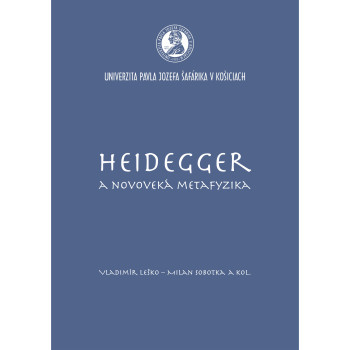
Heidegger a novoveká metafyzika

Heidegger a novoveká metafyzika

E-book

E-book

Vladimír Leško, Milan Sobotka a kol.

Filozofické dielo Martina Heideggera, ktorého hlavnou otázkou je otázka bytia, je v rozhodujúcej miere zviazané s pochopením filozo-fického reflektovania tejto otázky v gréckej a novovekej filozofii. Filozofický vývoj nemeckého mysliteľa túto dejinno-filozofickú sku-točnosť prezentuje v jedinečnej podobe od dvadsiatych rokov 20. storočia až do konca svojej tvorby. Problém Heideggerovej recepcie gréckej filozofie s jej chápaním metafyziky bol predmetom nášho skúmania v práci Heidegger, metafyzika a Gréci (Košice: UPJŠ 2016, 693 s.).

Download the e-book for free (pdf)

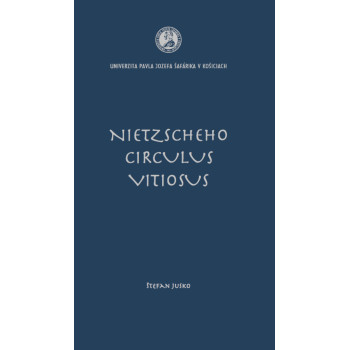
NIETZSCHEHO CIRCULUS VITIOSUS

NIETZSCHEHO CIRCULUS VITIOSUS

E-book

E-publication

Štefan Jusko

This monograph aims at following the study of P. S. Loeb in which he presented a significant turning point in the issue of the interpretation of Nietzsche's idea of the eternal return of the same. What was that reversal? Despite prominent scholars of Nietzsche's philosophy of the 20th century who rejected the idea of eternal return because of its logical incoherence, Loeb eruditely proved the temporal identity of eternal return of the same, thus verifying the logical connection of the idea concerned.

Download the e-book for free (pdf)

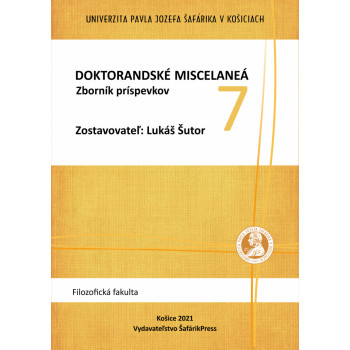
Doktorandské miscelaneá 7

Doktorandské miscelaneá 7

E-book

E-book

Lukáš Šutor

The seventh volume of Doctoral Miscellanea was created in this year's specific research and educational situation, which predetermined its character as a non-conference collection.

The previous two editions continued the tradition of domestic scientific events (initially seminars, later conferences) at the Autumn School of Doctoral Students of the Faculty of Arts at UPJŠ in Košice, thereby creating an opportunity to verify more comprehensive scientific conclusions before a diverse audience, not only of experienced educators but also of researchers from their own generation. This phase was narrowed down to communication between the supervisor/reviewer and the doctoral student during the publication's creation. However, this did not automatically mean a less intense dialogue. Many contributions underwent interesting changes and variations.

The resulting studies reflect not only the degree of development of dissertation projects but often also the interest of young scientists in specific issues that have the potential for independent research. After all, they chose our domestic collection for testing their ideas.

Download e-book for free (pdf)

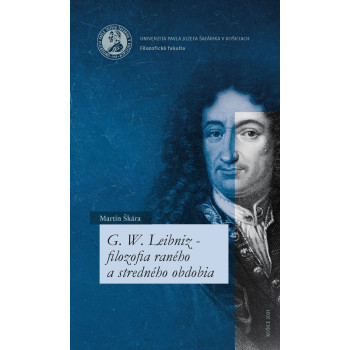
G. W. Leibniz - filozofia raného a stredného obdobia

G. W. Leibniz - filozofia raného a stredného...

E-book

E-book

Martin Škára

The presented university textbook is a reaction to two fundamental shortcomings. The first one is the absence of a similar, if not equivalent, textbook in the Slovak university environment. The second shortcoming is the mistake that Leibniz's philosophy is a system called monadology.

The presented textbook corrects this mistake and at the same time fills the gap of the absence of this kind of textbook with a Leibniz subject. For the above reasons, the presented textbook brings a new perspective on the philosophy of G. W. Leibniz, especially in the period of early philosophical beginnings with an overlap into the so-called Paris period and the De summa rerum period up to the first philosophical doctrinal formulation expressed in the Discours de métaphysique (Winter 1685-1686). The textbook is conceived as a selection of sections of source texts translated by the author of the textbook from French and partly from Latin and equipped with comments accessible to the target audience.

It is therefore the author's wish that this textbook not only serve as a form of correction for the misinterpretation of Leibniz's philosophy, but as an inspiring text that will introduce the reader to the world of Leibniz's philosophy in its undistorted light.

Download e-book for free (pdf)

Vybrané kapitoly z axiológie (v kontexte kritiky tradičnej metafyziky)

Vybrané kapitoly z axiológie (v kontexte...

E-book

E-book

Štefan Jusko

Selected chapters from axiology are the result of the author's multi-year research work and also a certain fulfillment of the requirements from pedagogical practice in this subject. The chapters in this synthesizing form have not been published yet, and I am convinced that precisely in this form they can acquire higher value and greater real impact on our philosophy students.

Individual chapters focus on the problem of the collapse of traditional values, often leading to nihilism and loss of meaning in human existence. It is no coincidence that Friedrich Nietzsche, a philosopher who first called for a reevaluation of all values, is a common denominator among these texts. Another key figure is F. Dostojevskij, a Russian philosophising writer who views nihilism—the problem of value destruction—differently. The goal of these texts is literally to provoke our students so that they independently and creatively address questions related to the meaning of their own existence.

As I am convinced, our time presents a great challenge for new, original ideas and axiological judgments that have always preceded cognitive ones. To what extent my intentions and goals have been fulfilled remains up to the reader to decide.

Autor

Download the e-book for free (pdf)

Vybrané kapitoly z epistemológie (v kontexte postmetafyzického myslenia)

Vybrané kapitoly z epistemológie (v kontexte...

E-book

E-book

Štefan Jusko

Selected Chapters in Epistemology" is a work resulting from the author's multi-year research and also represents a fulfillment of the requirements from pedagogical practice in this subject. The chapters, presented in this synthesized form, have not been published before, and I am convinced that precisely in this form they can gain higher value and greater real impact on our philosophy students.

The individual chapters focus on the problem of knowledge today, primarily on the problem of criticizing metaphysics and questions related to creating post-metaphysical thinking. It is no coincidence that Friedrich Nietzsche is a common denominator for the presented texts; he is a philosopher who has fundamentally influenced and continues to influence current philosophical discussions and intellectual movements. The chapters are written to lead our students or other readers toward reflection, i.e., critical thinking, personal growth, and professional independence.

To what extent I have succeeded in fulfilling my intentions and goals remains for the reader to decide.

Autor

Download the e-book for free (pdf)

Sokratovská otázka ako filozofický problém

Sokratovská otázka ako filozofický problém

E-book

E-book

Štefan Jusko

The goal of the monograph is to highlight the significant problem of interpreting the Socratic question, as its approach represents a method of interpreting the history of philosophy, specifically in our case, the interpretation of Socrates and Plato. The Socratic question can be grasped in diametrically different ways, as shown by Patočka and Nietzsche, among others. The former aligns with Socrates and innovatively updates his question for the present. The latter is ambivalent towards Socrates but ultimately labels him a decadent.

In the first part of the monograph, Patočka's characterization of human existence is presented, which he formulates as unified and morally firm. Patočka interprets the Socratic question as care for the soul, for its well-being, without deriving the concept of good from something positively defined but from the whole world, which can only be defined negatively due to its constant openness. This sphere of negativity is for Patočka something immensely positive because transcendence lifts humans from relative goods to the overall meaning, making them morally capable in the true sense. The good, i.e., the requirement for a surge, for a turn of humans from the world of things to the whole world, is for him a program that Socrates first formulated through his knowing ignorance.

The second part of the work is dedicated to Nietzsche's concept based on the non-unified nature of human existence, which is not derived from the whole world or overall meaning but from situational meaning. Nietzsche strives to prove that in every situation, human existence is exposed to two opposing perspectives, between which it is impossible to decide which is correct. He concludes that both perspectives are equally valid and mutually conditioned, meaning that the opposite of good, what threatens meaning, is a beneficial condition for situational meaning. He labels this level as immoral, as a sphere where human existence creates meaning outside the thinking of good and evil in opposition.

The conclusion of the work is open because, as it turns out, we do not have a common denominator that could decide on the correctness of one or the other concept. Precisely in this lies the fact that the Socratic question remains a serious philosophical problem even today.

Download the e-book for free  (pdf)

Heidegger – Nietzsche (problém interpretácie)

Heidegger – Nietzsche (problém interpretácie)

E-book

E-book

Štefan Jusko

The stimulus for this monograph was my two studies on Heidegger’s interpretation of Nietzsche’s ideas of the will to power and eternal return of the same, published in Heidegger and Modern Metaphysics (supported by the Slovak Research and Development Agency, APVV-14-0706, under the leadership of V. Leška and M. Sobotka). In the submitted monograph, I present both studies in expanded (particularly “Will to Power as Art”) and refined versions (“Eternal Return of the Same”) and add a third chapter addressing the question of the meaning of interpreting philosophical texts, which themselves are interpretations of other texts.

In seeking an appropriate approach to the meaning of interpretation, I conclude that—generally—the purpose of interpretation is to uncover the productive dimension of the interpreted text, which can only be revealed if the interpreter enters the text openly and as neutrally as possible. If the interpreter does not open themselves to the text, allowing it to interpret them in turn, interpretation remains trapped. I believe that without mutual openness between interpreter and interpreted, interpretation has no meaning and typically becomes either rejection or misinterpretation—a form of violence.

In the third chapter, which I consider foundational, I attempt to “balance” the interpretive context of “Heidegger–Nietzsche” from the first two chapters through a reversible context of “Nietzsche–Heidegger,” albeit with the risk that my interpretation of Nietzsche’s thought—specifically his ideas of eternal return and will to power—may remain subjective, even if unintended as misinterpretation. Ultimately, the ambition of the third chapter is to explore intersections between the two philosophers, one of which—a rudimentary yet significant overlap—I identify as Heidegger’s concept of being-in-the-world, reinterpreted through Nietzsche’s lens. It is Nietzsche who challenges us to adopt a self-defined stance toward the world, to confront what it means to be in the world.

The challenge for me—and perhaps the reader—is to remain faithful to oneself, which is only possible by persisting in the context of mutual interpretation between interpreter and interpreted, regardless of who/what is interpreting or being interpreted. For the context of being-in-the-world is always co-created by both sides.

Download the e-book for free  (pdf)

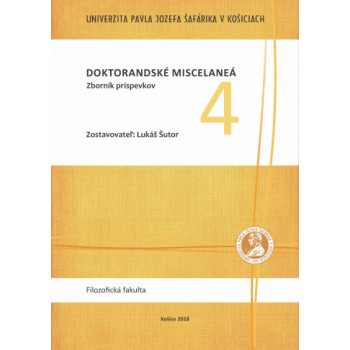
Doktorandské miscelaneá 4

Doktorandské miscelaneá 4

E-book

E-book

Lukáš Šutor (ed.)

The proposed anthology represents for many doctoral students their first entry into the publishing environment of scientific genres. The studies in such cases contain the essence of future dissertation works, which represent the creative pinnacle of doctoral studies. In addition to providing doctoral students with the opportunity to publish scientific outputs, we also consider the anthology a space for interdisciplinary encounters and mutual enrichment. However, interdisciplinarity is not merely a characteristic of the anthology as a whole but also of some studies.

Most notable interdisciplinary approaches are observed in literary studies. The traditional subject of research into artistic texts is enriched in individual studies by examining theatrical and film works (Peter Getlík), linguistic aspects of phrasemes (Ivana Hudiková), musical elements (Terézia Kulíková), visual art (Dominika Petáková), and digital spaces of new media (Alexandra Popovičová). From other disciplines, we highlight Miroslava Süčová Vernarská’s study, which extends psychological research into sociological and linguistically communicative contexts (the concept of metaphor), or conversely, Zuzana Šoltésová and Dušan Šlosár’s contribution, analyzing eating disorders from their disciplinary background in social work.

Both mentioned disciplines also include contributions with traditional research subjects. Nikola Fabiny from psychology analyzes consequence expectations in the context of goal selection and achievement. Jana Plavnická and Dušan Šlosár’s co-authored study from the Department of Social Work presents a multi-perspective analysis of integration barriers for immigrants in Slovakia. Within their own disciplines, both philosophy contributions operate: Juraj Brenišin interprets the ethical aspects of Avicbron’s Fons vitæ, while Michal Kručko examines Edmund Husserl’s unfinished work through a comparative lens of his students Jan Patočka and Roman Ingarden. The anthology concludes with Lukáš Lukačín’s study (written in English), which explores the semantic-grammatical category of modality in the verbs MAY and CAN within legal-administrative documents of the European Union.

The representation of academic disciplines and doctoral students’ individual creative outputs in Doktorandské miscelaneá 4 is thus appropriately diverse. We present this publication to the broader academic community as a representative overview of trends in young scholars’ thinking across the spectrum of humanities and social sciences doctoral programs at the Faculty of Arts, UPJŠ in Košice.

Lukáš Šutor

Download the e-book for free (pdf)

This website uses cookies to ensure you get the best experience on our website