Filter By

Year of publication:

Year of publication:

Publication language:

Publication language:

Faculty:

Faculty:

Active filters

  • Year of publication:: 2017
  • Year of publication:: 2017
  • Year of publication:: 2018
  • Year of publication:: 2020
  • Year of publication:: 2025
  • Year of publication:: 2025
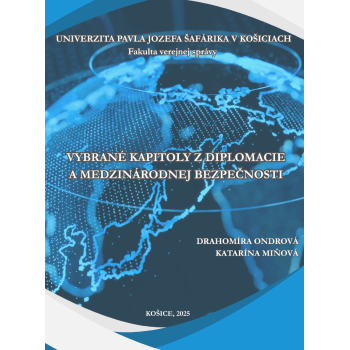
Vybrané kapitoly z diplomacie a medzinárodnej bezpečnosti

Vybrané kapitoly z diplomacie a medzinárodnej...

E-book

E-book

Drahomíra Ondrová Katarína Miňová

Súčasne potreba vytvoriť učebnicu pre vysoké školy uvedeného typu bola motivovaná požiadavkami a značným záujmom pomerne veľkého počtu samotných študentov a absolventov o danú problematiku v súvislosti s nedostatkom podobnej  učebnice zameranej na potreby Fakulty verejnej správy, ktorá by zodpovedala stanovenému obsahu a rozsahu spracovania so zameraním sa na najpodstatnejšie problémové okruhy diplomacie v prepojení na oblasť verejnej správy.

Okrem zabezpečenia potrebnej učebnice pre vysoké školy, hlavný cieľ spočíva v snahe podať študentom a mladým vedeckým pracovníkom základnú orientáciu v danej problematike, a to tak v pojmovej oblasti, ako aj v teoretickej. V neposlednom rade  učebnica napĺňa ambíciu motivovať záujem k ďalšej tvorivej akademickej práce a v rozširovaní vedomostí z oblasti zahraničnej, bezpečnostnej a medzinárodnej politiky v prepojení na diplomaciou.
Download the e-book for free (pdf)

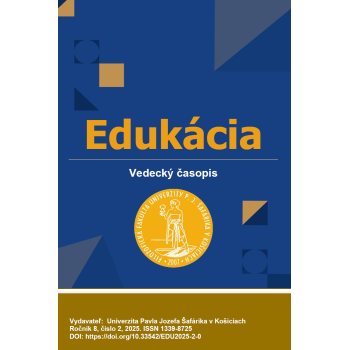
Edukácia roč.8, č. 2/2025

EDUKÁCIA, roč. 8, č. 2/2025

E-book

E-journal

Renáta Orosová (výkonný redaktor)

Stránka časopisu >>>

Vedecký recenzovaný časopis Edukácia je zameraný na problematiku vzdelávania a výchovy v oblasti základného, stredného a vysokého školstva. Zreteľ kladie na súčasný stav a perspektívy edukačnej praxe, aktuálne aspekty pregraduálnej prípravy učiteľov, sociálnej pedagogiky, špeciálnej pedagogiky, ako aj pedagogické a psychologické aspekty výchovy v základných výchovných inštitúciách z pohľadu širokej pedagogickej verejnosti. Je určený vedeckým pracovníkom, mladým vysokoškolským učiteľom, doktorandom, ako aj odborným a pedagogickým pracovníkom s cieľom prezentovať trendy v edukácii a vyvolať diskusiu k aktuálnym otázkam prezentovaných oblastí výchovy a vzdelávania.

Ciele vedeckého časopisu Edukácia:

• prezentovať súčasné postavenie a funkciu pedagóga v edukačnej praxi a jeho perspektívy,

• prezentovať aktuálne otázky vzdelávania a výchovy z pohľadu učiteľov, sociálnych pedagógov, špeciálnych pedagógov a psychológov,

• prezentovať inovácie v edukačnej praxi; analyzovať stav a problémy prepájania teórie a praxe výchovy a vzdelávania vo vzťahu k moderným vyučovacím koncepciám,

• prezentovať aktuálne trendy v pregraduálnej príprave pedagógov,

• prezentovať výsledky empirických výskumov z oblasti pedagogiky, sociálnej pedagogiky, špeciálnej pedagogiky a psychológie v prostredí rodiny, školy a mimoškolských výchovných inštitúcií.

Download the e-journal for free (pdf)

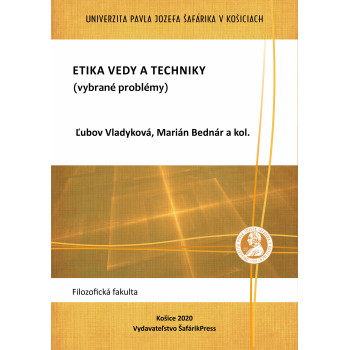
Etika vedy a techniky (vybrané problémy)

Etika vedy a techniky (vybrané problémy)

E-book

E-book

Ľubov VladykováMarián Bednár a kol.

The university textbook Ethics of Science and Technique (Selected Problems) is a collection of contributions by various authors who deal with selected problems and areas of science and technique. For the last hundred years, we can observe the rapid development of science and technique (technology). The transition of society in the 20th century into the information age and in the current 21st century into the digital age brings radical challenges and changes in all areas of human life, but especially in the moral field.

Ethical discussions, responding to the development of science and technique (technology), have stimulated the emergence of ethics of science and technique, which as a subdiscipline of applied ethics is a way out of the conflict between professional autonomy, social control and self-regulation of action and behaviour; not only in science and technique, but also in economy and politics. In the digital age, technique, technology and science are fundamentally changing our lives; from the way we work to the way we communicate, how we fight local and global problems, and how we try to solve societal problems.

These radical changes are not without controversy, and many provoke intense debates that are often polarized or associated with scientific ambiguities or dishonest demagoguery and ideology.

Download the e-book for free (pdf)

Hodnota ľudského života v konotáciách Postmoderny

Hodnota ľudského života v konotáciách Postmoderny

E-book

E-book

Marián Bednár

The scientific monograph The Value of Human Life in the Connotations of Postmodernism presents a current issue of reflections on the value of human life. It sees in the broader connotations of postmodern society, where the approaches of applied ethics (bioethics), philosophy and Christian theology intersect. This issue is embedded in the historical, philosophical, sociological and cultural-social Postmodernism.

The monograph analyses the postmodern value system, the dominant postmodern anthropological concept, secular bioethics and civil law in relation to human life and its value. The key is the confrontation of the postmodern anti-life mentality and life in the most discussed bioethical issues: contraception, artificial insemination techniques, genetic manipulation, abortion, sterilization, (bio) technology, euthanasia. An alternative approach is offered by the theological vision of human and life presented in the Judeo-Christian context. In the light of modern theological disciplines, the personnel concept is enriched by theological anthropology culminating in an eschatological vision.

In this sense, the issue of the value of human life culminates, which is also inspired by one of the most important encyclicals of Pope John Paul II. Evangelium vitae (25th anniversary of its writing). It is she who calls for the acceptance and respect of every human life and for the practical development of a new culture of life.

Stiahnite si e-knihu zadarmo (pdf)

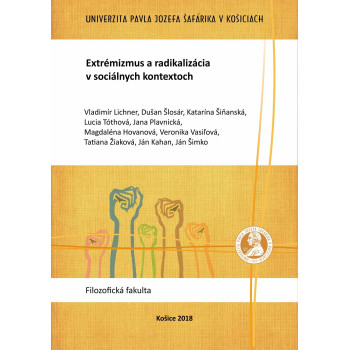
Extrémizmus a radikalizácia v sociálnych kontextoch

Extrémizmus a radikalizácia v sociálnych...

E-book

E-book

Vladimír LichnerDušan Šlosár et al.

It is very difficult to refer to any act of extremism or action having extremist characteristics, or to exclude it unambiguously. The boundary between extremism and accepted, conformal behavior is very broad and vaguely worded. Each company tends to set certain criteria to determine what can be considered as unwanted, violent, radical or extreme, or what signs of such a manifestation do not have. Therefore, when comparing the individual countries of the European Union in this area, we come across a different definition of what is or is not considered to be radical or extremist. In essence, the level of tolerance to some of the manifestations and the setting of indicators for the evaluation of the proceedings as extremist.

The presented monograph aims to present the basic social contexts of extremism and radicalization in the form of their philosophical and theoretical backgrounds, influencing the factors, the basic directions. In the author's work, the authors focus on the target group of adolescents, which they consider to be one of the most endangered groups in society in terms of development of the radicalization process. At the conclusion of the monograph is also offered the criminal level of these phenomena, which is not unavoidable in terms of complex analysis.

Download the e-book for free  (pdf)

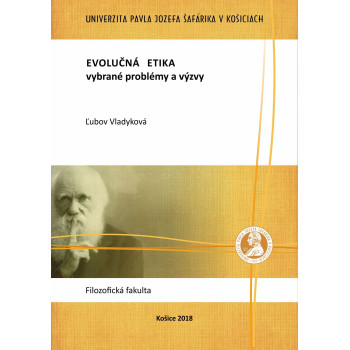
Evolučná etika – vybrané problémy a výzvy

Evolučná etika – vybrané problémy a výzvy

E-book

E-book

Ľubov Vladyková

The present monograph titled Evolutionary Ethics: Selected Issues and Challenges discusses a range of problems, theoretical concepts, and beliefs from the perspective of evolutionary ethics. The term evolution has become one of the central terms in contemporary science and philosophy.

In social sciences in general, and in socio-biology and evolutionary psychology in particular, evolution has had great impact on our understanding of the genesis of culture. Evolutionary theories play a similar role within the theory of consciousness and of the mind (evolutionary epistemology). The interrelation between our evolutionary past and our sense of good and evil is also a subject of heightened interest in ethics; it has in fact become one of its challenges. The concept of evolution challenges the way we create thought patterns through which we understand, or hope to understand, ourselves and the world around us.

This monograph represents a general summary of selected issues in evolutionary ethics, touching upon various aspects of current research into evolutionary ethics and the related domains of evolution, science, ethics, and morals. Evolutionary ethics has become a project which presupposes that in order to understand the essence and basis of morals one must turn to the process of evolution of thought, and to the theories put forth by evolutionists, specifically evolutionary biologists.

The structure of this monograph, as well as its potential usefulness for research and education clearly show that the analysis of the problems discussed here has significant implications for domains far removed from the purely theoretical parts of moral philosophy or biology. The advantage of such discourse is that it enables the implementation of evolutionary ethics in social and ethical issues of public interest (for example Sex Literacy, Sex Education), and this should be recognised and welcome.

Download the e-book for free (pdf)

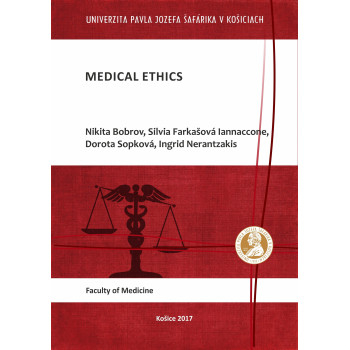
Medical Ethics

Medical Ethics

E-book

E-book

Nikita Bobrov et al.

History of ethics represents a search for basic principle, which would enable a distinction between moral and immoral, good and bad, right and wrong. The main problem lies in motives, methods and consequences of human conduct. The integrity of medical profession puts emphasis on life-long study and practice according to the professional competence, and last but not least on ethical principles and rules of medical ethics.
Medical ethics, as a part of bioethics, is currently taking on a huge importance in everyday clinical practice and must face many serious ethical issues regarding the whole system of health care. On general level the decision-making in medical practice is quite easy, based on the requirement to always act in the patient's best interest. However, it is often difficult to know exactly what is best for the patient, in a certain situation, for this particular patient. Also with each progress in medicine and its globalization, the more aspects of human lives are being affected.

Biomedical research, and the new treatment and diagnostic methods it provides are viewed differently in each country, therefore various cultural, religious, social and legal aspects must be considered in their assessment, as well as the basic principles of medical ethics. Worldwide effort on unifying ethical regulations on certain aspects of health care led to the establishment of many legally recognized documents the doctors must be familiar with.

Teaching ethics to students of medical school aims to educate the future doctors towards ethical decision-making, behaviour and professional conduct according to the basic principles of medical ethics.
This textbook provides the basic information on medical ethics for students of medical faculties and serves as a practical introduction to the most common ethical problems of health care provision for their future professional practise.

Authors

Download the e-book for free (pdf)

O odbornej praxi v praxi (pre študentov aplikovanej etiky)

O odbornej praxi v praxi (pre študentov...

E-book

E-book

Andrea Klimková

The current development of applied ethics globally suggests that applied ethics is entering a new, qualitatively distinct era of innovative application approaches, methodologies, and methods, as well as novel educational formats. The application levels in applied ethics (in bioethics, business ethics, technology ethics, professional ethics, etc.) are tied to critical reflection on previous strategies and methodologies in their teaching.

Combining ethical rationality with practical variability and implementing ethical policies and tools in concrete practice truly demands new competencies, new skills, and the ability to work in novel ways with empirical and normative frameworks. This requires working with ethical theory and moral practice inventively, heuristically, innovatively, and propedeutically.

The creation of useful and professionally constructed procedures and formats is part of the professional and academic preparation of applied ethicists at modern departments of applied ethics.

Download the e-book for free (pdf)

This website uses cookies to ensure you get the best experience on our website