Filter By

Selections

Selections

Year of publication:

Year of publication:

Publication language:

Publication language:

Active filters

  • Year of publication:: 2013
  • Year of publication:: 2015
  • Year of publication:: 2017
  • Year of publication:: 2022
  • Year of publication:: 2026
  • Year of publication:: 2026
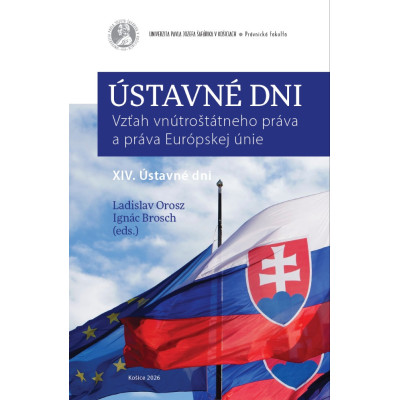
Vzťah vnútroštátneho práva a práva Európskej únie, XIV. Ústavné dni
  • New

Vzťah vnútroštátneho práva a práva Európskej...

E-book

E-book

Ladislav Orosz    Ignác Brosch  (eds.)

Scientific proceedings from the traditional international scientific conference organized by the Constitutional Court of the Slovak Republic and the Faculty of Law of the Pavol Jozef Šafárik University in Košice, titled “The Relationship Between Domestic Law and European Union Law – 14th Constitutional Days,” consists of papers by renowned representatives of domestic and foreign constitutional doctrine, as well as authors who currently serve as judges of constitutional courts and the Court of Justice of the European Union, or as their advisors. From a substantive perspective, the contributions included in the collection address the challenges arising from current developments in the case law of the Court of Justice of the European Union and the case law of the Constitutional Court of the Slovak Republic and certain other foreign constitutional courts regarding the relationship between national legal systems and European Union law. 
Download e-book for free (pdf)

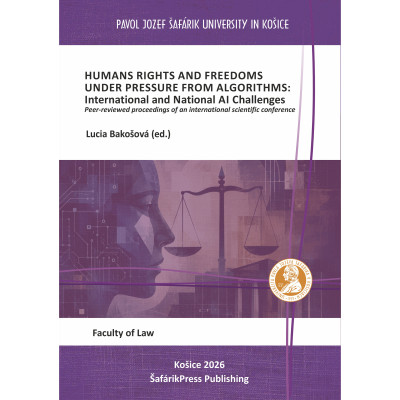
Human Rights and Freedoms under Pressure from Algorithms: International and National AI Challenges

Human Rights and Freedoms under Pressure from...

E-book

E-book

Lucia Bakošová (ed.)
The proceedings Human Rights and Freedoms under Pressure from Algorithms: International and National AI Challenges constitute a peer-reviewed outcome of an international scientific conference devoted to the legal challenges arising from the development of artificial intelligence. The volume focuses on the impact of algorithmic systems on the protection of human rights and fundamental freedoms at the international, European and national levels. The individual contributions examine issues such as transparency, accountability, the right to a fair trial, privacy protection, non-discrimination, children’s rights, labour relations, digital constitutionalism, autonomous weapons, and the use of AI in public administration and armed conflicts. Particular attention is paid to the risks of algorithmic decision-making, legal hallucinations, profiling, surveillance, and the influence of digital technologies on democratic processes.

Download the e-book for free (pdf)

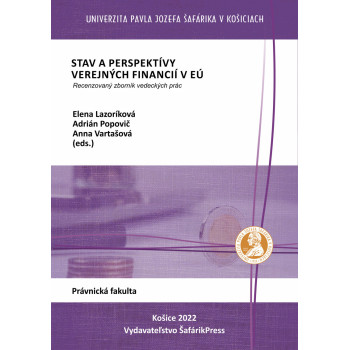
STAV A PERSPEKTÍVY VEREJNÝCH FINANCIÍ V EÚ

STAV A PERSPEKTÍVY VEREJNÝCH FINANCIÍ V EÚ

E-book

E-book

Elena Lazoríková - Adrián Popovič - Anna Románová

Reviewed proceedings of scientific papers

The Proceedings presents papers from international scientific conference “The Condition of Public Finances in the EU and their Future Perspectives” held on June 2 – 3, 2022 in Košice, Slovakia and is published as a partial outcome of the implementation of the VEGA project No. 1/0485/21: "Simultaneity and possibilities of reforming the system of own resources of the EU budget (legal and economic aspects also in the context of the consequences of the COVID-19 pandemic)" and VEGA project No. 1/0214/21: "Real Property Tax - Legal Status and Potential".

The proceedings consist of contributions from conference participants divided into two thematic sections: “The EU Budget” and “Real Estate in Taxation.” While the first section addresses both the revenue side of the EU budget (particularly in the context of the own resources system), as well as its expenditure side and its relationship to other budgets, the second section focuses on real estate as the subject of specific regulations under various taxes, including those that directly tax real estate through a tax of the same name.

Download e-book for free (pdf)

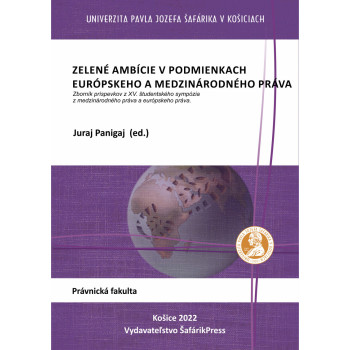
Zelené ambície v podmienkach európskeho a medzinárodného práva

Zelené ambície v podmienkach európskeho a...

E-book

E-book

Juraj Panigaj (ed.)

Collection of Contributions from the XVth Student Symposium on International Law and European Law, held on April 22, 2022, in a hybrid format, with the participation of students from the Faculty of Law of Pavol Jozef Šafárik University in Košice and the Faculty of Law of Trnava University in Trnava.

The jubilee XV. year of student symposium from international and European law took place at the University of Pavol Jozef Šafárik, faculty of law, on April 22, 2022, symbolically on Day Earth. This year's event was dedicated to the increasingly pressing issue of environmental protection. The topic "Green ambitions in the light of European and international law" appealed to many students, resulting in several interesting contributions, falling under both European Union law and international law. European law currently brings great challenges, but also expectations through the European Green Deal. This is also why several student contributions dealt with topics falling under the European Green Deal, either from the point of view of its individual initiatives in general, or more specifically, in the intentions of Agenda 2030, or the implementation of the so-called green diplomacy.

The other part of contributions dealt with environmental protection within international law. Students addressed issues of an environmental nature in the areas of climate change, international maritime law, atmospheric protection, or the issue of so-called climate refugees. The publication itself is an output of the APVV project APVV-20-0576 "Green ambitions for sustainable development (European Green Deal in the context of international and national law)".

Download e-book for free (pdf)

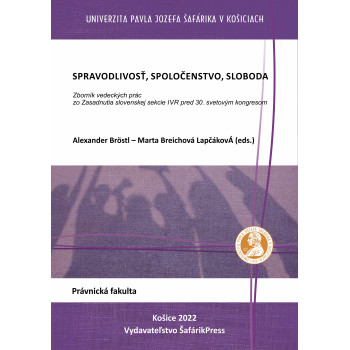
Spravodlivosť, spoločenstvo, sloboda

Spravodlivosť, spoločenstvo, sloboda

E-book

E-book

Alexander Bröstl - Marta Breichová Lapčáková (eds.)

The presented Collection Volume is dedicated to three framework areas, namely justice, community and freedom. These are the thematic areas of the 30th IVR World Congress, on the occasion of which a meeting of its Slovak section was held. The published contributions focus on the main topic of the congress, which is also the central topic of legal and social sciences. Thus, in the Collection we will find reflections on the freedom of the individual in society, its various shades of meaning and forms. The question of the organization of social relations in the form of the degree of participation of citizens in state power in the context of the democratic form of government and its current challenges should not be neglected either. Thus, the institutions of direct and indirect democracy, the dangers of the lures of the so-called totalitarian democracy, or the question of identities in a postmodern pluralistic society. The question of justice in procedural law is not avoided either.

The collection thus provides the reader with a wide area of research from legal-philosophical questions, through questions of the theory of the constitutional state, to their application in legal practice. Geographically, it maps the events in the Central European and wider European area with an impact on their global dimension. The publication can thus become a useful source of knowledge and current developments in jurisprudence and its main topics with the aim of a better understanding of social reality.

Download the e-book for free  (pdf)

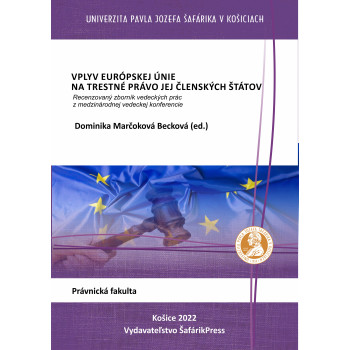
Impact of the European Union on Criminal Law of EU Member States

Impact of the European Union on Criminal Law of...

E-book

E-book

Dominika Marčoková Becková (ed.)

Reviewed collection of papers of the international scientific conference is the output of the international scientific conference held on 7th October 2022 within the framework of the project APVV-18-0421 „European Public Prosecutor's Office in Connections of the Constitutional Order of the Slovak Republic as Strengthening of the European Integration through Law“.

Unlike other areas of activities of the European Union, the European Union did not begin to enter the area of criminal law and criminal policy until much later. The reason is that the sphere of criminal law has traditionally been associated with the sovereignty of the state, which is why the Member States of the European Union are very slow to allow the European Union into it. The issue of the European Union's influence on the criminal law of its Member States is therefore becoming actual and raises many questions and application problems. In their papers, the authors address the various problems posed by the European Union's influence in the area of criminal law. Among the scientific problems and issues that the authors paid attention to in their works are the following: reasons for competence of the European Union within the field of criminal law; Impact of the EU legislation on criminal law of EU Member States; proposals to improve existing legislation, whether at European Union or national level, cooperation of the Court of Justice of the European Union and national judges via preliminary proceedings within the field of criminal law; as well as the issue of the European Public Prosecutor's Office.

Download the e-book for free  (pdf)

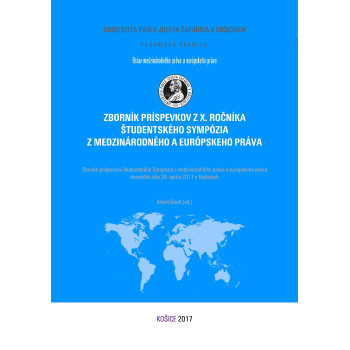
Zborník príspevkov z X. ročníka študentského sympózia z medzinárodného a európskeho práva

Zborník príspevkov z X. ročníka študentského...

E-book

E-book

Adam Giertl (ed.)

Proceedings of the Student Symposium on International Law and European Law held on April 28, 2017, at the Faculty of Law of Pavol Jozef Šafárik University in Košice

The Student Symposium is regularly organized by the Institute of International Law and European Law, and in 2017, it marked the jubilee tenth edition of the symposium, which over time expanded its focus to include European law.

The tradition of holding student symposia is also associated with the good practice of preparing proceedings from each event. Understandably, the tenth edition is no exception, and thus, the tenth edition of the symposium proceedings is now available to readers. In previous years, the symposium has always focused on specific areas of international and European law. Thus, the subjects of study for symposium participants have included migration issues (2016), the protection of cultural values (2015), and the challenges of cyberspace (2013).

This year, given that it is the jubilee tenth edition, the symposium organizers have chosen to approach the symposium's focus thematically and recall some significant milestones in the development of international law that occurred in years ending with the number seven.

Download the e-book for free (pdf)

Medzinárodné právo verejné (Materiály k štúdiu)

Medzinárodné právo verejné (Materiály k štúdiu)

E-book

E-book

Ľudmila Pošiváková - Adam Giertl

The presented selection of public international law documents aims to map international law from both historical and sectoral perspectives. The reader will find several historical documents in this collection, but the focus is primarily on currently valid legal sources.

The selection is guided by the publication Public International Law – General and Special Part by Prof. Ján Klučko, which is reflected in the division into general and special parts. The general part addresses the historical development of international law but primarily focuses on the protection of individuals and responsibility relationships in international law. The special part then examines the international regulation of various institutions of international law.

We acknowledge that this selection offers room for expansion, but we believe it meets basic requirements and fills a certain gap in the study of international law.

We trust that this collection of public international law materials will be beneficial for students, and not only for them, in the study of public international law and will contribute to raising awareness in this field.

Download the e-book for free (pdf)

Oslava právneho štátu (Právny štát z pohľadu teórie štátu a práva a medzinárodného práva)

Oslava právneho štátu (Právny štát z pohľadu...

E-book

E-book

Ľudmila Pošiváková -  Zuzana Antošová - Milan Kočan (eds.)

Proceedings from the Student Debate held on April 24, 2013, at the Faculty of Law of Pavol Jozef Šafárik University in Košice.

In the current period, the rule of law is widely debated both at the academic and political levels. This debate is not only related to the effort to establish the Rule of Law in states that have transitioned from socialist to democratic systems but also in states experiencing various unrests, whether political or religious.

However, it is not just a debate about certain characteristics of the Rule of Law that are missing in domestic law or at the level of international law, but also a debate about the very definition and meaning of the Rule of Law. The rule of law can be likened to an ideal that almost every state strives to achieve. Even in the case of the establishment of the independent Slovak Republic, the framers decided to include among the introductory provisions, which should form the core of the constitution, that the Slovak Republic is a state governed by the rule of law.

However, to achieve the ideal of the rule of law, it is necessary not only to declare it but also to adopt measures essential for an independent judiciary, democracy, the effective enforcement of human rights, the separation of powers, and many other elements that characterize a state governed by the rule of law.

Download the e-book for free (pdf)

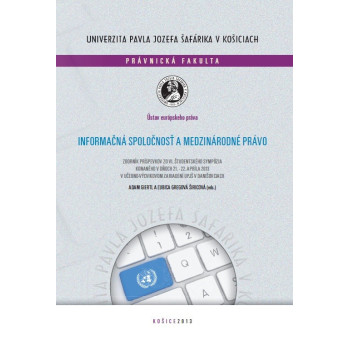
Informačná spoločnosť a medzinárodné právo

Informačná spoločnosť a medzinárodné právo

E-book

E-book

Adam Giertl - Ľubica Gregová Širicová (eds.)

Proceedings from the 5th Student Symposium held on April 21-22, 2013

The French delegate to the Commission on Human Rights, while discussing the inclusion of the term "media" in the article on freedom of expression in the draft of the International Covenant on Civil and Political Rights, wisely urged other members of the commission to be forward-looking regarding the information media of the future.

The discussion took place in 1950, when delegates could not yet foresee the impact of the internet on social relations. Given that it is now clear that information technologies significantly influence law, including international law, the organizers of the student symposium decided to dedicate its sixth edition to the theme "Information Society and International Law."

Students of the Faculty of Law, after registering for the symposium, first focused on preparing their contributions, with each participant having access to a consultant if needed. This year, the list of consultants, in addition to members of the Institute of European Law and the Department of International Law, was expanded to include an expert in intellectual property law, Mgr. Martin Husovec, a graduate of our Faculty of Law and currently an IMPRS-CI doctoral student at the Max Planck Institute for Intellectual Property and Competition Law. We also take this opportunity to thank him for dedicating his time to the students and providing them with valuable advice in preparing their contributions. After the preparatory phase, the symposium itself took place, with the aim of presenting the prepared contributions and discussing them.

The presented contributions reflected a wide range of intersections between international law and the information society.

Download the e-book for free (pdf)

Regionalizmus: Stav, východiská, perspektívy

Regionalizmus: Stav, východiská, perspektívy

E-book

E-book

Adam Giertl (ed.)

Proceedings of Scientific Works

International law does not represent a monolithic entity of uniform legal norms. It is a legal system that is fundamentally created by the consensus of states. It reflects the collective will of multiple entities regarding what should be binding and enforceable as law among them.

From this understanding arises the fact that the needs for legal regulation will differ in various parts of the world. The consequence of this situation is the formation of regional groupings where, to some extent, specific legal rules apply. As Professor Klučka points out in his study published in this proceedings, regionalization can occur both on a contractual basis and on an institutional basis. Regionalism in law thus raises many interesting questions that legal science addresses.

This proceedings of scientific papers also aims to contribute to the knowledge in this field.

Download the e-book for free (pdf)

Regionalizmus a jeho prínos pre všeobecné medzinárodné právo

Regionalizmus a jeho prínos pre všeobecné...

E-book

E-book

Ján Klučka a kol.

The presented monograph, “Regionalism and Its Contribution to General International Law,” was prepared at the Institute of European Law and the Department of International Law of the Faculty of Law at Pavol Jozef Šafárik University in Košice as part of a project of the same name (APVV-0823-11) carried out in the years 2011–2015, and represents one of its final publication outputs.

The main reason for choosing this topic was the effort to evaluate regionalism in its various forms in relation to international law, and, conversely, to assess the place, significance, and role of international law in the creation and functioning of different forms of regional groupings. In fact, although regionalism is receiving increasing attention in doctrine, a more comprehensive assessment of its impact on international law and vice versa has so far been lacking.

This monograph attempts to partially fill this gap. Against the background of a brief historical development of regionalism, as well as its substantive and terminological components, the monograph examines in greater detail the individual types of regionalism—such as old and new regionalism, as well as contractual and institutional regionalism—their specific features, and their contribution to general international law.

Attention is also devoted to a specific phenomenon of contemporary regionalism, namely the influence of the European Union on its stabilization and development, both through practical measures and through a set of measures regulated by international treaties.

Download the e-book for free (pdf)

Regionalism and Its Contribution to General International Law

Regionalism and Its Contribution to General...

E-book

E-book

Ján Klučka - Ľudmila Elbert

The present monograph "Regionalism and its Contribution to General International Law" was written at the Institute of European Law and Department of International Law, Faculty of Law, Pavol Jozef Safarik University in Kosice, as a part of the project (APVV-O823-11) carried out in 2011-2015, representing one of its final publication utputs. 

The main reason for choosing the topic was to evaluate regionalism in its various relationships and forms with respect to international law, and also to evaluate the place,importance and duties of international law in respect to the establishment and functioning of various forms of regionalgroups.

It is a fact that even though a lot of attention has been paid to regionalism, a more complex evaluation of the impact it has had on international law, and vice versa, is still lacking. The efforts of the present monograph are to partially eliminate this gap.

After giving a brief insight into how regionalism has developed, its content and terminology, the monograph studies in more details individual types of regionalism in the form of old and new regionalism, as well as treaty and institutional regionalism; its specifications and contributions to the international law.

Download the e-book for free (pdf)

Ochrana kultúrnych hodnôt prostriedkami medzinárodného a regionálneho práva

Ochrana kultúrnych hodnôt prostriedkami...

E-book

E-book

Adam Giertl - Ľudmila Elbert

Collection of Papers from the 8th Student Symposium held on April 20–21, 2015 in Danišovce

The capture of the historic Syrian city of Palmyra by fighters of the radical Islamic State caused shock among the global public. The main reason is the barbarism with which this organization proceeds, not only in relation to the treasures of the world’s cultural heritage. The situation in the Middle East, where cultural treasures of inestimable value are under direct threat, demonstrates how fragile the world’s cultural heritage is. The reaction of the international public and world leaders shows how sensitively the destruction of cultural heritage is perceived.

The quoted statement chosen by the editors relates to the threat posed by the Islamic State—however, the spirit of this statement can be applied to any cultural wealth that forms part of the world’s cultural heritage. The destruction or damage of these values primarily represents a loss for humanity as such. Each destroyed artifact of world cultural heritage signifies the disappearance of a unique legacy left by previous generations for the future. At the same time, cultural heritage must be understood as a broad spectrum of assets—both tangible and intangible. Their legal protection was the topic of this year’s symposium. As with any social interest, the protection of cultural heritage can be ensured through various mechanisms and under different forms of social organization.

These diverse approaches are unified by law as a normative system. The question for the 8th year of the symposium on international law was what role international law plays in the protection of cultural heritage. In the context of the European region, the role of the European Union as a regional organization was examined.

Download the e-book for free (pdf)

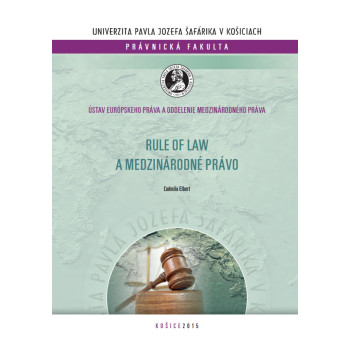
Rule of Law a medzinárodné právo

Rule of Law a medzinárodné právo

E-book

E-book

Ľudmila Elbert

The presented scientific monograph addresses the issue of the Rule of Law and its place, roles, and particularities at the level of international law. The Rule of Law is understood as a value that should govern communities, both domestic and international. It is thus compared to Kelsen’s basic norm, which should stand at the top of the legal order as the norm justifying the validity and existence of the norms of the legal order, both domestic and international.

Although the Rule of Law is studied at the international law level, it cannot be considered without understanding the Rule of Law in domestic law. Just as its development differs depending on whether it evolved within Anglo-American or continental law, its application and development also differ between domestic law and international law.

These differences are mainly caused by the roles and objectives that international Rule of Law is meant to secure, as well as by the distinct characteristics of domestic and international law.

Download the e-book for free (pdf)

This website uses cookies to ensure you get the best experience on our website