Slovenčina


E-book
Lucia Bakošová (ed.)
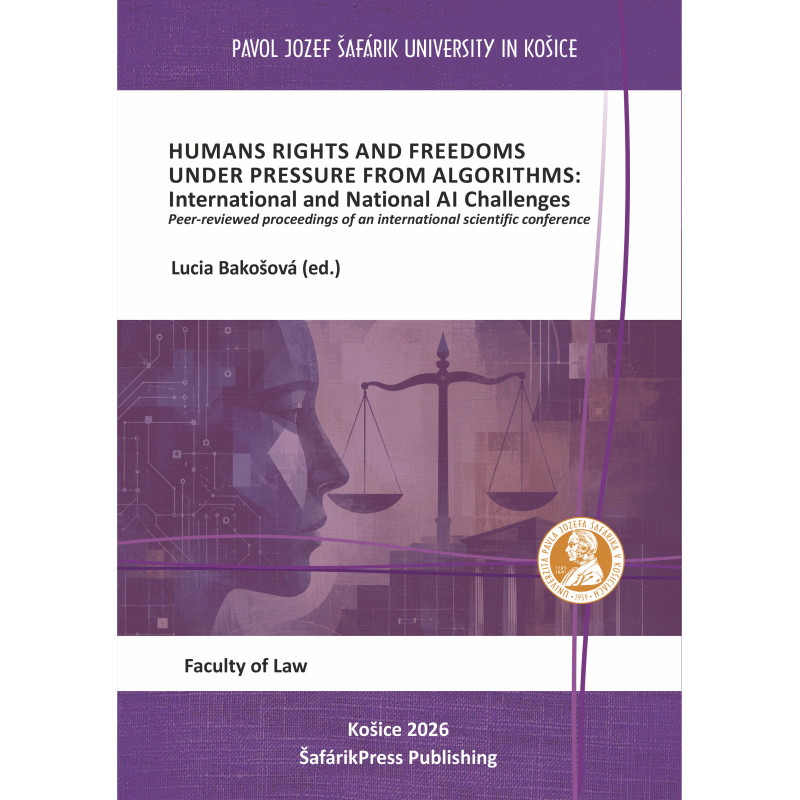
The proceedings Human Rights and Freedoms under Pressure from Algorithms: International and National AI Challenges constitute a peer-reviewed outcome of an international scientific conference devoted to the legal challenges arising from the development of artificial intelligence. The volume focuses on the impact of algorithmic systems on the protection of human rights and fundamental freedoms at the international, European and national levels. The individual contributions examine issues such as transparency, accountability, the right to a fair trial, privacy protection, non-discrimination, children’s rights, labour relations, digital constitutionalism, autonomous weapons, and the use of AI in public administration and armed conflicts. Particular attention is paid to the risks of algorithmic decision-making, legal hallucinations, profiling, surveillance, and the influence of digital technologies on democratic processes.
The proceedings Human Rights and Freedoms under Pressure from Algorithms: International and National AI Challenges constitute a peer-reviewed outcome of an international scientific conference devoted to the legal challenges arising from the development of artificial intelligence. The volume focuses on the impact of algorithmic systems on the protection of human rights and fundamental freedoms at the international, European and national levels. The individual contributions examine issues such as transparency, accountability, the right to a fair trial, privacy protection, non-discrimination, children’s rights, labour relations, digital constitutionalism, autonomous weapons, and the use of AI in public administration and armed conflicts. Particular attention is paid to the risks of algorithmic decision-making, legal hallucinations, profiling, surveillance, and the influence of digital technologies on democratic processes. The proceedings reflect the tension between technological progress and the capacity of existing legal frameworks to respond effectively to new forms of interference with individual rights. The contributions also highlight the need to strengthen transparency, human oversight, reviewability, and access to effective remedies. The volume brings together diverse scholarly perspectives and connects international law, European law, constitutional law, private law and criminal law aspects of AI regulation. Its aim is to contribute to the academic debate on how law should respond to the challenges of the algorithmic age while preserving human dignity, freedom and the rule of law.
Data sheet
E-book
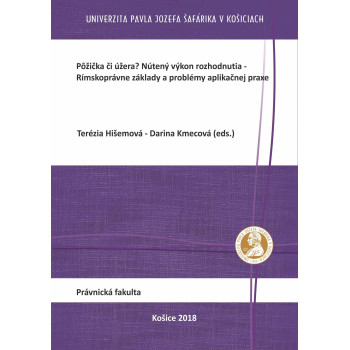
Terézia Hišemová - Darina Kmecová (eds.)
Reviewed proceedings of scientific papers of Conference of Slovak and Czech law romanists, which take place at May, 10.-11.5.2018, at Faculty of Law, UPJŠ in Košice.
The submitted reviewed proceeding of scientific papers on „The loan or usury? Compulsory enforcement of roman - law basics and problems of application practice.” is prepared within the solution of the grant project VEGA on: „The loan or usury? Compulsory enforcement of historical - law basics and problems of application practice.”, no. p. 1/0198/17.
The authors of papers are important personalities of Roman law working in the Slovak and Czech Republic, as well as PhD students and young scientists from Slovak and foreign universities who are active in the academic environment as well as in legal practice. The main goal of the editors is to help improve the current legal situation, which is assessed as unsatisfactory, and through a historical excursion of the development of the loan institute and then the forced execution of the decision, to create de lege ferenda proposals considering all areas of research.
The Proceedings trace the interrelationships between the substantive law institute in terms of the Roman law of contractus unilaterales - mutuum in its various types, often realized by the attachment of high interest rates, which bordered on the insurrection and the procedural law of individual lawsuits enforced in the legislative, formular and cognitive process. If there was no possibility to impose certain behaviour on the obligated person (the debtor, the sentenced person), then the declared general obligation to enforce the legal norms was only a legal term. It has always been the case that every internally well-organized state, whether antique or present, has to use power tools - often with the use of gross violence - but within the limits of the law, to promote what it has declared valid law. It must protect creditors on the one hand, but it must also prevent self-help and the use of illegal, unjustified and disproportionate violence.
The loan contract as a real contract has often become an integral part and relatively the most frequent reason leading to the compulsory enforcement, especially when contracting parties often agree on the connection of interest - sometimes within the legal limit, sometimes exceeding the legal framework - and in this way the potential future creditor (the plaintiff) significantly increased the insolvency risk of the debtor (the defendant, the sentenced) and of the subsequent execution. The pronounced and deepening social stratification of the Roman population and the secondary depreciation effort, the cancellation of the debts of the poor part of the population logically culminated in social unrest and revolt against the enforcement of the enforcement law.
The proceedings capture not only the rich scientific discussion of Slovak and Czech legal Romanists, but also the opinions, experience and knowledge of experts on contemporary law dealing with this type of issues. As a result, it provides a unique interdisciplinary view of the subject and raises many stimulus points for future research. This work proves that the problems encountered by the various representatives of the Roman jurisprudence and their legal and theoretical bases and solutions are undoubtedly useful and serve as a guideline also for solving legal issues in the field of modern enforcement proceedings.
E-book
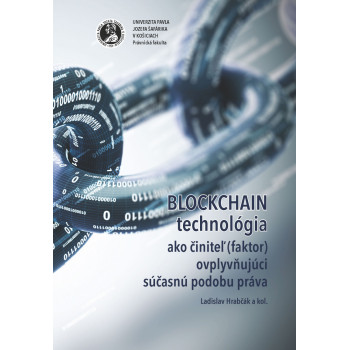
Ladislav Hrabčák et al.
The comprehensive work represents the final output from solving Project VVGS-2019-1068 titled 'Blockchain technology as a factor influencing the current form of law' and was created simultaneously as one of the partial outputs from Project APVV-19-0124 titled 'Tax Law and New Phenomena in Economy (Digital Services, Shared Economy, Virtual Currencies)'. The partial overlap in research topics between these projects allowed for such research, especially regarding digital (virtual) currencies.
Download e-book for free (pdf)
E-book
Marcel Dolobáč - Ľuboš Dobrovič - Ivan Kundrát
Hypothesis, disposition, sanction. The standard tripartite structure of a legal norm, which is taught to first-year law students. Three concepts that students undoubtedly master from their perspective, yet they simultaneously challenge legal science, which repeatedly revisits them. The publication does not aim to theoretically address all aspects of the legal norm; it focuses solely on one of them, and as the title suggests, that is the sanction.
The monograph has been developed by three authors, whose contributions are equal; they engaged in debates and often could not reach a consensus. We hope that the reader will also join this debate and that the presented monograph will inspire further reflection and scientific activity.
E-book
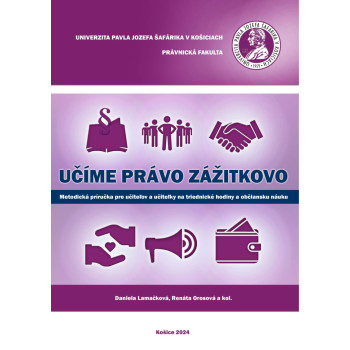
Daniela Lamačková-Renáta Orosová- Beáta Sakalová- Diana Repiščáková
Methodological guide for teachers for classroom lessons and civics Teaching law experientially? Is it even possible? The answers to these questions are provided by a methodological guide that uniquely links experiential learning methods with legal content. This methodological guide is a set of techniques based on the use of interactive and participatory learning methods, focusing on selected human rights and value-oriented topics, which also have the potential to develop other key competences of students, such as their communication skills, their ability to learn and educate independently, their ability to think critically, their ability to work with and analyse texts, their ability to discuss and express their opinions, and their ability to listen to each other. The methodological guide consists of a set of training activities - techniques, while each technique contains a precise description of the procedure for conducting a specific activity, the expected duration of the activity, aids, discussion topics and also a short pedagogical and legal commentary, precisely "tailored" to the specific legal topic. The legal topics are chosen to be generally applicable to both classroom and civics lessons, to raise questions about the functioning of rules and the need to respect them, mutual respect and tolerance, and to encourage reflection on the limits of individual rights and on responsibility in exercising one's rights. The techniques use training methods such as group work, brainstorming, role-playing, dealing with model situations, as well as a simulated court process. The methodological guide is intended for classroom teachers in the implementation of classroom lessons, and also for the purposes of the subject of civics, as well as for students of pedagogy at the Pavol Jozef Šafárik University in Košice.
Download e-book for free (pdf)