Slovenčina



E-book
Ladislav Orosz Ignác Brosch (eds.)
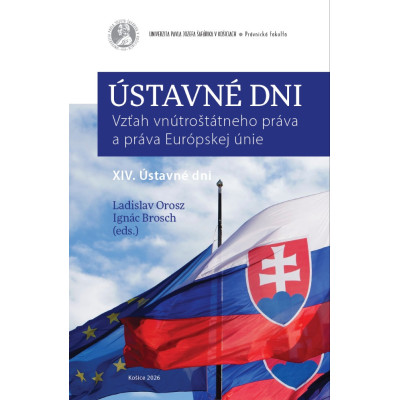
Scientific proceedings from the traditional international scientific conference organized by the Constitutional Court of the Slovak Republic and the Faculty of Law of the Pavol Jozef Šafárik University in Košice, titled “The Relationship Between Domestic Law and European Union Law – 14th Constitutional Days,” consists of papers by renowned representatives of domestic and foreign constitutional doctrine, as well as authors who currently serve as judges of constitutional courts and the Court of Justice of the European Union, or as their advisors. From a substantive perspective, the contributions included in the collection address the challenges arising from current developments in the case law of the Court of Justice of the European Union and the case law of the Constitutional Court of the Slovak Republic and certain other foreign constitutional courts regarding the relationship between national legal systems and European Union law.
Scientific proceedings from the traditional international scientific conference organized by the Constitutional Court of the Slovak Republic and the Faculty of Law of the Pavol Jozef Šafárik University in Košice, titled “The Relationship Between Domestic Law and European Union Law – 14th Constitutional Days,” consists of papers by renowned representatives of domestic and foreign constitutional doctrine, as well as authors who currently serve as judges of constitutional courts and the Court of Justice of the European Union, or as their advisors. From a substantive perspective, the contributions included in the collection address the challenges arising from current developments in the case law of the Court of Justice of the European Union and the case law of the Constitutional Court of the Slovak Republic and certain other foreign constitutional courts regarding the relationship between national legal systems and European Union law.
The authors of several articles included in the collection pay particular attention to analysing differing views on the scope of the primacy of European law over national legal systems and the increase in conflicts between national constitutions – and their current amendments – and the current case law of the judicial bodies of the European Union and the decisions of the European Union’s highest institutions, particularly the European Commission. The content of the conference proceedings was significantly influenced by the fact that the 14th Constitutional Days took place just a few days after the adoption of the amendment to the Slovak Constitution – which has been controversially assessed in constitutional doctrine-enacted by Constitutional Act No. 255/2005 Coll., whose key objective was to declare the national identity of the Slovak Republic in matters of culture and ethics. The differing views on the merits of this constitutional amendment – and the reservations expressed regarding it immediately after its adoption in several conference papers – enhance both the relevance and the appeal of the academic proceedings from last year’s Constitutional Days.
Data sheet
E-book
Dominika Marčoková Becková (ed.)
Proceedings of Papers of XVIth year of the student symposium of the Institute of International Law and European Law
Proceedings of Papers of XVIth year of the student symposium of the Institute of International Law and European Law is devoted to selected aspects of the place and role of criminal law from the point of view of contemporary EU law and international law. In their contributions, students deal with current topics of criminal law in the law of the European Union and international law. In the EU law, the most actual issue is the European Public Prosecutor's Office, a body of the EU responsible for investigateing and prosecuting criminal offenses affecting the Union's financial interests.
The first part of papers dealt with the reasons for the establishment of the European Public Prosecutor's Office, its structure and tasks, the issue of conducting the investigation of the European Public Prosecutor's Office in the conditions of the Slovak Republic, as well as with the relations of the European Public Prosecutor's Office with its closest partner, the European Anti-Fraud Office.
The second part of the contributions reflects current issues and challenges of criminal law in international law. Authors in their papers focused on the issue of the International Criminal Tribunal for Ukraine, the legal problems and challenges associated with its creation, on the issue of the crime of aggression before the International Criminal Court, as well as on issues of immunity of state representatives before national courts.
E-book
Juraj Panigaj (ed.)
Collection of Contributions from the XVth Student Symposium on International Law and European Law, held on April 22, 2022, in a hybrid format, with the participation of students from the Faculty of Law of Pavol Jozef Šafárik University in Košice and the Faculty of Law of Trnava University in Trnava.
The jubilee XV. year of student symposium from international and European law took place at the University of Pavol Jozef Šafárik, faculty of law, on April 22, 2022, symbolically on Day Earth. This year's event was dedicated to the increasingly pressing issue of environmental protection. The topic "Green ambitions in the light of European and international law" appealed to many students, resulting in several interesting contributions, falling under both European Union law and international law. European law currently brings great challenges, but also expectations through the European Green Deal. This is also why several student contributions dealt with topics falling under the European Green Deal, either from the point of view of its individual initiatives in general, or more specifically, in the intentions of Agenda 2030, or the implementation of the so-called green diplomacy.
The other part of contributions dealt with environmental protection within international law. Students addressed issues of an environmental nature in the areas of climate change, international maritime law, atmospheric protection, or the issue of so-called climate refugees. The publication itself is an output of the APVV project APVV-20-0576 "Green ambitions for sustainable development (European Green Deal in the context of international and national law)".
Download e-book for free (pdf)
E-book
Jozef Suchoža - Ján Husár - Regina Hučková (eds.)
Collection of Scientific Works
The scientific papers presented in this Collection are primarily the result of academic research conducted by experts working within the academic environment—particularly at Faculties of Law in the Slovak Republic and the Czech Republic, as well as by foreign experts, including those from Poland, the Russian Federation, Serbia, and others. In addition to academic contributions, this Collection also includes scientific and professional articles authored by legal practitioners, especially lawyers, notaries, and judges—not only from our own jurisdiction, but also judges from the General Court of the European Union. Contributions from professionals in the field of banking have also enriched this Collection. Moreover, the Collection provides space for aspiring scholars in the field of legal science, thereby combining timelessness with dynamism.
Given the diversity of the published contributions, it can be said that this Collection represents a connection between theory and practice, private and public law, as well as various branches of law. Nevertheless, the content of this Collection aligns with and reflects the central theme of the international symposium, namely: "CORPORATIONS – CONTRACTS – CODIFICATIONS – CONTEXTS." The individual sections of the Collection are interconnected and create a coherent whole, subsumed under a publication characterized by unity.
E-book
The author's ambition is to build on the current and at the same time to stimulate further discussion of the anchoring of labour law in the system of private law sectors and to contribute to the variation of views in relation to freedom of contract and its limits in labour law. The broad contractual freedom of civil law does not apply to the field of labour law, and thus the penetration of standard civil law institutes into labour law relations is not always self-evident.
The above constitutes the main theses of the present monograph. The issue of freedom of contract in labour law can be grasped in several ways. The author has chosen a content structure that is built on three basic pillars. In the first part, the author assesses the position of labour law in the system of law, which is determined primarily by the actual subject of legal regulation - dependent labour and the specific method of legal regulation through cogent and relatively cogent norms. In this context, the author would like to note at the outset that the much-discussed dispositive nature of labour law norms appears to be merely presumptive. Labour law is built on minima and maxima, with relative mandatory norms being the building blocks of fixed boundaries, a fact that distinguishes labour law from other branches of private law. These considerations are followed by the author's view of autonomy of will in labour law. The limits of contractual freedom (not only) in the theoretical sense form the second pillar of the author's ideas.
Finally, the third part of the thesis is to be the one that translates the theoretical-legal considerations of the interconnection of civil law and labour law into the interpretation of selected civil law institutes and the possibility of their application and implementation in labour law relations.