Filter By

Categories

Categories

Year of publication:

Year of publication:

Publication language:

Publication language:

Faculty:

Faculty:

UPJŠ Unit

UPJŠ Unit

Method of publication:

Method of publication:

Active filters

  • Year of publication:: 2011
  • Year of publication:: 2018
  • Year of publication:: 2018
  • Year of publication:: 2018
  • Year of publication:: 2018
  • Year of publication:: 2018
  • Year of publication:: 2018
  • Publication language:: English
  • Publication language:: slovenčina
  • Publication language:: slovenčina
  • Publication language:: slovenčina, čeština
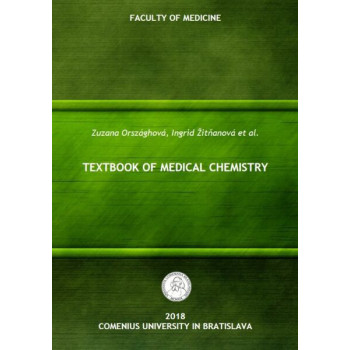
TEXTBOOK OF MEDICAL CHEMISTRY

TEXTBOOK OF MEDICAL CHEMISTRY

E-book

E-book

Lucia Andrezálová, Zdeňka Ďuračková,Mária Chomová,Vladimír Jakuš, Miriam Ježovičová, Jana Muchová, Zuzana Országhová,Ingrid Žitňanová

Chemistry and biochemistry at medical faculties are integral parts of basic theoretic knowledge of contemporary graduate. Educational book “Textbook of Medical Chemistry” is destined to students of study branches General Medicine and Dentistry for the course “Medical Chemistry”.

It is structured into 13 chapters concerning several topics: general and physical chemistry, organic chemistry, chemistry of natural substances (static biochemistry), enzymology and oxidative stress.

Individual chapters provide comprehensible explanation of the fundamentals of physico-chemical, chemical and biochemical relationships applying in living systems as well as the knowledge of the structure of biologically important molecules (simple molecules and macromolecules) related to their properties and biological function.

Download e-book for free (pdf)
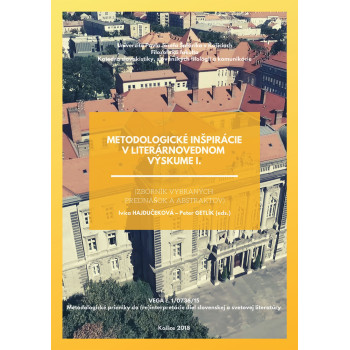
Methodological Inspirations in the Research of Literary Science I.

Methodological Inspirations in the Research of...

E-book

E-book

Ivica HajdučekováPeter Getlík (eds.)

Proceedings of Selected Lectures and Abstracts

Grant project VEGA No. 1/0736/15 Methodological Basis of Literary (re)interpretation in Slovak and World Literature (the head of the project: prof. PhDr. Ján Gbúr, CSc.), whose realization lasted for four years (2015 – 2018) at the Department of Slovak Studies, Slavonic Philologies and Communication of Faculty of Arts of Pavol Jozef Šafárik University in Košice, brought several lecture events with the participation of experts from Slovak and Czech academical space. The original and progressively accomplishing project goal was to continue the tradition of exactness and support its implementation into our everyday scientific thinking and literary-scientific exploration. Each of fourteen invited lectures was a unique, professionally inspiring and humanly enriching meeting.

On that account there is a nontraditional project output: the proceedings of selected lectures and abstracts (abstracts were translated into English language by Mgr. Dominika Petáková, internal postgraduate student of literary science at Department of Slovak Studies, Slavonic Philologies and Communication) titled Methodological Inspirations in the Research of Literary Science I., which is intended for academical and study purposes at universities. The topics of the lectures were completed successively according to interest and demands of research team and current scientific research of invited guests.

Download the e-book for free (pdf)

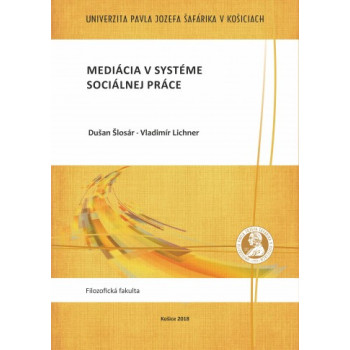
Mediácia v systéme sociálnej práce

Mediácia v systéme sociálnej práce

E-book

E-book

Dušan ŠlosárVladimír Lichner

This university textbook aims to provide readers with knowledge of the philosophical foundations, meaning, and purpose of mediation, based on research and analysis of mediators' activities. In countries where mediation services operate, their staff often include graduates of social work departments.

An individual approach to both the perpetrator and victim of a criminal offense requires knowledge and skills from social work, psychology, sociology, communication, and related fields tied to social work. The principles of social work apply not only in social policy and social care but also in justice. A mediator’s mission is to facilitate alternative resolutions to unlawful acts while preserving the purpose of legal proceedings as defined by valid legal norms. They fulfill this mission through specific methods of individual social work applied in the justice sector. The mediator’s focus extends beyond the current conflict to uncover related issues, activate parties to resolve disputes, and prevent new conflicts.

Special attention is devoted to the philosophical foundations of mediation in Slovakia. We provide an overview of mediators’ core activities and mediation types used to uphold justice in Slovakia. We analyze mediation goals, the roles of parties involved, and procedural steps. In applying mediation, we explore its potential and implementation in both legal and social work contexts.

As indicated, mediation cannot be understood solely as a specialized activity in criminal justice, as it has broader applications in non-judicial dispute resolution, such as family or community work, which are often overlooked by the public. The mediator’s approach to diverse target groups is grounded in theoretical frameworks. From this foundation, we derive activities expected of mediators in the future. Expanded activities arise from concrete situations encountered during mediation.

Download the e-book for free (pdf)

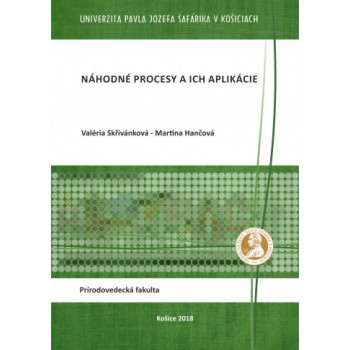
Náhodné procesy a ich aplikácie

Náhodné procesy a ich aplikácie

E-book

E-book

Valéria SkřivánkováMartina Hančová

The publication is focused on discrete random processes, primarily on Markov chains, which have wide application in the field of economics and finance.

The textbook is divided into five chapters, the first of which serves as an introduction to random processes and provides definition, properties and classification of random processes in general. The second chapter discusses Markov chains with discrete time, including valuation of transitions between states and their optimal management. The third chapter focuses on special Markov chains with continuous time and emphasizes construction and solution to the system of Kolmogorov differential equations, which describe the dynamics of the process development. The last two chapters illustrate applications of Markov chains using examples of queuing system modeling and renewal theory.

Besides the explanation of basic terms, definitions and theorems with proofs, this textbook also provides number of solved examples to illustrate the discussed theory. Problem assignments are placed at the end of each chapter, so that readers can test their understanding of the content as they progress through the book. Solutions to all the problems and the list of references are provided at the end of the publication.

This textbook is primarily intented for students majoring in Economics and Financial Mathematics at the Faculty of Science of Pavol Jozef Šafárik University in Košice, and it covers content of the course “Random Proceses 1“ thought there. It might however serve also students from other schools in similar progams or professionals interested in this topic.

Download the e-book for free (pdf)

Myths and Manipulation in Political Discourse

Myths and Manipulation in Political Discourse

E-book

E-book

Jaroslav Marcin - Viktória Marcinová a kol.

This little book started out in a way that probably many other scholarly publications do: When the five of us met as doctoral students and instructors in the Department of British and American Studies, we soon realized that our research overlapped on a number of points. Most prominent among those was our interest in political or politicallymotivated discourse and the study of myths and manipulation that it employed. 

In the end, we decided to pool the results of our research together in order to create a more complex picture, providing a variety of perspectives and voices. In our endeavor, we were greatly aided by the financial support we received from a grant offered by the Šafárik University. The outcome of these efforts is the five chapters of this brief, but hopefully informative and insightful monograph.

In Chapter 1, Viktória Marcinová deals with the impact of totalitarian ideology on the translation of so-called “capitalist” drama during the first stage of normalization in Slovakia (1948-1968). In Chapter 2, the focus shifts to political discourse and manipulation in a democracy, as Jaroslav Marcin takes a closer look at the wartime rhetoric of American presidents. USA remains the focus also in Chapter 3, but this time the question, addressed by Martina Martausová, will be one of the myth of the American Dream and its presentation in post-9/11 United States. A similar idea, though in a different geographical-cultural context, is dealt with in Chapter 4, where Božena Velebná identifies myths of Scottish identity as portrayed in historic films. Finally, in Chapter 5, Eduard Soták will take a look at the role of the mass media within the topic of politically-motivated discourse and spread of political ideology.

Download the e-book for free (pdf)

Philosophy of the history of philosophy

Philosophy of the history of philosophy

E-book

E-book

Vladimír Leško

The book is the result of long-term contemplation on the relationships between the history of philosophy and its reflection in more or less systematic, or non-systematic forms of philosophizing of the most significant philosophical teachings of the 19th and 20th centuries (Hegel, Schelling, Marx, Nietzsche, Husserl, Heidegger, Fink, Patočka, and Gadamer).

The primary goal of the work is to present the most significant historical-philosophical teachings of the 19th and 20th centuries in the formation and fulfillment of strong and weak models of the philosophy of the history of philosophy in the concepts of Hegel, Schelling, Marx, Nietzsche, Husserl, Heidegger, Fink, Patočka, and Gadamer.

The results of the philosophy of the history of philosophy are presented here as a metatheoretical movement within historical-philosophical thinking, whose aim is not to empirically describe the historical-philosophical process, but to understand and explain it as an inseparable part of the most significant philosophical problems – what is philosophy, what is metaphysics, and the question of being.

Download the e-book for free (pdf)


100 years of the koruna

100 years of the koruna

€30.69
Availability: 1 In Stock

Vladimír Tomšík et al.

The book was prepared to mark an important anniversary – one hundred years of our national currency. It was written by a team of Czech National Bank experts headed by CNB Vice-Governor, Professor Vladimír Tomšík. This publication charts the monetary policy history of our central bank (or, to use older terminology, the bank of issue) and describes its institutional development and the banknotes it has issued over time. It covers the period from the establishment of the independent Czechoslovak state in October 1918 and its currency in February 1919 to the present. We have therefore named the publication 100 years of the koruna. Given the twists and turns of history, however, part of the narrative relates to the joint Czechoslovak state, part to the occupied Protectorate and part to the independent Czech Republic. As a result, the original joint Czechoslovak currency was divided temporarily in 1939–1945 and then again – this time for good – in 1993. From that point on, the currencies of the two successor states went their own ways, the Czech koruna continuing to the present day and the Slovak koruna until it was replaced by the single European currency in 2009.

This website uses cookies to ensure you get the best experience on our website