Filter By

Categories

Categories

Year of publication:

Year of publication:

Publication language:

Publication language:

Faculty:

Faculty:

Active filters

  • Year of publication:: 2013
  • Year of publication:: 2019
  • Year of publication:: 2019
  • Year of publication:: 2019
  • Year of publication:: 2019
  • Faculty:: Faculty of Law
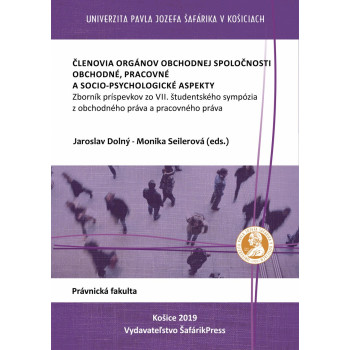
Členovia orgánov obchodnej spoločnosti. Obchodné, pracovné a socio-psychologické aspekty

Členovia orgánov obchodnej spoločnosti....

E-book

E-book

Jaroslav DolnýMonika Seilerová (eds.)

The collection of contributions from the VII. Student Symposium on Commercial Law and Labor Law held on December 5, 2019, at the Faculty of Law of Pavol Jozef Šafárik University in Košice

The theme of this year's symposium provided students with the opportunity to choose between addressing issues related to commercial law or focusing on labor law aspects concerning the position of members of the governing bodies of commercial companies, based on an analysis of legal regulations and case law.

The creative exploration of commercial law questions particularly related to areas such as the manner of acting on behalf of a commercial company, the liability of the de facto statutory body of a commercial company, information obligations of the statutory body towards its shareholders, and the remuneration for serving as a member of the board of directors of a joint-stock company. It also addressed the liability of the statutory body for the insolvency of the company and the enforcement of non-competition clauses concerning managing directors of limited liability companies.

The connection between commercial law and labor law was directed towards a legal analysis of personal data protection related to health and its misuse by members of the governing bodies of commercial companies, as well as the legitimacy of concurrently holding a position (as a member) in a statutory body with an employment relationship, and the legal status of senior employees, particularly concerning their duties and responsibilities for ensuring employee health through creating healthy working conditions.
Download the e-book for free (pdf)

Sankcie v pracovnom práve

Sankcie v pracovnom práve

E-book

E-book

Marcel DolobáčĽuboš DobrovičIvan Kundrát

Hypothesis, disposition, sanction. The standard tripartite structure of a legal norm, which is taught to first-year law students. Three concepts that students undoubtedly master from their perspective, yet they simultaneously challenge legal science, which repeatedly revisits them. The publication does not aim to theoretically address all aspects of the legal norm; it focuses solely on one of them, and as the title suggests, that is the sanction.

The monograph has been developed by three authors, whose contributions are equal; they engaged in debates and often could not reach a consensus. We hope that the reader will also join this debate and that the presented monograph will inspire further reflection and scientific activity.

Download the e-book for free (pdf)

Návrh metodického postupu medzinárodných mimovládych organizácií pri reakcii na katastrofy

Návrh metodického postupu medzinárodných...

E-book

E-book

Lucia BakošováĽudmila ElbertĽubica Gregová Širicová 

Disasters, whether natural or industrial, have a serious impact on the functioning of society and are a negative phenomenon which, with the increasing impact of climate change, is increasingly affecting the sustainable development and prosperity of States. Their increasing regularity and intensity affect the current evolution not only of social life, but also of legal debates on the necessity of responding to international and national disaster response, eliminating their negative consequences and protecting affected persons. No State is immune to the occurrence of disasters, and this also applies to the Slovak Republic, which is mostly affected by sudden natural disasters, namely floods, landslides, droughts, fires, windstorms and snow calamities.

The subject of this publication is the proposal of the methodological guidelines regulating the activities of NGOs in case of disaster, as well as cooperation with the state affected by the disaster, and the glossary of legal terms which need to be clear and unified in case of disaster. Slovak and English version of the proposal is basic precondition of its usability not only for the state organs of the Slovak republic and Slovak NGOs, but also for foreign NGOs.The Proposal of the methodological guidelines is the result of the research project VVGS-PCOV 2018-459: Návrh metodického postupu mimovládnych organizácií v prípade katastrofy v podmienkach Slovenskej republiky (The Proposal of the methodological guidelines for the non-governmental organisations in case of disaster in conditions of the Slovak republic).

Download the e-book for free  (pdf)

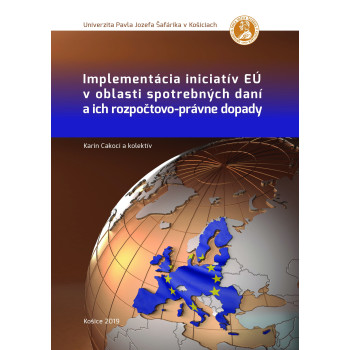
Implementácia iniciatív EÚ v oblasti spotrebných daní a ich rozpočtovo-právne dopady

Implementácia iniciatív EÚ v oblasti...

E-book

E-book

Karin Cakoci et al.

The authors in the monograph focused on describing the genesis and current state of the legal regulation of consumption taxes in the Slovak Republic in interaction with the harmonization process, as well as identifying the mutual dependence of the legal regulation and revenues from consumption taxation on the effect on the state budget of the Slovak Republic.

Given the importance and justification of the researched issue, particularly in relation to the future functioning of the European Union, as well as the impact on the performance of the economies of individual member states, with an emphasis on the development and quality functioning of the single internal market, the authors, through the publication of the monograph, attempt to provoke a broader professional discussion about their own summarized presented results, which were obtained during the entire period of solving the scientific project, concerning current trends as well as perspectives in the field of EU tax policy and its influence on domestic tax legislation in the Slovak Republic in the area of consumption taxes in interaction with budgetary impacts.

The overall goal of the monograph is to present existing and own acquired knowledge related to the issue of consumption taxes in Slovakia, with an emphasis on the development of EU initiatives in this area, as well as a critical evaluation of their impact on the state budget of the Slovak Republic, and presenting possible future developments.

Download the e-book for free  (pdf)

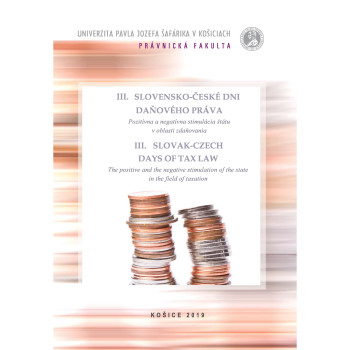
III. SLOVAK-CZECH DAYS OF TAX LAW. Positive and Negative Stimulation of the State in the Area of Taxation

III. SLOVAK-CZECH DAYS OF TAX LAW. Positive and...

E-book

E-book

Vladimír BabčákAdrián PopovičJozef Sábo (eds.)

Within the project APVV-16-0160 "Tax evasion and tax avoidance (motivation factors , formation and elimination)" was organized conference called III. SLOVAK-CZECH DAYS OF TAX LAW " Positive and Negative Stimulation of the State in the Area of Taxation ". From this conference was prepared the eponymous output in the form of reviewed proceedings of scientific works.

In this publication is published the contributions from several prominent personalities of tax law science in Slovakia and the Czech Republic. lndividual contributions map tax legislation and also changes due to the development of tax legislation , especially under the influence of European Union law. Th ese changes are approached in the context of their specific economic impacts and their impact on status and legal relations in the business and social field . The main topics elaborated in the individual contributions are in particular: EU activities in relation to tax fraud and tax evasion, the impact of tax construction on the act of the addressees of tax law and tax policy of the state and its economic impacts.

The publication presents one of the most actual topics in the current legal and economic environment.

Prof. h.c. prof. JUDr. Vladimír Babčák, CSc.

Download the e-book for free  (pdf)

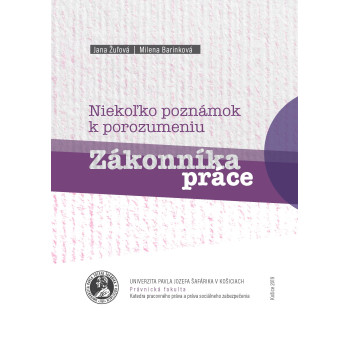
Niekoľko poznámok k porozumeniu Zákonníka práce

Niekoľko poznámok k porozumeniu Zákonníka práce

E-book

E-book

Jana ŽuľováMilena Barinková 

Legal norms regulate everyday life. We learn about the rights and obligations that arise for us from these norms through language. It is therefore very important that they are created in such a way that all levels of society understand them, not only recipients with legal education.

The Labour Code is a norm of everyday use, and so far there is no publication that approximates or clarifies the understanding of the provisions of this law through the prism of its language. The main goal of the publication is to apply the acquired linguistic knowledge about the pitfalls of the comprehensibility of legal language for the general public to the Labour Code and thus enable its more adequate understanding. Our ambition is not a comprehensive interpretation of the provisions of the Labour Code, which give the impression of incomprehensibility for the average addressee.

We focused on selected problematic phenomena observed and identified during the solution of the VEGA grant project no. 1/0526/17 Linguistic and Sanctioning Mechanisms in the Creation and Operation of Labor Law Norms and strived for a conceptual approach to their examination enriched by empirical research.

Download the e-book for free  (pdf)

LAW - COMMERCE - ECONOMY IX.

LAW - COMMERCE - ECONOMY IX.

E-book

E-book

Jozef SuchožaJán HusárRegina Hučková (eds.)

Collection of papers presented at an international scientific symposium LAW - COMMERCE - ECONOMY held from 23rd. – 25th. of October 2019 in High Tatras

This year's conference program and the proposed collection reflect current topics not only in domestic legal science (recodification of private law in the conditions of the Slovak legal order) but also in European and international legal science (legal and ethical aspects of artificial intelligence). The conference program is enriched this year by a section, which the organizers have prepared in cooperation with the International Arbitration Court at the Czech-Moravian Commodity Exchange and the Arbitration Court at the Chamber of Commerce of the Czech Republic and the Agrarian Chamber of the Czech Republic.

Download the e-book for free  (pdf)

Medzinárodné a európske právo v kinematografii

Medzinárodné a európske právo v kinematografii

E-book

E-book

Lucia Bakošová (ed.)

Proceedings from the XII Student Symposium on International and European Law held on March 29, 2019, in Košice

The primary goal of films or TV series is typically not to educate their audience. However, contemporary cinematography includes a significant number of works that present issues related to international and European law to both professional and general audiences.

For this reason, the Institute of International and European Law at the Faculty of Law of Pavol Jozef Šafárik University in Košice organized the XII Student Symposium on International and European Law titled "International and European Law in Cinematography," under the auspices of Professor JUDr. Ján Klučka, CSc.

The main objective of the symposium was to popularize international and European law among students through films or series. The films analyzed during the symposium could be divided into two categories: those dramatizing real events and those creating fictional scenarios incorporating aspects of international or European law. Most contributions focused on films depicting real events, such as the genocide in Rwanda in the 1990s, the Nuremberg Trials, the occupation of the U.S. Embassy in Tehran, or the legal dispute between the heir of the painting Woman in Gold and Austria. On the other hand, works like the series MASH* were also discussed; while not based on real events, it uses its narrative to portray the lives of medical personnel in a military field hospital during the Korean War.

Download the e-book for free (pdf)

Ochrana zamestnanca perspektívou priemyselnej revolúcie 4.0

Ochrana zamestnanca perspektívou priemyselnej...

E-book

E-book

Milena Barinková (ed.)

Proceedings from the IV Annual Student Symposium on Labor Law held on April 5–6, 2019, in Danišovce

The term "Industrial Revolution 4.0" is currently widely used, yet remains mysterious and its content unfamiliar to many. While we do not claim omniscience, through the educational process at the Faculty of Law of Pavol Jozef Šafárik University in Košice and the scientific research of the Department of Labor Law and Social Security Law, we have delved into examining the accompanying features and anticipated phenomena of this modern industrial revolution.

It can be stated with great certainty that this revolution already affects—and will continue to affect—production processes, including radical changes in their structure, the emergence of groundbreaking technological and communication tools, and, undoubtedly, labor relations. The rise of new forms and methods of work based on automation and digitalization, applied within new models of labor relations, is beginning to threaten jobs in certain sectors of the economy. There is an increasing demand for specialized qualifications and skills, particularly in information technology, with an emphasis on process digitalization, data processing, and the creation of communication networks connecting objects and people. This intelligent industry inevitably disqualifies many existing jobs from their current structures, leading to job losses for numerous employees. Analysts openly predict that by 2030, robots will replace up to 20 million industrial jobs worldwide.

The vision of which occupations or working conditions will be impacted is becoming increasingly concrete. Radical changes will require radical solutions as well as previously unknown movements and new elements or measures in the labor market.

Download the e-book for free  (pdf)

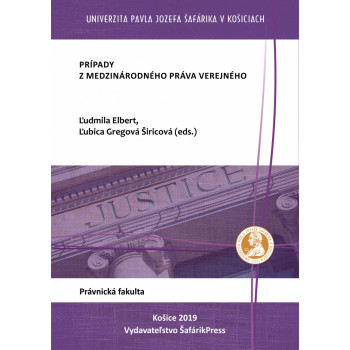
Prípady z medzinárodného práva verejného

Prípady z medzinárodného práva verejného

E-book

E-book

Ľudmila ElbertĽubica Gregová Širicová (eds.)

In addition to acquiring theoretical knowledge, it is necessary to study and analyze the decisions of international judicial and arbitration bodies in order to fully understand the subject of the Public International Law or disciplines closely related to it.

Since the Slovak literature in the field of Public International Law does not contain any electronic textbook of selected decisions of international judicial and arbitration bodies, the authors of the submitted publication aim to eliminate this gap by elaborating the “Public International Law Casebook”, which will primarily be intended for undergraduate students of the law faculties in the Slovak republic and the Czech republic.

The proposed publication seeks to make the study of international law more attractive through a publication that will make students familiar with the decisions translated into the Slovak language in a popular electronic form.

Download the e-book for free (pdf)

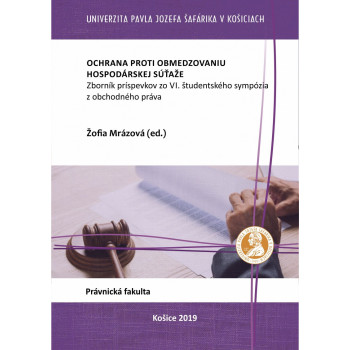
Ochrana proti obmedzovaniu hospodárskej súťaže

Ochrana proti obmedzovaniu hospodárskej súťaže

E-book

E-book

Žofia Mrázová(ed.)

Proceedings from the VI. Student Symposium on Commercial Law Held on November 28, 2018, at the Faculty of Law, Pavol Jozef Šafárik University in Košice

The Department of Commercial and Economic Law at the Faculty of Law, Pavol Jozef Šafárik University in Košice, organized the sixth annual Student Symposium on Commercial Law on November 28, 2018. The event was part of the research project VEGA 1/0917/16 titled "Atypical and De Facto Relationships in Commercial Law." The symposium aims to provide a platform for discussion among students with the guidance of mentors from the department, including professors, researchers, and doctoral candidates.

This year’s symposium focused on protection against anti-competitive practices. Unchecked anti-competitive behavior could grant economic advantages to violators at the expense of other competitors and threaten the free-market system. Students explored various challenges related to competition law, analyzing Slovak and European legal frameworks as well as court rulings and decisions by other authorities. Through their research, students honed their analytical thinking, argumentation skills, and critical reasoning. The discussions generated new perspectives and encouraged active engagement among participants.

This proceedings volume presents the outcomes of students' work from this event.

Download the e-book for free(pdf)

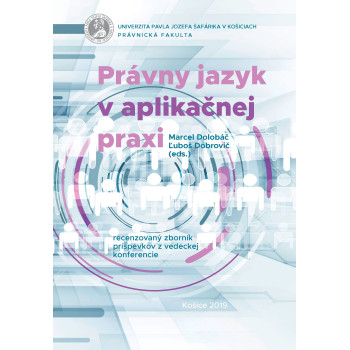
Právny jazyk v aplikačnej praxi

Právny jazyk v aplikačnej praxi

E-book

E-book

Marcel Dolobáč - Ľuboš Dobrovič (eds.)

Reviewed Proceedings of Contributions from a Scientific Conference

This reviewed collection of contributions from the scientific e-conference Legal Language in Application Practice, held from December 3 to 21, 2018, presents various academic contributions.

Legal language, as expressed in legal norms, is specific and should ideally be unambiguous, concise, and resistant to multiple interpretations. Is this an ideal world that does not exist but is worth striving for? Interpretative challenges and ambiguities in legal language and terminology (especially in the Labour Code) led the Department of Labour Law and Social Security Law at UPJŠ in Košice to undertake the VEGA grant project No. 1/0526/17 titled Linguistic and Sanction Mechanisms in the Creation and Operation of Labour Law Norms.

As part of this grant project, the department organized an e-conference open not only to labor law specialists but also to experts from other legal fields. Unsurprisingly, interpretative issues extend beyond labor law. The contributions in this collection are thus somewhat interdisciplinary, though with a focus on labor law. We hope this collection serves as an introduction to broader research and deeper study of legal language by experts beyond legal theory. Additionally, we trust these contributions will inspire you, the readers.

Authors

Download the e-book for free  (pdf)

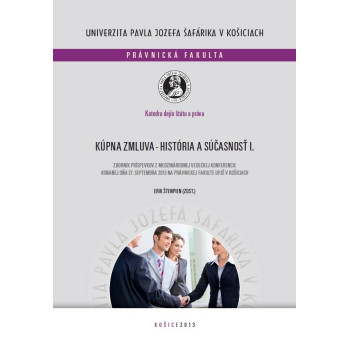
Kúpna zmluva – história a súčasnosť I.

Kúpna zmluva – história a súčasnosť I.

E-book

E-book

Erik Štenpien (ed.)

Proceedings of the International Scientific Conference held on September 27, 2013, at the Faculty of Law of UPJŠ in Košice

The Civil Code is one of the fundamental legal codifications of our time. Paradoxically, in the Slovak Republic, the 1964 Code still applies today, albeit with certain modifications brought by the modern era. Currently, recodification efforts are underway, with the goal of adopting a new Civil Code.

However, it is not possible to build something new without knowledge of the old. It is therefore a positive sign when legal historians and civil law experts come together at a conference to exchange views and insights. The Department of State and Legal History at the Faculty of Law in Košice is in its first year of working on the scientific grant project VEGA: The Historical-Legal Development of the Institute of the Sales Contract and Trends in Its Current Recodification in the Slovak Republic - No. 1/0131/13.

This project was acquired as a historical-legal initiative, but the Department of Civil Law is also participating, as Assoc. Prof. JUDr. K. Kirstová, CSc., is the deputy head of the project. Aware that this represents a completely unique connection between legal history and practice, our department organized the international scientific conference The Sales Contract - History and Present I. on September 27, 2013, which was a planned grant output but ultimately coincided with the 40th anniversary of the Faculty of Law in Košice.

This proceedings volume thus summarizes contributions from the grant project, as well as related presentations. It aims to significantly contribute to the understanding of the history and current recodification efforts of the sales contract institution both domestically and internationally.

Download the e-book for free (pdf)

Medzinárodné právo verejné (Materiály k štúdiu)

Medzinárodné právo verejné (Materiály k štúdiu)

E-book

E-book

Ľudmila Pošiváková - Adam Giertl

The presented selection of public international law documents aims to map international law from both historical and sectoral perspectives. The reader will find several historical documents in this collection, but the focus is primarily on currently valid legal sources.

The selection is guided by the publication Public International Law – General and Special Part by Prof. Ján Klučko, which is reflected in the division into general and special parts. The general part addresses the historical development of international law but primarily focuses on the protection of individuals and responsibility relationships in international law. The special part then examines the international regulation of various institutions of international law.

We acknowledge that this selection offers room for expansion, but we believe it meets basic requirements and fills a certain gap in the study of international law.

We trust that this collection of public international law materials will be beneficial for students, and not only for them, in the study of public international law and will contribute to raising awareness in this field.

Download the e-book for free (pdf)

Oslava právneho štátu (Právny štát z pohľadu teórie štátu a práva a medzinárodného práva)

Oslava právneho štátu (Právny štát z pohľadu...

E-book

E-book

Ľudmila Pošiváková Zuzana Antošová - Milan Kočan (eds.)

Proceedings from the Student Debate held on April 24, 2013, at the Faculty of Law of Pavol Jozef Šafárik University in Košice.

In the current period, the rule of law is widely debated both at the academic and political levels. This debate is not only related to the effort to establish the Rule of Law in states that have transitioned from socialist to democratic systems but also in states experiencing various unrests, whether political or religious.

However, it is not just a debate about certain characteristics of the Rule of Law that are missing in domestic law or at the level of international law, but also a debate about the very definition and meaning of the Rule of Law. The rule of law can be likened to an ideal that almost every state strives to achieve. Even in the case of the establishment of the independent Slovak Republic, the framers decided to include among the introductory provisions, which should form the core of the constitution, that the Slovak Republic is a state governed by the rule of law.

However, to achieve the ideal of the rule of law, it is necessary not only to declare it but also to adopt measures essential for an independent judiciary, democracy, the effective enforcement of human rights, the separation of powers, and many other elements that characterize a state governed by the rule of law.

Download the e-book for free (pdf)

Informačná spoločnosť a medzinárodné právo

Informačná spoločnosť a medzinárodné právo

E-book

E-book

Adam Giertl - Ľubica Gregová Širicová (eds.)

Proceedings from the 5th Student Symposium held on April 21-22, 2013

The French delegate to the Commission on Human Rights, while discussing the inclusion of the term "media" in the article on freedom of expression in the draft of the International Covenant on Civil and Political Rights, wisely urged other members of the commission to be forward-looking regarding the information media of the future.

The discussion took place in 1950, when delegates could not yet foresee the impact of the internet on social relations. Given that it is now clear that information technologies significantly influence law, including international law, the organizers of the student symposium decided to dedicate its sixth edition to the theme "Information Society and International Law."

Students of the Faculty of Law, after registering for the symposium, first focused on preparing their contributions, with each participant having access to a consultant if needed. This year, the list of consultants, in addition to members of the Institute of European Law and the Department of International Law, was expanded to include an expert in intellectual property law, Mgr. Martin Husovec, a graduate of our Faculty of Law and currently an IMPRS-CI doctoral student at the Max Planck Institute for Intellectual Property and Competition Law. We also take this opportunity to thank him for dedicating his time to the students and providing them with valuable advice in preparing their contributions. After the preparatory phase, the symposium itself took place, with the aim of presenting the prepared contributions and discussing them.

The presented contributions reflected a wide range of intersections between international law and the information society.

Download the e-book for free (pdf)

Regionalizmus: Stav, východiská, perspektívy

Regionalizmus: Stav, východiská, perspektívy

E-book

E-book

Adam Giertl (ed.)

Proceedings of Scientific Works

International law does not represent a monolithic entity of uniform legal norms. It is a legal system that is fundamentally created by the consensus of states. It reflects the collective will of multiple entities regarding what should be binding and enforceable as law among them.

From this understanding arises the fact that the needs for legal regulation will differ in various parts of the world. The consequence of this situation is the formation of regional groupings where, to some extent, specific legal rules apply. As Professor Klučka points out in his study published in this proceedings, regionalization can occur both on a contractual basis and on an institutional basis. Regionalism in law thus raises many interesting questions that legal science addresses.

This proceedings of scientific papers also aims to contribute to the knowledge in this field.

Download the e-book for free (pdf)

Tvorba a realizácia pracovného práva so zreteľom na regionálne aspekty trhu práce

Tvorba a realizácia pracovného práva so...

E-book

E-book

Milena Barinková (ed.)

The researchers of the grant task ‘Creation and implementation of labour law with regard to regional aspects of the labour market’ deal in their work with the analysis of employers' attempts for legislative changes in the level of social rights of employees justified by regional differences, the analysis of possible impacts in their implementation, as well as the assessment of their compliance with the protective function of Slovak labour law and the value character of fundamental human rights inherent in the European and legal culture.

Download the e-book for free (pdf)

This website uses cookies to ensure you get the best experience on our website