Filter By

Categories

Categories

Year of publication:

Year of publication:

Publication language:

Publication language:

Faculty:

Faculty:

Active filters

  • Categories: Law
  • Year of publication:: 2018
  • Year of publication:: 2018
  • Year of publication:: 2018
  • Year of publication:: 2018
  • Faculty:: Faculty of Arts
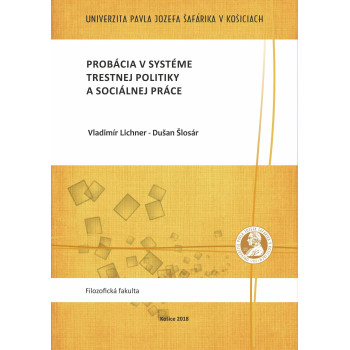
Probácia v systéme trestnej politiky a sociálnej práce

Probácia v systéme trestnej politiky a...

E-book

E-book

Vladimír LichnerDušan Šlosár

Issues of punishment are directly linked to a state’s criminal policy, which is an inseparable part of its social policy. Historically, the state has held a unique dominant position in the realm of punishment. Once the conditions for imposing a penalty are met, the state fulfills its obligation by sentencing through independent courts. However, it does not address questions of satisfaction, which belong to the victim. The victim may be a specific physical person or legal entity that suffered harm due to the criminal act. This harm simultaneously affects civil society as a whole. The state prioritizes its duty to punish and decide on the matter over compensating the harmed individual or civil society.

By mediation in criminal cases, we mean extrajudicial facilitation of resolving disputes between the offender and the harmed party, with the assistance and personal participation of a mediator. The mediator, as an independent and impartial person, helps parties identify their interests and supports them in finding shared, practical, and realistic solutions to the points causing their conflict. Probation refers to monitoring, supervising the accused, defendant, or convicted individual, as well as providing individual assistance to the offender and encouraging them to lead a lawful life. This reduces the risk of recidivism, or repeated criminal behavior.
Download the e-book for free (pdf)

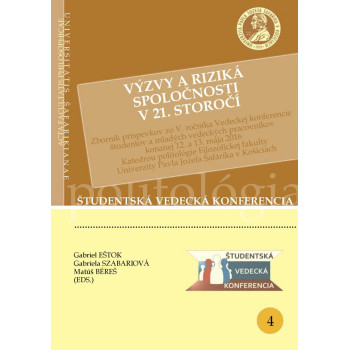
Výzva a riziká spoločnosti v 21. storočí

Výzva a riziká spoločnosti v 21. storočí

E-book

E-book

Gabriel EštokGabriela SzabariováMatúš Béreš (eds.)

Presented publication is an outcome from the scientific conference for students and young scientists that took place on 12th and 13th May 2016 at the Department of Political science, Faculty of Arts, Pavol Jozef Šafárik University in Košice. The main aim of the presented is to bring up outcomes of research of young scientists and students from Slovakia, as well as from abroad. Many of the presented papers have become integral part of qualification theses of their authors.

This conference proceedings contains 22 papers in Slovak, Czech and English language thematically creating four different parts.

Papers regarding international relations or issues exceeding a level of state power are dealing with issues of globalization, counterculture, international terrorism, extremism and a role of the EU in the Arctic. Papers dealing with the situation in the Slovak republic and abroad cover reform of security in Slovakia and in Romania, issue of dealing with totalitarian history of the states of the Visegrad group as well as development of funding of education system in Slovakia since 1919. In case of authors focusing on the socio-political situation in Slovakia we can find papers analyzing role of a reeve in city of Košice, first great political conflict during a rule of Vladimír Mečiar in Slovakia, role of Roma population in political environment in Slovakia, but also those concerning local activist or action groups and examining attitude of nursing care students towards euthanasia. The conference proceedings contents also four papers regarding theoretical or philosophical issues.

Their authors focused on topic of social state, social equality, democratic theories and transformation of human nature in “post-human” era.

Download the e-book for free (pdf)

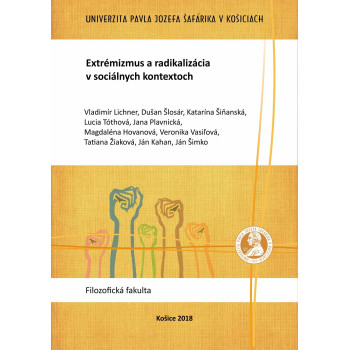
Extrémizmus a radikalizácia v sociálnych kontextoch

Extrémizmus a radikalizácia v sociálnych...

E-book

E-book

Vladimír LichnerDušan Šlosár et al.

It is very difficult to refer to any act of extremism or action having extremist characteristics, or to exclude it unambiguously. The boundary between extremism and accepted, conformal behavior is very broad and vaguely worded. Each company tends to set certain criteria to determine what can be considered as unwanted, violent, radical or extreme, or what signs of such a manifestation do not have. Therefore, when comparing the individual countries of the European Union in this area, we come across a different definition of what is or is not considered to be radical or extremist. In essence, the level of tolerance to some of the manifestations and the setting of indicators for the evaluation of the proceedings as extremist.

The presented monograph aims to present the basic social contexts of extremism and radicalization in the form of their philosophical and theoretical backgrounds, influencing the factors, the basic directions. In the author's work, the authors focus on the target group of adolescents, which they consider to be one of the most endangered groups in society in terms of development of the radicalization process. At the conclusion of the monograph is also offered the criminal level of these phenomena, which is not unavoidable in terms of complex analysis.

Download the e-book for free  (pdf)

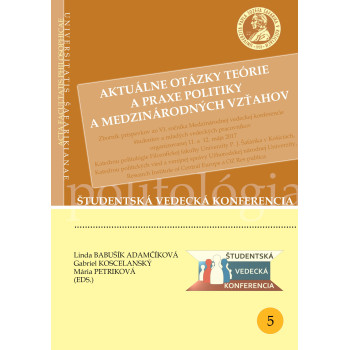
Aktuálne otázky teórie a praxe politiky a medzinárodných vzťahov

Aktuálne otázky teórie a praxe politiky a...

E-book

E-book

Linda Babušík AdamčíkováGabriel KoscelanskýMária Petriková (eds.)

Proceedings of the VI. Annual International Scientific Conference of Students and Young Researchers organized on May 11–12, 2017 by the Department of Political Science of the Faculty of Arts at Pavol Jozef Šafárik University in Košice, the Department of Political Sciences and Public Administration at Uzhhorod National University, the Research Institute of Central Europe, and the Res publica Association.

Presented publication is an outcome from the international scientific conference for students and young scientists that took place on 11th and 12th May 2017 at the Department of Political science, Faculty of Arts, Pavol Jozef Šafárik University in Košice. The main aim of the presented is to bring up outcomes of research of young scientists and students from Slovakia, as well as from abroad.

This conference proceedings contains 19 papers in Slovak, Czech and English language. Papers are dealing with current issues of theory and practice of politics and international relations. We can find paper analyzing globalization, international terrorism, topic of EU or development of European states. The conference proceedings contents also papers regarding the far-right parties, role of women in  politics and integration migrants in Slovak republic.

Download the e-book for free (pdf)

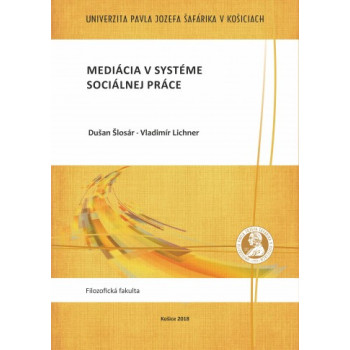
Mediácia v systéme sociálnej práce

Mediácia v systéme sociálnej práce

E-book

E-book

Dušan ŠlosárVladimír Lichner

This university textbook aims to provide readers with knowledge of the philosophical foundations, meaning, and purpose of mediation, based on research and analysis of mediators' activities. In countries where mediation services operate, their staff often include graduates of social work departments.

An individual approach to both the perpetrator and victim of a criminal offense requires knowledge and skills from social work, psychology, sociology, communication, and related fields tied to social work. The principles of social work apply not only in social policy and social care but also in justice. A mediator’s mission is to facilitate alternative resolutions to unlawful acts while preserving the purpose of legal proceedings as defined by valid legal norms. They fulfill this mission through specific methods of individual social work applied in the justice sector. The mediator’s focus extends beyond the current conflict to uncover related issues, activate parties to resolve disputes, and prevent new conflicts.

Special attention is devoted to the philosophical foundations of mediation in Slovakia. We provide an overview of mediators’ core activities and mediation types used to uphold justice in Slovakia. We analyze mediation goals, the roles of parties involved, and procedural steps. In applying mediation, we explore its potential and implementation in both legal and social work contexts.

As indicated, mediation cannot be understood solely as a specialized activity in criminal justice, as it has broader applications in non-judicial dispute resolution, such as family or community work, which are often overlooked by the public. The mediator’s approach to diverse target groups is grounded in theoretical frameworks. From this foundation, we derive activities expected of mediators in the future. Expanded activities arise from concrete situations encountered during mediation.

Download the e-book for free (pdf)

This website uses cookies to ensure you get the best experience on our website