Filter By

Categories

Categories

Selections

Selections

Year of publication:

Year of publication:

Publication language:

Publication language:

Faculty:

Faculty:

UPJŠ Unit

UPJŠ Unit

Method of publication:

Method of publication:

Active filters

  • Categories: Economics
  • Categories: Law
  • Method of publication:: E-book (pdf)
Organizational Behavior

Organizational Behavior

E-book

E-book

Gabriela Kravčáková a kol.

The second revised and extended edition of University textbook Organizational Behavior is the work of an international team of authors. University teachers of two Slovak universities and two Czech universities are the authors of this book. Problem areas of organizational behavior and its processing comprehensively was the intention of the authors. University textbook is complemented by 10 chapters, other chapters are significantly revised. University textbook is thematically divided into five parts. The first part treats the issue of organizational behavior as a discipline. Organizational behavior is theoretically defined, there is indicated the subject matter of the discipline, relationship with other sciences, historical and scientific foundations of organizational behavior. There are also presented knowledge about formal organizations and bureaucracy. Final of the first part is dedicated to social science research and social audit in organizations. The second part is called Individual aspects of organizational behavior and there are included themes as personality, work and its role in human life, job satisfaction, work motivation and loyalty of employees. This part is complemented by the issue of personality, competency and power of manager and career issues. Interpersonal interaction and group processes in an organization is the name of the third part of the book. It includes the chapters as working group, team and team roles, leadership and its impact on human personality, communication, performance management, friendships and loneliness in the organization. This section was complemented by the issue of interculturar communication in the international organizational context, conflicts in the workplace and workplace misbehavior. Fourth, complemented part is called Resources and means of ensuring employees and there are included themes such as external and internal mobility of workers, personal marketing, and unemployed as a potential source of workforce and talent management. The fifth part is called The organization as a culture and organizational dynamics. Authors included topics such as organizational culture, social responsibility of organizations and added the themes ethics on workplace, change management and radical change – reengineering. University textbook presents current theoretical knowledge and also the results of relevant research. Contents of chapters are complemented by practical examples of organizations. There are included questions for reflection and tasks at the end of each chapter. Tasks that help students and professional public apply the theoretical knowledge to solve practical problems. This University textbook comes with support KEGA no. 013-UPJŠ 4/2013 titled Organizational Behavior - University textbook for the compulsory subject of the new study program.
Download the e-book for free (pdf)

Územná samospráva a tvorba práva

Územná samospráva a tvorba práva

E-book

E-book

Michal Jesenko - Martina Kantorová(eds.)

Peer-reviewed proceedings of the scientific conference, which took place on 27.11.2015 at the Faculty of Public Administration, UPJŠ v Košice, Popradská 66, 041 32 Košice

Territorial self-government forms an integral part of a modern democratic and legal state. It is an expression of efforts to implement tasks to ensure the needs of the territorial community of citizens at the level that is closest to them.

One of the most important tools at the disposal of local self-government units in the performance of the tasks entrusted to them is the power to issue general binding regulations in matters of local self-government and to ensure the tasks arising for local self-government from the law. Law-making at the level of towns and municipalities or higher territorial units is thus an integral part of the exercise of territorial self-government and ultimately expresses its specific character as an essential part of public administration.

The aim of the scientific conference organized by the Department of Public Law Disciplines, Faculty of Public Administration, UPJŠ in Košice on 27 November 2015 was an effort to present the achieved results of scientific research activities in the field of law-making at the level of cities and municipalities, or higher territorial units. The conference provided a wide space for discussion on current issues of municipal standard-setting with the participation of representatives of the professional public, as well as representatives of local government and local self-government.

The scientific conference and the peer-reviewed proceedings of the conference were realized as a part of the solution of the VEGA grant project No. 1/0683/13 under the title "Normative Formation of Municipalities in the Matters of Local Self-Government. The present collection of papers from the scientific conference is an expression of the long-term efforts of the Department of Public Administration, Faculty of Public Administration, UPJŠ in Košice to address current issues of public administration with a special focus on the issue of local government.

Download the e-book for free (pdf)

Aktuálne otázky migrácie z pohľadu medzinárodného práva s osobitným zreteľom na Chartu práv Európskej únie

Aktuálne otázky migrácie z pohľadu...

E-book

E-book

Adam Giertl (ed.)

Collection of Papers from the 9th Annual Student Symposium on International and European Law held on April 22, 2016 at the Faculty of Law, Pavol Jozef Šafárik University in Košice

As indicated by the very title of the 9th Annual Student Symposium on International and European Law, “Current Issues of Migration from the Perspective of International Law with Special Regard to the Charter of Fundamental Rights of the European Union,” the participants focused on the highly topical subject of European migration, which they examined from various aspects of both international and Union law (a total of 9 contributions).

In assessing the role of individual actors primarily involved in addressing the problems arising from migration to Europe, particular emphasis was placed on the role of international specialized organizations, which often provide direct assistance to migrants “in the field” through humanitarian or medical aid. However, this is not the only response of the international community, as it is complemented by the activities of the concerned states as well as various non-governmental organizations and volunteers. Regarding the evaluation of the European Union’s activities, the symposium participants agreed that the mass migration wave caught the EU relatively unprepared—institutionally, legislatively, and technically—accompanied by a lack of clarity in adopting a fundamental approach to this reality.

It was also emphasized that these shortcomings occurred despite the fact that developments in the preceding period clearly signaled the possibility of gradual migration to the European Union escalating into a mass phenomenon. According to the participants, additional ex post and sometimes delayed measures adopted in response to the ongoing migration process contributed to an overall increase in political tension within the EU and divided its member states into opposing camps.

Download the e-book for free (pdf)

Európska únia a jej vplyv na organizáciu a fungovanie verejnej správy v Slovenskej republike

Európska únia a jej vplyv na organizáciu a...

E-book

E-book

Alena Krunková (ed.)

Proceedings of the Scientific Conference Held on June 28, 2016 at the Faculty of Law of Pavol Jozef Šafárik University in Košice in connection with the implementation of the project “The European Union and Its Impact on the Organization and Functioning of Public Administration in the Slovak Republic” – approved under number MVZP – SK PRES/2016/134

The Slovak Republic, as a member state of the European Union, is undertaking a historic role associated with the Presidency of the Council of the European Union within the presidency trio. At the beginning of 2016, the Ministry of Foreign and European Affairs of the Slovak Republic announced a call for applications for grants for 2016 in the field of international relations and foreign policy, specifically focused on the Slovak Republic’s Presidency of the Council of the European Union. The Faculty of Law of Pavol Jozef Šafárik University in Košice responded to this call and obtained a project aimed at carrying out research activities through a series of events focused on regional self-government in the Slovak Republic in the context of its role within the European Union. The Faculty has long been engaged with issues of European Union law both in its teaching and in the scientific research activities of its individual faculty members. The project aims to enrich this portfolio with special activities targeting not only professionals, but also students and the general public.

The first activity of the project was a conference entitled “The European Union and Its Impact on the Organization and Functioning of Public Administration in the Slovak Republic – Development So Far, Current State, and Perspectives.” The conference was attended by invited public officials, representatives of academia, and representatives of local government, as one of the main goals of the project is to connect the academic community with the practical sphere and thus involve practitioners in the planned activities within the project.

Download the e-book for free (pdf)

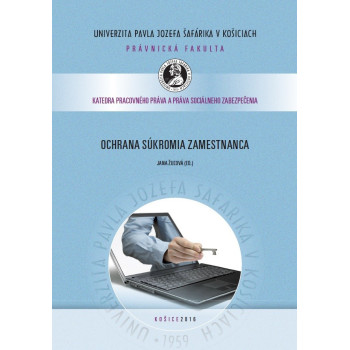
Ochrana súkromia zamestnanca

Ochrana súkromia zamestnanca

E-book

E-book

Jana Žuľová(ed.)

Proceedings from the 1st Annual Student Symposium on Labor Law held on April 8–9, 2016 in Danišovce

Discussions on the topic of privacy are currently very topical and interesting. The advancement and progress of technology have added a new dimension to individual privacy. With the use of modern electronic devices, terms such as precious commodity, chimera, or illusion are increasingly associated with privacy. Workplaces have not remained immune to modernization either. Machines are replacing human labor, programming and planning the production process, but also controlling, monitoring, and recording the fulfillment of assigned work tasks.

The availability of technology and its implementation in employers’ operations intrude upon the personal and private sphere of employees, which is an inherent part of every person’s life and does not remain left behind the doors of the workplace. Proper and correct use of monitoring mechanisms by employers means not only mastering their technical installation at the workplace and covering the associated financial costs, but also respecting the privacy of employees.

It cannot be overlooked that the right to privacy is among the fundamental human rights and freedoms, enjoying the corresponding characteristics (inalienability, non-transferability, irrevocability, etc.) and appropriate legal protection. And even though it is not absolute and may be suspended in favor of another right (especially the employer’s right to protect their property), every intervention—such as comprehensive camera surveillance, monitoring of phone calls, email correspondence, blocking certain websites, etc.—always has adverse consequences for the privacy of the employee.

Download the e-book for free (pdf)

Právo - obchod - ekonomika V.

Právo - obchod - ekonomika V.

E-book

E-book

Jozef Suchoža - Ján Husár - Regina Hučková (eds.)

Collection of Scientific Works

The scientific papers presented in this Collection are primarily the result of academic research conducted by experts working within the academic environment—particularly at Faculties of Law in the Slovak Republic and the Czech Republic, as well as by foreign experts, including those from Poland, the Russian Federation, Serbia, and others. In addition to academic contributions, this Collection also includes scientific and professional articles authored by legal practitioners, especially lawyers, notaries, and judges—not only from our own jurisdiction, but also judges from the General Court of the European Union. Contributions from professionals in the field of banking have also enriched this Collection. Moreover, the Collection provides space for aspiring scholars in the field of legal science, thereby combining timelessness with dynamism.

Given the diversity of the published contributions, it can be said that this Collection represents a connection between theory and practice, private and public law, as well as various branches of law. Nevertheless, the content of this Collection aligns with and reflects the central theme of the international symposium, namely: "CORPORATIONS – CONTRACTS – CODIFICATIONS – CONTEXTS." The individual sections of the Collection are interconnected and create a coherent whole, subsumed under a publication characterized by unity.

Download the e-book for free (pdf)

Obchodné záväzky: Všeobecná časť

Obchodné záväzky: Všeobecná časť

E-book

E-book

Dominika Zavadová(ed.)

Proceedings from the 3rd Student Symposium on Commercial Law

In November 2015, the third annual Student Symposium on Commercial Law took place at the university facility in Danišovce.

After two years of symposia focused on company law, the main topic of the third edition was the general part of commercial obligations law. This year as well, the goal of the student symposium remained to provide more space for students to formulate their own perspectives on current legal issues and to present the results of their own work.

The overarching topic made it possible to assign several current issues, allowing students to tackle problems they are likely to encounter in their future practice. The selected topics are not among those unanimously accepted by legal doctrine or established case law. On the contrary, the topics were deliberately chosen for the lack of sufficient domestic literary sources. As a result, processing the individual topics required more than just standard textbook or commentary knowledge.

The participating members of the department, both teachers and doctoral candidates, acted this year primarily as contact persons, rather than as consultants or supervisors of the students’ work. The primary purpose of the symposium at the faculty is to enable students interested in commercial law to develop their analytical and argumentative skills, as well as to express their personalities. We aim for students to develop not only professional knowledge but also personal skills-so-called soft skills-the art of presenting their own opinions and arguing persuasively.

Download the e-book for free (pdf)

Medzinárodné daňové úniky a metódy ich predchádzania

Medzinárodné daňové úniky a metódy ich...

E-book

E-book

Peter Huba - Jozef Sábo - Martin Štrkolec

The presented monograph aims to provide an in-depth overview of the issue of international tax evasion, both in terms of its conceptual foundations and with regard to specific methods and schemes used to carry out tax evasion.

The members of the authorial team have also addressed questions of tax evasion in their previous works: "International Tax Evasion and Tax Havens" (JUDr. Jozef Sábo) and "Legal Aspects of the Elimination of Double Taxation and Prevention of Tax Evasion" (JUDr. Peter Huba).

This monograph represents a synthesis of the relevant research activities of the authorial team, enriched by the interdisciplinary dimension of the tax evasion problem. At the same time, it highlights those shortcomings that appear to be the most serious from the perspective of the risk of international tax evasion and base erosion in Slovakia. In this respect, a comparative perspective on the issue is presented, drawing extensively from American sources, mainly due to the high quality and long-standing research on international tax evasion in the United States.

The authorial team believes that this monograph will help to bring the issue of corporate income tax evasion closer to the professional public, and that it will receive attention equal to that given to VAT fraud and other pressing issues of current tax legislation.

Download the e-book for free (pdf)

This website uses cookies to ensure you get the best experience on our website