Filter By

Year of publication:

Year of publication:

Publication language:

Publication language:

Active filters

  • Year of publication:: 2013
  • Year of publication:: 2017
  • Year of publication:: 2018
  • Year of publication:: 2018
Fonologická ontogenéza detskej reči

Fonologická ontogenéza detskej reči

E-book

E-book

Iveta Bónová

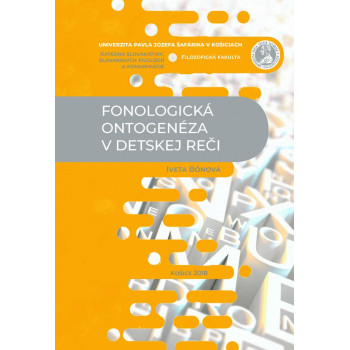
The foundations of the presented work were developed alongside the emerging research on child language in Slovakia. An enthusiastic team of individuals from several scientific fields—psychology (Marína Mikulajová), speech therapy (Svetlana Kapalková), and linguistics (Daniela Slančová, Jana Kesselová, Zuzana Ondráčková, Stanislava Zajacová, Iveta Bónová)—met regularly, discussed, and sought ways to mobilize efforts to achieve their set goals: conducting research on the language of intact (healthily developing) children based on actual longitudinal observation.

I am very pleased and grateful to have been part of the team at the beginning of systematic research in the field of child language acquisition in Slovakia. As a member of this team and a co-researcher on several projects in this area, I had the opportunity to participate in research on child language, which is no longer "on the fringes" of scientific interest. It has become a serious, exact study supported by quantitative and qualitative data, conducted systematically "at an excellent scientific level" (Průcha, 2011, p. 14).

The research itself was naturally preceded by data collection. The technologies of the late 20th century enabled the replacement of the outdated diary recording method with what is now the most commonly applied approach to material collection—audio-visual recordings. The synthesis of analyzed data collected over time, its explanation, generalization, and integration into a broader interdisciplinary research context is all the more interesting and beneficial as it contributes to speech therapy practice. Thanks to the results of the latest research, intervention possibilities in speech therapy are expanding, and methods for (early) diagnosis and stimulation are being developed and refined.
Download the e-book for free (pdf)

Metodologické inšpirácie v literárnovednom výskume II

Metodologické inšpirácie v literárnovednom...

E-book

E-book

Ivica Hajdučeková et al.  

The four-year grant project VEGA No. 1/0736/15, titled Methodological Approaches to the (Re)Interpretation of Works of Slovak and World Literature (led by Prof. PhDr. Ján Gbúr, CSc.), conducted at the Department of Slovak Studies, Slavonic Philologies, and Communication at the Faculty of Arts, Pavol Jozef Šafárik University in Košice between 2015 and 2018, yielded several outputs during its duration. In addition to individual scientific studies published in journals both domestically and internationally, the project resulted in: A proceedings volume from the international scientific conference Text in Contexts: Text in Interdisciplinary Interpretations (2018). A scientific monograph titled Spirituality in the (Re)Interpretation of Slovak Literary Works (2016). The collaboration culminated in two key complementary publications forming an interconnected whole:

Methodological Inspirations in Literary Research I (a collection of selected lectures and abstracts).

Methodological Inspirations in Literary Research II (a monograph).

An electronic collection of abstracts and video recordings from ongoing lecture colloquia—featuring notable figures from Slovak and Czech academia—and the scientific monograph were conceptually aligned, as evidenced by their shared titles differentiated numerically. This approach adhered to the project's aim of continuing a tradition of precision in literary research while emphasizing methodological pluralism. It also sought to promote contemporary, generationally diverse research within the academic environment of Eastern Slovakia, historically linked to Pavol Jozef Šafárik University in Košice.

Download the e-book for free (pdf)

Methodological Inspirations in the Research of Literary Science I.

Methodological Inspirations in the Research of...

E-book

E-book

Ivica HajdučekováPeter Getlík (eds.)

Proceedings of Selected Lectures and Abstracts

Grant project VEGA No. 1/0736/15 Methodological Basis of Literary (re)interpretation in Slovak and World Literature (the head of the project: prof. PhDr. Ján Gbúr, CSc.), whose realization lasted for four years (2015 – 2018) at the Department of Slovak Studies, Slavonic Philologies and Communication of Faculty of Arts of Pavol Jozef Šafárik University in Košice, brought several lecture events with the participation of experts from Slovak and Czech academical space. The original and progressively accomplishing project goal was to continue the tradition of exactness and support its implementation into our everyday scientific thinking and literary-scientific exploration. Each of fourteen invited lectures was a unique, professionally inspiring and humanly enriching meeting.

On that account there is a nontraditional project output: the proceedings of selected lectures and abstracts (abstracts were translated into English language by Mgr. Dominika Petáková, internal postgraduate student of literary science at Department of Slovak Studies, Slavonic Philologies and Communication) titled Methodological Inspirations in the Research of Literary Science I., which is intended for academical and study purposes at universities. The topics of the lectures were completed successively according to interest and demands of research team and current scientific research of invited guests.

Download the e-book for free (pdf)

Pavol Jozef Šafárik v kontinuite

Pavol Jozef Šafárik v kontinuite

E-book

E-book

Marianna SedlákováMarián Gladiš (eds.)

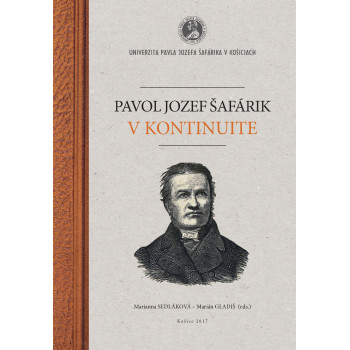
The content of the book publication Pavol Jozef Šafárik in Continuity consists of contributions from two events organized by the Department of Slovak Studies, Slavic Philologies, and Communication at the Faculty of Arts of Pavol Jozef Šafárik University in Košice during its short existence.

The first event was a scientific seminar held on the occasion of the 150th anniversary of the death of P. J. Šafárik, titled Pavol Jozef Šafárik – Scientist and Artist, which took place on January 27–28, 2012, in Košice and Kobeliarovo. The second event was an internal scientific seminar on the occasion of the 220th anniversary of Šafárik’s birth, held on December 15, 2015, under the title In the Quiet Home Circle. Symbolically—beginning with death and ending with birth (thus indicating the living continuity of Šafárik’s research legacy)—we aim to continue the study of Pavol Jozef Šafárik’s scientific work and increasingly involve the youngest generation of researchers (represented by doctoral students of the department in the field of literary studies). This is despite the fact that the literature on the life and work of this scholar and poet, who stood at the birth of Slavic studies, is very rich, and most of his works have already been scientifically analyzed. However, it appears that even seemingly outdated views of Šafárik still deserve scientific attention in the new context of humanities and natural sciences, as can be read in the contributions published in this volume.

Through the continuous publication of the Collected Works of Pavol Jozef Šafárik, both mentioned seminars, and the publication of this volume, the Faculty of Arts of Pavol Jozef Šafárik University in Košice has continued the activities of the Prešov Faculty of Arts from the time before its separation from the union of faculties of Pavol Jozef Šafárik University in Košice in 1997. The selection and arrangement of contributions in the volume symbolize the "passing of the baton" in research and publishing activities related to Pavol Jozef Šafárik—a scientific personality of global stature, who in 1959 gave his name to our university.

Compiled by the editors.

Download the e-book for free  (pdf)

Cesty (k) textu. Inšpirácie Františka Mika

Cesty (k) textu. Inšpirácie Františka Mika

E-book

E-book

Iveta Bónová - Marián Gladiš (eds.)

About the personality of university professor František Miko, DrSc., much has rightly been written, especially after 1989. Indeed, anyone involved in language and literature, at least within the geographical scope of the West Slavic region, is familiar with his work, particularly his brilliant expressive conception of style.

Our ambition in the introduction of this presented collection is not to substitute a dictionary of linguists, nor to provide a comprehensive view of his life and professional career. Rather, it is to remind ourselves of an exceptional individual—a scientist whose attitude, contributions, and results have influenced and continue to influence not only entire generations of researchers but also scientific thinking as a whole.

In the presented collection, we supplement the characterization contained in the inventively and convincingly formulated title of the obituary The Quiet Revolutionary of Our Science, František Miko, with a set of thematically diverse contributions (from the fields of style, sound, translation studies, phraseology, didactics...) dedicated to this significant figure of Slovak science on the occasion of what would have been his ninety-fifth birthday.

Download the e-book for free

Slovenčina pre cudzincov (Pracovné listy)

Slovenčina pre cudzincov (Pracovné listy)

E-book

E-book

Marianna Sedláková a kol. 

The worksheets, based on the direct specific needs of teaching medical students in Košice, respect the real situation of teaching Slovak as a foreign language at UPJŠ.

They also reflect the relatively high number of Slavic students, especially from neighboring countries, who, although just beginning with the Slovak language, are at a higher communicative level compared to students from non-Slavic countries. Therefore, a special part of the worksheets with exercises is dedicated to them, which includes special exercises and dictionaries aimed at eliminating Slovak-Polish or Slovak-Ukrainian interference phenomena. Since some non-Slavic students come from the Czech language environment, we also add a glossary of the most common different expressions in Slovak, Czech, and, for the aforementioned reasons, Polish and Ukrainian. In the part intended for all students, both Slavic and non-Slavic, communicatively focused exercises for practicing grammatical phenomena predominantly at the A1 and A2 communication skill levels (according to the Common European Framework of Reference) prevail, and last but not least, exercises thematically focused on medicine and healthcare.

The texts from the thematic area are, of course, supplemented with realia of the city of Košice. As a functional supplement in the working material, we also publish test samples.

Download the e-book for free (pdf)

This website uses cookies to ensure you get the best experience on our website