Filter By

Year of publication:

Year of publication:

Publication language:

Publication language:

Faculty:

Faculty:

Active filters

  • Year of publication:: 2014
  • Year of publication:: 2015
  • Year of publication:: 2025
  • Publication language:: Slovak
  • Faculty:: Faculty of Arts
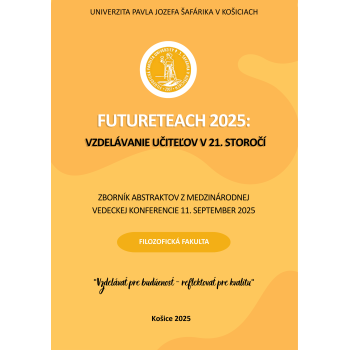
Zborník príspevkov: FutureTeach 2025: Vzdelávanie učiteľov v 21. storočí. “Vzdelávať pre budúcnosť – reflektovať pre kvalitu“

Zborník príspevkov: FutureTeach 2025:...

E-book

E-book

Renáta Orosová, Michal Novocký, Beáta Sakalová, Zuzana Vagaská (eds.)

Zborník príspevkov z medzinárodnej vedeckej konferencie, 11. september 2025

Medzinárodná vedecká konferencia je zameraná na problematiku vzdelávania a výchovy v oblasti základného, stredného a vysokého školstva a školských zariadení z pohľadu pedagóga. Zreteľ kladie na perspektívy pedagóga 21. storočia v edukačnej praxi a inovatívne aspekty pregraduálnej prípravy pedagógov. Je určená vedeckým pracovníkom, mladým vysokoškolským učiteľom, doktorandom s cieľom prezentovať učiteľa v súčasnej perspektíve a vyvolať diskusiu k aktuálnym otázkam prezentovaných oblastí výchovy a vzdelávania v kontexte súčasnej situácie v školstve.

Ciele konferencie:

  • prezentovať a analyzovať možnosti rozvoja budúcich učiteľov a učiteľov v praxi s ohľadom na zdroje a nástroje podpory ich sebavzdelávania,
  • prezentovať a analyzovať možnosti rozvoja budúcich učiteľov a učiteľov v praxi cez kultúru školy reagujúcu na potreby všetkých aktérov vzdelávania,
  • prezentovať a analyzovať formovanie digitálnych zručností učiteľov a modifikovania výučby smerom k špecifikám žiakov,
  • prezentovať a analyzovať využívanie umelej inteligencie v edukácii z didaktického a etického aspektu,
  • prezentovať a analyzovať najnovšie edukačné trendy vo výučbe vychádzajúce z paradigmy didaktického konštruktivizmu,
  • prezentovať a analyzovať možnosti aktualizácie profesijných kompetencií učiteľov cez učenie sa skúsenosťou a riešenie komplexných edukačných problémov.
Download the e-book for free (pdf)

FutureTeach 2025: Vzdelávanie učiteľov v 21. storočí. “Vzdelávať pre budúcnosť – reflektovať pre kvalitu“ (Zborník abstraktov)

FutureTeach 2025: Vzdelávanie učiteľov v 21....

E-book

E-book

Renáta Orosová, Michal Novocký, Beáta Sakalová, Zuzana Vagaská (eds.)

Medzinárodná vedecká konferencia je zameraná na problematiku vzdelávania a výchovy v oblasti základného, stredného a vysokého školstva a školských zariadení z pohľadu pedagóga. Zreteľ kladie na perspektívy pedagóga 21. storočia v edukačnej praxi a inovatívne aspekty pregraduálnej prípravy pedagógov. Je určená vedeckým pracovníkom, mladým vysokoškolským učiteľom, doktorandom s cieľom prezentovať učiteľa v súčasnej perspektíve a vyvolať diskusiu k aktuálnym otázkam prezentovaných oblastí výchovy a vzdelávania v kontexte súčasnej situácie v školstve.

Download the e-book for free (pdf)

Výchova a vzdelávanie 2014: Kontexty vzdelávania a výchovy v súčasnej perspektíve

Výchova a vzdelávanie 2014: Kontexty...

E-book

E-book

Ján Juščák - Renáta Orosová - Zuzana Nováková


Proceedings of the International Scientific Conference February 5 -február 2014 6, 2014

Conference proceedings of abstracts is one of the outputs of the international scientific conference entitled Education 2014: Contexts of education in the current perspective held 5 to 6 Feb 2014 at University of Pavol Jozef Šafárika in Kosice. This conference focused on the issues of education and emphasizes the current state and prospects of educational practice, topical aspects of undergraduate teacher training, health psychology in educational practice, as well as pedagogical and psychological aspects of education in primary educational institutions in view of the broad educational community. It was aimed for scientists, young university teachers, PhD students as well as experts and teachers, to present trends in education and to stimulate discussion on topical issues presented in the field of education.


Download the e-book for free (pdf)

Reflexia pedagogických možností vých. systémov vybraných detských a mládež. organizácií  v edukačnom priestore SR

Reflexia pedagogických možností vých. systémov...

E-book

E-book

Ján Juščák - Milan Darák

The aim of the monograph was to analyze the pedagogical possibilities of educational systems within children's and youth organizations, with an emphasis on those targeting the age group of children up to 15 years.

The starting point was an analysis of the current state of theory and practice in children's and youth organizations, with the intention of describing prevailing trends in their development and activities. This publication closely follows the previous monograph (Juščák, J. – Darák, M.: 2015), in which we processed, according to a unified methodology and using generally accepted pedagogical terminology, the collected available materials on the educational systems of selected (most representative) children's and youth organizations in Slovakia. Through a subsequent comparison of the obtained empirical data on educational systems, we aimed to identify their similar (identical) as well as specific (distinct) elements as a basis for establishing categorization criteria for their classification.

The culmination of our efforts was an attempt to characterize a children's organization as an educational institution, describing its characteristic features, functions, aims, content, principles, and educational methodology.

Download the e-book for free (pdf)

Reflexia pedagogických možností vých. systémov vybraných detských a mládež. organizácií  v edukačnom priestore SR

Reflexia pedagogických možností vých. systémov...

E-book

E-book

Ján Juščák - Milan Darák

 The aim of the monograph was to analyze and address the issue of educational systems within children's and youth organizations, with an emphasis on those focused on the age category of children up to 15 years.

The starting point was an analysis of the current state of the educational environment in terms of the systemic nature of education and the basic categories of the educational system. The collected available materials on the educational systems of selected (most representative) children's and youth organizations in the Slovak Republic were subsequently processed according to a unified methodology and using generally accepted pedagogical terminology.

Download the e-book for free (pdf)

Školský systém na Slovensku v medzivojnovej Československej republike (1918 - 1938)

Školský systém na Slovensku v medzivojnovej...

E-book

E-book

Soňa Gabzdilová

The educational system (schooling) is one of the most effective tools for shaping the young generation in any advanced society. Schools not only create the knowledge base necessary for fulfilling the demands of the economy and the social sphere, but they also shape the national and ideological identity of each member of society. The school plays a decisive role in forming positive values, but it can also become a breeding ground for xenophobia and racist attitudes. The school has an irreplaceable role in creating national consciousness, identification with one's own nation, its history, the heroic deeds of ancestors, and the meaning of its existence.

After the dissolution of Austria-Hungary, there were fundamental geopolitical changes in Central Europe. One of these was the creation of Czechoslovakia, a state founded on radically different principles than pre-war Hungary. The founders of the Czechoslovak Republic (CSR), the personalities who decisively determined the character of the political system in the newly established republic, did not belong to the privileged classes of the previous regime. Unlike Hungary, where political power was controlled almost without exception by the nobility, the elite in Czechoslovakia consisted of men who were radical critics of Austria-Hungary.

A fitting example was the most influential figure of interwar Czechoslovakia, President Tomáš Garrigue Masaryk. Despite his origins, Masaryk was perceived by both Czechs and Slovaks as the founder of the state, a legendary figure whose political and social influence far exceeded the powers of the presidential office.

Download the e-book for free (pdf)

This website uses cookies to ensure you get the best experience on our website