 English
 Slovenčina


History (e-books)
There are 9 products.
Active filters
Historik, archivár a univerzitný profesor...
E-book
E-book
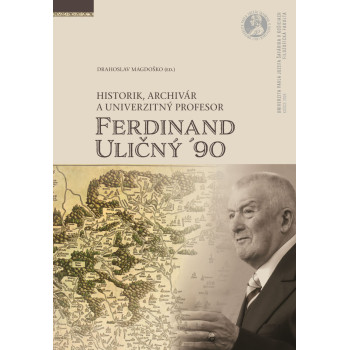
Drahoslav Magdoško (ed.)
Hlavný zámer zborníka, ktorý držíte v rukách, predstavuje práve vzdanie pocty historikovi, ktorý svojim úctyhodným vedeckým dielom výrazne prispel k utváraniu slovenskej historiografie, predovšetkým medievalistiky. Zároveň sa tu vyslovuje uznanie za rozsiahlu a v nemalej miere priekopnícku prácu archivára, ktorý pomáhal rozvíjať moderné archívnictvo na východe Slovenska. A v neposlednom rade ide o formu poďakovania za prácu vysokoškolského pedagóga, ktorého predmety absolvovali stovky študentov, a ktorý si svojim podnetným prístupom získal ich srdcia. Na všetkých týchto troch rovinách má cenné zásluhy prof. PhDr. Ferdinand Uličný, DrSc. (*18. 8. 1933, Ploštín), ktorý v lete roku 2023 oslávil životné jubileum 90. rokov.
Študentská vedecká konferencia XII.
E-book
E-book
Mikuláš Jančura - Maroš Melichárek
The Textbook is based on the output of the twelveth year of the student scientific conference held in December 2023. The student scientific conference is a study subject included in the study plans of the Department of History, Faculty of Arts, UPJŠ, implemented since 2011 and aims to offer space for Bc. and Mgr. degree students to present fragments of their primary research as part of the creation of their bachelor and master thesis. The aim of the presented Textbook is not only to publish these thematically broad-spectrum texts, but also to target the effort for above-standard pedagogical activities and the added value of university studies towards students in the form of publication output.This year's anthology contains 6 texts with a chronological framing from the Middle Ages to the history of the 20th century.
Moc v dejinách ľudskej spoločnosti. Stretnutie...
E-book
E-book
Simona Bilecová-Monika Tresová
Proceedings of the 13th Scientific Conference of Young Historians, organized by the Department of History of the Faculty of Arts of the University of Pavol Jozef Šafárik in Košice in cooperation with the State Archives in Košice and the Slovak Historical Society at the Slovak Academy of Sciences on 24 October 2023 The central theme of the conference proceedings of the scientific conference of doctoral students is the issue of power as an instance that is an inherent part of human existence and has been present in society de facto since its beginning. Since power and the desire for power are present even today, perhaps more than at any other time in the history of human society, the proceedings provide adequate answers to the questions: where is power born and from what does it originate? How do social science disciplines view those social groups that do not hold power? The publication consists of eight contributions by authors working at Slovak and Czech universities. The volume opens with a paper by Dávid Nykodým on power in the city of silver in the era of Jiří of Poděbrady. The administration of estates in the hands of widows in the 17th century (on the example of Judith Balassa) was discussed by Sabina Danková. The issue of the role of the university grand master in the monopolization of education during the First Empire 1808-1815 in France was examined by Michael Dudzik. The period between the two world wars on the territory of Czechoslovakia was mapped in their contributions by two authors: Simona Bilecová, who characterized the emergence and creation of the political elite on the example of the Rožňava region, and Dominik Šípoš, who evaluated the power of the party as an ideological problem of the Czechoslovak National Democracy. This line was continued by Patrik Beňuš, who analysed in detail the crisis in railway transport in the southern territory of Slovakia after 1938. Monika Tresová dealt with the activities of Catholic associations in Košice and their disappearance under the pressure of the communist power after 1948. Miriama Balvirčáková dealt with the power and its legitimacy, judicial rehabilitation of the victims of the communist regime in Eastern Slovakia in 1968-1971.
Download e-book for free (pdf)
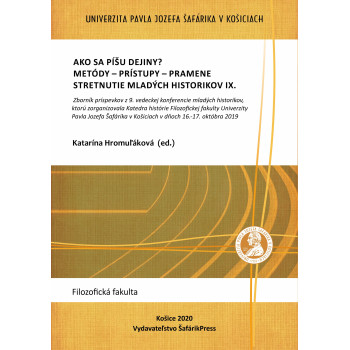
Ako sa píšu dejiny? Metódy – prístupy – pramene...
E-book
E-book
Katarína Hromuľáková (ed.)
Proceedings of the Scientific Conference. Košice, October 16-17, 2019
The proceedings titled "Ako sa píšu dejiny? Metódy – prístupy – pramene" present the contributions from the conference "Meeting of Young Historians IX," annually organized by the Department of History, Faculty of Arts, UPJŠ.
In the individual contributions, which span from the Middle Ages to the most recent history, the authors propose various theoretical and methodological research approaches to history, which currently represent fundamental prerequisites for historical research.
The ambition of the authors, as the next generation of historians, is not only to open up current questions of theoretical reflection in historiography but also to offer concrete examples supported by their own research.
Mgr. Katarína Hromuľáková
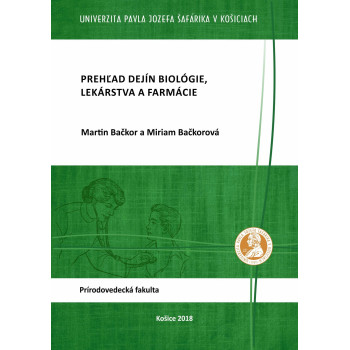
Prehľad dejín biológie, lekárstva a farmácie
E-book
E-book
Martin Bačkor - Miriam Bačkorová
The proposed text focuses on the history of studying biology, medicine, and pharmacy as scientific disciplines from prehistoric times through antiquity, the Middle Ages, and the modern era. The text chronologically organizes the most significant figures in the history of biological scientific disciplines, outlines key characteristics of major historical discoveries, and reevaluates their significance from the perspective of 21st-century science.
The educational text is chronologically divided into the most significant periods of civilization development. The last two completed centuries—the 19th and 20th—are subdivided into major life science fields due to the unprecedented growth of biological disciplines and the resulting volume of acquired information.
Since it can sometimes be challenging in science to define what constitutes the past versus the present of a particular discipline, we have excluded significant biological discoveries from the early 21st century, which are typically regarded as the “present” of biology.
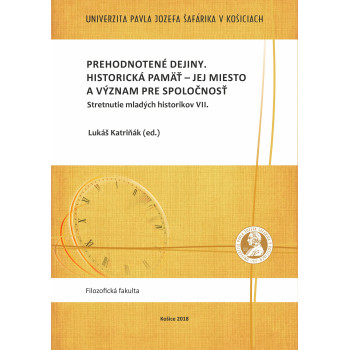
Prehodnotené dejiny. Historická pamäť – jej...
E-book
E-book
Lukáš Katriňák (ed.)
Meeting of Young Historians VII.
Proceedings of contributions from the 7th scientific conference of young historians, organized by the Department of History at the Faculty of Arts of UPJŠ in Košice,
European Network Remembrance and Solidarity,
Centre of Social and Psychological Sciences SAS,
Historical Institute SAS,
and the Slovak Historical Society at SAS, held on October 25, 2017 in Košice.
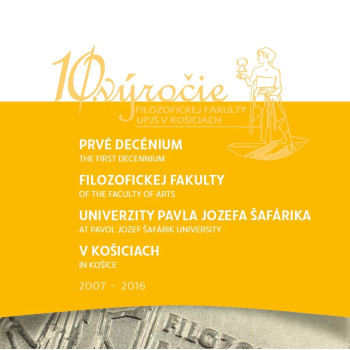
Prvé decénium Filozofickej fakulty Univerzity...
E-book
E-book
Iveta Bónová - Marián Gladiš (eds.)
The Foundation of the Faculty is a major “thing” created and developed by many personalities. The collected information, opinions, and critical judgements have led me to the conclusion that there exist among us plenty of narratives on the formation of this Faculty.
What is appealing about this fact is that from each party concerned, specifically teachers of Philosophy, Psychology and Education at the UPJŠ Faculty of Science, teachers of Psychology at the UPJŠ Faculty of Public Administration in Košice, teachers of the Department of Foreign Languages at UPJŠ, teachers at Prešov University who were approached with a bid to create the conditions of and opportunities for the development of their study branches at the new UPJŠ Faculty of Arts in Košice, there is a significant clue reflected in the inception of the new Faculty of this University.
It is necessary to say that it is a justifiable reflection, because without this, it would not be possible to develop exploration and offer the students courses in the field of Humanities, in social and behavioural sciences, educational sciences, and in the field of History and Ethnology.
Rómovia v Abovskej, Šarišskej a Turnianskej...
E-book
E-book
The main topic of this publication is the Roma, their status, and life in Hungary, specifically in the Abov, Šariš, and Turnia counties in the second half of the 18th century, particularly according to the censuses conducted during the reign of Maria Theresa and Joseph II.
The work is divided into six chapters and fourteen subchapters. It contains three images, twenty-eight tables, and twenty-nine graphs. The introductory chapter deals with the state of research on the subject (i.e., the Roma in the second half of the 18th century) from 18th-century authors to contemporary authors who have dealt with or are still dealing with it.
In the first chapter, the author briefly mentions the Indian origin of the Roma, the social affiliation of the Roma ancestors, their departure from India, their migration until their arrival in Hungary, as well as the names given to the Roma by the surrounding world. It also mentions the first reports on the Roma in Hungary and in the territory of today's eastern Slovakia, as well as their status in Hungary until the first half of the 18th century.
In the second chapter, the author touches on the life of the Roma in the Abov, Šariš, and Turnia counties in the light of archival materials from the second half of the 18th century and presents the administrative division of these counties during this period.
The third chapter discusses the royal decrees of the Enlightenment rulers Maria Theresa and Joseph II concerning the Roma and briefly describes the political situation and the resolution of socio-economic issues in Hungary in the second half of the 18th century.
The fourth chapter is devoted in detail to the censuses of the Roma in the Abov, Šariš, and Turnia counties during the reign of Maria Theresa and Joseph II, their objectives, characteristics, contributions, as well as their shortcomings, and presents the methodology of numerical and graphical processing of these censuses.
The fifth chapter contains a comprehensive graphical comparison and evaluation of the Roma censuses from all three counties. The overall findings about the life of the Roma in the Abov, Šariš, and Turnia counties are presented in the sixth, concluding chapter.
The main finding of this research is that the regulation of the Roma was carried out with only minimally successful (from the rulers' perspective) results, as the affected Roma families continued to roam both during and after the regulation. They practiced so-called "hidden roaming."