Filter By

Year of publication:

Year of publication:

Publication language:

Publication language:

Faculty:

Faculty:

Active filters

  • Year of publication:: 2010
  • Year of publication:: 2012
  • Year of publication:: 2017
  • Year of publication:: 2020
  • Year of publication:: 2024
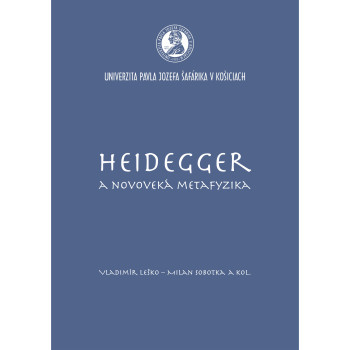
Heidegger a novoveká metafyzika

Heidegger a novoveká metafyzika

E-book

E-book

Vladimír Leško, Milan Sobotka a kol.

Filozofické dielo Martina Heideggera, ktorého hlavnou otázkou je otázka bytia, je v rozhodujúcej miere zviazané s pochopením filozo-fického reflektovania tejto otázky v gréckej a novovekej filozofii. Filozofický vývoj nemeckého mysliteľa túto dejinno-filozofickú sku-točnosť prezentuje v jedinečnej podobe od dvadsiatych rokov 20. storočia až do konca svojej tvorby. Problém Heideggerovej recepcie gréckej filozofie s jej chápaním metafyziky bol predmetom nášho skúmania v práci Heidegger, metafyzika a Gréci (Košice: UPJŠ 2016, 693 s.).

Download the e-book for free (pdf)

Vybrané kapitoly z axiológie (v kontexte kritiky tradičnej metafyziky)

Vybrané kapitoly z axiológie (v kontexte...

E-book

E-book

Štefan Jusko

Selected chapters from axiology are the result of the author's multi-year research work and also a certain fulfillment of the requirements from pedagogical practice in this subject. The chapters in this synthesizing form have not been published yet, and I am convinced that precisely in this form they can acquire higher value and greater real impact on our philosophy students.

Individual chapters focus on the problem of the collapse of traditional values, often leading to nihilism and loss of meaning in human existence. It is no coincidence that Friedrich Nietzsche, a philosopher who first called for a reevaluation of all values, is a common denominator among these texts. Another key figure is F. Dostojevskij, a Russian philosophising writer who views nihilism—the problem of value destruction—differently. The goal of these texts is literally to provoke our students so that they independently and creatively address questions related to the meaning of their own existence.

As I am convinced, our time presents a great challenge for new, original ideas and axiological judgments that have always preceded cognitive ones. To what extent my intentions and goals have been fulfilled remains up to the reader to decide.

Autor

Download the e-book for free (pdf)

Vybrané kapitoly z epistemológie (v kontexte postmetafyzického myslenia)

Vybrané kapitoly z epistemológie (v kontexte...

E-book

E-book

Štefan Jusko

Selected Chapters in Epistemology" is a work resulting from the author's multi-year research and also represents a fulfillment of the requirements from pedagogical practice in this subject. The chapters, presented in this synthesized form, have not been published before, and I am convinced that precisely in this form they can gain higher value and greater real impact on our philosophy students.

The individual chapters focus on the problem of knowledge today, primarily on the problem of criticizing metaphysics and questions related to creating post-metaphysical thinking. It is no coincidence that Friedrich Nietzsche is a common denominator for the presented texts; he is a philosopher who has fundamentally influenced and continues to influence current philosophical discussions and intellectual movements. The chapters are written to lead our students or other readers toward reflection, i.e., critical thinking, personal growth, and professional independence.

To what extent I have succeeded in fulfilling my intentions and goals remains for the reader to decide.

Autor

Download the e-book for free (pdf)

Leibniz a Heidegger – veta o (dostatočnom) dôvode

Leibniz a Heidegger – veta o (dostatočnom) dôvode

E-book

E-book

Martin Škára

Philosophy is interwoven throughout its history with several principles that bring light and order to this kind of thinking, whether it is a systematic or a non-systematic form of philosophizing.

Each of the principles represents in its own way the origin (ἀρχή) of all deductive reasoning, but not all philosophical statements and conceptions are obliged to proceed in the same way, for not all philosophical statements and conceptions are calculus. Actually, such a form of rationalist philosophizing is really a minority in the history of philosophy. But in spite of its minority presence, it will always attract attention to some extent, whether by becoming a pillar of thought itself and finding a permanent place in its foundations, or by becoming an indispensable mainstay of philosophical reasoning. In fact, there are not many principles in the history of philosophical thought.

The state of affairs is primarily due to the heterogeneous and in many cases irrationalist nature of philosophical thinking.

Download the e-book for free (pdf)

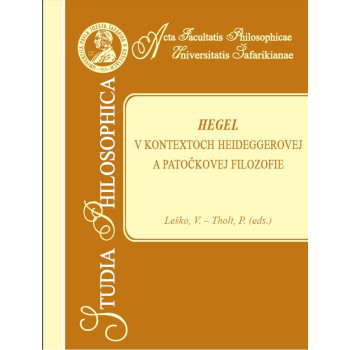
Hegel v kontextoch Heideggerovej a Patočkovej filozofie

Hegel v kontextoch Heideggerovej a Patočkovej...

E-book

E-book

Vladimír Leško - Pavol Tholt (eds.)

Proceedings of the Third International Philosophical Conference Hegel in the Contexts of Heidegger's and Patoček's Philosophy, held on 1-2 October 2009.

The Philosophical Proceedings is a presentation of the results of the work of the research teams of the research projects VEGA 1/0650/08 - Heidegger and the History of Philosophy and VEGA 1/4679/07 - Jan Patočka's Asubjective Phenomenology and the History of Philosophy solved at the Department of Philosophy and the History of Philosophy of the Faculty of Philosophy of the University of Applied Sciences in Košice.

Download the e-book for free (pdf)

Dejiny filozofie ako filozofický problém

Dejiny filozofie ako filozofický problém

E-book

E-book

Vladimír Leško - Pavol Tholt (eds.)

Proceedings of the Fourth International Philosophical Symposium History of Philosophy as a Philosophical Problem, held on 14-15 October 2010

The Philosophical Proceedings is the final presentation of the results of the work of the research teams of the research projects VEGA 1/0650/08 - Heidegger and the History of Philosophy and VEGA 1/4679/07 - Jan Patočka's Asubjective Phenomenology and the History of Philosophy solved at the Department of Philosophy and the History of Philosophy of the Faculty of Philosophy of the University of Applied Sciences in Košice.

Download the e-book for free (pdf)

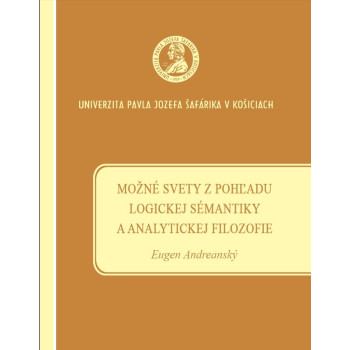
Možné svety z pohľadu logickej sémantiky a analytickej filozofie

Možné svety z pohľadu logickej sémantiky a...

E-book

E-book

Eugen Andreanský

The presented monograph aims to critically map the understanding of the concept of possible worlds.

The first chapter describes the formation of the semantics of possible worlds, along with indicating some problems it brings, which were incisively revealed primarily by W. V. O. Quine. In the next two chapters, the work focuses on more modern views on the nature of possible worlds, with the main attention given to the dichotomy between the possibilist and actualist approach to the question of modalities, alongside which it is necessary to assess other distinctions (essentialism - anti-essentialism, realism - reductionism (or ersatzism or fictionalism), naturalism - non-naturalism, etc.). Increased attention in the work is specifically devoted to the possibilism of D. Lewis and the actualist concepts of S. Kripke, A. Plantinga, R. M. Adams, N. Rescher, D. Armstrong, and J. Hintikka.

An unconventional approach to the issue of possible worlds is captured in the fourth chapter. It is primarily dedicated to the significant concept of Jaakko Hintikka, which works with the notion of epistemic possible worlds and documents the inclination towards the modification and relativization of modal discourse. The conclusion provides an evaluation of the discussion that touches on the main problems associated with considerations of possible worlds.

In the presented monograph, some representative concepts of possible worlds, or possible individuals, are clarified, and the overall process is indicated from assessing possible worlds as ideal logical constructs through their relativization by separate domains of individuals for individual worlds and further through the relationship of attainability to financial, impossible, and non-standard possible worlds.

Download the e-book for free (pdf)

This website uses cookies to ensure you get the best experience on our website