 English
 Slovenčina


Philosophy & History of Philosophy (e-books)
There are 10 products.
Active filters
Patočka o vzniku matematickej prírodovedy
E-book
E-book
The work presented in the following text is an attempt to analyze Patočka's perspective on the emergence and essence of mathematical natural science in the 17th century. During this period, Patočka's attention was particularly drawn to Descartes' philosophy and Cartesianism, as well as the philosophies of Galileo, Bacon, and Leibniz.
Patočka himself devoted continuous and exceptional attention to these questions, as evidenced by several monographic works and numerous articles and studies he wrote on the subject.
Patočkova filozofia dejín
E-book
E-book
The aim of the presented monograph is primarily to introduce Patočka's concept of the philosophy of history as comprehensively as possible, although I am aware that this is by no means an easy task. This difficulty arises not only because, as already mentioned, there is currently no extensive and exhaustive work on this topic.
While there is a relatively large number of studies devoted to Patočka's concept of the philosophy of history, none of them, however, examine this concept from a comprehensive perspective as a unified whole – most focus on specific partial issues (and there are many) stemming from this concept. This fact, incidentally, serves as clear evidence to me that this is undoubtedly a highly demanding topic.
Patočka, fenomenológia a dejiny filozofie
E-book
E-book
Vladimír Leško - Milovan Ješič - Pavol Tholt
The philosophical work of the most significant Czech philosopher of the 20th century, Jan Patočka (1907–1977), stands out for its unique intellectual originality.
Even at the time of its creation, it significantly transcended the narrow boundaries of the contemporary Czechoslovak spiritual space and uniquely connected our country with the most advanced philosophical teachings of Western thought, in which Husserl's phenomenology and Heidegger's fundamental ontology played a dominant role. Certainly, it would be a great mistake to reduce the decisive position of Patočka's philosophical work merely to the reception and critical-creative elaboration of Husserl's and Heidegger's philosophy.
In this context, we cannot overlook the decisive contribution of Eugen Fink, who introduced Patočka to the intricacies of Husserl's and Heidegger's philosophy. Both thinkers then continued in a lifelong creative philosophical dialogue. However, it is also necessary to mention Patočka's intense interest in the works of Scheler, Ingarden, Landgrebe, as well as Sartre and others.
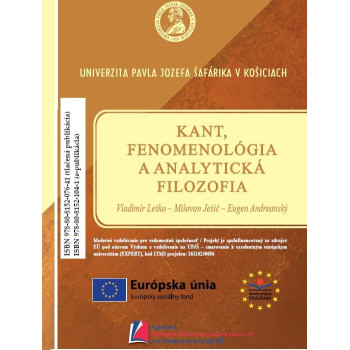
Kant, fenomenológia a analytická filozofia
E-book
E-book
Vladimír Leško - Milovan Ješič - Eugen Andreanský
The philosophical work of Immanuel Kant, the founder of German classical idealism, is one of those which, by the strength of its theoretical legacy, is permanently inspiring even in contemporary philosophical activities. This is an indisputable fact that cannot be seriously objected to. The philosophical teachings of Edmund Husserl, the founder of phenomenology, his successor Martin Heidegger, as well as several representatives of analytic philosophy, are proof of this fact. The above fact led the authors of this work to the idea of devoting a separate collective monograph to the indicated problem.
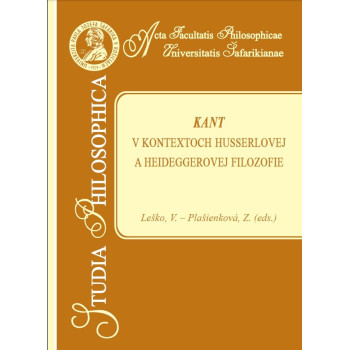
Kant v kontextoch Husserlovej a Heideggerovej...
E-book
E-book
Vladimír Leško - Zlatica Plašienková (eds.)
Philosophical Proceedings Kant in the Contexts of Husserl's and Heidegger's Philosophy is a presentation of the results of the Second International Philosophical Conference, which took place on November 5-7, 2008 at the UPJŠ in Košice.
The conference was prepared by the Department of Philosophy and History of Philosophy, Faculty of Philosophy, UPJŠ in very close cooperation with the Slovak Philosophical Association at the Slovak Academy of Sciences in Bratislava. The structure of the presented proceedings was divided into three basic parts. The first part contains the papers that were presented at the conference and constitute a crucial part of the content of our proceedings. The individual papers are arranged in the order in which they were presented at the conference. The second part of the proceedings contains the speeches from the inauguration ceremony of the award of the honorary title of Doctor honoris causa to Milan Sobotka and Teodor Münz. In the third part, a photo-documentation is published in which the ceremonial academic act of conferring the honorary degree of Doctor honoris causa is captured. Translated with DeepL.com (free version)
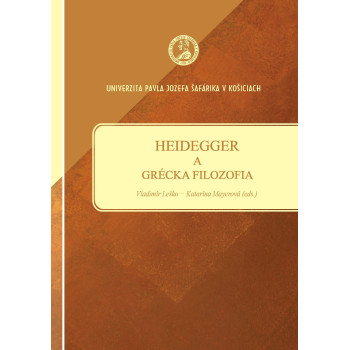
Heidegger a grécka filozofia
E-book
E-kniha
Vladimír Leško - Katarína Mayerová (eds.)
The main aim of the present work is to try to capture the decisive mode of Heidegger's philosophical understanding of the central problem of Greek philosophy, the problem of being, in the teachings of Anaximander, Heracleitus, Parmenides, Plato, and Aristotle. The authors of each section present their own understanding of Heidegger and his distinctive philosophical reception of Greek philosophy. In this context, it should be noted that the authors themselves sought their own point of view. With Heidegger's work in general, it is almost impossible to find the same interpretive consonance. This is also true for his reception of the Greek heritage. However, it is all the more professionally provoking for further philosophical investigations.
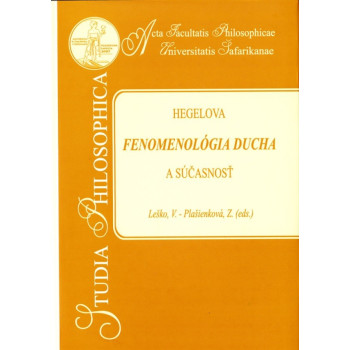
Hegelova Fenomenológia ducha a súčasnosť
E-book
E-book
Vladimír Leško - Zlatica Plašienková (eds.)
In 2007, the philosophical world commemorated an extraordinary anniversary - two hundred years since the first publication of Georg Wilhelm Friedrich Hegel's brilliant work The Phenomenology of Spirit (1807). Of course, we can have different value scales of the most important philosophical works written in the history of philosophy, but the above-mentioned work of Hegel should certainly not be absent from the top places in them. Hegel's Phenomenology of Spirit decisively changed the philosophical discourse of the 19th century and greatly influenced philosophy in the 20th century. Few of the great philosophers after Hegel could afford to pass over the philosophical work of the 1807 supreme representative of German classical philosophy and not draw, either positively or critically, on his philosophical legacy.
The philosophical conference entitled Hegel's "Phenomenology of Spirit" and the Present, dedicated to Hegel's work Phenomenology of Spirit, was prepared by the Department of Philosophy and History of Philosophy of the Faculty of Arts of the Pavol Jozef Šafárik University in Košice in cooperation with the Slovak Philosophical Association at the Slovak Academy of Sciences in Bratislava on October 4, 2007 and was organized by the Slovak Philosophical Association in Košice.
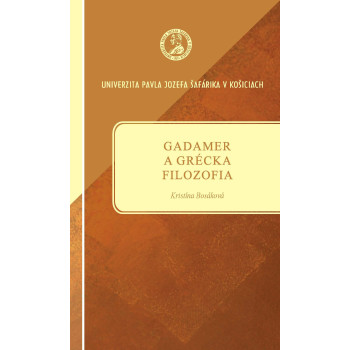
Gadamer a grécka filozofia
E-book
E-book
Attempting to confront Gadamer's teachings not only with the giants of Greek philosophy but also with Hegel and Heidegger is no easy task. However, Gadamer's entire historical-philosophical work is most prominently associated with these ancient thinkers and the two geniuses of German philosophical thought. Therefore, there is no avoiding it. Without this confrontation, all my efforts would be, in a certain sense, futile. Whether and how I succeed is another question. Every reader will surely form their own judgment.

THE FUNCTION OF METAPHOR IN MEDIEVAL NEOPLATONISM
E-book
E-book
Mária Mičaninová - Ivica Hajdučeková (eds.)
In the framework of the project VEGA of the Ministry of Education, Science, Research and Sport of the Slovak Republic 1/0330/12 The Function of Metaphor in the Philosophy of Shlomo ben Yehuda ibn Gabirol and Shihab al-Din Yahya al-Suhrawardi, project leader Assoc. Prof. Mária Mičaninová, CSc., under the patronage of the rector of Pavol Jozef Šafárik University in Košice, The Slovak Republic, Prof. MUDr. Ladislav Mirossay, DrSc., and of The Department of Philosophy and History of Philosophy of the Faculty of Arts of the same University, took place on 4th – 5th October 2013 an International conference on The Function of Metaphor in Medieval Neoplatonism. Two days´conference was opened by Dean of the Faculty of Arts of P. J. Šafárik University, Prof. PhDr. Ján Gbúr, CSc.,in the presence of Prof. PhDr. Vladimír Leško, CSc., Head of The Department of Philosophy and History of Philosophy, and of foreign guests and students of the University.