Filter By

Selections

Selections

Year of publication:

Year of publication:

Publication language:

Publication language:

Active filters

  • Year of publication:: 2009
  • Year of publication:: 2021
  • Year of publication:: 2026
  • Year of publication:: 2026
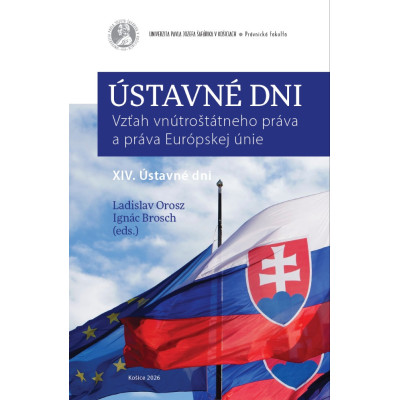
Vzťah vnútroštátneho práva a práva Európskej únie, XIV. Ústavné dni
  • New

Vzťah vnútroštátneho práva a práva Európskej...

E-book

E-book

Ladislav Orosz    Ignác Brosch  (eds.)

Scientific proceedings from the traditional international scientific conference organized by the Constitutional Court of the Slovak Republic and the Faculty of Law of the Pavol Jozef Šafárik University in Košice, titled “The Relationship Between Domestic Law and European Union Law – 14th Constitutional Days,” consists of papers by renowned representatives of domestic and foreign constitutional doctrine, as well as authors who currently serve as judges of constitutional courts and the Court of Justice of the European Union, or as their advisors. From a substantive perspective, the contributions included in the collection address the challenges arising from current developments in the case law of the Court of Justice of the European Union and the case law of the Constitutional Court of the Slovak Republic and certain other foreign constitutional courts regarding the relationship between national legal systems and European Union law. 
Download e-book for free (pdf)

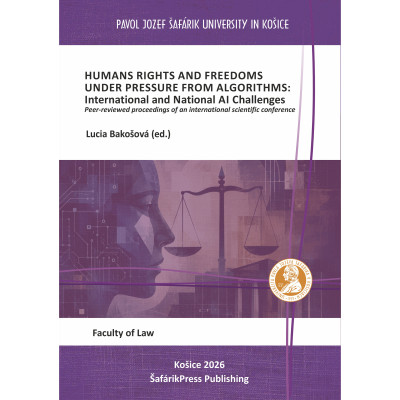
Human Rights and Freedoms under Pressure from Algorithms: International and National AI Challenges

Human Rights and Freedoms under Pressure from...

E-book

E-book

Lucia Bakošová (ed.)
The proceedings Human Rights and Freedoms under Pressure from Algorithms: International and National AI Challenges constitute a peer-reviewed outcome of an international scientific conference devoted to the legal challenges arising from the development of artificial intelligence. The volume focuses on the impact of algorithmic systems on the protection of human rights and fundamental freedoms at the international, European and national levels. The individual contributions examine issues such as transparency, accountability, the right to a fair trial, privacy protection, non-discrimination, children’s rights, labour relations, digital constitutionalism, autonomous weapons, and the use of AI in public administration and armed conflicts. Particular attention is paid to the risks of algorithmic decision-making, legal hallucinations, profiling, surveillance, and the influence of digital technologies on democratic processes.

Download the e-book for free (pdf)

Liber Amicorum Ján Klučka

Liber Amicorum Ján Klučka

E-book

E-book

Dominika Becková (ed.)

This Liber Amicorum presents a collection of contributions in Honour of Professor Ján Klučka. This Liber Amicorum was written by his colleagues from universities, collaborators from the judiciary, former colleagues from the Constitutional Court of the Slovak republic and the Court of Justice of the European Union, current colleagues from the Faculty of Law and his former PhD. students. Their contributions elaborate the knowledge their gained from the work they conducted together with Professor Ján Klučka and are interspersed with references to memories associated with Professor Ján Klučka.

Download e-book for free (pdf)

Umelá inteligencia z pohľadu práva

Umelá inteligencia z pohľadu práva

E-book

E-book

Valéria Ružičková (ed.)

Proceedings of the XIVth Student Symposium on International Law and European Law.

For the XIV Year of Student Symposium on International Law and European Law under the topic „Artificial Intelligence from the Perspective of Law“, students of the Faculty of Law and the Faculty of Science prepared several papers regarding current questions related to the ongoing development of the artificial intelligence. From the legal point of view, the papers regard the importance of the artificial intelligence in human activities in space, its impact on fundamental rights, development of new human rights in relation to its application in healthcare and nursing care as well as personal data protection while making use of the artificial intelligence.

Apart from the papers concerning the artificial intelligence from the legal perspective, two of the papers regard the artificial intelligence from the scientific perspective, explaining the importance of the artificial intelligence in localization in indoor environment as well as its importance in prediction of healthcare costs.

Download the e-book for free (pdf)

Ako správne pracovať s prameňmi práva Európskej únie. Metodická príručka.

Ako správne pracovať s prameňmi práva Európskej...

E-book

E-book

Dominika Becková - Radoslav Benko - Valéria Ružičková

Studies of the European Union law may hardly be possible without making use of its sources. Lots of types of legal rules, several forms of judicial decisions as well as a wide spectrum of criteria used while searching among legal acts of the European Union and case-law of its courts in search engines on the official websites of the European Union may, however, appear confusing, thereby making the work with sources of the European Union law more complicated and prolonging it.

Methodology Guide „How to Work Correctly with the Sources of the European Union Law“ aims to help students to understand the system of sources of the European Union law as well as the sources themselves, offer them tips and advice useful during their search and thus contribute to the adoption of fundamental procedures for working with them.

Download the e-book for free (pdf)

Medzinárodné právo súkromné

Medzinárodné právo súkromné

E-book

E-book

Kristián Csach - Ľubica Širicová

Private international law has undergone dramatic changes in recent periods. The fully operational process of communitarization of this legal field has not yet – and perhaps could not have been – effectively reflected by domestic legislators. Under the current legal status, it is not uncommon for legal issues to intertwine regulations of community origin and domestic legislation (embodied primarily by Act No. 97/1963 Coll. on Private International Law and Procedure).

Questions about the obsolescence of some provisions of this, until recently, universal codified regulation of private international law arise mainly (but not exclusively) from the conflict rules contained in the so-called "Rome I" Regulation on the law applicable to contractual obligations, the "Rome II" Regulation on the law applicable to non-contractual obligations, and most recently in Council Regulation (EC) No. 4/2009 of 18 December 2008 on jurisdiction, applicable law, recognition, and enforcement of decisions and cooperation in matters relating to maintenance obligations.

Respecting the principle of the primacy of generally binding acts of the Community over domestic law, the correct application of normative texts cannot be achieved without the ability to quickly navigate through the norms and subsequently compare them.

Students and anyone else are therefore confronted with a multitude of legal regulations of substantial scope and detailed regulation. Currently, apart from systematically arranged references on the websites of the Ministry of Justice, we do not find a comprehensive material that would offer an overview of legal regulations in the field of private international law and procedure.

Download the e-book for free (pdf)

This website uses cookies to ensure you get the best experience on our website