Filter By

Year of publication:

Year of publication:

Publication language:

Publication language:

Active filters

  • Year of publication:: 2018
  • Year of publication:: 2021
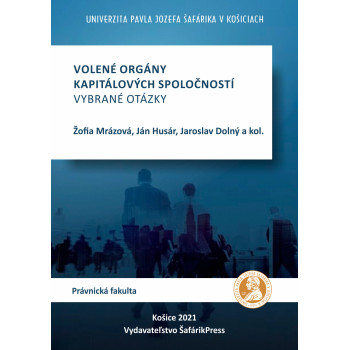
Volené orgány kapitálových spoločností. Vybrané otázky.

Volené orgány kapitálových spoločností. Vybrané...

E-book

E-book

Žofia MrázováJán HusárJaroslav Dolný a kol.

The publication "Volené orgány kapitálových spoločností. Vybrané otázky" focuses on the assessment of legal aspects of the performance of corporate boards members and on solving application problems regarding relations arising between members of the board of directors and supervisory board and the company itself.

The first part of the publication deals with the basic conceptual preconditions to become members of elected corporate boards, including conditions for their appointment and removal. Among the issues addressed is also the required standard of performance of corporate boards members in relation to the concept of professional care and duty of loyalty. Remuneration of elected board members as well as the possibility of opposing the contract for performance are also analysed.

The application problems partly extend to bankruptcy law when examining the obligations of board of directors after the bankruptcy of a company, specifically in matters of the emergence of special liability of the board of directors as well as their performance even after the bankruptcy.

Download the e-book for free  (pdf)

PRÁVO – OBCHOD – EKONOMIKA X.

PRÁVO – OBCHOD – EKONOMIKA X.

E-book

E-book

Jozef SuchožaJán Husár - Regina Hučková

Proceedings of the International Scientific Symposium

Collection Law-Commerce-Economy X. is a publication containing professional contributions by the authors, especially with regard to commercial law, civil law, labor law, intellectual property law, but also digital technology law. The thematic focus of the international scientific symposium was concentrated in three areas representing open problems of commercial law with regard to the solution of the economic and social crisis caused by the so-called pandemic (corona crisis), current issues of corporate law in the EU and artificial intelligence and law: the influence of artificial intelligence on the normative activity of the state and court decisions. With regard to the content orientation of the outputs, the publication is suitable not only for readers from the academic environment, but also from applied practice.

Download e-book for free (pdf)

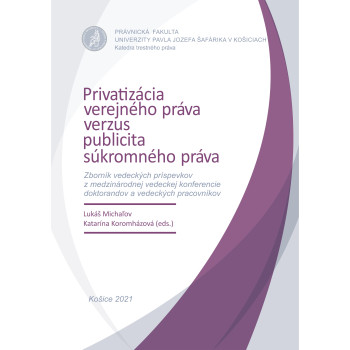
Privatizácia verejného práva verzus publicita súkromného práva

Privatizácia verejného práva verzus publicita...

E-book

E-book

Lukáš MichaľovKatarína Koromházová (eds.)

The Collection of scientific contributions "Privatization of public law versus publicity of private law" is an output of the International scientific conference of Phd. students and scientific researchers organized by the Department of Criminal Law, Faculty of Law, Pavol Jozef Šafárik University.

The collection contains contributions focused on the issues of the intersection of private and public law, specifically on the privatization of public law and publicity of private law. This is a highly important topic, because the elements of privatization can be found across the entire public law, not only in the field of criminal law, but also in other legal branches of public law.Recently, there have been significant elements of publicity of private law, especially commercial or civil law. Therefore, we consider the topic of the conference and the title of the collection to be appropriately chosen and up to date without any significant limits in scientific research. The participants of theInternational scientific conference in their contributions also focused on de lege ferenda considerations and offer a new perspective on the formation of public or private law.

The aim of the published Collection of scientific contributions isto continue in improving and developing new knowledge of the public law in the field of its privatization and private law in the field of its publicity.

Download the e-book for free  (pdf)

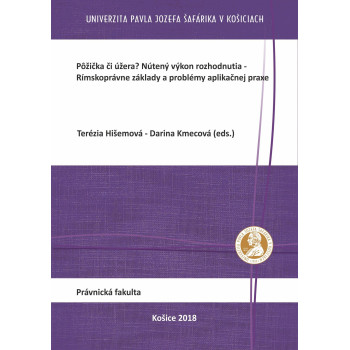
The loan or usury? Compulsory enforcement of judgment - roman and law foundations and problems of application practice

The loan or usury? Compulsory enforcement of...

E-book

E-book

Terézia HišemováDarina Kmecová (eds.)

Reviewed proceedings of scientific papers of Conference of Slovak and Czech law romanists, which take place at May, 10.-11.5.2018, at Faculty of Law, UPJŠ in Košice.

The submitted reviewed proceeding of scientific papers on „The loan or usury? Compulsory enforcement of roman - law basics and problems of application practice.”  is prepared within the solution of the grant project VEGA on: „The loan or usury? Compulsory enforcement of historical - law basics and problems of application practice.”, no. p. 1/0198/17.

The authors of papers are important personalities of Roman law working in the Slovak and Czech Republic, as well as PhD students and young scientists from Slovak and foreign universities who are active in the academic environment as well as in legal practice. The main goal of the editors is to help improve the current legal situation, which is assessed as unsatisfactory, and through a historical excursion of the development of the loan institute and then the forced execution of the decision, to create de lege ferenda proposals considering all areas of research.

The Proceedings trace the interrelationships between the substantive law institute in terms of the Roman law of contractus unilaterales - mutuum in its various types, often realized by the attachment of high interest rates, which bordered on the insurrection and the procedural law of individual lawsuits enforced in the legislative, formular and cognitive process. If there was no possibility to impose certain behaviour on the obligated person (the debtor, the sentenced person), then the declared general obligation to enforce the legal norms was only a legal term. It has always been the case that every internally well-organized state, whether antique or present, has to use power tools - often with the use of gross violence - but within the limits of the law, to promote what it has declared valid law. It must protect creditors on the one hand, but it must also prevent self-help and the use of illegal, unjustified and disproportionate violence.

The loan contract as a real contract has often become an integral part and relatively the most frequent reason leading to the compulsory enforcement, especially when contracting parties often agree on the connection of interest - sometimes within the legal limit, sometimes exceeding the legal framework - and in this way the potential future creditor (the plaintiff) significantly increased the insolvency risk of the debtor (the defendant, the sentenced) and of the subsequent execution. The pronounced and deepening social stratification of the Roman population and the secondary depreciation effort, the cancellation of the debts of the poor part of the population logically culminated in social unrest and revolt against the enforcement of the enforcement law.

The proceedings capture not only the rich scientific discussion of Slovak and Czech legal Romanists, but also the opinions, experience and knowledge of experts on contemporary law dealing with this type of issues. As a result, it provides a unique interdisciplinary view of the subject and raises many stimulus points for future research. This work proves that the problems encountered by the various representatives of the Roman jurisprudence and their legal and theoretical bases and solutions are undoubtedly useful and serve as a guideline also for solving legal issues in the field of modern enforcement proceedings.

Download the e-book for free (pdf)

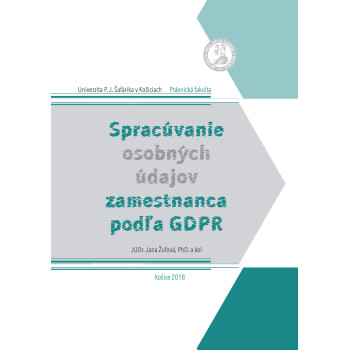
Spracúvanie osobných údajov zamestnanca podľa GDPR

Spracúvanie osobných údajov zamestnanca podľa GDPR

E-book

E-book

Jana Žuľová a kol.

The presented publication is intended for employers, managers, and HR professionals who process employees' personal data for various employment-related purposes and need to conduct an audit of their processing in compliance with the GDPR and the new Personal Data Protection Act. The publication will also be useful for new employers who are encountering data protection for the first time and need to establish internal data protection rules, essentially starting from scratch.

The reader has the opportunity to gain a comprehensive understanding of the data protection rules applicable in the employment sector, the obligations of the employer, and the rights of the data subject, i.e., job applicants, employees, and former employees.

Download the e-book for free (pdf)

This website uses cookies to ensure you get the best experience on our website