Filter By

Selections

Selections

Year of publication:

Year of publication:

Active filters

  • Year of publication:: 2013
  • Year of publication:: 2015
  • Year of publication:: 2026
  • Year of publication:: 2026
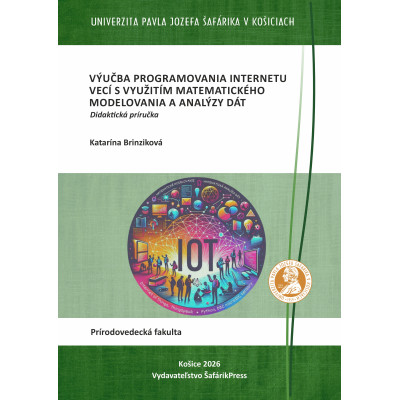
Výučba programovania internetu vecí s využitím matematického modelovania a analýzy dát
  • New

Výučba programovania internetu vecí s využitím...

E-book

E-book

Katarína Brinziková

This teaching guide for instructing students in Internet of Things programming using mathematical modeling and data analysis is intended for mathematics and computer science teachers in elementary and secondary schools, as well as for students training to teach these subjects. It responds to the requirements of the new curriculum reform in Slovakia, which emphasizes a cyclical learning process, the development of data, digital, and mathematical literacy, and the integration of teaching with real-world problems and technologies. The guide is designed in accordance with the methodological framework of design-based research. It contains technological and methodological foundations, as well as a set of proven teaching activities divided into three levels of difficulty. The teaching guide provides teachers with specific instructions, recommendations, and examples of best practices for the meaningful integration of IoT and mathematical modeling into teaching across different educational cycles, creating space for modern, interdisciplinary, and data-driven education.
Download the e-book for free (pdf)

Informačné systémy o území a inteligentné mestá
  • New

Informačné systémy o území a inteligentné mestá

E-book

E-book

Jaroslav Hofierka

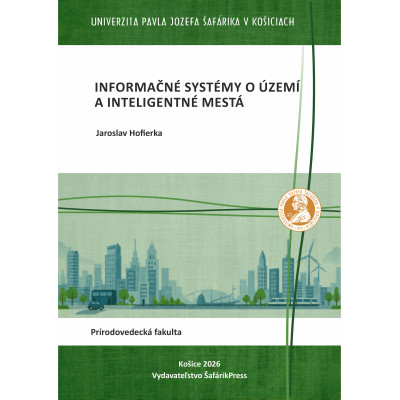
The lecture notes "Land Information Systems and Smart Cities" provides a comprehensive overview of geoinformation technologies within the context of public administration and modern land management. The publication systematically explains the principles of Land Information Systems (LIS), their architecture, components, and practical applications. Emphasis is placed on linking GIS technologies with real-world applications in local governments, infrastructure organizations, and the business sector. The text covers the hardware and software equipment of LIS, including modern trends such as cloud computing, open-source solutions, and the integration of artificial intelligence.

Special attention is given to data, which represent a key component of LIS, including an overview of the most important geospatial data products in Slovakia. The publication analyzes WebGIS technologies, map portals, and OGC standards (WMS, WFS, WCS) in detail, which enable the effective accessibility and sharing of geodata. A significant part is also dedicated to the National Infrastructure for Spatial Information (NIPI) and the INSPIRE Directive, ensuring data interoperability at both national and European levels.

Download the e-book for free (pdf)

Študentská vedecká konferencia PF UPJŠ 2013

Študentská vedecká konferencia PF UPJŠ 2013

E-book

E-book

Vladimír Zeleňák (ed.)

The publication contains abstracts of contributions presented at the Student Scientific Conference of the Faculty of Natural Sciences at UPJŠ in Košice, held on April 25, 2013. The event was marked by the celebration of the 50th anniversary of the Faculty of Natural Sciences at UPJŠ and was part of a series of events called ScienceFest.

Download the e-book for free (pdf)

Počítačová fyzika I

Počítačová fyzika I

E-book

E-book

Milan Žukovič

The textbook Computational Physics I covers the topics taught in the course of the same name at the bachelor's level of the Physics study program, as well as in the course Application of Numerical Methods at the bachelor's level of the Applied Informatics study program.

The text builds upon the basic course in numerical methods, focusing on explaining the fundamental principles of computer-based solutions to some typical physics problems. It includes both the area of deterministic methods for solving problems modeled by ordinary and partial differential equations, as well as the area of stochastic Monte Carlo simulations. The course Computational Physics I lays the foundation for further study of more advanced computational methods taught at the master's level in the subject Computational Physics II. Nowadays, the use of computers as a tool for solving real physics problems, and for students as a tool for preparing their final bachelor's or master's theses, is almost indispensable.

This has led to the creation of numerous user-oriented software packages in various environments for solving a wide range of problems. However, without a thorough understanding of how individual computational techniques work, these programs become black boxes with many pitfalls and risks in their use. Therefore, this text emphasizes understanding both the strengths and weaknesses of individual methods and the assumptions for their successful application.

Download the e-book for free (pdf)

Študentská vedecká konferencia PF UPJŠ 2015

Študentská vedecká konferencia PF UPJŠ 2015

E-book

E-book

Vladimír Zeleňák(ed.)

The proceedings contain abstracts of contributions from participants of the Student Scientific Conference of the Faculty of Science, Pavol Jozef Šafárik University in Košice, which took place on April 22, 2015.

The Student Scientific Conference (SSC) enjoys long-term popularity among the faculty's students and teachers, and we are pleased that this was no different this year, with 128 contributions submitted to the SSC.

The contributions were organized into 19 sections, additionally complemented by an open programming competition and the final of the IHRA contest. For many students, presenting at the SSC is one of the first opportunities to gain experience in presenting their results before a professional audience. Considering the number of submitted contributions, along with the members of the expert juries from the faculty's teaching staff and the audience who came to support their classmates' presentations, the SSC is an event where a large part of the student and academic community of the faculty meets at one place and time. Many abstracts presented in this proceedings were developed as part of students' work on partial tasks that are components of research projects at the departments of the Faculty of Science, Pavol Jozef Šafárik University.

The abstracts represent, in a way, an overview of research topics at the individual workplaces of the faculty. The SSC proceedings thus serve as a useful tool that students and faculty teachers can use to present the faculty externally to partners, employers, and potential collaborators. Partners from practice have shown interest in cooperating in organizing the SSC for a long time. Since 2005, the association of IT companies has awarded a Prize for the Most Original Work and a Prize for the Work with the Best Prospects for Practical Application.

Download the e-book for free (pdf)

This website uses cookies to ensure you get the best experience on our website