Filter By

Selections

Selections

Year of publication:

Year of publication:

Publication language:

Publication language:

Faculty:

Faculty:

Active filters

  • Year of publication:: 2013
  • Year of publication:: 2014
  • Year of publication:: 2019
  • Year of publication:: 2021
  • Year of publication:: 2022
  • Year of publication:: 2026
  • Year of publication:: 2026
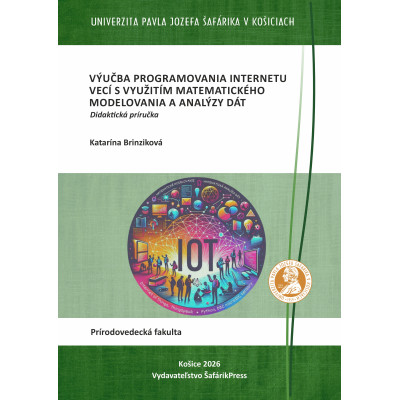
Výučba programovania internetu vecí s využitím matematického modelovania a analýzy dát
  • New

Výučba programovania internetu vecí s využitím...

E-book

E-book

Katarína Brinziková

This teaching guide for instructing students in Internet of Things programming using mathematical modeling and data analysis is intended for mathematics and computer science teachers in elementary and secondary schools, as well as for students training to teach these subjects. It responds to the requirements of the new curriculum reform in Slovakia, which emphasizes a cyclical learning process, the development of data, digital, and mathematical literacy, and the integration of teaching with real-world problems and technologies. The guide is designed in accordance with the methodological framework of design-based research. It contains technological and methodological foundations, as well as a set of proven teaching activities divided into three levels of difficulty. The teaching guide provides teachers with specific instructions, recommendations, and examples of best practices for the meaningful integration of IoT and mathematical modeling into teaching across different educational cycles, creating space for modern, interdisciplinary, and data-driven education.
Download the e-book for free (pdf)

Informačné systémy o území a inteligentné mestá
  • New

Informačné systémy o území a inteligentné mestá

E-book

E-book

Jaroslav Hofierka

The lecture notes "Land Information Systems and Smart Cities" provides a comprehensive overview of geoinformation technologies within the context of public administration and modern land management. The publication systematically explains the principles of Land Information Systems (LIS), their architecture, components, and practical applications. Emphasis is placed on linking GIS technologies with real-world applications in local governments, infrastructure organizations, and the business sector. The text covers the hardware and software equipment of LIS, including modern trends such as cloud computing, open-source solutions, and the integration of artificial intelligence.

Special attention is given to data, which represent a key component of LIS, including an overview of the most important geospatial data products in Slovakia. The publication analyzes WebGIS technologies, map portals, and OGC standards (WMS, WFS, WCS) in detail, which enable the effective accessibility and sharing of geodata. A significant part is also dedicated to the National Infrastructure for Spatial Information (NIPI) and the INSPIRE Directive, ensuring data interoperability at both national and European levels.

Download the e-book for free (pdf)

Počítačová fyzika II

Počítačová fyzika II

E-book

E-book

Milan Žukovič

This textbook is intended for master's degree students and is a follow-up to the Computational Physics I course studied at the bachelor's level. The content of the textbook Computational Physics II focuses on stochastic methods of solving physical problems, mainly on Monte Carlo (MC) simulation of many-particle systems.

The focus on this computationally intensive approach is motivated by the gradual increase in the computing capacities of ordinary computers as well as the introduction of high-performance computing clusters. This has led to significant progress in the development of new simulation techniques, thanks to which MC simulations have found application in various areas of research and application practice. Considering the main research focus of the department, this text is particularly devoted to the presentation of basic and more advanced MC simulation techniques applied to a simple Ising spin model in order to investigate its magnetic, thermodynamic and critical properties.

The next part is devoted to MC simulations of random processes. It focuses on the simplest but also the most basic random walk process and demonstrates its applications in financial analysis and the solution of a quantum system described by the time-dependent Schrödinger equation. The last part is dedicated to the basics of molecular dynamics, applied to simulating the classical movement of atoms in a given force field. By mastering the problems addressed in this course, students will obtain a potential tool for working out of their diploma theses, or a methodology useful for their further scientific and research practice in the field of investigating of complex systems.

The lectured topic is subsequently exercised in the form of preparing projects implemented in the freely distributable software Octave, which is easy on the user's programming skills and which students have the opportunity to familiarize themselves with in the previous study.

Download e-book for free (pdf)

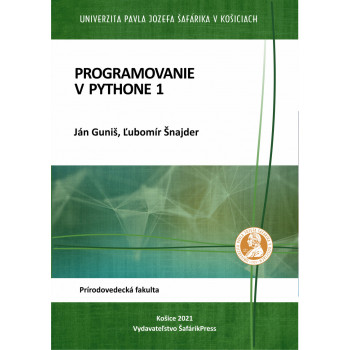
Programovanie v Pythone 1

Programovanie v Pythone 1

E-book

E-book

Ján GunišĽubomír Šnajder

Prílohy

College scripts Programming in Python 1 are intended for future teachers of computer science. The content of the course is related to the teaching of programming in Scratch and is an introduction to text-based programming in Python.

Programming is introduced as a means of developing problem-solving skills. The first chapter is devoted to problem solving. The next 12 chapters sequentially introduce basic language constructions, data structures, and selected types of algorithms. Each of these chapters begins with an introduction to the problem. This section is primarily intended for self-study, to prepare students for the exercises. The following subchapter summarizes and completes the knowledge, and additional insights and approaches related to the chapter topic are presented. The chapters include a collection of exercises designed to practice and deepen knowledge and skills on the topic.

The final part of the chapter presents the solved problems. This section serves as a guide to solving the problems in the collection.

i

Download the e-book for free (pdf)

Študentská vedecká konferencia PF UPJŠ 2019

Študentská vedecká konferencia PF UPJŠ 2019

E-book

E-book

Katarína Cechlárová (ed.)

This year, the Student Scientific Conference was held on April 24, 2019, across 17 sections in disciplines such as biology and ecology, chemistry, physics, geography, mathematics, informatics, and their didactics. Bachelor’s and master’s students presented a total of 124 contributions. The most successful participants advanced to national or traditional Czech-Slovak student scientific showcases in fields like physics, chemistry, mathematics, informatics, and mathematics didactics.

In addition to faculty students, 10 high school students participated outside the competition. They were invited based on their achievements in subject-specific Olympiads or because they were already engaged with the faculty under the guidance of dedicated teachers in laboratory work as part of their preparation for future studies. The day also featured a programming competition with 23 participants, an IHRA contest involving 16 teams of high school students and 15 teams from elementary schools, and a new Puzzle section where 72 high school students from the region competed.

The abstracts from the Student Scientific Conference demonstrate that our faculty's students not only absorb theoretical knowledge delivered in lectures but also actively engage in solving partial scientific problems that align with research objectives at the institutes of PF UPJŠ. This collection serves as both a record of scientific activity at the faculty and a dignified presentation for the broader public.

Prof. RNDr. Katarína Cechlárová, DrSc.

Vice-Dean for Education

Doc. RNDr. Gabriel Semanišin, PhD.

Dean of the Faculty

Download the e-book for free  (pdf)

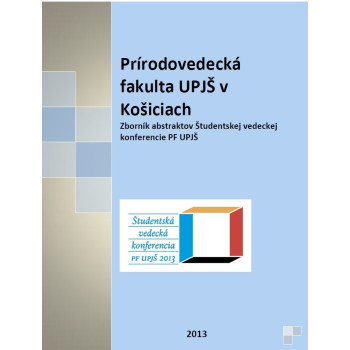
Študentská vedecká konferencia PF UPJŠ 2013

Študentská vedecká konferencia PF UPJŠ 2013

E-book

E-book

Vladimír Zeleňák (ed.)

The publication contains abstracts of contributions presented at the Student Scientific Conference of the Faculty of Natural Sciences at UPJŠ in Košice, held on April 25, 2013. The event was marked by the celebration of the 50th anniversary of the Faculty of Natural Sciences at UPJŠ and was part of a series of events called ScienceFest.

Download the e-book for free (pdf)

Tvorba úloh pre programátorské súťaže

Tvorba úloh pre programátorské súťaže

E-book

E-book

Ľubomír ŠnajderJán Guniš

The publication lists interim results of qualitative educational research focused on the development and evaluation of programming tasks being carried out by authors since 2005 in the frame of programming competition PALMA junior.

The publication consists of three chapters: Computer science competitions in Slovakia, Tasks in computer science education, Selected problems of PALMA junior competition. The first chapter provides an overview of computer science competitions for a primary and secondary schools in Slovakia. The second chapter described the issue of learning tasks - their components, focus, formulation types, and development system of tasks. The third chapter contains the assignments and commented author solutions of selected problems represented focus of PALMA junior competition – programming, algorithms and mathematics.

For each problem is mentioned analysis of pupils’ solutions aimed to ways of thinking, typical misconceptions, sets of preparatory and extended problems. The publication is addressed to computer science teacher trainers, authors of programming competitions problems, and computer science teachers.  

Download the e-book for free (pdf)

UNINFOS 2014 • Univerzitné informačné systémy (Zborník príspevkov)

UNINFOS 2014 • Univerzitné informačné systémy...

E-book

E-book

Gabriel Semanišin - Emil HutňanJana Oleničová

The proceedings contain contributions from participants of the UNIFOS 2014 conference, University Information Systems in Košice, which took place from October 27 to 29, 2014.

ICT centers are important element that provide functioning and development hardware and software infrastructure at Slovak Universities. There are more differences between them in real position, management, personal sources and financing. ICT centers provide a wide range of services to large number of university users and they implement the policy of information security recently.

Download the e-book for free (pdf)

UNINFOS 2014 • Univerzitné informačné systémy (Zborník abstraktov)

UNINFOS 2014 • Univerzitné informačné systémy...

E-book

E-book

Gabriel Semanišin - Emil Hutňan - Jana Oleničová

The proceedings contain abstracts of contributions from participants of the UNIFOS 2014 conference, University Information Systems in Košice, which took place from October 27 to 29, 2014.

ICT centers are important element that provide functioning and development hardware and software infrastructure at Slovak Universities. There are more differences between them in real position, management, personal sources and financing. ICT centers provide a wide range of services to large number of university users and they implement the policy of information security recently.

Download the e-book for free (pdf)

This website uses cookies to ensure you get the best experience on our website