Filter By

Year of publication:

Year of publication:

Publication language:

Publication language:

Method of publication:

Method of publication:

Active filters

  • Year of publication:: 2012
  • Year of publication:: 2013
  • Year of publication:: 2015
  • Year of publication:: 2017
Základné fyzikálne praktikum III.

Základné fyzikálne praktikum III.

E-book

E-book

Janka Vrláková - Stanislav Vokál

Atomic and nuclear physics are relatively young scientific disciplines forming the final part of the general physics course at the Faculty of Physics of the Jagiellonian University. Their aim is to explain the nature of the basic physical properties of atoms, atomic nucleus and elementary particles.

This is also the content of the lectures and exercises ‘General Physics IV’ in the 2nd year of the Bachelor's degree in Physics at the Faculty of Natural Sciences (PF) of the P.J. Šafárik University (UPJŠ) in Košice. They are followed by optional lectures ‘Nuclear Radiation in the Environment’, ‘Introduction to the Physics of the Microworld’ in the 3rd year of the Bachelor's degree of single-discipline study of physics, or teacher study of physics in combination with another subject, and ‘Subnuclear Physics’ in the 1st year of the Master's degree of teacher study of physics in combination with another subject.

In the aforementioned lectures, the latest experimental findings on the structure and behaviour of the microworld are presented by means of physical theories and their subsequent experimental verification in experiments.
Download the e-book for free (pdf)

Teória efektívneho poľa pre lokalizované spinové modely

Teória efektívneho poľa pre lokalizované...

E-book

E-book

Michal Jaščur

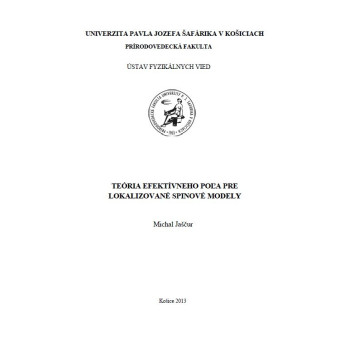
This monograph is devoted to the discussion of effective field theory based on the differential operator method, originally introduced by Honmura and Kaneyoshi in 1979, which remains actively used for theoretical studies of localized spin models of magnetism—particularly variants of the Ising model. To date, this methodology has been applied by numerous authors to investigate a wide range of systems, including crystalline systems, diluted magnetic systems, systems with random exchange interactions, amorphous magnetic materials, systems under random magnetic and crystalline fields, thin magnetic layers, magnetic systems with free surfaces, binary and ternary magnetic alloys, among others.

During my scientific career, I have collaborated with several leading experts in this field—including Prof. Kaneyoshi, with whom I completed two long-term research stays—to advance the development of the differential operator method (and consequently effective field theory). Within this research area, I have published over 40 scientific papers in prominent international physics journals. These works include both methodological advancements and significant applications that predict intriguing physical phenomena, such as multicompensation phenomena in ferrimagnets.

Download the e-book for free

Úvod do termodynamiky

Úvod do termodynamiky

E-book

E-book

Michal Jaščur - Michal Hnatič

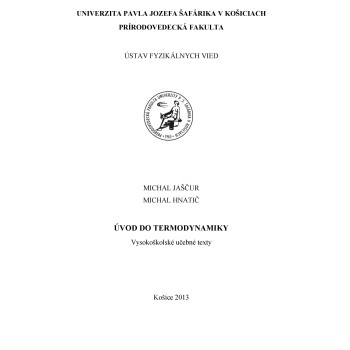
This textbook covers the fundamentals of phenomenological thermodynamics to the extent typically taught in standard theoretical physics courses at the undergraduate level in the Physics degree program. A slightly reduced scope is also taught in all interdisciplinary study programs combined with physics. In recent years, the time allocation for individual courses has been slightly reduced, which is reflected in our selection and coverage of topics.

Our primary aim was to provide a sufficiently solid explanation of the key concepts and laws of thermodynamics necessary for mastering further theoretical physics courses at the master's level (e.g., Statistical Physics, Condensed Matter Physics, Quantum Theory of Solids, Quantum Theory of Magnetism, etc.). The book also presents the essential minimum knowledge required for the study of further applications of thermodynamics in biophysics, biology, chemistry, and engineering disciplines.

Understanding individual sections, as well as the text as a whole, requires a grasp of the basic concepts of thermodynamics at the level of a General Physics course and knowledge equivalent to a standard university mathematics course. Each topic is treated with the utmost emphasis on conceptual clarity and mathematical rigor.

Download the e-book for free (pdf)

Qauntum theory of magnetism

Qauntum theory of magnetism

E-book

E-book

Michal Jaščur

This is a supporting text for the undergraduate students interested in quan- tum theory of magnetism. The text represents an introduction to various theoretical approaches used in this eld. It is an open material, in the sense that it will be supported by appropriate problems to be solved by student at seminars and also as a homework.

The text consists of four chapters that form closed themes of the in- troductory quantum theory of magnetism. In the rst part we explain the quantum origin of the magnetism illustrating the appearance of the ex- change interaction for the case of hydrogen molecule. The second chapter is devoted to the application of the Bogolyubov inequality to the Heisenberg model and it represents the part which is usually missing in the textbooks of magnetism. The third chapter deals with the standard spin wave-theory including the Bloch and Holstein-Primakoff a approach. Finally, we discuss the application of the Jordan-Wigner transformation to one-dimensional spin-1/2 XY model.

The primary ambition of this supportive text is to explain diverse math- ematical methods and their applications in the quantum theory of mag- netism. The text is written in the form which should be sufficient to de- velop the skills of the students up to the very high level. In fact, it is expected that students following this course will able to make their own original applications of the methods presented in this book.

Download the e-book for free (pdf)

Študentská vedecká konferencia PF UPJŠ 2013

Študentská vedecká konferencia PF UPJŠ 2013

E-book

E-book

Vladimír Zeleňák (ed.)

The publication contains abstracts of contributions presented at the Student Scientific Conference of the Faculty of Natural Sciences at UPJŠ in Košice, held on April 25, 2013. The event was marked by the celebration of the 50th anniversary of the Faculty of Natural Sciences at UPJŠ and was part of a series of events called ScienceFest.

Download the e-book for free (pdf)

Zbierka úloh z fyziky elementárnych častíc

Zbierka úloh z fyziky elementárnych častíc

E-book

E-book

Marek Bombara

The collection of exercises summarises and supplements the exercises realised at the Pavol Jozef Šafárik in Košice within the lecture course Elementary Particle Physics. The collection is intended for the master students of the Nuclear and Subnuclear Physics subject, but it could be beneficial also for other physics subjects or even for interdisciplinary study. 

The division of chapters roughly copies the order of lectures. At the beginning, students will briefly familiarize themselves with the basics of special relativity and its practical use in particle physics.

Download the e-book for free (pdf)

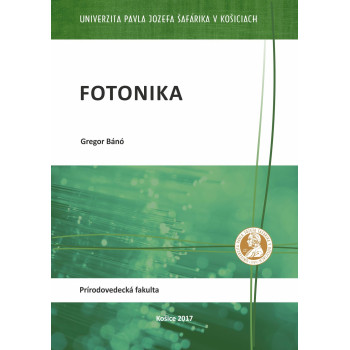
Fotonika

Fotonika

E-book

E-book

Gregor Bánó

Photonics is an application-oriented discipline at the interface of optics, opto-electronics and quantum optics. It includes classical optics extended by the description of physical phenomena and optical devices that rely on quantum (photon) nature of light.
The main objective of the Photonics course is to provide a comprehensive overview of essential optical and photonic phenomena routinely applied in experimental scientific research while working with various light sources (e.g. in the field of biophotonics). The first chapters are devoted to the description of light at different levels. The logical order of subsections in this part corresponds to the structure of the textbook: B. E. A. Saleh, M. C. Teich, Fundamentals of Photonics. The following chapters contain a description of laser operation and an overview of selected optical instruments and their applications.
The body text is complemented by practical notes on the use of theoretical knowledge during daily work in the laboratory. The course of Photonics requires a basic knowledge of mathematics, electromagnetism and optics, and thus it is recommended to students who previously passed through the courses of the Bachelor's program in Physics.

Download the e-book for free (pdf)

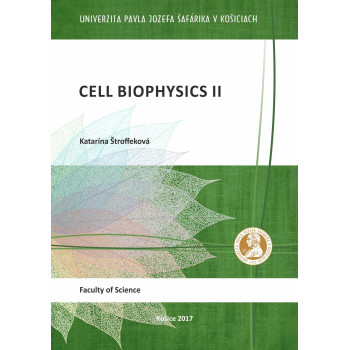
Cell Biophysics II

Cell Biophysics II

E-book

E-book

Katarína Štrofeková

Cell Biophysics II is the one semester comprehensive course textbook for PhD students. It encompasses basic principles and mechanisms underlying cell physiology and biophysics with aims:

• General knowledge of the principles of cellular function, including membrane, cytoplasmic and nuclear roles in normal and abnormal conditions.
• In-depth understanding of the mechanisms underlying the cell functions at the molecular and subcellular level.
• Awareness of cell pathologies that lead to specific disease symptoms and phenotypes.
• The ability to apply learned principles to solve new problems (analysis & synthesis).

Download the e-book for free (pdf)

Počítačová fyzika I

Počítačová fyzika I

E-book

E-book

Milan Žukovič

The textbook Computational Physics I covers the topics taught in the course of the same name at the bachelor's level of the Physics study program, as well as in the course Application of Numerical Methods at the bachelor's level of the Applied Informatics study program.

The text builds upon the basic course in numerical methods, focusing on explaining the fundamental principles of computer-based solutions to some typical physics problems. It includes both the area of deterministic methods for solving problems modeled by ordinary and partial differential equations, as well as the area of stochastic Monte Carlo simulations. The course Computational Physics I lays the foundation for further study of more advanced computational methods taught at the master's level in the subject Computational Physics II. Nowadays, the use of computers as a tool for solving real physics problems, and for students as a tool for preparing their final bachelor's or master's theses, is almost indispensable.

This has led to the creation of numerous user-oriented software packages in various environments for solving a wide range of problems. However, without a thorough understanding of how individual computational techniques work, these programs become black boxes with many pitfalls and risks in their use. Therefore, this text emphasizes understanding both the strengths and weaknesses of individual methods and the assumptions for their successful application.

Download the e-book for free (pdf)

Študentská vedecká konferencia PF UPJŠ 2015

Študentská vedecká konferencia PF UPJŠ 2015

E-book

E-book

Vladimír Zeleňák(ed.)

The proceedings contain abstracts of contributions from participants of the Student Scientific Conference of the Faculty of Science, Pavol Jozef Šafárik University in Košice, which took place on April 22, 2015.

The Student Scientific Conference (SSC) enjoys long-term popularity among the faculty's students and teachers, and we are pleased that this was no different this year, with 128 contributions submitted to the SSC.

The contributions were organized into 19 sections, additionally complemented by an open programming competition and the final of the IHRA contest. For many students, presenting at the SSC is one of the first opportunities to gain experience in presenting their results before a professional audience. Considering the number of submitted contributions, along with the members of the expert juries from the faculty's teaching staff and the audience who came to support their classmates' presentations, the SSC is an event where a large part of the student and academic community of the faculty meets at one place and time. Many abstracts presented in this proceedings were developed as part of students' work on partial tasks that are components of research projects at the departments of the Faculty of Science, Pavol Jozef Šafárik University.

The abstracts represent, in a way, an overview of research topics at the individual workplaces of the faculty. The SSC proceedings thus serve as a useful tool that students and faculty teachers can use to present the faculty externally to partners, employers, and potential collaborators. Partners from practice have shown interest in cooperating in organizing the SSC for a long time. Since 2005, the association of IT companies has awarded a Prize for the Most Original Work and a Prize for the Work with the Best Prospects for Practical Application.

Download the e-book for free (pdf)

This website uses cookies to ensure you get the best experience on our website