Active filters

  • Year of publication:: 2013
  • Year of publication:: 2017
  • Year of publication:: 2018
  • Year of publication:: 2025
  • Faculty:: Prírodovedecká fakulta
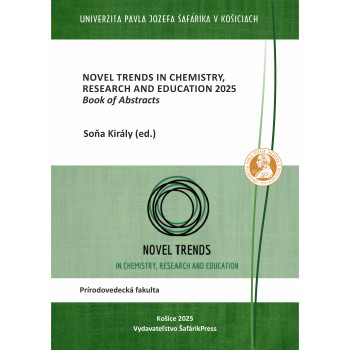
Novel Trends in Chemistry, Research and Education 2025

Novel Trends in Chemistry, Research and...

E-book

E-publication
Soňa Király

The Book of Abstracts of the institutional conference Novel Trends in Chemistry, Research and Education 2025 consists of 88 contributions that reflect the current scientific direction and disciplinary diversity of chemical research at our faculty. The publication is divided into several chapters, including abstracts of 6 invited lectures, 4 plenary lectures, and thematically oriented sessions covering a broad spectrum of chemical disciplines. A total of 78 abstracts are included within the sections.
Download the e-book for free

EFFUSE Scientific education for advanced

EFFUSE Scientific education for advanced

E-book

E-publication

Beáta Valkay ed.
Ivana Slepáková-Monika Balogová a kol.

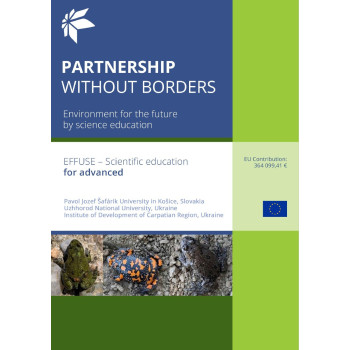
EFFUSE - Scientific Education for Advanced is an educational material designed for university students interested in ecological sciences, biology and environmental protection. The publication was developed as part of the EFFUSE project and focuses on the scientific investigation of living organisms in the river ecosystem, with an emphasis on their ecological role and importance as bioindicators. The river ecosystem is a dynamic environment where a wide range of organisms can be studied, from algae and phytoplankton to aquatic invertebrates, fish, amphibians and reptiles. This publication presents a detailed study of their adaptations, life cycles, reproductive strategies and their importance for ecological balance. Particular attention is paid to fish and amphibians, whose environmental demands and sensitivity to pollution make them important indicators of water quality and environmental status. The publication also provides guidance on how to integrate their study into university education in the form of practical research. It also includes a chapter on science education in the context of sustainable development, which is often absent from university curricula in Slovakia and Ukraine. This material promotes the link between theory and practice and develops students' scientific thinking in order to prepare them to meet the environmental challenges of the future.

Download the e-book for free (pdf)

Predictive Modeling of Soil Types and Their Characteristics

Predictive Modeling of Soil Types and Their...

E-book

E-book

Vasyl Cherlinka - Michal Gallay - Yuryi Dmytruk

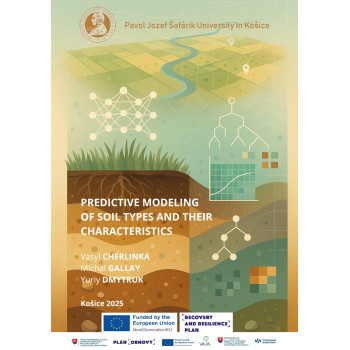
The textbook is a practical guide to predictive mapping of soil types and properties in R. It bridges digital soil mapping theory with hands-on practice, covering the full workflow from data acquisition and preprocessing to validation and uncertainty quantification. Early chapters introduce the tidyverse ecosystem and the sf and terra packages for spatial data handling. Subsequent parts address modelling of categorical variables (soil types/WRB) and continuous variables (soil organic carbon) using Random Forest, Cubist, and Quantile Regression Forests. Step-by-step code examples show training/testing, feature selection, accuracy metrics, and model interpretation. Reproducibility and cartographic best practice are emphasised. A Slovakia case study demonstrates real-world application while outlining limits and generalisability. The book targets bachelor’s, master’s, and PhD students in geography, geoinformatics, environmental and agricultural sciences, as well as practitioners. Written in English, it fits international courses and mobility programmes.

Download the e-book for free (pdf)

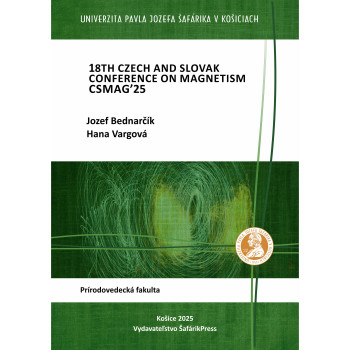
18th Czech and Slovak Conference on Magnetism – CSMAG’25

18th Czech and Slovak Conference on Magnetism –...

E-book

E-book

Jozef Bednarčík - Hana Vargová (eds.)

The Czech and Slovak Conference on Magnetism (CSMAG) is a scientific meeting that honors a longstanding tradition initiated in Košice in 1960. Evolving from a regional gathering of the Czechoslovak magnetic community into a prominent international forum, CSMAG brings together researchers from diverse fields of magnetism. The conference covers a wide range of topics including theoretical and experimental magnetism, magnetic materials for energy and spintronics applications, low-dimensional and molecular magnets, rare-earth and actinide systems, and multifunctional materials. With contributions from over 20 countries, CSMAG’25 fosters cross-disciplinary collaboration and showcases the latest advances in both fundamental studies and practical applications of magnetic phenomena.

Download the e-book for free (pdf)

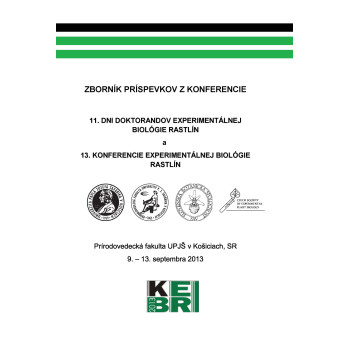
Zborník príspevkov z 11. Dní doktorandov experimentálnej biológie rastlín a 13. Konferencie experimentálnej biológie rastlín

Zborník príspevkov z 11. Dní doktorandov...

E-book

E-book

Martin Bačkor - Silvia Mihaličová (eds.)

Proceedings of the 11th Conference of Doctoral Students in Experimental Plant Biology and the 13th Conference on Experimental Plant Biology, Košice, September 9–13, 2013

13th Conference of Experimental Plant Biology (Sections)

  1. Cell Biology and Cytology: Michal Martinka
  2. Developmental Biology and Morphogenesis: Alexander Lux
  3. “Omics” – Genomics, Transcriptomics, and Proteomics: Boris Vyskot
  4. Hormonal Regulation of Plant Growth and Development: Jana Albrechtová
  5. Photosynthesis, Assimilate Production, and Transport: Jiří Šantrůček
  6. GMOs and Plant Biotechnology: Eva Čellárová
  7. Biophysical Signals and Optical Properties of Plants: Jan Nauš Stress
  8. Physiology: Ľudmila Slováková
  9. Plant Interactions with Organisms: Martin Bačkor
  10. Water and Mineral Nutrition of Plants: Miroslav Repčák
  11. Productive Biology of Plants and Agriculture: Václav Hejnák
  12. Ecological Plant Biology and Global Climate Change: Michal Marek

11th Days of Doctoral Students in Experimental Plant Biology (Sections)

  1. Molecular & Cell Genetics: Viktor Žárský
  2. Developmental Biology: Alexander Lux
  3. Biochemistry & Physiology: Jiří Šantrůček
  4. Systematics & Evolution: Jana Albrechtová
  5. Ecophysiology: Jana Albrechtová

Download the e-book for free (pdf)

Qauntum theory of magnetism

Qauntum theory of magnetism

E-book

E-book

Michal Jaščur

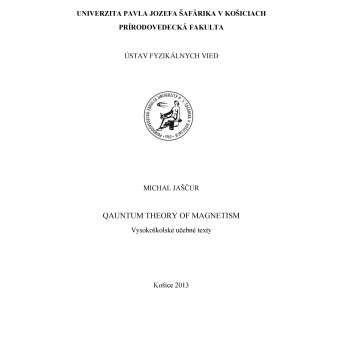
This is a supporting text for the undergraduate students interested in quan- tum theory of magnetism. The text represents an introduction to various theoretical approaches used in this eld. It is an open material, in the sense that it will be supported by appropriate problems to be solved by student at seminars and also as a homework.

The text consists of four chapters that form closed themes of the in- troductory quantum theory of magnetism. In the rst part we explain the quantum origin of the magnetism illustrating the appearance of the ex- change interaction for the case of hydrogen molecule. The second chapter is devoted to the application of the Bogolyubov inequality to the Heisenberg model and it represents the part which is usually missing in the textbooks of magnetism. The third chapter deals with the standard spin wave-theory including the Bloch and Holstein-Primakoff a approach. Finally, we discuss the application of the Jordan-Wigner transformation to one-dimensional spin-1/2 XY model.

The primary ambition of this supportive text is to explain diverse math- ematical methods and their applications in the quantum theory of mag- netism. The text is written in the form which should be sufficient to de- velop the skills of the students up to the very high level. In fact, it is expected that students following this course will able to make their own original applications of the methods presented in this book.

Download the e-book for free (pdf)

Cell Biophysics II

Cell Biophysics II

E-book

E-book

Katarína Štrofeková

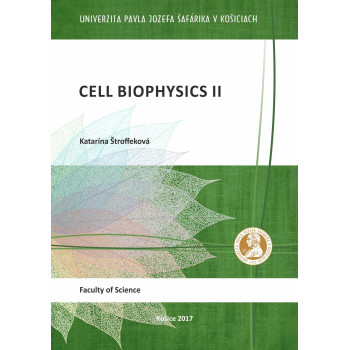
Cell Biophysics II is the one semester comprehensive course textbook for PhD students. It encompasses basic principles and mechanisms underlying cell physiology and biophysics with aims:

• General knowledge of the principles of cellular function, including membrane, cytoplasmic and nuclear roles in normal and abnormal conditions.
• In-depth understanding of the mechanisms underlying the cell functions at the molecular and subcellular level.
• Awareness of cell pathologies that lead to specific disease symptoms and phenotypes.
• The ability to apply learned principles to solve new problems (analysis & synthesis).

Download the e-book for free (pdf)

This website uses cookies to ensure you get the best experience on our website