Filter By

Year of publication:

Year of publication:

Publication language:

Publication language:

Faculty:

Faculty:

Method of publication:

Method of publication:

Active filters

  • Year of publication:: 2011
  • Year of publication:: 2014
  • Year of publication:: 2017
  • Year of publication:: 2023
  • Faculty:: Faculty of Arts
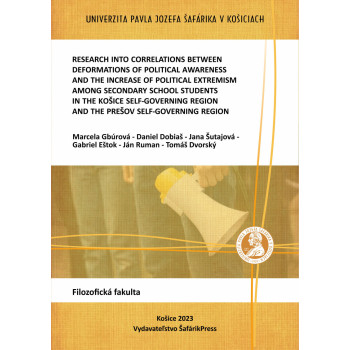
Research Into Correlations Between Deformations of Political Awareness...

Research Into Correlations Between Deformations...

E-book

E-book

Marcela Gbúrová - Daniel Dobiaš - Jana Šutajová - Gabriel Eštok - Ján Ruman - Tomáš Dvorský

Research Into Correlations Between Deformations of Political Awareness and the Increase of Political Extremism Among Secondary School Students in the Košice Self-governing Region and the Prešov.

Self-governing Region The issue of political extremism has a relatively long research period, and it should be emphasised that, especially in the recent period, it has received increased attention in the political science community not just in Slovakia but also abroad. Given the specifics of this anti-democratic form of political discourse, which has not only explicit forms, but also highly sophisticated manifestations against democracy (extremism of the centre, or centrist extremism), it is also addressed by experts of other humanities and social disciplines: history, psychology, anthropology, sociology, etc.

The common interest of this professional community is both to analyse different forms of extremist discourses and narratives, to search for national specificities of extremism that are anchored in their historical, social and cultural contexts, but at the same time to reveal transnational extremist influences within a globalizing world and to propose evidence-based strategies to counter extremist discourses.

Download e-book for free (pdf)
Mentor a mentee v profesijnej praktickej príprave /Príručka mentoringu študenta učiteľstva cvičným učiteľom

Mentor a mentee v profesijnej praktickej...

E-book

E-book

Renáta Orosová - Michal Novocký - Katarína Petríková

An integral part of the process of becoming a teacher is the mentoring of student teachers by mentor teachers, serving as guidance and support for future teachers. Developing mentoring skills and fostering reflective mentoring practices are means of enhancing the practical training of student teachers, their professional development, and improving the quality of their future educational practice.

The foundation of the mentoring relationship between the mentor teacher as a mentor and the student teacher as a mentee is not to evaluate the student, but to analyse their learning and teaching and contemplate ways to enhance these processes. The university textbook represents a creative textual tool focused on innovations in strategies for supporting the development of mentoring abilities in mentors and mentees during professional practical training. This university textbook, intended for student teachers in the role of mentees and mentor teachers in the role of mentors, systematizes the theoretical foundations of mentoring, provides guidance and directives for mentoring in professional practical training. Furthermore, it offers the university teacher, in the role of supervising the student's teaching practice, an overview of techniques and methods pertaining to the mentoring relationship between mentor and mentee. It is applicable as a university textbook for student teachers, students pursuing supplementary pedagogical studies or advanced studies, as well as for mentor teachers in primary and secondary schools, and university educators involved in professional practical training.

Its English version provides opportunities for utilization during study stays of student teachers abroad and for foreign students in Slovakia.

Download the e-book for free  (pdf)

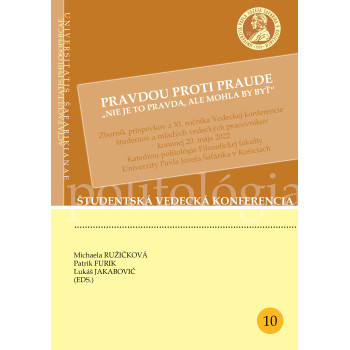
Truth vs. Post-Truth. „It is not true, but it could be.”

Truth vs. Post-Truth. „It is not true, but it...

E-book

E-book

Michaela Ružičková - Patrik Furik - Lukáš Jakabovič (eds.)

The collection of articles from the XI. International Scientific Conference for Students and Young Scientists, organized by the Department of Political Science of the Faculty of Arts of the Pavol Jozef Šafárik University in Košice, in cooperation with the Res Publica Civic Association, the Department of Security Studies of the Faculty of Political Science and International Relations of the Matej Bel University in Banská Bystrica, Institute of Political Sciences and Administration, Faculty of Political Science and Journalism, Marie Curie-Sklodowska University in Lublin, Institute of Social Studies, Faculty of Regional Development and International Studies, Mendel University in Brno, and the Department of Political Science, Faculty of Arts, University of Miskolc, held on 20 May 2022 in Košice.

The aim of this publication, entitled Truth vs. Post-Truth. „It is not true, but it could be.”, is to highlight the threats arising from the issue of the spread of disinformation, conspiracies and hoaxes today, reflecting not only on the national context, but also on the impact of these elements in the international environment.

The proceedings consist of 12 articles written in Slovak and English. The individual contributions deal with selected topics and aspects of the spread of disinformation, conspiracy theories or hoaxes, among others in the context of elections, media landscape and politics.

The topics of the contributions are the limits of freedom of expression, media freedom and regulation in the media space, the issue of propaganda or information warfare. The present volume also includes papers focusing on issues in the field of political ideologies or the issue of false narratives about the COVID-19 disease.

Download the e-book for free  (pdf)

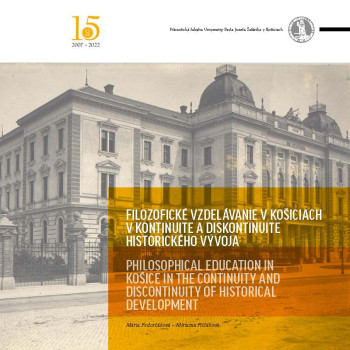
Philosophical Education in Košice in the Continuity and Discontinuity of Historical Development

Philosophical Education in Košice in the...

E-book

E-book

Mária Fedorčáková - Miriama Filčáková

Current publication is dealing with the history of philosophical education in Košice since the beginning to the foundation of the Faculty of Arts at Pavol Jozef Šafárik University in Košice in 2007. Beginnings of philosophical education in Košice are connected to the fundation of the University of Košice in 1657, which was originally founded as Jesuit university with two faculties – Faculty of Theology and Faculy of Arts.

The publication is dealing with the philosophy teaching in the Faculty of Arts and examines the philosophy teachers and students. Another interest is given to decline of philosophy teaching caused by transformation of the University into the Royal Academy and the Academy of Law at the end of the 18 and during 19 century. The second part of the publication is dealing with the history of higher education after the second world war and the foundation of the University of Pavol Jozef Šafárik in Košice.

The authoress focuses on circumstances of the foundation of the Faculty of Arts in Prešov and its history and later development after 1989, which included also division of the university in 1997. The last part of publication presents the history of the university buildings, in which the Faculty of Arts is situated.

Download the e-book for free  (pdf)

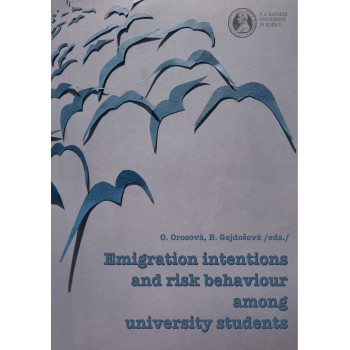
Emigration intentions and risk behaviour among university students

Emigration intentions and risk behaviour among...

E-book

E-book

Oľga OrosováBeáta Gajdošová (eds.)

This publication considers social, economic, political, and psychological indicators of emigration behavior and emigration intentions as appropriate predictors of future behavior.

Theories of motivation and theories of behavioral intentions and their effectiveness are popular in migration research. On the other hand, the Health Belief Model and its adaptation in the research of emigration intentions bring a relatively new and perspective view on this topic.

According to the results presented in this publication, the factors that attract students to emigration (pull factors) are language skills and career opportunities abroad, the desire for change and new experiences, perceived feasibility of emigration, and self-efficacy.

Download the e-book for free (pdf)

Myths and Manipulation in Political Discourse

Myths and Manipulation in Political Discourse

E-book

E-book

Jaroslav Marcin - Viktória Marcinová a kol.

This little book started out in a way that probably many other scholarly publications do: When the five of us met as doctoral students and instructors in the Department of British and American Studies, we soon realized that our research overlapped on a number of points. Most prominent among those was our interest in political or politicallymotivated discourse and the study of myths and manipulation that it employed. 

In the end, we decided to pool the results of our research together in order to create a more complex picture, providing a variety of perspectives and voices. In our endeavor, we were greatly aided by the financial support we received from a grant offered by the Šafárik University. The outcome of these efforts is the five chapters of this brief, but hopefully informative and insightful monograph.

In Chapter 1, Viktória Marcinová deals with the impact of totalitarian ideology on the translation of so-called “capitalist” drama during the first stage of normalization in Slovakia (1948-1968). In Chapter 2, the focus shifts to political discourse and manipulation in a democracy, as Jaroslav Marcin takes a closer look at the wartime rhetoric of American presidents. USA remains the focus also in Chapter 3, but this time the question, addressed by Martina Martausová, will be one of the myth of the American Dream and its presentation in post-9/11 United States. A similar idea, though in a different geographical-cultural context, is dealt with in Chapter 4, where Božena Velebná identifies myths of Scottish identity as portrayed in historic films. Finally, in Chapter 5, Eduard Soták will take a look at the role of the mass media within the topic of politically-motivated discourse and spread of political ideology.

Download the e-book for free (pdf)

Philosophy of the history of philosophy

Philosophy of the history of philosophy

E-book

E-book

Vladimír Leško

The book is the result of long-term contemplation on the relationships between the history of philosophy and its reflection in more or less systematic, or non-systematic forms of philosophizing of the most significant philosophical teachings of the 19th and 20th centuries (Hegel, Schelling, Marx, Nietzsche, Husserl, Heidegger, Fink, Patočka, and Gadamer).

The primary goal of the work is to present the most significant historical-philosophical teachings of the 19th and 20th centuries in the formation and fulfillment of strong and weak models of the philosophy of the history of philosophy in the concepts of Hegel, Schelling, Marx, Nietzsche, Husserl, Heidegger, Fink, Patočka, and Gadamer.

The results of the philosophy of the history of philosophy are presented here as a metatheoretical movement within historical-philosophical thinking, whose aim is not to empirically describe the historical-philosophical process, but to understand and explain it as an inseparable part of the most significant philosophical problems – what is philosophy, what is metaphysics, and the question of being.

Download the e-book for free (pdf)


THE FUNCTION OF METAPHOR IN MEDIEVAL NEOPLATONISM

THE FUNCTION OF METAPHOR IN MEDIEVAL NEOPLATONISM

E-book

E-book

Mária Mičaninová - Ivica Hajdučeková (eds.)

In the framework of the project VEGA of the Ministry of Education, Science, Research and Sport of the Slovak Republic 1/0330/12 The Function of Metaphor in the Philosophy of Shlomo ben Yehuda ibn Gabirol and Shihab al-Din Yahya al-Suhrawardi, project leader Assoc. Prof. Mária Mičaninová, CSc., under the patronage of the rector of Pavol Jozef Šafárik University in Košice, The Slovak Republic, Prof. MUDr. Ladislav Mirossay, DrSc., and of The Department of Philosophy and History of Philosophy of the Faculty of Arts of the same University, took place on 4th – 5th October 2013 an International conference on The Function of Metaphor in Medieval Neoplatonism. Two days´conference was opened by Dean of the Faculty of Arts of P. J. Šafárik University, Prof. PhDr. Ján Gbúr, CSc.,in the presence of Prof. PhDr. Vladimír Leško, CSc., Head of The Department of Philosophy and History of Philosophy, and of foreign guests and students of the University.

Download the e-book for free (pdf)

This website uses cookies to ensure you get the best experience on our website