Active filters

  • Year of publication:: 2011
  • Year of publication:: 2013
  • Year of publication:: 2014
  • Year of publication:: 2021
  • Year of publication:: 2021
  • Year of publication:: 2021
  • Year of publication:: 2021
  • Year of publication:: 2023
  • Year of publication:: 2023
  • Year of publication:: 2023
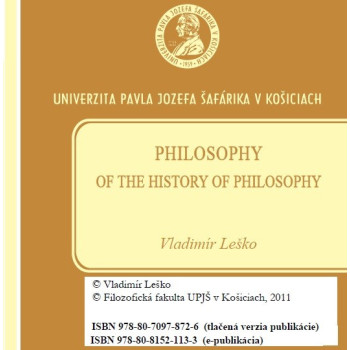
Philosophy of the history of philosophy

Philosophy of the history of philosophy

E-book

E-book

Vladimír Leško

The book is the result of long-term contemplation on the relationships between the history of philosophy and its reflection in more or less systematic, or non-systematic forms of philosophizing of the most significant philosophical teachings of the 19th and 20th centuries (Hegel, Schelling, Marx, Nietzsche, Husserl, Heidegger, Fink, Patočka, and Gadamer).

The primary goal of the work is to present the most significant historical-philosophical teachings of the 19th and 20th centuries in the formation and fulfillment of strong and weak models of the philosophy of the history of philosophy in the concepts of Hegel, Schelling, Marx, Nietzsche, Husserl, Heidegger, Fink, Patočka, and Gadamer.

The results of the philosophy of the history of philosophy are presented here as a metatheoretical movement within historical-philosophical thinking, whose aim is not to empirically describe the historical-philosophical process, but to understand and explain it as an inseparable part of the most significant philosophical problems – what is philosophy, what is metaphysics, and the question of being.

Download the e-book for free (pdf)


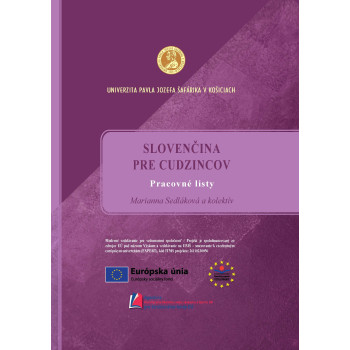
Slovenčina pre cudzincov (Pracovné listy)

Slovenčina pre cudzincov (Pracovné listy)

E-book

E-book

Marianna Sedláková a kol. 

The worksheets, based on the direct specific needs of teaching medical students in Košice, respect the real situation of teaching Slovak as a foreign language at UPJŠ.

They also reflect the relatively high number of Slavic students, especially from neighboring countries, who, although just beginning with the Slovak language, are at a higher communicative level compared to students from non-Slavic countries. Therefore, a special part of the worksheets with exercises is dedicated to them, which includes special exercises and dictionaries aimed at eliminating Slovak-Polish or Slovak-Ukrainian interference phenomena. Since some non-Slavic students come from the Czech language environment, we also add a glossary of the most common different expressions in Slovak, Czech, and, for the aforementioned reasons, Polish and Ukrainian. In the part intended for all students, both Slavic and non-Slavic, communicatively focused exercises for practicing grammatical phenomena predominantly at the A1 and A2 communication skill levels (according to the Common European Framework of Reference) prevail, and last but not least, exercises thematically focused on medicine and healthcare.

The texts from the thematic area are, of course, supplemented with realia of the city of Košice. As a functional supplement in the working material, we also publish test samples.

Download the e-book for free (pdf)

THE FUNCTION OF METAPHOR IN MEDIEVAL NEOPLATONISM

THE FUNCTION OF METAPHOR IN MEDIEVAL NEOPLATONISM

E-book

E-book

Mária Mičaninová - Ivica Hajdučeková (eds.)

In the framework of the project VEGA of the Ministry of Education, Science, Research and Sport of the Slovak Republic 1/0330/12 The Function of Metaphor in the Philosophy of Shlomo ben Yehuda ibn Gabirol and Shihab al-Din Yahya al-Suhrawardi, project leader Assoc. Prof. Mária Mičaninová, CSc., under the patronage of the rector of Pavol Jozef Šafárik University in Košice, The Slovak Republic, Prof. MUDr. Ladislav Mirossay, DrSc., and of The Department of Philosophy and History of Philosophy of the Faculty of Arts of the same University, took place on 4th – 5th October 2013 an International conference on The Function of Metaphor in Medieval Neoplatonism. Two days´conference was opened by Dean of the Faculty of Arts of P. J. Šafárik University, Prof. PhDr. Ján Gbúr, CSc.,in the presence of Prof. PhDr. Vladimír Leško, CSc., Head of The Department of Philosophy and History of Philosophy, and of foreign guests and students of the University.

Download the e-book for free (pdf)

This website uses cookies to ensure you get the best experience on our website