Filter By

Year of publication:

Year of publication:

Publication language:

Publication language:

Faculty:

Faculty:

UPJŠ Unit

UPJŠ Unit

Active filters

  • Year of publication:: 2016
  • Year of publication:: 2017
  • Year of publication:: 2021
  • Year of publication:: 2021
  • Year of publication:: 2025
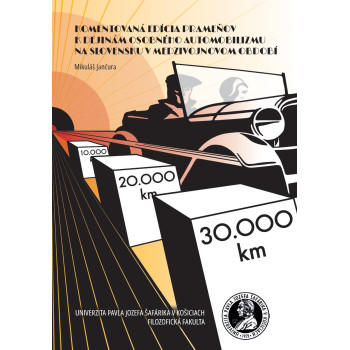
Komentovaná edícia prameňov k dejinám osobného automobilizmu na Slovensku v medzivojnovom období

Komentovaná edícia prameňov k dejinám osobného...

E-book

E-book

Mikuláš Jančura

The presented annotated source edition represents the first systematic attempt to process selected documents related to the history of personal automobilism in Slovakia during the interwar period. It addresses a notable research and publication gap in Slovak historiography, where the topic of automobilism has long remained marginal. Although research in this field has progressed over the last two decades, Slovak scholarship still lags behind Czech historiography. The main ambition of the edition is to present a broad selection of sources to highlight key thematic lines in the development of personal automobilism. The sources are divided into two main thematic groups: economic-legislative issues and cultural-social dimensions. Special attention is given to car accessibility, infrastructure, legal frameworks, visual advertising, and the activities of motoring associations. The typologically diverse corpus includes archival records, printed materials, visual sources, and photographs. The edition builds on a 2017 authorial monograph, expanding it with new insights and sources. It draws from collections housed in the National Archives in Prague, the Slovak National Archive, and various regional archives. The work also benefits from the application of modern methodological approaches, such as Business History and cultural history. The project was carried out under the scientific grant VVGS-2022-2431 at the Faculty of Arts, Pavol Jozef Šafárik University in Košice. Its results are closely linked to the teaching activities of the research team. The edition is the result of several stages – from heuristics, selection, and processing to peer review and publication. The publication contributes to a vivid understanding of the historical aspects of automobilism and expands knowledge of modernization processes in Slovakia. It also offers potential for use in educational practice and further academic research.
Download the e-book for free (pdf)

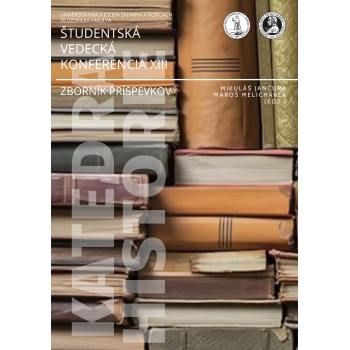
Študentská vedecká konferencia XIII.

Študentská vedecká konferencia XIII.

E-book

E-kniha

Mikuláš Jančura - Maroš Melichárek (eds.)

Predkladaný zborník je publikovaným výstupom zo Študentskej vedeckej konferencie, ktorá sa na pôde Katedry histórie FF UPJŠ uskutočnila dňa 02.12.2024. Bolo to už po trinásty krát. Zborník z tohto ročníka (už tretí v poradí) sa tak zaradil do tejto úspešnej série. Obsiahnuté príspevky, podobne ako aj v starších zborníkoch z tejto konferencie, približujú stav bádania korelujúci so záverečnými prácami študentov na bakalárskom a magisterskom stupni štúdia.

Stiahnite si e-knihu zadarmo (pdf)

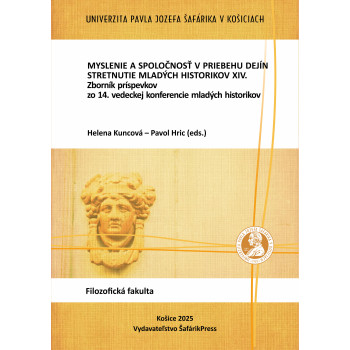
Myslenie a spoločnosť v priebehu dejín. Stretnutie mladých historikov XIV.

Myslenie a spoločnosť v priebehu dejín....

E-book

E-book

Helena KuncováPavol Hric (eds.)

Zborník “Stretnutie mladých historikov XIV“ s témou Myslenie a spoločnosť v priebehu dejín prináša súbor vedeckých príspevkov, ktoré sa venujú vzťahu medzi myslením a spoločenskými zmenami v historickom vývoji. Doktorandi a doktorandky z rôznych univerzít a inštitúcií analyzujú, ako politické, ekonomické a sociálne premeny ovplyvňovali myslenie rôznych sociálnych skupín a naopak, ako tieto zmeny v myslení formovali dejinné procesy. Každý príspevok bol podrobený odbornému hodnoteniu dvoch garantov, ktorých pripomienky sú reflektované v predkladanej verzii zborníku. Témy príspevkov sú rozdelené do jednotlivých blokov, v ktorých boli prezentované na konferencii 15. a 16. októbra 2024 na Katedre histórie, FF UPJŠ v Košiciach. Zborník obsahuje príspevky nasledujúcich prezentujúcich: Mgr. Michal Pajer, Mgr. Helena Kuncová, Mgr. Barbora Mlyneková, PhDr. Patrik Beňuš, Mgr. Mária Rímešová, Mgr. Pavol Hric, Mgr. Monika Tresová, Mgr. Miriama Balvirčáková, Mgr. Monika Soukupová, PhDr. Ivan Chylák, Mgr. Dorota Tóthová, Mgr. Dominik Šípoš, Mgr. Martin Pastor a Mgr. Jaroslav Valent.

Download the e-book for free (pdf)

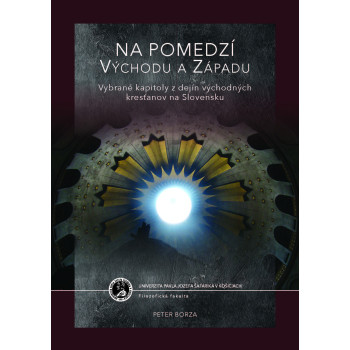
Na pomedzí Východu a Západu. Vybrané kapitoly z dejín východných kresťanov na Slovensku

Na pomedzí Východu a Západu. Vybrané kapitoly z...

E-book

E-book

Peter Borza

Eastern Christianity, represented in Slovakia by the Greek Catholic and Orthodox Churches, has influenced the development of Slovak society over the centuries. Both the common history and the coexistence of the two churches in one geographical area have brought diverse experiences that both churches keep in mind.

The university textbook, which deals with their history, contains basic materials for study and focuses on important milestones in their history. It contains general information about the origin of Eastern Christianity and presents in chronological order knowledge of the history of the churches that represent it in Slovakia from the 9th to the 21st century.

Download the e-book for free  (pdf)

Hranice v priestore a čase. Stretnutie mladých historikov X.

Hranice v priestore a čase. Stretnutie mladých...

E-book

E-book

Dana KušnírováPeter Pavonič

Collection of Contributions from the Scientific Conference. Košice, November 18-19, 2020

The collection titled Borders in Space and Time consists of twelve contributions presented at the tenth edition of the doctoral conference Meeting of Young Historians, which is organized annually by the Department of History at the Faculty of Arts, UPJŠ in Košice. In 2020, we commemorated the centenary of the signing of the Trianon Peace Treaty, which definitively established the borders of Hungary, including those with Czechoslovakia, after World War I; therefore, the theme of the conference was chosen to be the history of borders. The individual contributions focus on the development of borders in the 20th century, borders in thought and education, and borders in earlier historical periods.

Download e-book for free (pdf)

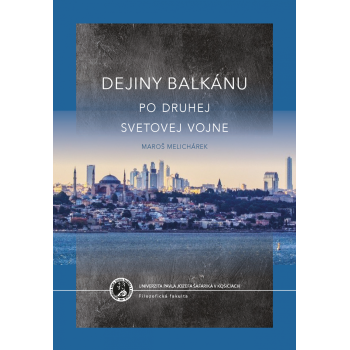
Dejiny Balkánu po druhej svetovej vojne

Dejiny Balkánu po druhej svetovej vojne

E-book

E-book

Maroš Melichárek

The history of the Balkans (not just in the 20th century) and its nations have had an irreplaceable place at the Department of History, Faculty of Arts, UPJŠ in Košice for several years. Therefore, this textbook is a logical culmination of this established trend. It represents the third publication focused on Southeastern Europe, as in 2015 a monograph titled International Relations in the 19th and 20th Centuries I (Nations of Southeastern Europe in International Politics, 1804 – 1856) was published, and in 2020 Nations of Southeastern Europe under International Politics from 1856 to 1913.

Logically then, this publication complements the literature portfolio (both thematically and chronologically) for students interested in this still turbulent region. Previous works are scientific monographs that can also be used during pedagogical processes; however, this work is directly aimed at students and their needs.

Download the e-book for free  (pdf)

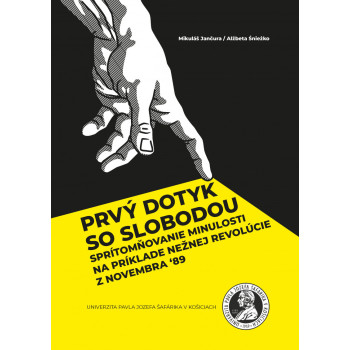
Prvý dotyk so slobodou. Sprítomňovanie minulosti na príklade Nežnej revolúcie z novembra ‘89

Prvý dotyk so slobodou. Sprítomňovanie...

E-book

E-book

Mikuláš JančuraAlžbeta Śnieżko   

In connection with the 30th anniversary of the Velvet Revolution, which was commemorated in the Czech Republic and Slovakia in 2019, an interactive exhibition titled "First Touch of Freedom" was organized under the auspices of Košice Self-Governing Region in collaboration with Ján Bocatius Public Library in Košice, Pavol Jozef Šafárik University in Košice, Nation's Memory Institute, and Slovak Radio and Television. The exhibition took place at Ján Bocatius Public Library and aimed to recall November's events from 1989 while emphasizing its cultural-social dimension and impact.

Conceptually, it focused on developing five dimensions of historical consciousness—a concept mainly developed in contemporary subject-specific didactics for history—namely identity, historicity, memory, spatial awareness, and temporal awareness.

Download the e-book for free (pdf)

Prvé decénium Filozofickej fakulty Univerzity Pavla Jozefa Šafárika v Košiciach (2007 – 2016)

Prvé decénium Filozofickej fakulty Univerzity...

E-book

E-book

Iveta Bónová - Marián Gladiš (eds.)

The Foundation of the Faculty is a major “thing” created and developed by many personalities. The collected information, opinions, and critical judgements have led me to the conclusion that there exist among us plenty of narratives on the formation of this Faculty.

What is appealing about this fact is that from each party concerned, specifically teachers of Philosophy, Psychology and Education at the UPJŠ Faculty of Science, teachers of Psychology at the UPJŠ Faculty of Public Administration in Košice, teachers of the Department of Foreign Languages at UPJŠ, teachers at Prešov University who were approached with a bid to create the conditions of and opportunities for the development of their study branches at the new UPJŠ Faculty of Arts in Košice, there is a significant clue reflected in the inception of the new Faculty of this University.

It is necessary to say that it is a justifiable reflection, because without this, it would not be possible to develop exploration and offer the students courses in the field of Humanities, in social and behavioural sciences, educational sciences, and in the field of History and Ethnology.

Download the e-book for free (pdf)

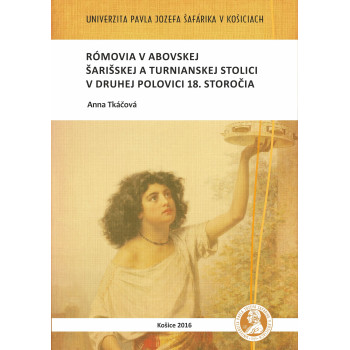
Rómovia v Abovskej, Šarišskej a Turnianskej stolici v druhej polovici 18. storočia

Rómovia v Abovskej, Šarišskej a Turnianskej...

E-book

E-book

Anna Tkáčová

The main topic of this publication is the Roma, their status, and life in Hungary, specifically in the Abov, Šariš, and Turnia counties in the second half of the 18th century, particularly according to the censuses conducted during the reign of Maria Theresa and Joseph II.

The work is divided into six chapters and fourteen subchapters. It contains three images, twenty-eight tables, and twenty-nine graphs. The introductory chapter deals with the state of research on the subject (i.e., the Roma in the second half of the 18th century) from 18th-century authors to contemporary authors who have dealt with or are still dealing with it.

In the first chapter, the author briefly mentions the Indian origin of the Roma, the social affiliation of the Roma ancestors, their departure from India, their migration until their arrival in Hungary, as well as the names given to the Roma by the surrounding world. It also mentions the first reports on the Roma in Hungary and in the territory of today's eastern Slovakia, as well as their status in Hungary until the first half of the 18th century. 

In the second chapter, the author touches on the life of the Roma in the Abov, Šariš, and Turnia counties in the light of archival materials from the second half of the 18th century and presents the administrative division of these counties during this period.

The third chapter discusses the royal decrees of the Enlightenment rulers Maria Theresa and Joseph II concerning the Roma and briefly describes the political situation and the resolution of socio-economic issues in Hungary in the second half of the 18th century.

The fourth chapter is devoted in detail to the censuses of the Roma in the Abov, Šariš, and Turnia counties during the reign of Maria Theresa and Joseph II, their objectives, characteristics, contributions, as well as their shortcomings, and presents the methodology of numerical and graphical processing of these censuses.

The fifth chapter contains a comprehensive graphical comparison and evaluation of the Roma censuses from all three counties. The overall findings about the life of the Roma in the Abov, Šariš, and Turnia counties are presented in the sixth, concluding chapter.

The main finding of this research is that the regulation of the Roma was carried out with only minimally successful (from the rulers' perspective) results, as the affected Roma families continued to roam both during and after the regulation. They practiced so-called "hidden roaming."

Download the e-book for free (pdf)

This website uses cookies to ensure you get the best experience on our website