Filter By

Year of publication:

Year of publication:

Publication language:

Publication language:

Faculty:

Faculty:

UPJŠ Unit

UPJŠ Unit

Active filters

  • Year of publication:: 2016
  • Year of publication:: 2017
  • Year of publication:: 2021
  • Year of publication:: 2021
  • Year of publication:: 2022
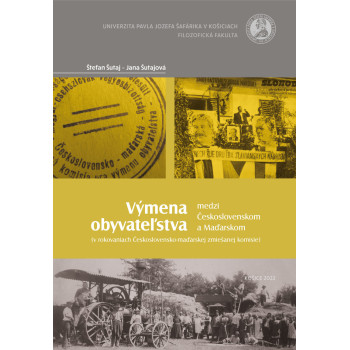
Výmena obyvateľstva medzi Československom a Maďarskom (v rokovaniach Československo-maďarskej zmiešanej komisie)

Výmena obyvateľstva medzi Československom a...

E-book

E-book

Štefan ŠutajJana Šutajová

The population exchange between Czechoslovakia and Hungary was carried out on the basis of the Agreement on the Exchange of Populations between Czechoslovakia and Hungary, which was signed on February 27, 1946. Its adoption was not only part of Czechoslovak solutions to the status of national minorities, but also part of the strategic concept of building a state of Czechs and Slovaks without Germans and Hungarians.

The agreement was part of the postwar resolution of mutual disputes and misunderstandings and was intended to be one of the solutions that, in the postwar period, would eliminate a factor which, according to Czechoslovak political leaders, had caused the war conflict.

The population exchange between Czechoslovakia and Hungary was therefore not an isolated historical event, but part of migratory movements that had begun in Europe already after the First World War, and can be seen as a continuation of previous developments as part of migration patterns in Europe.

Download e-book for free (pdf)

Študentská vedecká konferencia X. Zborník príspevkov.

Študentská vedecká konferencia X. Zborník...

E-book

E-book

Mikuláš Jančura - Maroš Melichárek (eds.)

The Student Scientific Conference is defined as a compulsory elective subject within the accredited study programs of the Department of History at the Faculty of Arts, UPJŠ. It was organized for the first time at the department in 2011.

The primary goal of this already traditional event is the presentation of partial results of student-authored research, primarily linked to selected factual parts or theoretical foundations of bachelor’s and master’s theses. This also explains the broad thematic spectrum of the internal content of each conference. Besides awarding credits for participation, the conference offers students a range of added values, which can be understood as its secondary objectives.

On this basis, as organizers, we considered it beneficial to qualitatively elevate the “round” anniversary edition of the Student Scientific Conference and give students the opportunity to publish their contributions. Within the submitted proceedings, 7 texts are published, of which 4 are from the bachelor’s level and 3 from the master’s level of study. The contributions cover a wider spectrum, mainly cultural-historical topics spanning from the Early Middle Ages to the second half of the 20th century, which also demonstrates the wide range of thesis topics processed at the department.

As organizers of the event, we have the ambition for publishing the proceedings to become as much a tradition as the Student Scientific Conference itself, as we consider this meaningful in relation to our work with students. Last but not least, we would like to express our gratitude to our colleague and friend Mgr. Henrich Hrehor, PhD., who has been the long-term main organizer and the “spiritual father” of the entire event since 2011. Thanks are also due to the head of the department for annual support and to the colleagues who undertook the reviewing of contributions within the submitted proceedings.

Download the e-book for free (pdf)

Poznanie, spoločnosť, dejiny. Stretnutie mladých historikov XI.

Poznanie, spoločnosť, dejiny. Stretnutie...

E-book

E-book

Miriama Filčáková (ed.)

Proceedings of the 11th Scientific Conference of Young Historians, organized by the Department of History at the Faculty of Arts, Pavol Jozef Šafárik University in Košice, in cooperation with the Slovak Historical Society at the Slovak Academy of Sciences, on October 19-20, 2021.

Currently, these histories are often presented as an extension of the history of science. The history of knowledge not only expands the boundaries of the history of science but also explores the boundaries between different forms of knowledge and ignorance. Just as studies of historical memory have expanded and complemented their interest in researching forgetting, the history of knowledge includes studies of ignorance. They focus on the change that has occurred over the past decades: from the sacralization of science and respect for professional knowledge to the rejection of science and constant questioning of professional knowledge, to which the history of knowledge must also respond. Findings as a product form the basis of human interactions and have their own past. What was the significance of knowledge and cognition in different historical periods? How did state power influence the development of knowledge and cognition? What can be considered knowledge in a particular historical era or culture? Finally, is there any human activity that cannot be considered knowledge?

Currently, in the field of the history of knowledge, a significant surge in research, publishing, and the emergence of new institutions can be observed. The eleventh doctoral conference—Meeting of Young Historians XI, organized by the Department of History at Pavol Jozef Šafárik University in cooperation with the Slovak Historical Society at the Slovak Academy of Sciences—will contribute to expanding the perspective on the past of knowledge and cognition. The conference, intended for Slovak and foreign doctoral students, aims to provide a space for presenting the latest results of scientific research, professional discussion, establishing contacts, developing cooperation, and exchanging experiences among the broader historical community. The starting point for the conference is a peer-reviewed proceedings volume consisting of publication outputs from active participants.

Download the e-book for free  (pdf)

Na pomedzí Východu a Západu. Vybrané kapitoly z dejín východných kresťanov na Slovensku

Na pomedzí Východu a Západu. Vybrané kapitoly z...

E-book

E-book

Peter Borza

Eastern Christianity, represented in Slovakia by the Greek Catholic and Orthodox Churches, has influenced the development of Slovak society over the centuries. Both the common history and the coexistence of the two churches in one geographical area have brought diverse experiences that both churches keep in mind.

The university textbook, which deals with their history, contains basic materials for study and focuses on important milestones in their history. It contains general information about the origin of Eastern Christianity and presents in chronological order knowledge of the history of the churches that represent it in Slovakia from the 9th to the 21st century.

Download the e-book for free  (pdf)

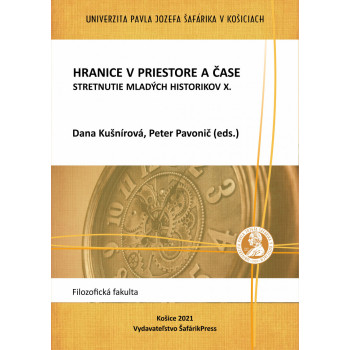
Hranice v priestore a čase. Stretnutie mladých historikov X.

Hranice v priestore a čase. Stretnutie mladých...

E-book

E-book

Dana KušnírováPeter Pavonič

Collection of Contributions from the Scientific Conference. Košice, November 18-19, 2020

The collection titled Borders in Space and Time consists of twelve contributions presented at the tenth edition of the doctoral conference Meeting of Young Historians, which is organized annually by the Department of History at the Faculty of Arts, UPJŠ in Košice. In 2020, we commemorated the centenary of the signing of the Trianon Peace Treaty, which definitively established the borders of Hungary, including those with Czechoslovakia, after World War I; therefore, the theme of the conference was chosen to be the history of borders. The individual contributions focus on the development of borders in the 20th century, borders in thought and education, and borders in earlier historical periods.

Download e-book for free (pdf)

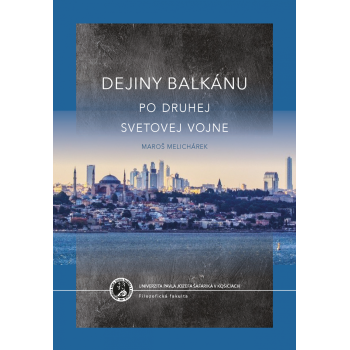
Dejiny Balkánu po druhej svetovej vojne

Dejiny Balkánu po druhej svetovej vojne

E-book

E-book

Maroš Melichárek

The history of the Balkans (not just in the 20th century) and its nations have had an irreplaceable place at the Department of History, Faculty of Arts, UPJŠ in Košice for several years. Therefore, this textbook is a logical culmination of this established trend. It represents the third publication focused on Southeastern Europe, as in 2015 a monograph titled International Relations in the 19th and 20th Centuries I (Nations of Southeastern Europe in International Politics, 1804 – 1856) was published, and in 2020 Nations of Southeastern Europe under International Politics from 1856 to 1913.

Logically then, this publication complements the literature portfolio (both thematically and chronologically) for students interested in this still turbulent region. Previous works are scientific monographs that can also be used during pedagogical processes; however, this work is directly aimed at students and their needs.

Download the e-book for free  (pdf)

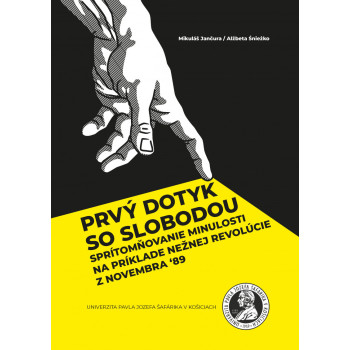
Prvý dotyk so slobodou. Sprítomňovanie minulosti na príklade Nežnej revolúcie z novembra ‘89

Prvý dotyk so slobodou. Sprítomňovanie...

E-book

E-book

Mikuláš JančuraAlžbeta Śnieżko   

In connection with the 30th anniversary of the Velvet Revolution, which was commemorated in the Czech Republic and Slovakia in 2019, an interactive exhibition titled "First Touch of Freedom" was organized under the auspices of Košice Self-Governing Region in collaboration with Ján Bocatius Public Library in Košice, Pavol Jozef Šafárik University in Košice, Nation's Memory Institute, and Slovak Radio and Television. The exhibition took place at Ján Bocatius Public Library and aimed to recall November's events from 1989 while emphasizing its cultural-social dimension and impact.

Conceptually, it focused on developing five dimensions of historical consciousness—a concept mainly developed in contemporary subject-specific didactics for history—namely identity, historicity, memory, spatial awareness, and temporal awareness.

Download the e-book for free (pdf)

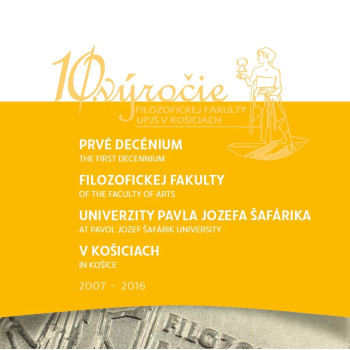
Prvé decénium Filozofickej fakulty Univerzity Pavla Jozefa Šafárika v Košiciach (2007 – 2016)

Prvé decénium Filozofickej fakulty Univerzity...

E-book

E-book

Iveta Bónová - Marián Gladiš (eds.)

The Foundation of the Faculty is a major “thing” created and developed by many personalities. The collected information, opinions, and critical judgements have led me to the conclusion that there exist among us plenty of narratives on the formation of this Faculty.

What is appealing about this fact is that from each party concerned, specifically teachers of Philosophy, Psychology and Education at the UPJŠ Faculty of Science, teachers of Psychology at the UPJŠ Faculty of Public Administration in Košice, teachers of the Department of Foreign Languages at UPJŠ, teachers at Prešov University who were approached with a bid to create the conditions of and opportunities for the development of their study branches at the new UPJŠ Faculty of Arts in Košice, there is a significant clue reflected in the inception of the new Faculty of this University.

It is necessary to say that it is a justifiable reflection, because without this, it would not be possible to develop exploration and offer the students courses in the field of Humanities, in social and behavioural sciences, educational sciences, and in the field of History and Ethnology.

Download the e-book for free (pdf)

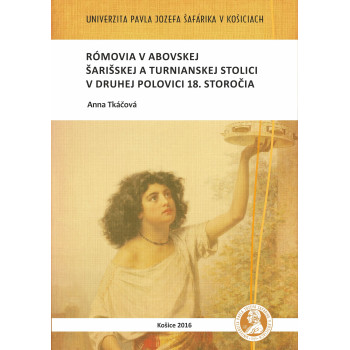
Rómovia v Abovskej, Šarišskej a Turnianskej stolici v druhej polovici 18. storočia

Rómovia v Abovskej, Šarišskej a Turnianskej...

E-book

E-book

Anna Tkáčová

The main topic of this publication is the Roma, their status, and life in Hungary, specifically in the Abov, Šariš, and Turnia counties in the second half of the 18th century, particularly according to the censuses conducted during the reign of Maria Theresa and Joseph II.

The work is divided into six chapters and fourteen subchapters. It contains three images, twenty-eight tables, and twenty-nine graphs. The introductory chapter deals with the state of research on the subject (i.e., the Roma in the second half of the 18th century) from 18th-century authors to contemporary authors who have dealt with or are still dealing with it.

In the first chapter, the author briefly mentions the Indian origin of the Roma, the social affiliation of the Roma ancestors, their departure from India, their migration until their arrival in Hungary, as well as the names given to the Roma by the surrounding world. It also mentions the first reports on the Roma in Hungary and in the territory of today's eastern Slovakia, as well as their status in Hungary until the first half of the 18th century. 

In the second chapter, the author touches on the life of the Roma in the Abov, Šariš, and Turnia counties in the light of archival materials from the second half of the 18th century and presents the administrative division of these counties during this period.

The third chapter discusses the royal decrees of the Enlightenment rulers Maria Theresa and Joseph II concerning the Roma and briefly describes the political situation and the resolution of socio-economic issues in Hungary in the second half of the 18th century.

The fourth chapter is devoted in detail to the censuses of the Roma in the Abov, Šariš, and Turnia counties during the reign of Maria Theresa and Joseph II, their objectives, characteristics, contributions, as well as their shortcomings, and presents the methodology of numerical and graphical processing of these censuses.

The fifth chapter contains a comprehensive graphical comparison and evaluation of the Roma censuses from all three counties. The overall findings about the life of the Roma in the Abov, Šariš, and Turnia counties are presented in the sixth, concluding chapter.

The main finding of this research is that the regulation of the Roma was carried out with only minimally successful (from the rulers' perspective) results, as the affected Roma families continued to roam both during and after the regulation. They practiced so-called "hidden roaming."

Download the e-book for free (pdf)

This website uses cookies to ensure you get the best experience on our website