Filter By

Year of publication:

Year of publication:

Publication language:

Publication language:

Faculty:

Faculty:

Active filters

  • Year of publication:: 2011
  • Year of publication:: 2013
  • Year of publication:: 2018
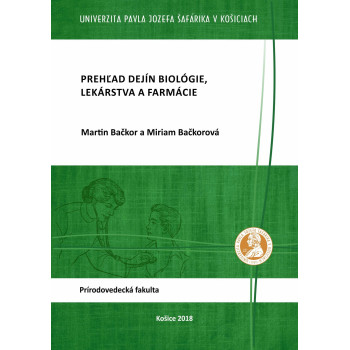
Prehľad dejín biológie, lekárstva a farmácie

Prehľad dejín biológie, lekárstva a farmácie

E-book

E-book

Martin BačkorMiriam Bačkorová

The proposed text focuses on the history of studying biology, medicine, and pharmacy as scientific disciplines from prehistoric times through antiquity, the Middle Ages, and the modern era. The text chronologically organizes the most significant figures in the history of biological scientific disciplines, outlines key characteristics of major historical discoveries, and reevaluates their significance from the perspective of 21st-century science.

The educational text is chronologically divided into the most significant periods of civilization development. The last two completed centuries—the 19th and 20th—are subdivided into major life science fields due to the unprecedented growth of biological disciplines and the resulting volume of acquired information.

Since it can sometimes be challenging in science to define what constitutes the past versus the present of a particular discipline, we have excluded significant biological discoveries from the early 21st century, which are typically regarded as the “present” of biology.
Download the e-book for free (pdf)

Prehodnotené dejiny. Historická pamäť – jej miesto a význam pre spoločnosť

Prehodnotené dejiny. Historická pamäť – jej...

E-book

E-book

Lukáš Katriňák (ed.)

Meeting of Young Historians VII.

Proceedings of contributions from the 7th scientific conference of young historians, organized by the Department of History at the Faculty of Arts of UPJŠ in Košice,

European Network Remembrance and Solidarity,

Centre of Social and Psychological Sciences SAS,

Historical Institute SAS,

and the Slovak Historical Society at SAS, held on October 25, 2017 in Košice.

Download the e-book for free (pdf)

Myths and Manipulation in Political Discourse

Myths and Manipulation in Political Discourse

E-book

E-book

Jaroslav Marcin - Viktória Marcinová a kol.

This little book started out in a way that probably many other scholarly publications do: When the five of us met as doctoral students and instructors in the Department of British and American Studies, we soon realized that our research overlapped on a number of points. Most prominent among those was our interest in political or politicallymotivated discourse and the study of myths and manipulation that it employed. 

In the end, we decided to pool the results of our research together in order to create a more complex picture, providing a variety of perspectives and voices. In our endeavor, we were greatly aided by the financial support we received from a grant offered by the Šafárik University. The outcome of these efforts is the five chapters of this brief, but hopefully informative and insightful monograph.

In Chapter 1, Viktória Marcinová deals with the impact of totalitarian ideology on the translation of so-called “capitalist” drama during the first stage of normalization in Slovakia (1948-1968). In Chapter 2, the focus shifts to political discourse and manipulation in a democracy, as Jaroslav Marcin takes a closer look at the wartime rhetoric of American presidents. USA remains the focus also in Chapter 3, but this time the question, addressed by Martina Martausová, will be one of the myth of the American Dream and its presentation in post-9/11 United States. A similar idea, though in a different geographical-cultural context, is dealt with in Chapter 4, where Božena Velebná identifies myths of Scottish identity as portrayed in historic films. Finally, in Chapter 5, Eduard Soták will take a look at the role of the mass media within the topic of politically-motivated discourse and spread of political ideology.

Download the e-book for free (pdf)

Vybrané kapitoly z dejín Grécka a Ríma

Vybrané kapitoly z dejín Grécka a Ríma

E-book

E-book

Milan Olejník

The history of ancient Greece and Rome represents the culmination of achievements made by ancient civilizations in political, economic, and social spheres, as well as in understanding humanity and the world, and in art. The Greeks were the first in human history to establish a system where a certain part of society—full-fledged citizens—had the opportunity to freely participate in political decisions. They could vote, be elected to offices within the political system, and discuss issues affecting community life.

A high level of education and the pursuit of rational explanations for natural phenomena enabled the Greeks to reach a level of knowledge that European nations only achieved in the modern era. Greek accomplishments in sculpture, architecture, and literature remain an inspiration to this day.

Despite a gap of more than two millennia, their thinking and actions are relatable; their victories and defeats resonate with us, offering lessons even today.

Download the e-book for free (pdf)

Stretnutie mladých historikov II. Priesečníky spoločnej histórie krajín V4

Stretnutie mladých historikov II. Priesečníky...

E-book

E-book

Bernadeta Fabová - MikulአJančura (eds.)

Collection of Studies from the 2nd Scientific Conference of Young Historians (Doctoral Students and Researchers), organized by the Department of History of the Faculty of Arts at Pavol Jozef Šafárik University in Košice, in cooperation with the Faculty of Arts at Masaryk University in Brno, the Faculty of Arts and Sciences at Silesian University in Opava, and the Faculty of Arts at the University of Miskolc, held on October 29-30, 2012 in Košice.

The collection is the output of the second annual scientific conference of young historians (doctoral students and researchers), organized at Pavol Jozef Šafárik University in Košice. The central theme of the event was the focus on intersections of shared history. The ten studies map various intersections of the history of the V4 countries, as well as the broader Central European region, in the time span from the 13th to the 20th century. The individual studies cover a wide range of areas from the medieval road network, military and urban history, through economy, education, issues of national identity, the relationship between the state and the church, to demographic questions.

Download the e-book for free (pdf)

This website uses cookies to ensure you get the best experience on our website