Filter By

Year of publication:

Year of publication:

Publication language:

Publication language:

Active filters

  • Year of publication:: 2013
  • Year of publication:: 2014
  • Year of publication:: 2018
  • Year of publication:: 2018
Sokratovská otázka ako filozofický problém

Sokratovská otázka ako filozofický problém

E-book

E-book

Štefan Jusko

The goal of the monograph is to highlight the significant problem of interpreting the Socratic question, as its approach represents a method of interpreting the history of philosophy, specifically in our case, the interpretation of Socrates and Plato. The Socratic question can be grasped in diametrically different ways, as shown by Patočka and Nietzsche, among others. The former aligns with Socrates and innovatively updates his question for the present. The latter is ambivalent towards Socrates but ultimately labels him a decadent.

In the first part of the monograph, Patočka's characterization of human existence is presented, which he formulates as unified and morally firm. Patočka interprets the Socratic question as care for the soul, for its well-being, without deriving the concept of good from something positively defined but from the whole world, which can only be defined negatively due to its constant openness. This sphere of negativity is for Patočka something immensely positive because transcendence lifts humans from relative goods to the overall meaning, making them morally capable in the true sense. The good, i.e., the requirement for a surge, for a turn of humans from the world of things to the whole world, is for him a program that Socrates first formulated through his knowing ignorance.

The second part of the work is dedicated to Nietzsche's concept based on the non-unified nature of human existence, which is not derived from the whole world or overall meaning but from situational meaning. Nietzsche strives to prove that in every situation, human existence is exposed to two opposing perspectives, between which it is impossible to decide which is correct. He concludes that both perspectives are equally valid and mutually conditioned, meaning that the opposite of good, what threatens meaning, is a beneficial condition for situational meaning. He labels this level as immoral, as a sphere where human existence creates meaning outside the thinking of good and evil in opposition.

The conclusion of the work is open because, as it turns out, we do not have a common denominator that could decide on the correctness of one or the other concept. Precisely in this lies the fact that the Socratic question remains a serious philosophical problem even today.
Download the e-book for free  (pdf)

Heidegger – Nietzsche (problém interpretácie)

Heidegger – Nietzsche (problém interpretácie)

E-book

E-book

Štefan Jusko

The stimulus for this monograph was my two studies on Heidegger’s interpretation of Nietzsche’s ideas of the will to power and eternal return of the same, published in Heidegger and Modern Metaphysics (supported by the Slovak Research and Development Agency, APVV-14-0706, under the leadership of V. Leška and M. Sobotka). In the submitted monograph, I present both studies in expanded (particularly “Will to Power as Art”) and refined versions (“Eternal Return of the Same”) and add a third chapter addressing the question of the meaning of interpreting philosophical texts, which themselves are interpretations of other texts.

In seeking an appropriate approach to the meaning of interpretation, I conclude that—generally—the purpose of interpretation is to uncover the productive dimension of the interpreted text, which can only be revealed if the interpreter enters the text openly and as neutrally as possible. If the interpreter does not open themselves to the text, allowing it to interpret them in turn, interpretation remains trapped. I believe that without mutual openness between interpreter and interpreted, interpretation has no meaning and typically becomes either rejection or misinterpretation—a form of violence.

In the third chapter, which I consider foundational, I attempt to “balance” the interpretive context of “Heidegger–Nietzsche” from the first two chapters through a reversible context of “Nietzsche–Heidegger,” albeit with the risk that my interpretation of Nietzsche’s thought—specifically his ideas of eternal return and will to power—may remain subjective, even if unintended as misinterpretation. Ultimately, the ambition of the third chapter is to explore intersections between the two philosophers, one of which—a rudimentary yet significant overlap—I identify as Heidegger’s concept of being-in-the-world, reinterpreted through Nietzsche’s lens. It is Nietzsche who challenges us to adopt a self-defined stance toward the world, to confront what it means to be in the world.

The challenge for me—and perhaps the reader—is to remain faithful to oneself, which is only possible by persisting in the context of mutual interpretation between interpreter and interpreted, regardless of who/what is interpreting or being interpreted. For the context of being-in-the-world is always co-created by both sides.

Download the e-book for free  (pdf)

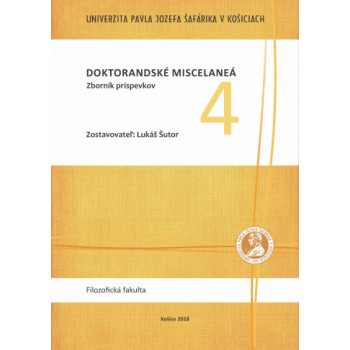
Doktorandské miscelaneá 4

Doktorandské miscelaneá 4

E-book

E-book

Lukáš Šutor (ed.)

The proposed anthology represents for many doctoral students their first entry into the publishing environment of scientific genres. The studies in such cases contain the essence of future dissertation works, which represent the creative pinnacle of doctoral studies. In addition to providing doctoral students with the opportunity to publish scientific outputs, we also consider the anthology a space for interdisciplinary encounters and mutual enrichment. However, interdisciplinarity is not merely a characteristic of the anthology as a whole but also of some studies.

Most notable interdisciplinary approaches are observed in literary studies. The traditional subject of research into artistic texts is enriched in individual studies by examining theatrical and film works (Peter Getlík), linguistic aspects of phrasemes (Ivana Hudiková), musical elements (Terézia Kulíková), visual art (Dominika Petáková), and digital spaces of new media (Alexandra Popovičová). From other disciplines, we highlight Miroslava Süčová Vernarská’s study, which extends psychological research into sociological and linguistically communicative contexts (the concept of metaphor), or conversely, Zuzana Šoltésová and Dušan Šlosár’s contribution, analyzing eating disorders from their disciplinary background in social work.

Both mentioned disciplines also include contributions with traditional research subjects. Nikola Fabiny from psychology analyzes consequence expectations in the context of goal selection and achievement. Jana Plavnická and Dušan Šlosár’s co-authored study from the Department of Social Work presents a multi-perspective analysis of integration barriers for immigrants in Slovakia. Within their own disciplines, both philosophy contributions operate: Juraj Brenišin interprets the ethical aspects of Avicbron’s Fons vitæ, while Michal Kručko examines Edmund Husserl’s unfinished work through a comparative lens of his students Jan Patočka and Roman Ingarden. The anthology concludes with Lukáš Lukačín’s study (written in English), which explores the semantic-grammatical category of modality in the verbs MAY and CAN within legal-administrative documents of the European Union.

The representation of academic disciplines and doctoral students’ individual creative outputs in Doktorandské miscelaneá 4 is thus appropriately diverse. We present this publication to the broader academic community as a representative overview of trends in young scholars’ thinking across the spectrum of humanities and social sciences doctoral programs at the Faculty of Arts, UPJŠ in Košice.

Lukáš Šutor

Download the e-book for free (pdf)

Patočka o vzniku matematickej prírodovedy

Patočka o vzniku matematickej prírodovedy

E-book

E-book

Pavol Tholt

The work presented in the following text is an attempt to analyze Patočka's perspective on the emergence and essence of mathematical natural science in the 17th century. During this period, Patočka's attention was particularly drawn to Descartes' philosophy and Cartesianism, as well as the philosophies of Galileo, Bacon, and Leibniz.

Patočka himself devoted continuous and exceptional attention to these questions, as evidenced by several monographic works and numerous articles and studies he wrote on the subject.

Download the e-book for free (pdf)

Patočkova filozofia dejín

Patočkova filozofia dejín

E-book

E-book

Róbert Stojka

The aim of the presented monograph is primarily to introduce Patočka's concept of the philosophy of history as comprehensively as possible, although I am aware that this is by no means an easy task. This difficulty arises not only because, as already mentioned, there is currently no extensive and exhaustive work on this topic.

While there is a relatively large number of studies devoted to Patočka's concept of the philosophy of history, none of them, however, examine this concept from a comprehensive perspective as a unified whole – most focus on specific partial issues (and there are many) stemming from this concept. This fact, incidentally, serves as clear evidence to me that this is undoubtedly a highly demanding topic.

Download the e-book for free (pdf)

Patočka, fenomenológia a dejiny filozofie

Patočka, fenomenológia a dejiny filozofie

E-book

E-book

Vladimír Leško - Milovan Ješič - Pavol Tholt

The philosophical work of the most significant Czech philosopher of the 20th century, Jan Patočka (1907–1977), stands out for its unique intellectual originality.

Even at the time of its creation, it significantly transcended the narrow boundaries of the contemporary Czechoslovak spiritual space and uniquely connected our country with the most advanced philosophical teachings of Western thought, in which Husserl's phenomenology and Heidegger's fundamental ontology played a dominant role. Certainly, it would be a great mistake to reduce the decisive position of Patočka's philosophical work merely to the reception and critical-creative elaboration of Husserl's and Heidegger's philosophy.

In this context, we cannot overlook the decisive contribution of Eugen Fink, who introduced Patočka to the intricacies of Husserl's and Heidegger's philosophy. Both thinkers then continued in a lifelong creative philosophical dialogue. However, it is also necessary to mention Patočka's intense interest in the works of Scheler, Ingarden, Landgrebe, as well as Sartre and others.

Download the e-book for free (pdf)

Kant, fenomenológia a analytická filozofia

Kant, fenomenológia a analytická filozofia

E-book

E-book

Vladimír Leško - Milovan Ješič - Eugen Andreanský

The philosophical work of Immanuel Kant, the founder of German classical idealism, is one of those which, by the strength of its theoretical legacy, is permanently inspiring even in contemporary philosophical activities. This is an indisputable fact that cannot be seriously objected to. The philosophical teachings of Edmund Husserl, the founder of phenomenology, his successor Martin Heidegger, as well as several representatives of analytic philosophy, are proof of this fact. The above fact led the authors of this work to the idea of devoting a separate collective monograph to the indicated problem. 

Download the e-book for free (pdf)

Heidegger a grécka filozofia

Heidegger a grécka filozofia

E-book

E-kniha

Vladimír Leško - Katarína Mayerová (eds.)


The main aim of the present work is to try to capture the decisive mode of Heidegger's philosophical understanding of the central problem of Greek philosophy, the problem of being, in the teachings of Anaximander, Heracleitus, Parmenides, Plato, and Aristotle. The authors of each section present their own understanding of Heidegger and his distinctive philosophical reception of Greek philosophy. In this context, it should be noted that the authors themselves sought their own point of view. With Heidegger's work in general, it is almost impossible to find the same interpretive consonance. This is also true for his reception of the Greek heritage. However, it is all the more professionally provoking for further philosophical investigations.

Download the e-book for free (pdf)

Gadamer a grécka filozofia

Gadamer a grécka filozofia

E-book

E-book

Kristína Bosáková

Attempting to confront Gadamer's teachings not only with the giants of Greek philosophy but also with Hegel and Heidegger is no easy task. However, Gadamer's entire historical-philosophical work is most prominently associated with these ancient thinkers and the two geniuses of German philosophical thought. Therefore, there is no avoiding it. Without this confrontation, all my efforts would be, in a certain sense, futile. Whether and how I succeed is another question. Every reader will surely form their own judgment.

Download the e-book for free (pdf)

THE FUNCTION OF METAPHOR IN MEDIEVAL NEOPLATONISM

THE FUNCTION OF METAPHOR IN MEDIEVAL NEOPLATONISM

E-book

E-book

Mária Mičaninová - Ivica Hajdučeková (eds.)

In the framework of the project VEGA of the Ministry of Education, Science, Research and Sport of the Slovak Republic 1/0330/12 The Function of Metaphor in the Philosophy of Shlomo ben Yehuda ibn Gabirol and Shihab al-Din Yahya al-Suhrawardi, project leader Assoc. Prof. Mária Mičaninová, CSc., under the patronage of the rector of Pavol Jozef Šafárik University in Košice, The Slovak Republic, Prof. MUDr. Ladislav Mirossay, DrSc., and of The Department of Philosophy and History of Philosophy of the Faculty of Arts of the same University, took place on 4th – 5th October 2013 an International conference on The Function of Metaphor in Medieval Neoplatonism. Two days´conference was opened by Dean of the Faculty of Arts of P. J. Šafárik University, Prof. PhDr. Ján Gbúr, CSc.,in the presence of Prof. PhDr. Vladimír Leško, CSc., Head of The Department of Philosophy and History of Philosophy, and of foreign guests and students of the University.

Download the e-book for free (pdf)

This website uses cookies to ensure you get the best experience on our website