Filter By

Selections

Selections

Year of publication:

Year of publication:

Publication language:

Publication language:

Active filters

  • Year of publication:: 2013
  • Year of publication:: 2026
  • Year of publication:: 2026
  • Faculty:: Faculty of Law
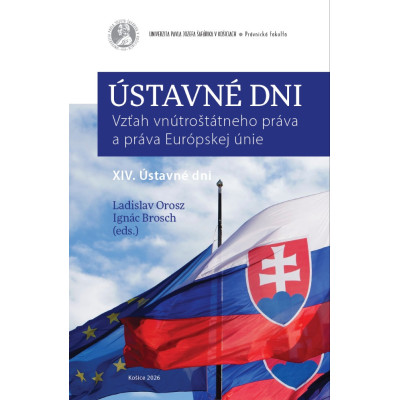
Vzťah vnútroštátneho práva a práva Európskej únie, XIV. Ústavné dni
  • New

Vzťah vnútroštátneho práva a práva Európskej...

E-book

E-book

Ladislav Orosz    Ignác Brosch  (eds.)

Scientific proceedings from the traditional international scientific conference organized by the Constitutional Court of the Slovak Republic and the Faculty of Law of the Pavol Jozef Šafárik University in Košice, titled “The Relationship Between Domestic Law and European Union Law – 14th Constitutional Days,” consists of papers by renowned representatives of domestic and foreign constitutional doctrine, as well as authors who currently serve as judges of constitutional courts and the Court of Justice of the European Union, or as their advisors. From a substantive perspective, the contributions included in the collection address the challenges arising from current developments in the case law of the Court of Justice of the European Union and the case law of the Constitutional Court of the Slovak Republic and certain other foreign constitutional courts regarding the relationship between national legal systems and European Union law. 
Download e-book for free (pdf)

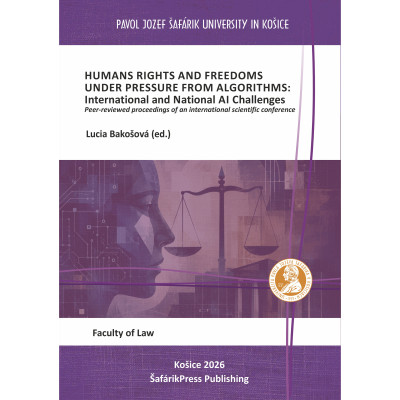
Human Rights and Freedoms under Pressure from Algorithms: International and National AI Challenges

Human Rights and Freedoms under Pressure from...

E-book

E-book

Lucia Bakošová (ed.)
The proceedings Human Rights and Freedoms under Pressure from Algorithms: International and National AI Challenges constitute a peer-reviewed outcome of an international scientific conference devoted to the legal challenges arising from the development of artificial intelligence. The volume focuses on the impact of algorithmic systems on the protection of human rights and fundamental freedoms at the international, European and national levels. The individual contributions examine issues such as transparency, accountability, the right to a fair trial, privacy protection, non-discrimination, children’s rights, labour relations, digital constitutionalism, autonomous weapons, and the use of AI in public administration and armed conflicts. Particular attention is paid to the risks of algorithmic decision-making, legal hallucinations, profiling, surveillance, and the influence of digital technologies on democratic processes.

Download the e-book for free (pdf)

Medzinárodné právo verejné (Materiály k štúdiu)

Medzinárodné právo verejné (Materiály k štúdiu)

E-book

E-book

Ľudmila Pošiváková - Adam Giertl

The presented selection of public international law documents aims to map international law from both historical and sectoral perspectives. The reader will find several historical documents in this collection, but the focus is primarily on currently valid legal sources.

The selection is guided by the publication Public International Law – General and Special Part by Prof. Ján Klučko, which is reflected in the division into general and special parts. The general part addresses the historical development of international law but primarily focuses on the protection of individuals and responsibility relationships in international law. The special part then examines the international regulation of various institutions of international law.

We acknowledge that this selection offers room for expansion, but we believe it meets basic requirements and fills a certain gap in the study of international law.

We trust that this collection of public international law materials will be beneficial for students, and not only for them, in the study of public international law and will contribute to raising awareness in this field.

Download the e-book for free (pdf)

Oslava právneho štátu (Právny štát z pohľadu teórie štátu a práva a medzinárodného práva)

Oslava právneho štátu (Právny štát z pohľadu...

E-book

E-book

Ľudmila Pošiváková -  Zuzana Antošová - Milan Kočan (eds.)

Proceedings from the Student Debate held on April 24, 2013, at the Faculty of Law of Pavol Jozef Šafárik University in Košice.

In the current period, the rule of law is widely debated both at the academic and political levels. This debate is not only related to the effort to establish the Rule of Law in states that have transitioned from socialist to democratic systems but also in states experiencing various unrests, whether political or religious.

However, it is not just a debate about certain characteristics of the Rule of Law that are missing in domestic law or at the level of international law, but also a debate about the very definition and meaning of the Rule of Law. The rule of law can be likened to an ideal that almost every state strives to achieve. Even in the case of the establishment of the independent Slovak Republic, the framers decided to include among the introductory provisions, which should form the core of the constitution, that the Slovak Republic is a state governed by the rule of law.

However, to achieve the ideal of the rule of law, it is necessary not only to declare it but also to adopt measures essential for an independent judiciary, democracy, the effective enforcement of human rights, the separation of powers, and many other elements that characterize a state governed by the rule of law.

Download the e-book for free (pdf)

Informačná spoločnosť a medzinárodné právo

Informačná spoločnosť a medzinárodné právo

E-book

E-book

Adam Giertl - Ľubica Gregová Širicová (eds.)

Proceedings from the 5th Student Symposium held on April 21-22, 2013

The French delegate to the Commission on Human Rights, while discussing the inclusion of the term "media" in the article on freedom of expression in the draft of the International Covenant on Civil and Political Rights, wisely urged other members of the commission to be forward-looking regarding the information media of the future.

The discussion took place in 1950, when delegates could not yet foresee the impact of the internet on social relations. Given that it is now clear that information technologies significantly influence law, including international law, the organizers of the student symposium decided to dedicate its sixth edition to the theme "Information Society and International Law."

Students of the Faculty of Law, after registering for the symposium, first focused on preparing their contributions, with each participant having access to a consultant if needed. This year, the list of consultants, in addition to members of the Institute of European Law and the Department of International Law, was expanded to include an expert in intellectual property law, Mgr. Martin Husovec, a graduate of our Faculty of Law and currently an IMPRS-CI doctoral student at the Max Planck Institute for Intellectual Property and Competition Law. We also take this opportunity to thank him for dedicating his time to the students and providing them with valuable advice in preparing their contributions. After the preparatory phase, the symposium itself took place, with the aim of presenting the prepared contributions and discussing them.

The presented contributions reflected a wide range of intersections between international law and the information society.

Download the e-book for free (pdf)

Regionalizmus: Stav, východiská, perspektívy

Regionalizmus: Stav, východiská, perspektívy

E-book

E-book

Adam Giertl (ed.)

Proceedings of Scientific Works

International law does not represent a monolithic entity of uniform legal norms. It is a legal system that is fundamentally created by the consensus of states. It reflects the collective will of multiple entities regarding what should be binding and enforceable as law among them.

From this understanding arises the fact that the needs for legal regulation will differ in various parts of the world. The consequence of this situation is the formation of regional groupings where, to some extent, specific legal rules apply. As Professor Klučka points out in his study published in this proceedings, regionalization can occur both on a contractual basis and on an institutional basis. Regionalism in law thus raises many interesting questions that legal science addresses.

This proceedings of scientific papers also aims to contribute to the knowledge in this field.

Download the e-book for free (pdf)

This website uses cookies to ensure you get the best experience on our website