Filter By

Selections

Selections

Year of publication:

Year of publication:

Faculty:

Faculty:

Active filters

  • Year of publication:: 2016
  • Year of publication:: 2017
  • Year of publication:: 2023
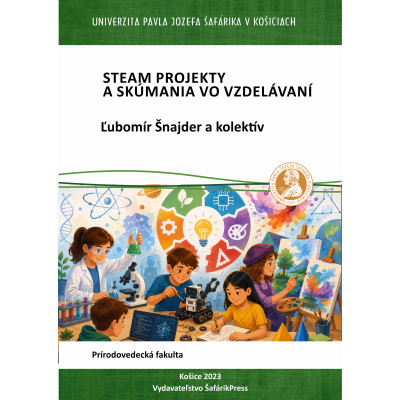
STEAM projekty a skúmania vo vzdelávaní
  • New

STEAM projekty a skúmania vo vzdelávaní

E-book

E-book

Ľubomír Šnajder a kol.

The publication is dedicated to teachers and future teachers of informatics, mathematics and science subjects. The publication presents activities that move students from the role of passive users of digital technologies to that of curious researchers, creative creators and critical thinkers. In the first chapter, we introduce educational strategies and practices to actively engage students in learning. In the second chapter, we briefly describe selected digital technologies that can be an aid to exploring the world around us and creating useful products. In the third chapter, we provide specific ideas for STEAM exploration and projects in which students search answers to real-world questions and solutions to real-world problems. Subject didacticians, experts from different fields and teachers worked closely together to develop ideas for the methodologies.

Download the e-book for free (pdf)

Attachment (zip)
O jaskyniach a krase pre každého – vybrané kapitoly

O jaskyniach a krase pre každého – vybrané...

E-book

E-book

Alena Gessert

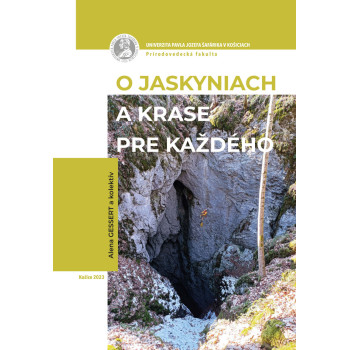
Caves have always been very specific places throughout history. In some cultures, they served as sites for sacrifices or remembrance, while in others, they were seen as places where one could cross to the "other side of life." People used caves for shelter, as places to leave messages, to wait out bad weather, and in some cases, even lived in them. During wars in our region, entire families or villages would hide from enemies in caves, or they would use them to conceal weapons.

Today, in most countries, caves are destinations for tourists who want to experience something new and unknown: darkness, high humidity, and the fascinating beauty of underground formations. They are also sought after by cavers who long to explore caves, enter worlds where no human has set foot before, find evidence of previous habitation, or conduct research that continually advances our knowledge.

In the publication you are holding, we present both traditional and less conventional topics about the formation of karst and caves, selected ecological aspects, maps and their creation, significant caves of the world, and the life of people in such areas. We also offer an overview of important karst locations that are definitely worth learning more about or visiting in person. This publication is intended for readers among pupils, students, teachers, and the general public, and we believe it will draw you into this mysterious world.

Download e-book for free (pdf)

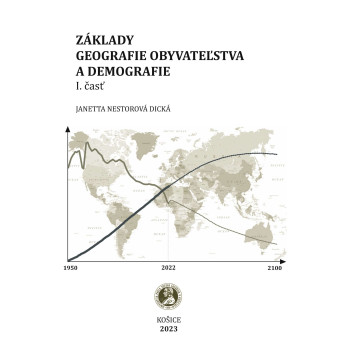
Základy geografie obyvateľstva a demografie I. časť

Základy geografie obyvateľstva a demografie I....

E-book

E-book

Janetta Nestorová Dická

The university handbook Elementals of Population Geography and Demography - Part I, as an introduction to population studies, is primary study material for students of the geography study program, as well as for students of the Information Systems in Public Administration study program at the Pavel Jozef Šafárik University in Košice, but also for the wider public interested in about population phenomena and their spatiality. Among other things, the handbook offers the latest population reports in the world and its regions.

The aim of the handbook is to introduce young geographers to the basics of population research, which includes the most frequently used tools and methods in geographic analysis. The first part of the handbook contains an introduction to the scientific disciplines of population geography and demography with an overview of basic sources of demographic data.

The next part discusses the issue of anthropogenesis, i.e. the development of humans from our ancestors and the spatial spread of humans across our Earth. Part of this part is the recent development of the world population and changes in the size and distribution of the global population over time. The last part analyses how the population is distributed in the world and in relation to the geographical components of the space.

Download the e-book for free  (pdf)

JARNÁ ŠKOLA DOKTORANDOV 2023

JARNÁ ŠKOLA DOKTORANDOV 2023

E-book

E-book

Peter Fedoročko (ed.)

From June 13 to June 16, 2023, the 9th annual Spring School for Doctoral Students at Pavol Jozef Šafárik University in Košice will take place in Stará Lesná. The scientific program of the spring school will comprise 3 plenary lectures by leading scientific experts and 1 workshop.

Doctoral students will present their research papers in two sections: 24 doctoral students of Faculty of Public Administration, Faculty of Law and Faculty of Arts, and 24 doctoral students of Faculty of Medicine and Faculty of Science. The scientific programme of the spring school will also include a panel discussion with the management of Pavol Jozef Šafárik University in Košice.

Download the e-book for free  (pdf)

Študentská vedecká konferencia PF UPJŠ 2023

Študentská vedecká konferencia PF UPJŠ 2023

E-book

E-book

Marián Kireš  (ed.)

Proceedings of Abstracts from the Student Scientific Conference of the Faculty of Science, Pavol Jozef Šafárik University in Košice

The Student Scientific Conference (SSC) represents the culmination of long-term and intensive work on a selected topic, collaboration with a supervisor, or a broader team at the workplace. In practice, however, it often marks the beginning of scientific research, focusing on a chosen subject, field, or close cooperation with a future supervisor of a bachelor's, master's, or doctoral thesis.

This year, the Student Scientific Conference took place on April 19, 2023, featuring 14 sections, a programming competition, and the IHRA contest. Bachelor’s and master’s students presented 101 contributions. Additionally, 8 high school students participated non-competitively, presenting their SOČ projects; 14 students took part in the programming competition, and 3 students competed in the IHRA contest.

We believe that the proceedings of abstracts and related documents serve not only as an archive but also as a dignified presentation of scientific activities at our faculty for the wider public.

Download the e-book for free  (pdf)

Globálne navigačné satelitné systémy

Globálne navigačné satelitné systémy

E-book

E-book

Vladimír Sedlák

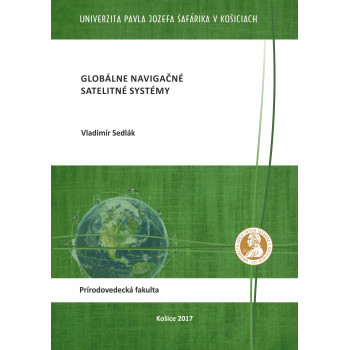
In the presented university textbooks, so-called satellite-based augmentation systems (SBAS, from the English Satellite Based Augmentation Systems, in Slovak Systémy rozširujúce základné satelitné systémy) are also discussed. These systems enhance, expand, or refine the basic satellite navigation systems. They are supportive satellite systems for GNSS (Global Navigation Satellite Systems). Currently, the long-operational American GPS and Russian GLONASS systems, as well as the partially operational European Galileo system (since December 2016), have and will continue to have broad applications in various fields of human activity, both professional and personal.

The university textbook Globálne navigačné satelitné systémy (Global Navigation Satellite Systems) reflects the current progressive development in the technological and instrumental principles and components of such satellite navigation systems. It presents the state of these satellite technologies from their historical origins and development to the present. The rapid advancements, particularly in the instrumental base of satellite navigation systems, will require updates on their current state in future editions of these university textbooks.

Download the e-book for free (pdf)

Študentská vedecká konferencia PF UPJŠ 2016

Študentská vedecká konferencia PF UPJŠ 2016

E-book

E-book

Vladimír Zeleňák (ed.)

Proceedings of Abstracts of the Student Scientific Conference of the Faculty of Science, Pavol Jozef Šafárik University in Košice

A characteristic feature of education at high-quality universities — among which the Faculty of Science at Pavol Jozef Šafárik University (UPJŠ) in Košice proudly belongs — is the close connection between education and scientific research. Students gain knowledge in their field of study not only through theoretical coursework in individual disciplines, but also through active involvement in solving specific scientific tasks as part of research teams. This can occur during the development of final theses or through participation in the Student Research Assistant Program (ŠPVS), which was revitalized at the faculty in 2015.

The Student Scientific Conference (ŠVK) is one of the faculty’s traditional events, organized during the Faculty’s Science Days as part of Sciencefest. By its very nature, it fits seamlessly into the aforementioned framework of combining education with research, and it has long enjoyed great popularity and student interest. In 2016, the conference featured presentations by 125 students of the Faculty of Science at UPJŠ in Košice, across 16 thematic sections. This collection of abstracts provides an overview of the focus and goals of the student projects. We believe it will serve as inspiration for other potential participants of future conferences and will also be of interest to the broader public, offering additional insight into the faculty's activities.

Download the e-book for free (pdf)

This website uses cookies to ensure you get the best experience on our website